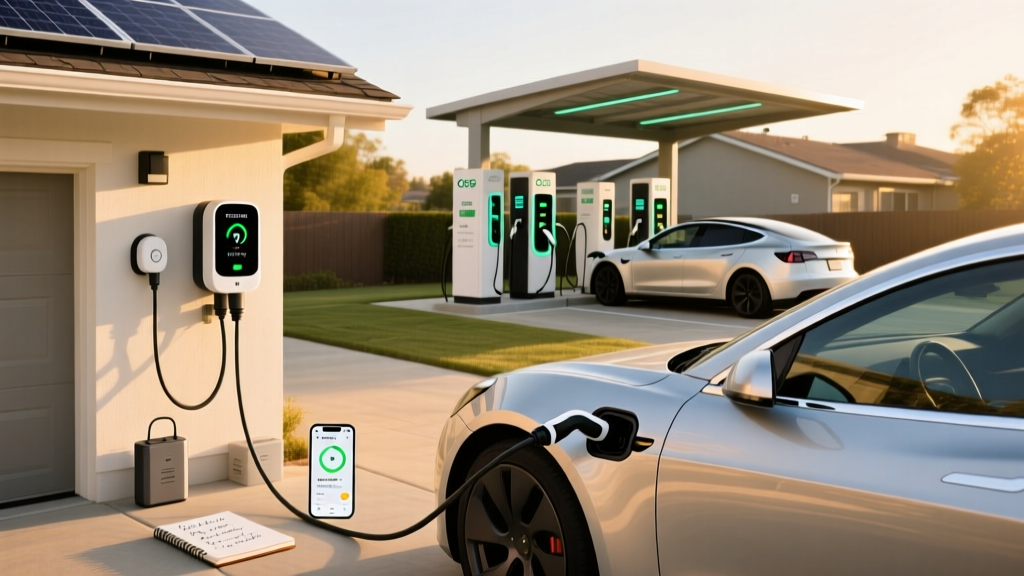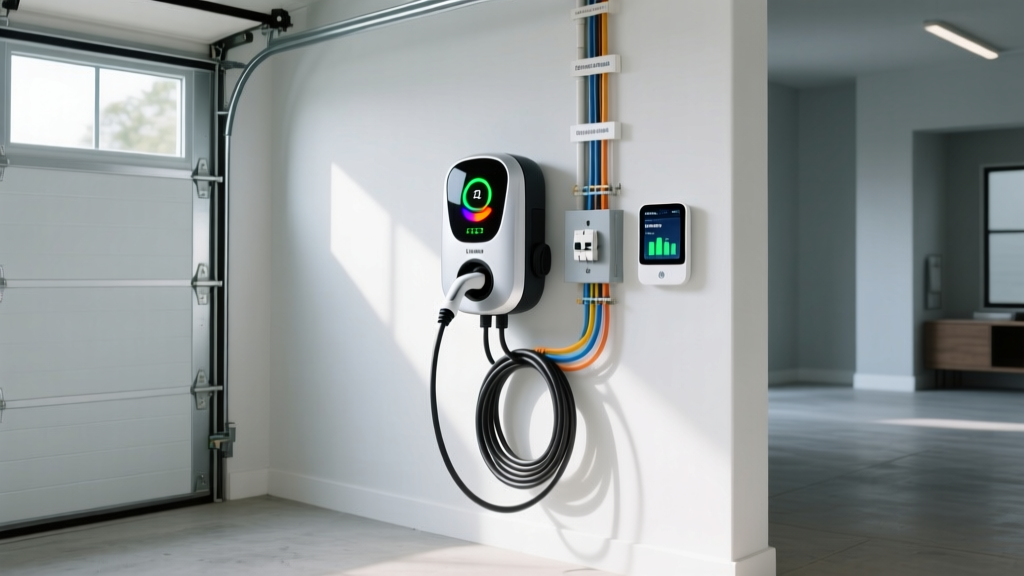
If you are transitioning from a gas vehicle — whether you traded in a rugged SUV like an 02 Nissan Xterra supercharged or a commuter sedan — the single biggest ownership shift is refueling at home instead of at a gas station. But "plugging in" means different things depending on your electrical setup, the charger hardware you choose, and the EV you drive. This guide breaks down every layer: charging speeds in hard numbers, what your electrical panel can (and can't) handle, real installation costs, and which chargers actually deliver in 2026.
Charging Levels Explained: Speeds in kW and Miles Per Hour
The most common EV confusion is between kW (kilowatts — the rate of power delivery, like water pressure from a hose) and kWh (kilowatt-hours — the total energy stored, like gallons in a tank). A charger's kW rating tells you how fast it can push energy into your battery. Your battery's kWh capacity tells you how much it holds. Divide the two and you get charging time — roughly.
Here is what each level actually delivers in practice:
| Level | Voltage | Power (kW) | Miles of Range Added Per Hour | Best For |
|---|---|---|---|---|
| Level 1 (120V) | 120V / 12A | ~1.4 kW | 3–5 mi/hr | Overnight top-ups, PHEVs, emergencies |
| Level 2 (240V) | 240V / 32–48A | 7.7–11.5 kW | 25–44 mi/hr | Daily home charging (the standard) |
| DC Fast Charging | 400–800V DC | 50–350 kW | 150–1,200+ mi/hr (peak) | Road trips, rapid top-ups |
Real-world context: A Level 1 outlet adds roughly 40 miles overnight (10 hours). That works for a plug-in hybrid with 30 miles of electric range, but for a BEV with a 75–100 kWh battery, Level 1 is impractical as a primary strategy — a full charge would take 3–4 days. Level 2 at 11.5 kW (48A) can refill a 75 kWh battery from 10% to 80% in about 5–6 hours, which is ideal for overnight charging.
DC fast charging is not typically installed at home (equipment costs $15,000–$50,000+ and requires 480V three-phase service), but understanding its speeds matters for road trips. Peak rates (e.g., 250 kW on a Tesla Supercharger V4 or 350 kW on an Electrify America station) only sustain for a portion of the session. Expect a typical 10–80% session on a 75 kWh battery to take 18–25 minutes at a 150–250 kW station, tapering significantly above 80% State of Charge (SoC) to protect battery health.
How Much Does It Cost to Install a Home EV Charger?
This is the number-one question EV buyers ask, and the honest answer spans a wide range. Your total cost depends on panel capacity, wiring distance, local permit fees, and whether you choose a hardwired unit or a 240V receptacle (NEMA 14-50). Here is a realistic 2026 breakdown:
| Component | Simple Install (Panel Nearby) | Complex Install (Panel Upgrade / Long Run) |
|---|---|---|
| Level 2 Charger Hardware | $350–$700 | $500–$800 |
| Electrician Labor (2–6 hrs @ $100–$175/hr) | $200–$500 | $600–$1,500 |
| 240V Circuit Wiring & Conduit | $150–$400 | $500–$1,200 |
| Permit & Inspection | $50–$150 | $100–$300 |
| Electrical Panel Upgrade (100A → 200A) | N/A (not needed) | $1,500–$3,500 |
| Total Estimated Cost | $750–$1,750 | $3,200–$7,300 |
The panel upgrade variable is the wildcard. Many homes built before 2000 have 100-amp or even 60-amp panels. Adding a 40–50 amp dedicated circuit for EV charging may exceed your panel's spare capacity. An electrician will perform a load calculation (per NEC Article 220) to determine if your existing panel can handle the added draw. If not, a panel upgrade to 200A runs $1,500–$3,500 depending on your utility and local code.
Cost-saving tip: Some utilities offer rebates of $250–$1,000 for Level 2 charger installation, and certain states provide additional incentives. The federal Residential Clean Energy Credit does not cover EV chargers (that expired for standalone charger hardware), but some utility programs effectively offset 30–50% of your install. Check with your local utility before scheduling work.
What Electrical Upgrades Might I Need?
Before calling an electrician, you can do a preliminary self-assessment:
- Check your panel amperage: Look at the main breaker — it will say 100A, 150A, or 200A. A 200A panel with existing moderate loads (electric stove, dryer, central AC) typically has room for a 40A EV circuit.
- Count your breaker spaces: A Level 2 charger requires a double-pole breaker (two adjacent spaces). If your panel is full, you may need a sub-panel or tandem breakers (where code allows).
- Measure the run distance: Wiring from your panel to the garage or driveway. Longer runs (over 50 feet) require thicker-gauge wire (6 AWG for 40A, 4 AWG for 50A), adding $2–$6 per foot in materials alone.
- Outdoor vs. indoor: If your parking spot is outside, you need a NEMA 4-rated (weatherproof) enclosure for the charger and potentially a GFCI breaker per NEC 2023/2026 code updates (Article 625). GFCI breakers for 240V/50A circuits cost $80–$200 and can be finicky with some EVSEs — hardwired installations with integrated ground-fault protection in the charger unit often avoid nuisance tripping.
Key code requirement: Per NEC Article 625, EV charging circuits must be dedicated — no sharing with other outlets or appliances. A 48A charger requires a 60A breaker (NEC requires circuits rated at 125% of continuous load). A 40A charger needs a 50A breaker. Do not undersize the circuit.
Which Connector and Charger Is Compatible with My EV?
The connector landscape has consolidated significantly by 2026. Here is where each standard stands:
| Connector | Brands Using It (2026 Models) | Notes |
|---|---|---|
| NACS (Tesla / SAE J3400) | Tesla, Ford, GM, Rivian, Volvo, Polestar, Nissan (new), Honda, Fisker, BMW (new), Hyundai/Kia (new) | Now the dominant North American standard. Compact, no locking pins. |
| CCS1 (Combined Charging System) | VW, Audi, Porsche, some legacy BMW/Mercedes, older Ford/GM models | Still widely supported at public stations. Many automakers transitioning to NACS by 2026–2027. |
| CHAdeMO | Nissan Leaf (legacy), Mitsubishi Outlander PHEV (older) | Effectively discontinued for new vehicles. Adapters available but limited. |
Adapter reality: If you own a CCS-equipped EV and want access to Tesla Superchargers (now open to non-Tesla vehicles via the "Magic Dock" NACS adapter at select stations), you will need a CCS-to-NACS adapter. Tesla sells an official adapter for ~$250, and third-party options from Lectron and A2Z exist at $150–$200, though quality varies. For home charging, most Level 2 chargers now ship with a NACS connector or offer CCS and NACS variants — choose the one matching your vehicle's port.
If you are buying a 2026 model-year EV, check the spec sheet: most new vehicles from Ford, GM, Rivian, Hyundai, and Kia now ship with NACS ports natively. CCS is becoming a legacy connector for vehicles purchased before 2025.
How Much Does Charging Cost Per Mile vs. Gas?
This is where EV ownership economics either shine or disappoint — it depends entirely on your electricity rate and whether you charge at home or rely on public DC fast charging.
| Scenario | Rate / Cost | Vehicle Efficiency | Cost Per Mile |
|---|---|---|---|
| Home charging (national avg. off-peak) | $0.12/kWh | 3.0 mi/kWh (100 MPGe) | $0.04/mi |
| Home charging (California peak) | $0.32/kWh | 3.0 mi/kWh | $0.107/mi |
| Home charging (Texas, low rate) | $0.09/kWh | 3.0 mi/kWh | $0.03/mi |
| Public Level 2 (ChargePoint, etc.) | $0.25–$0.49/kWh | 3.0 mi/kWh | $0.08–$0.16/mi |
| DC Fast Charging (Electrify America, Tesla) | $0.35–$0.58/kWh | 3.0 mi/kWh | $0.12–$0.19/mi |
| Gas vehicle (25 MPG combined) | $3.20/gallon | 25 MPG | $0.128/mi |
| Gas vehicle (15 MPG — older SUV) | $3.20/gallon | 15 MPG | $0.213/mi |
The takeaway: Home charging at average rates delivers fuel costs at roughly one-quarter to one-third the cost of gasoline. Even at California's higher rates, home-charged EVs beat a 25 MPG gas car. However, exclusive reliance on DC fast charging at $0.48–$0.58/kWh can push your cost per mile to parity with — or even above — an efficient gas vehicle. This is why home charging access is the economic linchpin of EV ownership.
For context, if you are replacing an older, less efficient vehicle (the kind of rugged body-on-frame SUV that got 14–16 MPG, like a supercharged early-2000s midsize truck), the per-mile savings from switching to a home-charged EV are dramatic — often $0.15–$0.18 per mile, adding up to $1,800–$2,700 annually at 12,000–15,000 miles/year.
Charging Time Examples: What to Expect with Common Battery Sizes
Charging time depends on battery capacity (kWh), the charger's power output (kW), and the vehicle's onboard charger limit (for Level 2). Here are real-world benchmarks for 2026 models:
Level 2 Home Charging (240V)
| Battery Size | Onboard Charger Limit | Charger Output | 10–80% Time | Example Vehicle |
|---|---|---|---|---|
| 62 kWh | 7.7 kW | 7.7 kW | ~5.5 hours | Nissan Leaf (60 kWh pack) |
| 75 kWh | 11.5 kW | 11.5 kW | ~4.5 hours | Tesla Model Y Long Range |
| 84 kWh | 10.9 kW | 10.9 kW | ~5.2 hours | Hyundai Ioniq 5 (Long Range) |
| 100 kWh | 11.5 kW | 11.5 kW | ~6 hours | Ford F-150 Lightning (Extended) |
DC Fast Charging (Public Stations)
| Battery Size | Peak Charge Rate | Station Capacity | 10–80% Time | Example Vehicle |
|---|---|---|---|---|
| 75 kWh | 250 kW | 250 kW Supercharger | ~18–22 min | Tesla Model Y |
| 77.4 kWh | 240 kW | 350 kW EA station | ~18 min | Hyundai Ioniq 5 |
| 100 kWh | 170 kW | 150 kW station | ~35 min | Ford F-150 Lightning |
| 95 kWh | 270 kW | 350 kW station | ~20 min | Cadillac Lyriq / GM Ultium |
Charge curve reality check: The "peak" kW number is not sustained. Most EVs hit peak charge rate between 10–30% SoC, then taper progressively. A vehicle rated at "250 kW peak" may only sustain that rate for 5–8 minutes before dropping to 150 kW, then 100 kW, then 50 kW above 80%. This is why 10–80% time is the industry-standard benchmark — charging from 80–100% can take as long as 10–80% due to the taper. For daily driving, charging to 80% is recommended for NMC batteries to preserve long-term health; LFP batteries can be charged to 100% regularly without significant degradation concerns.
Best Home EV Chargers for 2026: Equipment Picks
After testing and tracking reliability data across dozens of units, these are the Level 2 chargers that deliver in real-world use. All prices reflect 2026 MSRP:
ChargePoint Home Flex (NACS or CCS)
- Power Output: Up to 11.5 kW (48A) on a 60A circuit; adjustable down to 16A for smaller circuits
- Connector: Available in NACS and CCS1 variants
- Cable Length: 23 feet
- Smart Features: Wi-Fi, app scheduling, utility demand-response integration, Alexa/Google Home
- Price: $549–$599
- Verdict: Best all-around for flexibility — the amperage dip-switch adjustment means it works on circuits from 20A to 60A, future-proofing your install.
Tesla Wall Connector (NACS)
- Power Output: Up to 11.5 kW (48A) on a 60A circuit
- Connector: NACS native; includes Magic Dock adapter for CCS vehicles (sold separately, ~$250)
- Cable Length: 24 feet
- Smart Features: Wi-Fi, OTA firmware updates, Power Sharing (link multiple units on one circuit), vehicle-specific charge limits
- Price: $475
- Verdict: Best value if you own a Tesla or NACS-equipped vehicle. Sleek, reliable, and the lowest price among premium 48A units.
Emporia Vue Level 2 Charger
- Power Output: Up to 11.5 kW (48A)
- Connector: NACS and CCS1 options
- Cable Length: 24 feet
- Smart Features: Integrated energy monitoring (pairs with Emporia Vue home energy monitor), solar-aware scheduling, app control
- Price: $399–$449
- Verdict: Best budget smart charger — ideal if you have solar panels and want to charge only on excess production. Energy monitoring is a standout feature competitors charge extra for.
Grizzl-E Smart (United Chargers)
- Power Output: Up to 10 kW (40A) on a 50A circuit
- Connector: NACS and CCS1 (J1772 with adapter)
- Cable Length: 24 feet
- Smart Features: OCPP-compatible, app control, load balancing
- Price: $499
- Verdict: Built for extreme weather — rated to -40°F/-40°C, NEMA 4X enclosure. Best pick for unheated garages or outdoor installs in cold climates. Made in Canada.
Buying rule of thumb: Match the charger's maximum amperage to your circuit capacity, not your car's onboard charger limit. Installing a 48A charger on a 60A circuit today means you can upgrade to a vehicle with a larger onboard charger later without rewiring. The hardware cost difference between a 32A and 48A unit is typically only $50–$100.
Safety, Code, and Installation Best Practices
EV charging is a continuous high-draw electrical load — your charger will run at near-maximum output for 4–8 hours at a time. This is fundamentally different from a dryer or oven that cycles on and off. Safety margins matter:
- Dedicated circuit: Never share the EV circuit with other loads. NEC Article 625 requires a dedicated branch circuit.
- Hardwired vs. receptacle: A hardwired connection eliminates the NEMA 14-50 receptacle as a failure point. Receptacles can overheat if not properly torqued or if the plug loosens over time. Hardwired installations are preferred for 48A+ chargers and are required by some local codes for circuits above 50A.
- GFCI protection: NEC 2023 and later require GFCI protection for EV outlets in garages and outdoors. Hardwired chargers with built-in ground-fault detection may satisfy this without a GFCI breaker — confirm with your local inspector.
- Outdoor rating: Any charger installed outside must be rated NEMA 4 (weatherproof). Look for UL or ETL listing — do not buy uncertified chargers from overseas marketplaces regardless of price.
- Permit and inspection: Most jurisdictions require an electrical permit for a new 240V circuit. The inspection ($50–$150 fee) verifies wire gauge, breaker sizing, grounding, and torque specs. Skipping the permit risks insurance denial if an electrical fire occurs.
- Surge protection: A whole-panel surge protective device (SPD, $150–$300 installed) protects your charger and vehicle onboard charger from grid transients. Recommended in areas with frequent lightning or unstable utility power.
For the electrical work itself, always hire a licensed electrician familiar with NEC Article 625. The National Fire Protection Association (NFPA) publishes the NEC code cycle updates, and your local jurisdiction may be on the 2020, 2023, or 2026 edition — each has different GFCI and EV-specific requirements.
Frequently Asked Questions
Can I charge my EV on a regular 120V outlet?
Yes, but slowly. Level 1 charging at 120V/12A delivers about 1.4 kW, adding 3–5 miles of range per hour. For a PHEV with 25–40 miles of electric range, an overnight charge (8–10 hours) is sufficient. For a BEV with 250+ miles of range, Level 1 is only practical as emergency backup or for very low daily mileage (under 20 miles/day).
Do I need a 200-amp electrical panel for an EV charger?
Not necessarily. A 100-amp panel with low existing loads (gas appliances, no central electric AC) can often support a 32A (7.7 kW) EV circuit. However, a 100A panel with all-electric appliances (electric heat, dryer, oven, water heater) may not have capacity. Your electrician will run a NEC Article 220 load calculation to determine this. If an upgrade is needed, expect $1,500–$3,500 for a 200A panel swap.
How fast will each charging level add range?
Level 1 (120V): 3–5 miles/hour. Level 2 (240V, 48A): 30–44 miles/hour depending on vehicle efficiency. DC Fast (150–350 kW): 150–1,200+ miles/hour at peak, but sustained rates are lower — expect a 10–80% session in 18–35 minutes depending on battery size and station power.
Is it cheaper to charge at home or at public stations?
Home charging is almost always cheaper. At the U.S. average residential rate of ~$0.16/kWh (per EIA data), home charging costs $0.04–$0.06 per mile. Public DC fast charging at $0.35–$0.58/kWh costs $0.12–$0.19 per mile — comparable to gasoline. Maximize home charging to realize EV cost savings.
Which connector/charger is compatible with my EV?
For 2026 model-year vehicles, NACS (SAE J3400) is now the dominant standard — Tesla, Ford, GM, Rivian, Hyundai, Kia, Honda, Volvo, and Nissan all use it on new models. CCS1 remains on some VW/Audi/Porsche vehicles and older models. CHAdeMO is effectively legacy (Nissan Leaf only). Check your vehicle's charge port or the manufacturer's spec sheet. For home chargers, buy the connector variant that matches your car — adapters exist but add bulk and potential failure points for daily use.
What about the federal tax credit for home chargers?
The federal Alternative Fuel Vehicle Refueling Property Credit (§30C) was revived under the Inflation Reduction Act and offers up to $1,000 (30% of cost, capped) for home charger hardware and installation — but only if you live in a qualifying census tract (typically rural or low-income areas as defined by the IRS). Check eligibility at IRS.gov §30C. This credit is separate from the §30D vehicle purchase credit and has its own income and location requirements.
Should I get a smart charger or a basic "dumb" charger?
A smart charger ($50–$150 more than basic units) offers Wi-Fi scheduling, utility demand-response programs (which can earn you $5–$20/month in credits), energy monitoring, and remote start/stop. If your utility offers time-of-use rates, a smart charger's scheduling feature alone can save $10–$30/month by ensuring charging happens during off-peak hours. For most buyers, the smart charger pays for itself within 12–24 months.