If you're still holding onto memories of a supercharged 3800 V6 — the kind that made the 1997 Buick Riviera a sleeper muscle-luxury cruiser — you already understand the value of torque delivered smoothly and predictably. Swapping that 3.8L supercharged L67 for an electric drivetrain doesn't mean abandoning that philosophy; it means redirecting it. The difference is that your "supercharger" is now a Level 2 home EV charger pushing electrons instead of boost, and the fuel bill drops from $3.50/gallon to roughly $0.12/kWh off-peak. This guide walks through exactly what it takes to wire a modern EV charging setup at home, what it costs, and how it compares to the gas station.
Charging Levels Explained: kW, Miles per Hour, and Real Expectations
The single most important distinction in EV charging is between kW (kilowatts) and kWh (kilowatt-hours). kW measures power — the rate at which energy flows into your car. kWh measures energy — the total capacity of your battery. A 75 kWh battery charged at 7.2 kW takes roughly 10 hours from empty. Confusing these two is the most common EV literacy mistake new owners make.
| Level | Voltage | Power (kW) | Miles of Range / Hour | Typical Use Case |
|---|---|---|---|---|
| Level 1 | 120V | 1.2–1.9 kW | 3–5 mi/hr | Overnight top-up, PHEVs, low-mileage drivers |
| Level 2 | 240V | 3.3–19.2 kW | 12–75 mi/hr | Primary home charging, workplace, destination |
| DC Fast Charge | 400–800V DC | 50–350 kW | 150–1,200 mi/hr (peak) | Road trips, highway corridors, commercial fleets |
Level 1 is what comes in the box with most EVs — a standard 120V NEMA 5-15 plug. It works, but slowly: a 75 kWh battery (think Tesla Model Y Long Range or Hyundai Ioniq 5) will take 40+ hours from empty. Fine for a PHEV with a 15 kWh pack; inadequate for a BEV driven more than 30 miles daily.
Level 2 at 240V is the home standard. A 48-amp (11.5 kW) charger adds roughly 40–45 miles of range per hour for an efficient sedan like the Tesla Model 3, or 30–35 miles per hour for a heavier SUV like the Rivian R1S. Most EVs accept between 7.2 kW and 11.5 kW on Level 2, limited by their onboard charger — not the wall unit.
DC fast charging bypasses the onboard charger entirely, feeding DC current directly into the battery. Peak rates of 250–350 kW are real, but sustained rates are what matter: a Hyundai Ioniq 5 on a 350 kW charger peaks at ~240 kW and completes 10–80% in roughly 18 minutes, but that rate only holds between 10–55% SoC before tapering. Always look at 10–80% time, not peak kW.
Home Installation: Electrical Requirements, Panel Upgrades, and Real Costs
The sticker price of a Level 2 charger ($400–$750) is the cheap part. Installation is where the real budget lives, and it varies enormously based on your home's electrical panel, the distance from panel to garage, and local code.
| Component | Low End | High End | Notes |
|---|---|---|---|
| Level 2 Charger (hardware) | $400 | $750 | 32A–48A smart chargers (ChargePoint, Emporia, Wall Connector) |
| Electrician labor (2–6 hrs) | $300 | $900 | $150/hr average; longer runs cost more |
| Materials (wire, conduit, breaker) | $100 | $400 | 6 AWG copper for 48A; 8 AWG for 32A |
| Permit & inspection | $50 | $300 | Varies by municipality; some jurisdictions waive |
| Panel upgrade (if needed) | $1,500 | $4,000 | 100A → 200A service; common in pre-1990s homes |
| Total (no panel upgrade) | $850 | $2,350 | Typical scenario for modern 200A homes |
| Total (with panel upgrade) | $2,350 | $6,350 | Older homes with 100A service |
Electrical Requirements for a 48-Amp Level 2 Charger
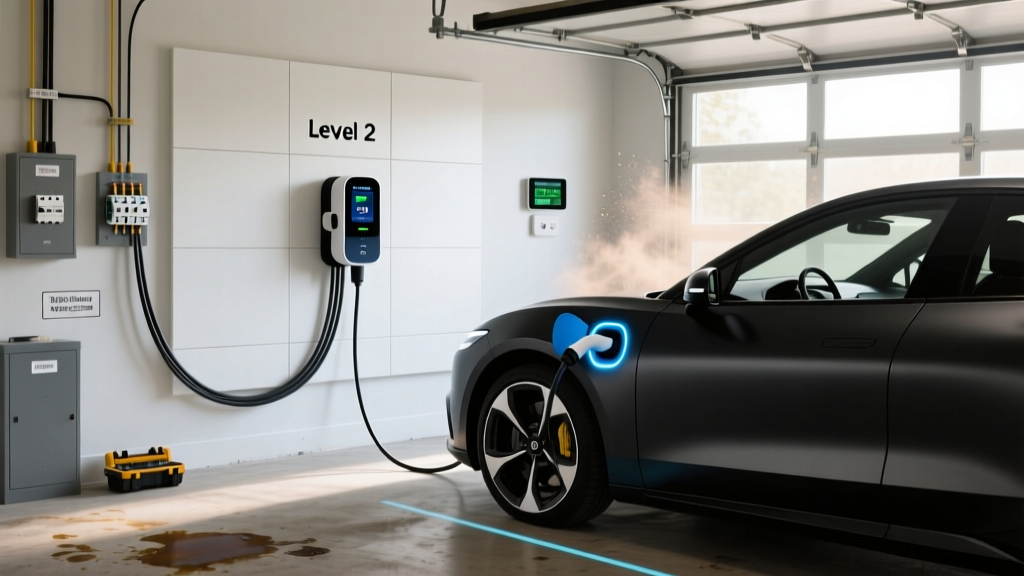
A 48-amp continuous-load charger requires a 60-amp breaker (NEC Article 210.20 mandates 125% headroom for continuous loads). That means 6 AWG copper wire (or 4 AWG aluminum) in conduit, a NEMA 14-60 receptacle or hardwired connection, and available capacity on your panel.
Here's how to check if your panel can handle it: a 200-amp panel with a 48A EV charger adds roughly 11.5 kW of continuous draw. If your home already runs electric heat (15–20 kW), an electric dryer (5 kW), and an electric oven (3–5 kW) simultaneously, you may be near capacity. A licensed electrician will perform a load calculation per NEC Article 220 to determine available headroom.
Panel upgrade trigger: Homes built before 1990 often have 100-amp service. If you owned that '97 Buick Riviera, your house likely had 100A — adequate for gas appliances but tight for an all-electric household adding an EV charger. Upgrading to 200A typically costs $1,500–$4,000 depending on utility drop, meter base, and local labor rates. Some utilities offer rebates covering $200–$500 of this cost.
Smart vs. Dumb Chargers, and the 80% Rule
NEC Article 625.41 requires EV chargers to be limited to 80% of the circuit rating for continuous operation. A 60-amp breaker supports 48 amps continuous. A 50-amp breaker supports 40 amps. This is non-negotiable for safety and code compliance — never set a charger to draw more than 80% of breaker capacity.
Connector Compatibility: NACS, CCS1, CHAdeMO, and the 2026 Landscape
The connector war is effectively over in North America. Tesla's North American Charging Standard (NACS) has been adopted by Ford, GM, Rivian, Volvo, BMW, Hyundai/Kia, and most major automakers. By 2026, nearly all new EVs sold in the U.S. ship with a native NACS port. CCS1 is being phased out on new vehicles but remains on 2022–2024 models. CHAdeMO is legacy-only (Nissan Leaf, Mitsubishi Outlander PHEV).
| Connector | Brands Using It (2026) | Home Charger Availability | Adapter Needed? |
|---|---|---|---|
| NACS (Tesla) | Tesla, Ford, GM, Rivian, Hyundai, Kia, BMW, Volvo, Polestar | Tesla Wall Connector, ChargePoint Home Flex (NACS), Emporia Vue | None for new EVs; CCS→NACS adapter for older CCS cars |
| CCS1 | 2022–2024 VW ID.4, Audi e-tron, older Bolt EV, legacy models | ChargePoint Home Flex, Emporia, JuiceBox (CCS variants) | NACS→CCS adapter (~$200) if charger is NACS-only |
| CHAdeMO | Nissan Leaf (discontinued 2025), Mitsubishi Outlander PHEV | Limited; most home chargers don't offer CHAdeMO | Rare adapters; most owners use public CHAdeMO stations |
Practical advice: If you're buying a 2025–2026 EV, get a NACS home charger. If you own a 2022–2024 CCS vehicle, buy a dual-standard or CCS charger, or invest in a NACS-to-CCS adapter (Lectron and A2Z make reliable units at ~$180–$250). For CHAdeMO owners, home charging still works via the J1772 Level 2 connector — CHAdeMO is only the DC fast standard; all CHAdeMO vehicles also have J1772 for Level 2.
Cost to Charge: $/kWh Scenarios and Cost-Per-Mile vs. Gas
The economics of EV charging depend entirely on your electricity rate and where you charge. Here's a realistic breakdown using a 2026 Hyundai Ioniq 6 SE Long Range (77.4 kWh battery, EPA 361 miles, 4.0 mi/kWh efficiency) as our reference vehicle.
| Scenario | Rate ($/kWh) | Cost for 300 mi | Cost Per Mile | Equivalent Gas Price (at 28 MPG) |
|---|---|---|---|---|
| Home off-peak (utility TOU rate) | $0.09 | $6.75 | $0.023 | $0.63/gal |
| Home standard residential | $0.16 | $12.00 | $0.040 | $1.12/gal |
| Public Level 2 (ChargePoint, EVgo) | $0.32 | $24.00 | $0.080 | $2.24/gal |
| DC Fast (Electrify America, Tesla Supercharger) | $0.48 | $36.00 | $0.120 | $3.36/gal |
| Gasoline (national avg, mid-2026) | — | $37.50 (at $3.50/gal) | $0.125 | $3.50/gal |
The takeaway: home charging at off-peak TOU (time-of-use) rates makes EVs dramatically cheaper per mile than gas — roughly 5x cheaper. Public DC fast charging at peak rates approaches gas parity, which is why home charging access remains the single biggest factor in EV ownership satisfaction. According to fueleconomy.gov, the average U.S. electricity rate is $0.16/kWh, but TOU plans in California, Texas, and the Southeast can drop to $0.06–$0.10/kWh overnight.
Real-world nuance: These calculations assume 4.0 mi/kWh efficiency. In cold weather (below 30°F), expect 20–30% efficiency loss due to battery heating and cabin HVAC, pushing cost per mile up proportionally. Highway driving at 75+ mph also reduces efficiency by 10–15% compared to the EPA combined cycle.
Charging Time Examples: 10–80% for Common Battery Sizes
The 10–80% metric is the industry standard because charging above 80% SoC slows dramatically — the battery management system (BMS) tapers current to protect cell longevity. Here's what to expect across common 2026 EV platforms:
- Tesla Model 3 Long Range (75 kWh, LFP): 250 kW peak DCFC → 10–80% in ~22 minutes. Level 2 at 11.5 kW → 0–100% in ~7.5 hours.
- Hyundai Ioniq 5 (77.4 kWh, NMC, 800V architecture): 240 kW peak → 10–80% in ~18 minutes. Level 2 at 10.9 kW → ~8 hours.
- Ford F-150 Lightning Extended Range (131 kWh, NMC): 150 kW peak → 10–80% in ~45 minutes. Level 2 at 19.2 kW (80A) → ~8 hours.
- Chevrolet Equinox EV (85 kWh, NMC): 150 kW peak → 10–80% in ~30 minutes. Level 2 at 11.5 kW → ~8.5 hours.
- Toyota bZ4X (71.4 kWh, NMC): 150 kW peak → 10–80% in ~30 minutes. Level 2 at 7.2 kW → ~11 hours.
Charging curve reality check: Peak kW is not sustained kW. A vehicle advertising "250 kW charging" typically holds that rate for 5–10% of the charge session (roughly 10–35% SoC), then tapers to 150 kW, then 100 kW, then 50 kW above 80%. The 10–80% time is a more honest metric than peak rate alone.
Equipment Recommendations: 2026 Charger Picks
Tesla Wall Connector (Gen 4) — Best Overall for NACS Vehicles
- Power Output: 48A (11.5 kW) on a 60A circuit
- Connector: NACS native
- Cable Length: 24 feet
- Smart Features: Wi-Fi, OTA updates, Power Sharing (up to 6 units on one circuit), load management
- Price: $475
- Best For: Tesla owners and all 2025+ NACS-equipped EVs
ChargePoint Home Flex — Most Versatile (Dual Connector Options)
- Power Output: Up to 50A (12 kW) on a 60A circuit; adjustable 16A–50A via DIP switches
- Connector: Available in NACS or CCS1/J1772 variants
- Cable Length: 23 feet
- Smart Features: Wi-Fi, app scheduling, Alexa/Google Home, utility TOU integration, energy tracking
- Price: $549 (NACS) / $499 (J1772)
- Best For: Multi-EV households, CCS-to-NACS transition period
Emporia Level 2 EV Charger — Best Value with Energy Monitoring
- Power Output: 48A (11.5 kW) on a 60A circuit
- Connector: J1772 (with NACS adapter available)
- Cable Length: 24 feet
- Smart Features: Integrated whole-home energy monitoring (with Emporia Vue panel), solar integration, TOU scheduling
- Price: $399
- Best For: Budget-conscious buyers, solar households, energy-monitoring enthusiasts
Installation note: All three chargers above support hardwired or plug-in (NEMA 14-60) installation. Hardwired is preferred for 48A+ units — it eliminates the receptacle as a failure point and is required by code in some jurisdictions for circuits above 50A. Per the National Electrical Code (NEC), outdoor installations require a GFCI breaker and weather-rated (NEMA 4) enclosure.
Safety, Code, and Permit Considerations
EV charging is a high-draw, continuous electrical load — it runs at near-maximum capacity for hours. This is fundamentally different from a dryer or oven that cycles on and off. Code requirements reflect this:
- Dedicated circuit: Your EV charger must be on its own dedicated breaker — no sharing with other outlets or appliances (NEC 625.40).
- GFCI protection: Required for all outdoor receptacles and many indoor garage installations (NEC 625.54). Some chargers have built-in GFCI; verify with your electrician.
- Outdoor rating: If mounting outside, the charger must carry a NEMA 4 (weather-resistant) rating. All three picks above qualify.
- Permit required: Most jurisdictions require an electrical permit for new 240V circuits. Permit costs range $50–$300. Skipping the permit risks insurance denial if an electrical fire occurs.
- Inspection: A post-install inspection by your local AHJ (Authority Having Jurisdiction) verifies code compliance. Typically scheduled by your electrician.
- Wire gauge: 6 AWG copper THHN for 48A circuits; 8 AWG for 32A. Aluminum wire (cheaper) requires upsizing to 4 AWG for 48A.
Panel upgrade reality for older homes: If your home was built before 1990 — the era of that supercharged '97 Riviera — there's a meaningful chance you have 100-amp service. Adding a 48A EV charger to a 100A panel that already serves electric heat, a dryer, and a range will likely exceed capacity. Budget $1,500–$4,000 for a 200A panel upgrade, or consider a 32A charger (requiring only a 40A breaker) as a lower-impact alternative that still adds ~25 miles of range per hour.
Federal Incentives and Utility Rebates for Home Charging
The IRS §30C Alternative Fuel Vehicle Refueling Property Credit covers 30% of home EV charger equipment and installation costs, up to $1,000. This credit applies to the total installed cost — so a $2,000 installation nets a $600 credit, and a $3,334+ installation maxes the $1,000 credit. Eligibility requires the charger to be installed at your primary residence in a qualifying census tract (most urban and suburban areas qualify; check irs.gov for the current tract map).
Many utilities also offer direct rebates: Pacific Gas & Electric offers up to $1,500 for panel upgrades paired with EV charger installs; ConEdison in New York offers $500 for smart charger installations on TOU plans. Check your local utility's EV program page — these stack with the federal credit.
Frequently Asked Questions
How much does it cost to install a home EV charger?
A typical Level 2 home charger installation costs $850–$2,350 including hardware, electrician labor, materials, and permit — assuming your electrical panel has adequate capacity. If a panel upgrade from 100A to 200A is needed, add $1,500–$4,000. The IRS §30C credit covers 30% of total costs up to $1,000, and many utilities offer additional rebates of $200–$1,500.
How fast will each charging level add range?
Level 1 (120V) adds 3–5 miles per hour — suitable for PHEVs or low-mileage drivers. Level 2 (240V, 48A) adds 30–45 miles per hour depending on vehicle efficiency — this is the standard for daily BEV charging. DC fast charging adds 150–1,200 miles per hour at peak rates, but sustained rates taper significantly above 55% SoC, making 10–80% time (typically 18–45 minutes) the more useful metric.
Which connector/charger is compatible with my EV?
For 2025–2026 EVs from Tesla, Ford, GM, Hyundai, Kia, BMW, Volvo, or Rivian: NACS is the standard — get a NACS home charger. For 2022–2024 CCS vehicles (VW ID.4, older Bolt, Audi e-tron): use a CCS/J1772 charger or buy a NACS-to-CCS adapter (~$200). For Nissan Leaf (CHAdeMO): use a J1772 Level 2 charger; CHAdeMO is only for DC fast charging.
How much does charging cost per mile vs. gas?
At home on off-peak TOU rates ($0.09/kWh), an efficient EV costs about $0.023/mile — equivalent to $0.63/gallon gas. At standard residential rates ($0.16/kWh), it's $0.04/mile. Public DC fast charging at $0.48/kWh reaches $0.12/mile, approaching the $0.125/mile cost of a 28 MPG car at $3.50/gallon. Home charging is where the savings live.
What electrical upgrades might I need?
Homes with 200-amp service (most post-1990 construction) typically need no panel upgrade — just a dedicated 60-amp breaker and 6 AWG wire run. Homes with 100-amp service (common in pre-1990 builds) may require a $1,500–$4,000 panel upgrade to 200A, especially if the home has other large electric loads. A licensed electrician will perform a NEC Article 220 load calculation to determine your exact requirements. Always get a professional assessment before purchasing equipment.