Why Sports Car EVs Demand a Serious Home Charger
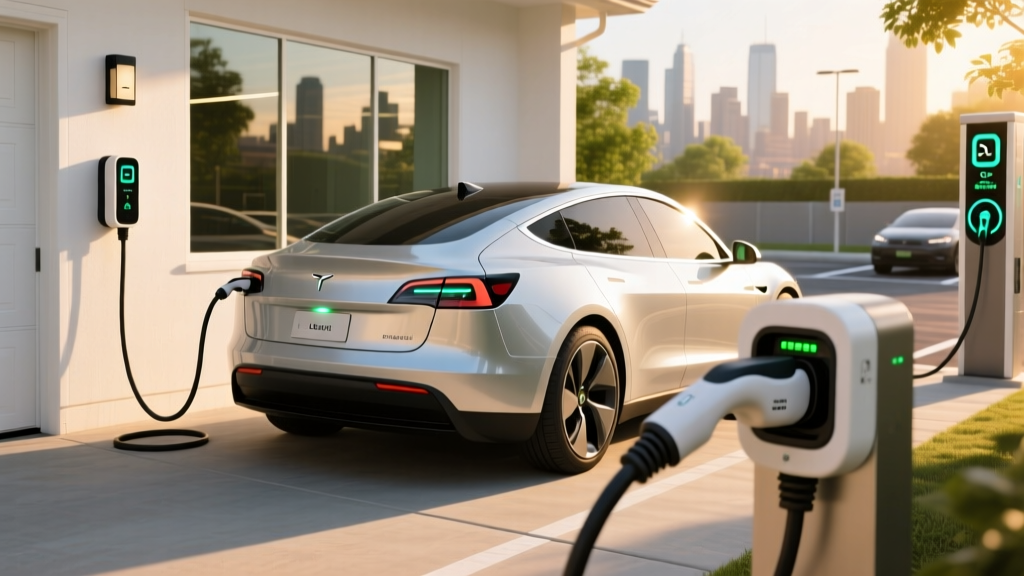
Electric sports cars and performance sedans—from the Porsche Taycan to the Tesla Model S Plaid, Hyundai Ioniq 5 N, and BMW i4 M50—share one defining trait beyond blistering 0-60 times: large, power-hungry battery packs. A 93.4 kWh Taycan or a 100 kWh Model S Plaid doesn't just devour electrons under hard acceleration; it also requires a robust Level 2 home charger to replenish those cells overnight so you wake up to a full battery and full performance. Plug a high-capacity sports car EV into a standard 120V wall outlet (Level 1) and you might add just 3–5 miles of range per hour—meaning a 10% to 80% session could take over 24 hours. That's not a charging strategy; it's a parking ornament.
This guide walks through exactly what charger hardware, electrical infrastructure, and connector type a sports car EV owner needs in 2026, with real numbers on cost, speed, and compatibility. We'll also address the single most common confusion in EV charging: the difference between kW (power—the rate at which energy flows) and kWh (energy—the total capacity stored in your battery). Think of kW as the width of a hose and kWh as the size of the bucket. A wider hose (higher kW) fills the bucket (kWh) faster.
Charging Levels Explained: How Fast Will Each Add Range?
Every EV owner needs to understand the three charging tiers. The table below shows typical power output in kW, approximate miles of range added per hour, and the 10%–80% session time for a representative 85 kWh sports car battery (roughly a Taycan 4S or i4 M50).
| Level | Voltage / Power | Miles of Range per Hour | 10%–80% Time (85 kWh) | Best Use Case |
|---|---|---|---|---|
| Level 1 | 120V / 1.4–1.9 kW | 3–5 mi/hr | 30–40 hours | Emergency top-up only |
| Level 2 (Home) | 240V / 7.2–19.2 kW | 20–55 mi/hr | 5–10 hours | Daily overnight charging |
| DC Fast Charging | 400V–800V / 50–350 kW | 150–600+ mi/hr | 15–25 minutes | Road trips, quick fill-ups |
Real-world caveat: DC fast-charging speeds are peak rates, not sustained rates. A Porsche Taycan on an 800V architecture can accept up to 270 kW at a 350 kW Electrify America stall, but that peak holds only while the battery's state of charge (SoC) is roughly between 10% and 40%. Above 80% SoC, the charge curve tapers sharply to protect battery chemistry—this is why manufacturers quote 10%–80% times rather than 0%–100%. Expect a 22-minute 10%–80% session on the Taycan, or roughly 18 minutes on a Tesla Model S at a V4 Supercharger.
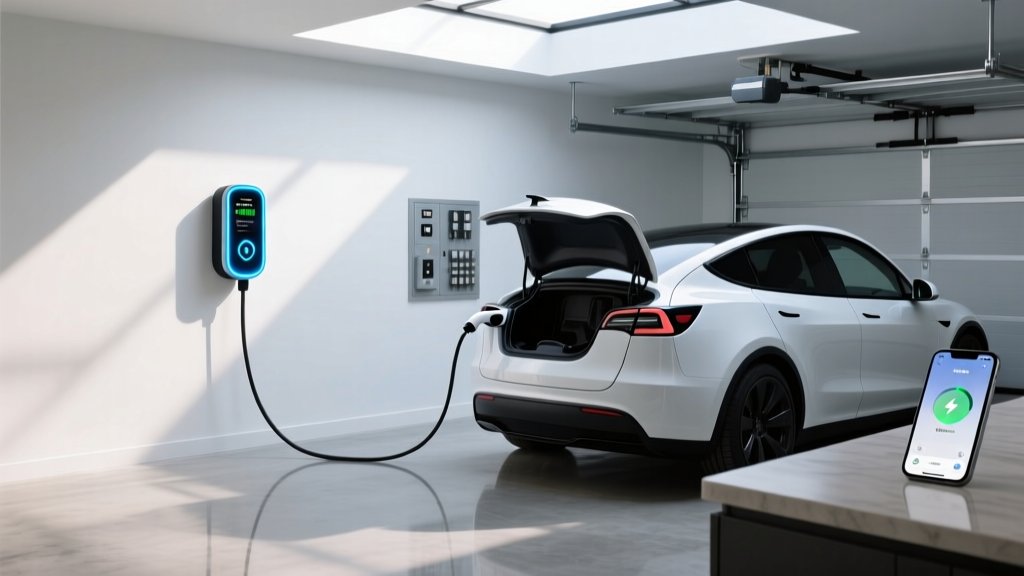
For daily driving, Level 2 home charging is the backbone. A 48-amp (11.5 kW) Level 2 charger will fully replenish a sports car EV overnight—typically in 7–9 hours—so you start each morning at your target SoC without ever visiting a public station.
Home Installation: Electrical Requirements and Cost Breakdown
Installing a dedicated Level 2 home charger for a sports car EV is a significant electrical project. High-output chargers (48A or higher) demand a dedicated 60-amp circuit on a 240V line. Here is what that entails:
Electrical Requirements
- Voltage: 240V (split-phase, same as an electric dryer or oven)
- Amperage: 40A circuit for a 32A charger, or 60A circuit for a 48A charger (the National Electrical Code requires circuits rated at 125% of the continuous load)
- Wire gauge: 6 AWG copper for 60A; 8 AWG for 40A
- Dedicated circuit: The charger must have its own breaker—no sharing with other appliances
- GFCI protection: Required for outdoor installations and in garages per NEC 2020+ in most jurisdictions
- NEMA 14-50 receptacle vs. hardwired: A NEMA 14-50 outlet offers portability; hardwired connections allow higher amperage (48A+) and avoid GFCI nuisance trips
Do You Need a Panel Upgrade?
Most homes built after 1990 have a 200-amp electrical panel. A load calculation (required by your permitting office) determines whether adding a 60A EV circuit exceeds 80% of your panel's capacity. If your panel is already near capacity—common in homes with electric heat, electric ovens, and hot tubs—you may need a panel upgrade to 200A or even 400A, or a secondary sub-panel. Older homes with 100A service will almost certainly require an upgrade for a high-output sports car charger. Some homeowners opt for a smart load-management system (like the Emporia VUE with auto-shed) to avoid a panel upgrade by dynamically throttling charger amperage when other large loads are active.
Installation Cost Breakdown
| Component | Low Estimate | High Estimate | Notes |
|---|---|---|---|
| Level 2 Charger Equipment | $400 | $750 | 48A smart charger, Wi-Fi enabled |
| Electrician Labor | $500 | $2,000 | Depends on run length, wall type |
| Electrical Permit | $50 | $300 | Varies by municipality |
| Panel Upgrade (if needed) | $1,500 | $4,500 | 200A to 400A service upgrade |
| Conduit, Wire, Breaker | $150 | $600 | 6 AWG copper, 60A breaker |
| Total (no panel upgrade) | $1,100 | $3,650 | Most typical scenario |
| Total (with panel upgrade) | $2,600 | $8,150 | Older homes, high-load panels |
The IRS §30D tax credit does not cover home charger equipment directly as of 2026 (the former §30C alternative fuel infrastructure credit expired for most residential installations), but some states and utilities offer rebates of $250–$1,000 for Level 2 charger installation. Check your local utility and AFDC state incentive database for current programs.
Connector Compatibility: NACS, CCS, and Adapter Needs
The connector landscape in 2026 has largely consolidated around the North American Charging Standard (NACS), originally developed by Tesla and now adopted by nearly every major automaker. Here's where sports car EVs stand:
| Vehicle | Native Connector | Adapter Needed for Tesla Superchargers? | Adapter Needed for CCS Stations? |
|---|---|---|---|
| Tesla Model S Plaid | NACS | No | Yes (Tesla CCS adapter, ~$175) |
| Porsche Taycan | NACS (2025+) | No | Legacy CCS adapter may be included |
| BMW i4 M50 | NACS (2025+) | No | Check dealer for CCS adapter |
| Hyundai Ioniq 5 N | NACS (2025+) | No | Legacy models need NACS adapter |
| Lucid Air Sapphire | NACS (2025+) | No | CCS adapter included |
| Older CCS EVs (pre-2025) | CCS1 | Yes (CCS-to-NACS adapter, ~$200–$250) | No |
Key takeaway: If you're buying a new sports car EV in 2026, it almost certainly ships with a NACS charge port. For home charging, this means you should purchase a NACS-equipped Level 2 charger (or a J1772 charger with a NACS adapter, since J1772 is the legacy Level 2 standard and NACS is backward-compatible with J1772 signaling). For DC fast charging on road trips, NACS gives you access to Tesla's Supercharger network—now the most extensive and reliable in the U.S.—without an adapter.
CHAdeMO, the connector used by the Nissan LEAF and older Mitsubishi models, is effectively discontinued in North America. No current sports car EV uses CHAdeMO, and new CHAdeMO stations are no longer being deployed.
Cost to Charge: Home vs. Public vs. Gas
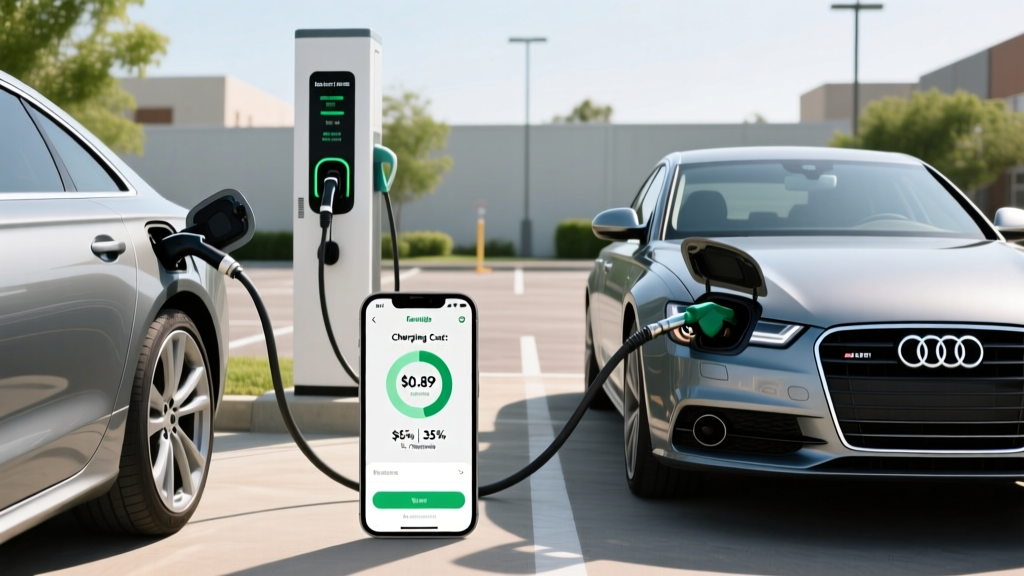
One of the strongest arguments for electrifying a sports car is the dramatic reduction in per-mile energy cost—especially when charging at home on off-peak rates. Below is a comparison based on an EV averaging 3.0 miles per kWh (a reasonable real-world figure for a performance EV driven with some enthusiasm).
| Scenario | Rate | Cost per kWh | Cost per Mile (3 mi/kWh) |
|---|---|---|---|
| Home Off-Peak (utility TOU rate) | $0.08–$0.12/kWh | $0.10 avg | $0.033 |
| Home Standard Rate | $0.13–$0.20/kWh | $0.16 avg | $0.053 |
| Public Level 2 (ChargePoint, etc.) | $0.25–$0.49/kWh | $0.35 avg | $0.117 |
| DC Fast Charging (Electrify America, Tesla) | $0.32–$0.56/kWh | $0.44 avg | $0.147 |
| Gas Sports Car (20 MPG, $3.80/gal) | $3.80/gal | N/A | $0.190 |
The math is clear: Charging at home off-peak costs roughly $0.03 per mile—about one-sixth the cost of fueling a 20 MPG gas sports car at $0.19 per mile. Even exclusive DC fast charging at $0.15/mile undercuts gasoline. For a sports car driven 10,000 miles per year, home charging saves approximately $1,500–$1,600 annually compared to premium gasoline.
Sports car EVs tend to consume more energy than commuter EVs—expect 2.5–3.5 mi/kWh in spirited driving versus 3.5–4.5 mi/kWh for a sedan like the Hyundai Ioniq 6. Adjust your expectations accordingly, but the per-mile advantage over gasoline remains substantial.
Equipment Picks: Best Level 2 Chargers for a Sports Car EV
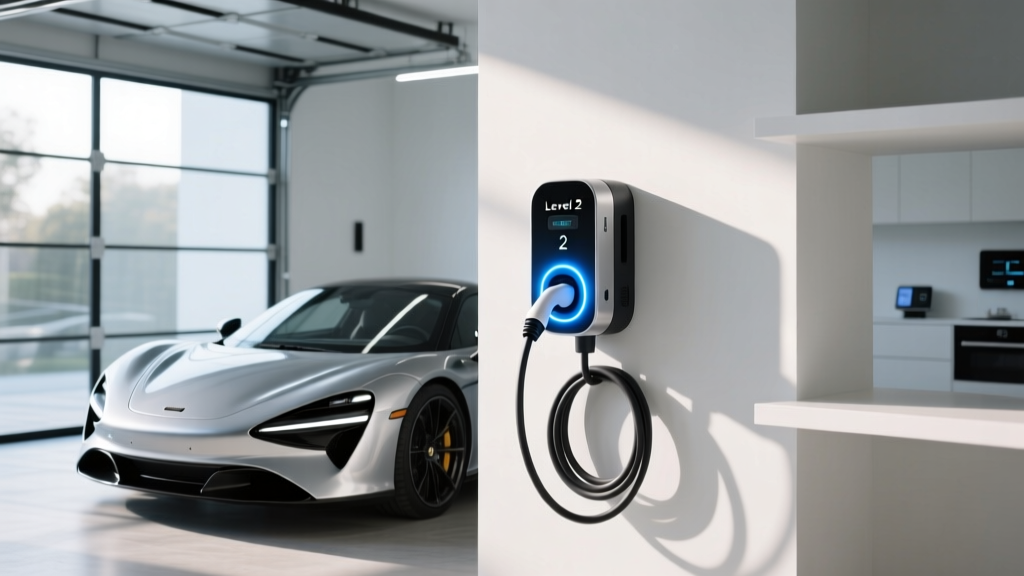
A sports car's large battery (80–100 kWh) rewards a high-amperage charger. A 48-amp unit delivers 11.5 kW on a 240V circuit, adding roughly 35–40 miles of range per hour—enough to fully replenish most sports car EVs overnight. Here are top-rated options for 2026:
ChargePoint Home Flex (NACS) — 50A / 12 kW
- Power: Up to 50A (12 kW) on a 60A circuit; adjustable down to 16A
- Connector: NACS (native), J1772 version also available
- Cable length: 23 feet
- Smart features: Wi-Fi, Alexa integration, scheduled charging, energy dashboard, load sharing for dual installations
- Price: ~$649
- Best for: Owners who want app-based scheduling and utility TOU optimization
Wall Connector (Tesla, Gen 4) — 48A / 11.5 kW
- Power: 48A (11.5 kW) on a 60A circuit
- Connector: NACS native; J1772 adapter available
- Cable length: 24 feet
- Smart features: Wi-Fi, over-the-air updates, Power Sharing for multiple units, integrates with Tesla app
- Price: ~$420
- Best for: Tesla Model S/3/X owners and any NACS-equipped sports car
Emporia Vue Level 2 Charger — 48A / 11.5 kW
- Power: 48A (11.5 kW) on a 60A circuit
- Connector: J1772 (use NACS adapter for newer EVs) or NACS version
- Cable length: 24 feet
- Smart features: Integrates with Emporia VUE energy monitor for whole-home load management, solar-aware charging, auto-shed to avoid panel overload
- Price: ~$399
- Best for: Homes with solar panels or limited panel capacity needing load management
Grizzl-E Smart — 40A / 9.6 kW
- Power: 40A (9.6 kW) on a 50A circuit
- Connector: J1772 or NACS
- Cable length: 24 feet
- Smart features: OCPP-compatible, adjustable amperage, extreme cold-rated (-40°F), aluminum enclosure
- Price: ~$449
- Best for: Cold-climate garages and outdoor installations where durability matters
Safety, Code, and Installation Best Practices
High-amperage EV charging is a continuous electrical load—defined by the NEC as operating at maximum current for three hours or more. This classification drives several code requirements:
- Dedicated circuit: Your charger must have its own breaker, never shared with HVAC, dryer, or kitchen circuits.
- 125% derating rule: A 48A charger requires a 60A breaker (48 × 1.25 = 60). Never undersize the breaker.
- GFCI protection: NEC 625.54 requires ground-fault protection for EV outlets in garages and all outdoor locations. Hardwired chargers may bypass this requirement in some jurisdictions—confirm with your local inspector.
- Outdoor rating: If mounting outside, ensure the charger is rated NEMA 4 (weatherproof). All units listed above meet this standard.
- Permit and inspection: Virtually all municipalities require an electrical permit and post-installation inspection. Skipping this step can void homeowner's insurance coverage for electrical fires.
- Load calculation: Your electrician must perform a NEC Article 220 load calculation to confirm your panel can handle the added circuit. If it can't, a panel upgrade or smart load-management system is required.
For a sports car EV that you'll be charging nightly, invest in a quality hardwired installation rather than a plug-in NEMA 14-50 setup. Hardwired connections eliminate the receptacle as a failure point, allow full 48A operation, and typically pass inspection more smoothly.
Frequently Asked Questions
How much does it cost to install a home EV charger for a sports car?
Expect $1,100–$3,650 for a typical 48A Level 2 installation in a home with adequate panel capacity. If your electrical panel needs upgrading from 100A to 200A, add $1,500–$4,500. The charger unit itself costs $400–$750.
How fast will a Level 2 charger add range to my sports car EV?
A 48A (11.5 kW) Level 2 charger adds roughly 35–40 miles of range per hour to a typical sports car EV. A full overnight charge (8–10 hours) will replenish 280–400 miles—more than enough for any daily driving and most weekend road trips with a single DC fast-charge stop.
Which connector does my sports car EV use?
Nearly all new sports car EVs sold in 2025–2026 use the NACS connector. If you own an older CCS-equipped EV, you'll need a CCS-to-NACS adapter (~$200–$250) to access Tesla Superchargers. CHAdeMO is discontinued for new vehicles.
How much does charging cost per mile compared to gasoline?
Home off-peak charging costs approximately $0.03/mile for a sports car EV averaging 3 mi/kWh. Gasoline in a 20 MPG sports car at $3.80/gallon costs $0.19/mile. That's a savings of over $1,500 per year at 10,000 miles driven.
What electrical upgrades might I need for a high-output charger?
The most common upgrade is a panel replacement—from 100A to 200A service—costing $1,500–$4,500. If your panel is already 200A but near capacity, a smart load-management system ($300–$600) can dynamically reduce charger amperage when other loads are active, avoiding the need for a panel upgrade entirely.