Why Long-Range EVs Demand a Smart Charging Strategy
If you're shopping for the highest range electric car on the market in 2026, you're likely looking at models like the Lucid Air Grand Touring (EPA 512 miles, 118 kWh usable battery), the Tesla Model S Long Range (EPA 402 miles, ~100 kWh), or the Chevrolet Silverado EV 4WT (EPA 440 miles, ~200 kWh pack). These ultra-long-range EVs share a common trait: massive battery packs that store enormous amounts of energy — and that means charging them requires planning, the right equipment, and realistic expectations about time and cost.
A 118 kWh battery like the Lucid Air's holds roughly 3–4× the energy of a compact EV like the Nissan Leaf. Plugging that into a standard 120V wall outlet would take over a week to fill. Even a basic Level 2 home charger can require 12+ hours from empty. This guide breaks down exactly how to set up home and public charging for a long-range EV, with real numbers for installation costs, charging speeds, electricity rates, and the hardware you actually need.
Charging Levels Explained: Speeds, Power, and Range Added Per Hour
Before buying any equipment, you need to understand the three charging levels and how they translate to real-world range recovery. Remember: kW (kilowatts) measures the rate of energy delivery (power), while kWh (kilowatt-hours) measures total energy stored in the battery (capacity). A 240 kW DC fast charger delivers energy 240 times faster than a 1 kW Level 1 outlet — but only for a portion of the session due to charge-curve tapering above 80% State of Charge (SoC).
| Level | Voltage | Power (kW) | Miles of Range Added/Hour | Typical Use |
|---|---|---|---|---|
| Level 1 | 120V AC | 1.0–1.4 kW | 3–5 mi/hr | Overnight trickle; emergency top-up |
| Level 2 (Home/Public) | 240V AC | 3.3–19.2 kW | 12–70 mi/hr | Daily home charging; workplace; destinations |
| DC Fast Charging | 400–900V DC | 50–350 kW | 150–1,000+ mi/hr (peak) | Road trips; rapid top-ups; fleet depots |
Real-world context for a 118 kWh long-range EV: On a 48A (11.5 kW) Level 2 home charger, a Lucid Air Grand Touring recovers roughly 40–45 miles of range per hour. A full 10–80% charge takes about 8–9 hours — fine for overnight. On a 350 kW DC fast charger, the same vehicle can add 200 miles in approximately 15 minutes (Lucid's 900V architecture sustains high charge rates longer than 400V competitors), with a 10–80% session taking roughly 25–30 minutes before tapering.
Home Charger Installation: Electrical Requirements, Panel Upgrades, and Costs
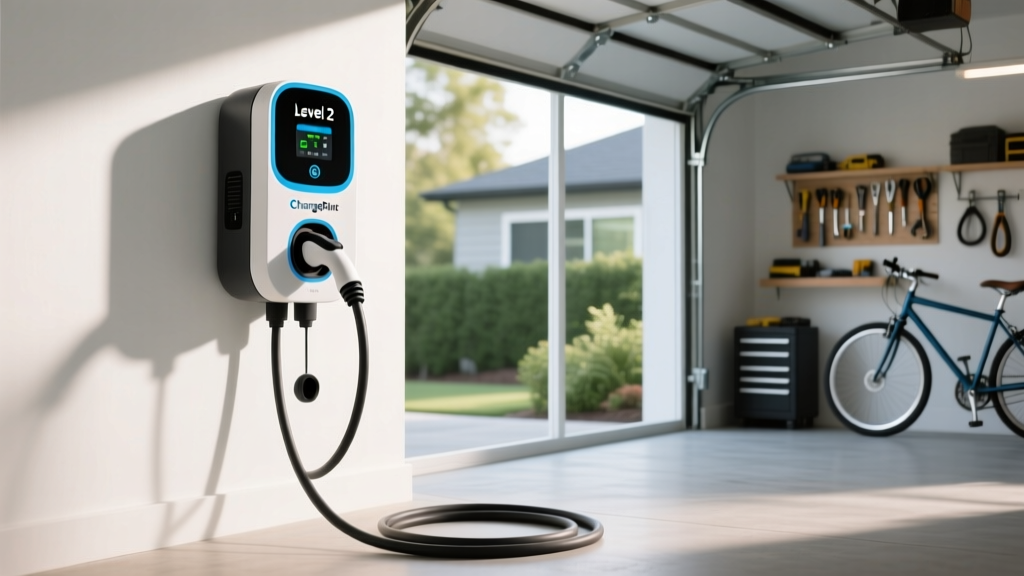
Charging the highest range electric car at home efficiently requires a dedicated 240V Level 2 circuit. Here's what that involves electrically and financially.
Electrical Requirements for Long-Range EV Charging
Most long-range EV owners benefit from a 240V / 48A circuit (hardwired) or a 240V / 40A circuit (NEMA 14-50 outlet). A 48A hardwired charger delivers up to 11.5 kW — the practical maximum for most residential panels without a service upgrade. The National Electrical Code (NEC) requires the circuit breaker to be rated at 125% of the continuous load, so a 48A charger requires a 60A breaker.
- Minimum recommended: 240V / 40A circuit (NEMA 14-50 or hardwired), delivering up to 9.6 kW
- Ideal for 100+ kWh packs: 240V / 48A hardwired circuit, delivering up to 11.5 kW
- Future-proof option: 240V / 80A circuit (hardwired), delivering up to 19.2 kW — requires a 200A+ panel with spare capacity
Do You Need a Panel Upgrade?
This is the make-or-break cost question. If your home has a 100A main service panel (common in homes built before 1990), adding a 60A EV circuit may exceed your panel's capacity, especially if you already run electric range, dryer, and HVAC. A 200A panel upgrade typically costs $1,500–$3,500 depending on your utility and local code. Homes with existing 200A service usually have enough headroom for a 48A or even 80A EV circuit without upgrading.
Have a licensed electrician perform a load calculation (NEC Article 220) before committing to equipment. Some utilities offer free or subsidized panel assessments for EV adopters.
Home Charger Installation Cost Breakdown
| Component | Low End | High End | Notes |
|---|---|---|---|
| Level 2 charger (hardware) | $400 | $1,200 | 40A–48A smart chargers; Wi-Fi enabled |
| Electrician labor | $500 | $2,000 | Depends on run length, conduit, panel proximity |
| Electrical permit | $50 | $300 | Varies by municipality |
| Panel upgrade (if needed) | $1,500 | $3,500 | 100A → 200A service upgrade |
| Load management device | $200 | $500 | Optional; avoids panel upgrade in some cases |
| Total (no panel upgrade) | $950 | $3,500 | Typical scenario for 200A-panel homes |
| Total (with panel upgrade) | $2,450 | $7,000 | Older homes needing service upgrade |
Check whether your utility or state offers rebates for home charger installation — many programs cover $250–$1,000 of equipment and labor. The federal Residential Clean Energy Credit (IRS §25D) may also apply to certain EV-related electrical upgrades; consult a tax professional for eligibility.
Connector Compatibility: NACS, CCS, and CHAdeMO in 2026
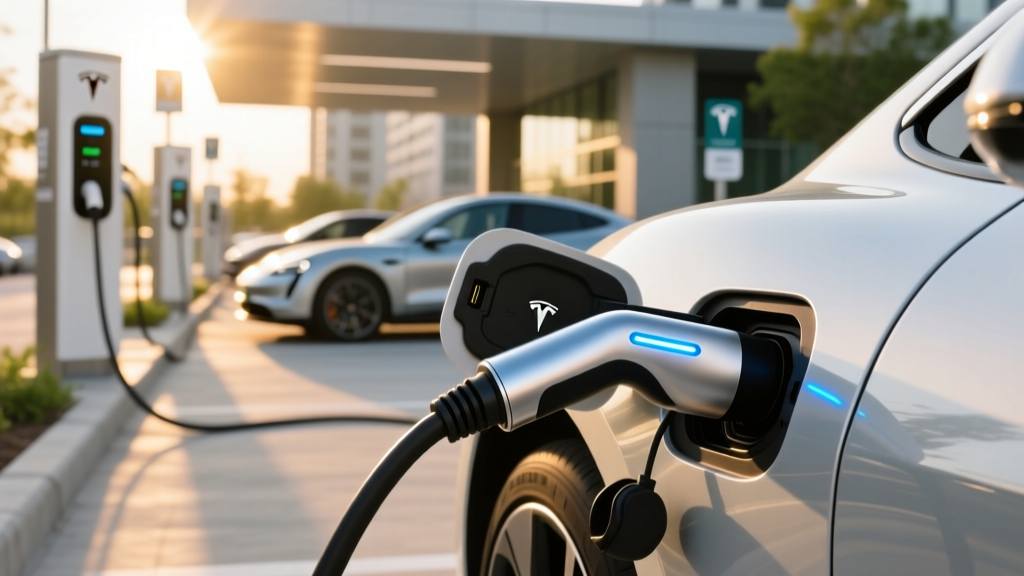
The connector landscape has consolidated significantly. As of 2026, nearly every major automaker has adopted the North American Charging Standard (NACS), originally developed by Tesla, as the primary connector for new EVs sold in North America. However, millions of CCS1-equipped EVs remain on the road, and adapter availability is critical for long-range EV owners who need access to all networks.
| Connector | Brands Using It (2026) | Network Access |
|---|---|---|
| NACS (native) | Tesla, Ford, GM, Rivian, Volvo, Polestar, Mercedes, BMW, Hyundai/Kia (select), Lucid | Tesla Superchargers (17,000+ stalls), Electrify America (select), EVgo, ChargePoint |
| CCS1 | Volkswagen, Stellantis, legacy Hyundai/Kia, BMW iX (prior MY), Nissan Ariana | Electrify America, EVgo, ChargePoint, Ionity (EU) |
| CHAdeMO | Nissan Leaf (legacy only — discontinued new) | Limited; being phased out at most networks |
Adapter needs: If you own a CCS1-equipped EV and want Tesla Supercharger access, you'll need a CCS-to-NACS adapter (approximately $150–$250 from Tesla or third-party makers like Lectron or A2Z). NACS-equipped vehicles from Ford, GM, and Rivian have native Supercharger access. For Lucid Air owners (NACS native in 2026), Tesla Superchargers and the growing NACS-enabled public networks are directly accessible.
Cost to Charge: Home vs. Public vs. Gas — The Real $/Mile
One of the strongest ownership arguments for the highest range electric car is the per-mile fuel cost advantage — but it varies dramatically depending on where and when you charge.
| Scenario | Rate ($/kWh) | Cost Per Mile | Annual Cost (12,000 mi) |
|---|---|---|---|
| Home off-peak (utility time-of-use) | $0.08–$0.12 | $0.027–$0.040 | $320–$480 |
| Home standard rate (national avg.) | $0.16 | $0.053 | $640 |
| Public Level 2 (ChargePoint, etc.) | $0.25–$0.49 | $0.083–$0.163 | $1,000–$1,960 |
| DC Fast Charging (Electrify America, EVgo) | $0.35–$0.55 | $0.117–$0.183 | $1,400–$2,200 |
| Tesla Supercharger (member rate) | $0.25–$0.35 | $0.083–$0.117 | $1,000–$1,400 |
| Gasoline vehicle (25 MPG, $3.40/gal) | — | $0.136 | $1,632 |
The bottom line: Home off-peak charging delivers fuel costs at roughly one-quarter to one-fifth the cost of gasoline per mile. Even at standard residential rates, you're saving 60%+ per mile. However, if you rely exclusively on DC fast charging at public rates, your per-mile cost can equal or exceed gasoline — making home charging access essential for the economic case of a long-range EV.
Long-range EVs like the Lucid Air achieve exceptional efficiency (EPA-rated 146 MPGe combined, approximately 3.5–4.0 mi/kWh on the highway), which amplifies these savings. A less efficient large EV SUV at 2.0 mi/kWh would see costs rise proportionally.
Charging Time Examples: 10–80% for Popular Long-Range EV Batteries
Long-range EVs have large batteries, so even fast charging takes meaningful time. Here are realistic 10–80% charging times across the three levels, based on manufacturer data and independent testing. Note that DC fast charging speeds peak at low SoC and taper significantly above 80% — the "10–80%" metric is the industry standard because charging above 80% slows dramatically to protect battery health.
| Vehicle | Battery (kWh usable) | Level 1 (1.4 kW) | Level 2 (11.5 kW) | DC Fast (peak kW / time) |
|---|---|---|---|---|
| Lucid Air Grand Touring | 118 kWh (NMC) | ~60 hrs | ~8.5 hrs | 300 kW peak / ~22 min |
| Tesla Model S Long Range | ~100 kWh (NMC) | ~50 hrs | ~7 hrs | 250 kW peak / ~27 min |
| Chevy Silverado EV 4WT | ~200 kWh (NMC) | ~100 hrs | ~14 hrs | 350 kW peak / ~40 min |
| Mercedes EQS 580 | 108 kWh (NMC) | ~55 hrs | ~7.5 hrs | 200 kW peak / ~32 min |
| BMW i7 xDrive60 | 101.7 kWh (NMC) | ~52 hrs | ~7 hrs | 195 kW peak / ~33 min |
Charge-curve reality check: A Lucid Air may peak at 300 kW at 10% SoC, but by 50% SoC it's likely pulling 180–200 kW, and by 80% it drops to under 50 kW. The "10–80%" time accounts for this taper. Never plan a road trip around peak kW numbers alone — use the 10–80% figure and add a buffer for cold weather, which can slow DC charging by 20–40% if the battery hasn't been preconditioned.
Recommended Home Charging Equipment for Long-Range EVs
For a 100+ kWh battery, you want a Level 2 charger that delivers at least 11.5 kW (48A) to ensure overnight charging completes before morning. Here are proven options as of 2026:
ChargePoint Home Flex (NACS or J1772)
- Power: Up to 11.5 kW (48A, hardwired) or 9.6 kW (40A, NEMA 14-50)
- Cable length: 23 ft
- Smart features: Wi-Fi, app scheduling, utility TOU integration, Alexa
- Price: ~$550–$650
- Best for: Most long-range EVs; flexible amperage settings via DIP switches
Tesla Wall Connector (NACS)
- Power: Up to 11.5 kW (48A, hardwired)
- Cable length: 24 ft
- Smart features: Wi-Fi, OTA updates, power sharing (link multiple units), load management
- Price: ~$475
- Best for: Tesla, Ford, GM, Rivian, Lucid, and other NACS-native EVs; excellent value
Emporia Vue Level 2 Charger (J1772 or NACS)
- Power: Up to 11.5 kW (48A, hardwired)
- Cable length: 24 ft
- Smart features: Integrated with Emporia home energy monitoring, solar-aware scheduling, TOU optimization
- Price: ~$400–$500
- Best for: Solar-panel homes; budget-conscious buyers who want energy tracking
Grizzl-E Smart (J1772 or NACS)
- Power: Up to 9.6 kW (40A, NEMA 14-50 or hardwired)
- Cable length: 24 ft
- Smart features: OCPP-compatible, app control, works with utility demand-response programs
- Price: ~$450–$550
- Best for: Cold-climate garages (rated to -40°F); rugged build
Safety, Electrical Code, and Installation Best Practices
EV charging draws sustained high current for hours — this is a continuous load under NEC Article 511 and requires proper installation to prevent overheating, breaker trips, or fire risk.
- Dedicated circuit: Your Level 2 charger must be on its own dedicated breaker — never share a circuit with other appliances.
- GFCI protection: NEC 2023 and later require GFCI protection for outdoor receptacles used for EV charging. Hardwired installations typically satisfy this via the charger's internal ground-fault protection.
- Outdoor rating: If your charger is mounted outside, ensure it carries a NEMA 4 or NEMA 4X rating (weatherproof). Indoor-rated units (NEMA 3R) are fine for garages.
- Wire gauge: A 48A circuit requires 6 AWG copper wire (THHN in conduit) or 4 AWG for longer runs to minimize voltage drop. Your electrician will size this per NEC Table 310.16.
- Permit and inspection: Nearly all jurisdictions require an electrical permit for new 240V circuits. The inspection verifies wire gauge, breaker sizing, grounding, and bonding. Do not skip this — unpermitted work can void homeowners insurance and cause issues at sale.
- Load management: If your panel is near capacity, devices like the Emporia Smart Load Center or Tesla's built-in power-sharing can dynamically limit charger draw when other circuits are active, avoiding a costly panel upgrade.
Frequently Asked Questions
How much does it cost to install a home EV charger?
For a typical 48A Level 2 charger on an existing 200A panel, expect $950–$3,500 total (hardware + electrician + permit). If your home needs a panel upgrade from 100A to 200A, add $1,500–$3,500, bringing the total to $2,450–$7,000. Utility rebates and state incentives can reduce this by $250–$1,000 in many areas.
How fast will each charging level add range?
Level 1 (120V) adds 3–5 miles per hour — essentially unusable for a 100+ kWh long-range EV. Level 2 (240V, 48A) adds 35–45 miles per hour, enough for overnight replenishment. DC fast charging at 250–350 kW adds 150–1,000+ miles per hour at peak, but tapers above 80% SoC. Plan road-trip stops around 10–80% sessions of 20–40 minutes depending on battery size and charger power.
Which connector and charger is compatible with my EV?
Check your vehicle's charge port. In 2026, most new EVs from Tesla, Ford, GM, Rivian, Lucid, Volvo, and Mercedes use NACS. Volkswagen, Stellantis, and some legacy models still use CCS1. CHAdeMO is effectively discontinued for new vehicles. For home charging, buy a charger matching your vehicle's native connector to avoid daily adapter hassle. For public DC fast charging, NACS vehicles access Tesla Superchargers directly; CCS1 vehicles may need a CCS-to-NACS adapter ($150–$250) for Supercharger access.
How much does charging cost per mile vs. gas?
At home on off-peak utility rates ($0.08–$0.12/kWh), a long-range EV achieving 3.5 mi/kWh costs roughly $0.023–$0.034 per mile — about 75–80% cheaper than a 25 MPG gas car at $3.40/gallon ($0.136/mile). At public DC fast chargers ($0.35–$0.55/kWh), the cost rises to $0.10–$0.16/mile, comparable to or slightly above gasoline. Home charging access is the single biggest factor in EV operating cost savings. See fueleconomy.gov for model-specific MPGe and kWh/100mi data.
What electrical upgrades might I need?
The most common upgrade is a panel replacement from 100A to 200A service ($1,500–$3,500) if your existing panel can't accommodate a 60A breaker for a 48A charger. Older homes (pre-1980) may also need aluminum-to-copper wire replacement, a new meter base, or utility transformer upgrades. In some cases, a smart load management device ($200–$500) can avoid a panel upgrade entirely by dynamically sharing capacity between the EV charger and other large appliances. Always get a professional load calculation before purchasing equipment.
Does cold weather affect charging speed for long-range EVs?
Yes, significantly. Lithium-ion batteries charge slower when cold because the electrolyte becomes more viscous, increasing internal resistance. In sub-freezing temperatures, DC fast charging can be 20–40% slower unless the vehicle has preconditioned the battery. Most long-range EVs (Lucid, Tesla, BMW i7) include battery preconditioning that warms the pack when you navigate to a charger. Always enable preconditioning before a DC fast stop in cold weather — it can cut your 10–80% time by 10–15 minutes.