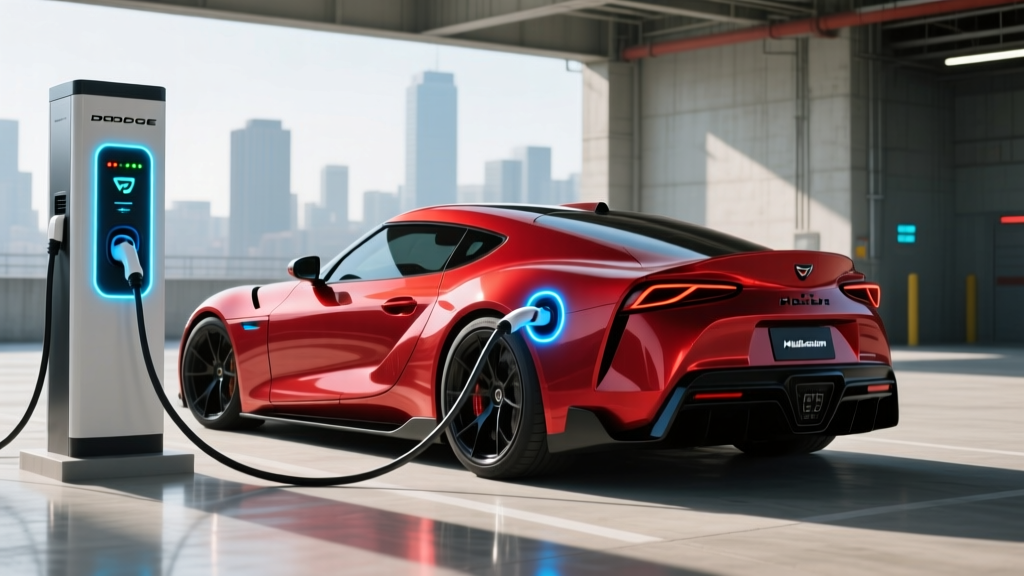
The Dodge Charger Daytona EV — what enthusiasts online have dubbed the "Hellraisin" Charger for its 670-horsepower Scat Pack variant — represents Stellantis's boldest electric pivot yet. But owning a 500+ horsepower electric muscle car means understanding its charging architecture before you sign the paperwork. This guide breaks down exactly how to charge the Charger Daytona at home and on the road, what electrical upgrades your garage might need, and the real-world costs per mile versus the gas-powered Hellcat it replaces.
Charger Daytona EV: Battery, Range & Charging Architecture
Before plugging in, here's what's under the floorboards. The 2025–2026 Dodge Charger Daytona uses a 100.5 kWh gross battery pack (approximately 92 kWh usable) with NMC (nickel-manganese-cobalt) chemistry. The R/T trim delivers an EPA-estimated 317 miles of range, while the Scat Pack's higher output and stickier tires drop that to an EPA 260 miles.
| Spec | R/T | Scat Pack |
|---|---|---|
| Battery (gross / usable) | 100.5 kWh / ~92 kWh | 100.5 kWh / ~92 kWh |
| EPA Range | 317 mi | 260 mi |
| Max DC Fast Charge | ~175 kW peak | ~175 kW peak |
| 10–80% DCFC Time | ~27 min (est.) | ~27 min (est.) |
| Level 2 (AC) Max Acceptance | 11.5 kW (48A) | 11.5 kW (48A) |
| Connector (2025–2026) | CCS1 (NACS adapter avail.) | CCS1 (NACS adapter avail.) |
| 0–60 mph | 4.7 sec | 3.3 sec |
| Horsepower | 496 hp | 670 hp |
| Base MSRP | ~$59,595 | ~$72,595 |
Charging Levels Explained: How Fast Will Each Level Add Range?
Understanding the three charging levels is essential. The critical distinction: kW (kilowatts) measures power — how fast energy flows into the battery. kWh (kilowatt-hours) measures energy — how much the battery holds. Think of kW as the flow rate of a hose and kWh as the size of the bucket.
| Level | Voltage / Amps | Power (kW) | Miles of Range/Hour | Full Charge Time (10–100%) |
|---|---|---|---|---|
| Level 1 (120V outlet) | 120V / 12A | ~1.4 kW | ~3–4 mi/hr | 60+ hours (impractical) |
| Level 2 (240V home/public) | 240V / 48A | 11.5 kW | ~28–33 mi/hr | ~8–9 hours |
| DC Fast Charging | 400V+ DC | Up to ~175 kW peak | ~400–550 mi/hr (peak) | 10–80% in ~27 min |
Level 1 is a last resort — plugging into a standard 120V household outlet. At ~1.4 kW, you'll add roughly 3–4 miles of range per hour. Overnight (10 hours) nets about 35 miles. Fine for a PHEV with a small battery; wholly inadequate for the Charger Daytona's 100.5 kWh pack.
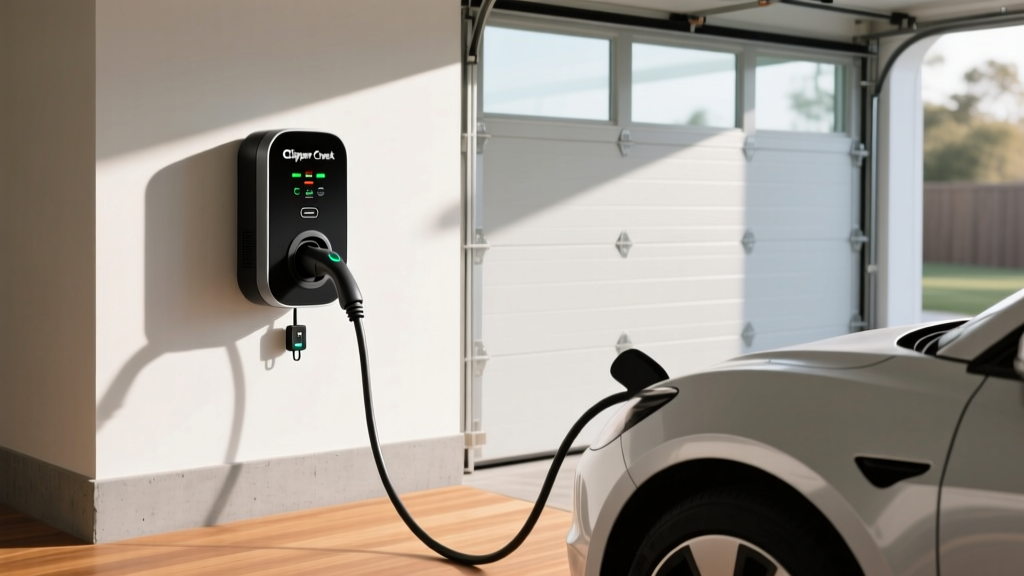
Level 2 is the home-charging standard. A 240V circuit (the same voltage as your dryer) at 48 amps delivers up to 11.5 kW into the Charger Daytona. That's roughly 30 miles of range per hour — enough to fully replenish overnight. This is where 90%+ of your charging should happen.
DC Fast Charging bypasses the car's onboard charger and feeds DC current directly to the battery. The Charger Daytona peaks around 175 kW on a capable station. However, peak kW is not sustained kW — the charge curve tapers significantly above 80% State of Charge (SoC) to protect battery health. Expect the 10–80% sprint in roughly 27 minutes on a 200+ kW station, but 80–100% could take another 20+ minutes. For road trips, charge to 80% and go.
Home Charger Installation: Electrical Requirements, Permits & Costs
Installing a Level 2 home charger for the Charger Daytona isn't as simple as plugging into an existing outlet. Here's what your electrical system needs to support.
Electrical Requirements
The Charger Daytona's onboard charger accepts up to 11.5 kW at 48 amps. Per the National Electrical Code (NEC), continuous loads must be derated to 80% of circuit capacity, meaning you need a dedicated 60-amp circuit on a 240V line. This requires:
- A double-pole 60A breaker in your main electrical panel
- 6 AWG copper wire (or 4 AWG aluminum) run from panel to charger location
- A NEMA 14-60 receptacle (if using a plug-in charger) or hardwired connection
- GFCI protection as required by NEC 2020+ for EV charging circuits
Panel Upgrade: The Hidden Cost
Many homes built before 2000 have 100-amp or 150-amp main panels. Adding a 60A EV circuit to an already-loaded panel may require a panel upgrade to 200 amps — or even a heavy-up to 400A in larger homes with existing electric heating, HVAC, and appliances. A licensed electrician will perform a load calculation per NEC Article 220 to determine if your panel has headroom.
| Component | Typical Range | Notes |
|---|---|---|
| Level 2 Charger (Equipment) | $350 – $750 | 48A smart charger, 25ft cable |
| Electrician Labor (standard install) | $400 – $1,200 | Depends on run length, wall type, conduit |
| Permit & Inspection | $50 – $250 | Required in most jurisdictions; varies by municipality |
| Panel Upgrade (if needed) | $1,500 – $4,000 | 200A upgrade; 400A heavy-up costs more |
| Total (no panel upgrade) | $800 – $2,200 | Most homes with 200A service |
| Total (with panel upgrade) | $2,300 – $6,200 | Older homes or high-load panels |
Some utilities offer rebates of $250–$500 for Level 2 charger installation, and the federal Residential Clean Energy Credit (IRC §25C, as extended) may cover up to 30% of charger equipment and installation costs (capped at $1,000) — check current-year eligibility with a tax professional.
Which Connector Is Compatible With the Charger Daytona?
The 2025–2026 Dodge Charger Daytona ships with a CCS1 (Combined Charging System) port. However, the North American charging landscape is rapidly shifting toward NACS (North American Charging Standard), the Tesla-designed connector now adopted by most major automakers for 2025+ models.
| Connector | Native Support? | Network Access | Adapter Needed? |
|---|---|---|---|
| CCS1 | ✅ Yes (native port) | Electrify America, EVgo, ChargePoint, Ionity (EU) | None |
| NACS (Tesla) | ❌ No (adapter required) | Tesla Supercharger network (15,000+ stalls) | CCS-to-NACS adapter (~$200–$250) |
| CHAdeMO | ❌ No | Legacy; largely discontinued in US | N/A — not recommended |
| J1772 (Level 2 AC) | ✅ Yes (via CCS inlet) | All public Level 2 stations, home chargers | None (J1772 is upper portion of CCS1) |
Key takeaway: The Charger Daytona's CCS1 port gives you native access to Electrify America, EVgo, and most non-Tesla DC fast networks. To access Tesla Superchargers — the largest and most reliable DC fast network in North America — you'll need a CCS-to-NACS adapter. Stellantis has indicated that future model years will ship with native NACS, but for 2025–2026, budget $200–$250 for an adapter from a reputable supplier (Tesla, Lectron, or A2Z).
Level 2 Home Charger Recommendations for the Charger Daytona
To maximize the Charger Daytona's 11.5 kW onboard charger, you need a 48-amp Level 2 charger on a 60-amp circuit. Here are top picks based on reliability, smart features, and value.
Emporia Vue Level 2 Charger
- Power: 48A / 11.5 kW (240V)
- Connector: J1772 (CCS1 compatible)
- Cable: 24 ft
- Smart Features: Wi-Fi, scheduling, energy monitoring, solar integration
- Price: ~$399
- Verdict: Best value. Real-time energy tracking pairs well with home solar.
ChargePoint Home Flex
- Power: Up to 50A / 12 kW (adjustable)
- Connector: J1772
- Cable: 23 ft
- Smart Features: Wi-Fi, app scheduling, Alexa integration, amperage dial
- Price: ~$699
- Verdict: Premium pick. Adjustable amperage lets you match any circuit (16A–50A).
Tesla Universal Wall Connector
- Power: Up to 48A / 11.5 kW
- Connector: Built-in CCS1 + NACS (Magic Dock style)
- Cable: 24 ft
- Smart Features: Wi-Fi, OTA updates, power sharing (2 units on 1 circuit)
- Price: ~$599
- Verdict: Future-proof. Dual connector means no adapter needed for any EV.
All three are NEMA 4-rated (suitable for indoor and outdoor installation) and support hardwired or plug-in (NEMA 14-60) configurations. Hardwired installations are preferred for 48A+ circuits, as NEMA 14-60 receptacles are technically rated for 50A maximum.
Cost to Charge: Per-Mile Cost vs. the Gas Hellcat
The Charger Daytona Scat Pack replaces the supercharged 6.2L V8 Hellcat — a car that averages roughly 15 MPG combined on premium fuel. Let's compare real fueling costs.
| Scenario | $/kWh | Cost for 10–80% (64.4 kWh) | Cost Per Mile |
|---|---|---|---|
| Home (off-peak utility rate) | $0.12 | $7.73 | $0.043 |
| Home (national avg. $0.17/kWh) | $0.17 | $10.95 | $0.061 |
| Public Level 2 (ChargePoint, etc.) | $0.25 | $16.10 | $0.089 |
| DC Fast (Electrify America) | $0.43 | $27.69 | $0.153 |
| Gas Hellcat (15 MPG, $3.80/gal premium) | — | ~$63 for equivalent range | $0.253 |
Even at the most expensive public DC fast-charging rates, the Charger Daytona costs roughly 40% less per mile to "fuel" than the Hellcat. Charge primarily at home on off-peak rates, and you're looking at $0.04–0.06 per mile — an 80% savings over premium gasoline. Over 15,000 miles per year, that's approximately $3,000+ in annual fuel savings versus the Hellcat.
Safety, Code Compliance & Best Practices
EV charger installation involves high-voltage, high-amperage circuits that must meet NEC requirements. Here's what to verify:
- Dedicated circuit: Your Level 2 charger must be on its own dedicated breaker — not shared with other appliances. A 48A charger requires a 60A breaker.
- GFCI protection: NEC 2020 and later requires Ground Fault Circuit Interrupter protection for EV charging outlets in garages. Hardwired chargers with built-in GFCI may satisfy this — confirm with your inspector.
- Outdoor rating: If mounting outside, the charger must be rated NEMA 4 (weather-resistant). All three recommendations above meet this standard.
- Permit and inspection: Most jurisdictions require an electrical permit for new 240V circuits. Skipping the permit risks insurance denial if an electrical fire occurs. Budget $50–$250 for the permit and a final inspection.
- Wire gauge: 6 AWG copper for runs up to ~50 feet; 4 AWG for longer runs to minimize voltage drop. Your electrician will size accordingly.
- Cable management: Use a wall-mounted cable holster or retractor to keep the 25-foot cord off the garage floor and away from vehicle tires.
Real-World Charging Times: What to Expect
Charging times depend on battery size, starting SoC, charger output, and battery temperature. Here are realistic scenarios for the Charger Daytona's ~92 kWh usable pack:
- Home Level 2 (11.5 kW, 10–100%): ~8.5 hours. Plug in at 10 PM, full by 6:30 AM. Ideal for daily use.
- DC Fast (175 kW peak, 10–80%): ~27 minutes on a 200+ kW station. The charge curve peaks early (around 30–50% SoC) and tapers progressively. Above 80%, power drops sharply — don't wait for 100% on road trips.
- DC Fast (50 kW station, 10–80%): ~85 minutes. Older 50 kW stations are painfully slow for a 100+ kWh battery. Plan stops around 150+ kW stations when possible.
- Cold weather note: Below 40°F, the battery management system (BMS) will limit charge speed until the pack warms. Preconditioning — using the car's navigation to route to a charger — activates battery heating and can cut cold-weather charge times by 30–40%.
Frequently Asked Questions
How much does it cost to install a home EV charger for the Charger Daytona?
A standard Level 2 installation (48A charger, 60A circuit, ~30-foot wire run) typically costs $800–$2,200 including equipment, electrician labor, and permit. If your home needs a panel upgrade (100A to 200A), add $1,500–$4,000. Total with panel upgrade: $2,300–$6,200. Always get a load calculation from a licensed electrician first.
Can I use a Tesla Supercharger with the Dodge Charger Daytona?
Not natively — the 2025–2026 Charger Daytona has a CCS1 port. However, you can purchase a CCS-to-NACS adapter ($200–$250) to access Tesla Supercharger stalls. Verify adapter compatibility with Stellantis before purchasing, as firmware support may be required.
Does the Charger Daytona qualify for the federal EV tax credit?
The federal §30D tax credit offers up to $7,500 for qualifying new EVs, but eligibility depends on MSRP caps ($55,000 for sedans), buyer income limits, and battery critical-mineral sourcing requirements. The Charger Daytona Scat Pack's ~$72,595 MSRP likely exceeds the sedan cap. The R/T at ~$59,595 may also exceed it depending on classification. Check the latest eligibility list at fueleconomy.gov and consult a tax professional for your specific situation.
How fast does the Charger Daytona charge at home overnight?
On a 48A / 11.5 kW Level 2 charger, the Charger Daytona adds approximately 30 miles of range per hour. A full 8-hour overnight session adds roughly 240 miles — enough to replenish the Scat Pack's entire EPA-rated range. This is the recommended daily charging method.
Is DC fast charging bad for the Charger Daytona's battery?
Occasional DC fast charging is fine and expected for road trips. However, exclusive reliance on DCFC accelerates degradation compared to Level 2 charging. Dodge/Stellantis warranties the battery for 8 years / 100,000 miles (typical for federally compliant EVs), guaranteeing a minimum capacity retention (usually 70%). For maximum longevity, charge at home on Level 2 daily and reserve DCFC for road trips.
What electrical upgrades might I need for a home charger?
The most common upgrade is a panel capacity increase (100A to 200A) if your existing panel lacks spare capacity for a 60A breaker. Other potential needs: replacing a Federal Pacific or Zinsco panel (known fire hazards), upgrading aluminum service entrance wiring, or adding a sub-panel if the charger is far from the main panel (e.g., detached garage). A licensed electrician's load calculation will identify requirements before work begins.