If you landed here searching for a Hellcat Redeye supercharger, you might be one of two people: a Mopar enthusiast hunting for a replacement 2.7-liter IHI twin-screw blower for Dodge's 797-horsepower beast, or an EV-curious shopper confused by the word "supercharger" — which Tesla has made synonymous with fast charging. This guide clears up the terminology, then delivers what you actually need: a complete breakdown of EV charging levels, home installation costs, connector standards, and real-world cost-per-mile math in 2026.
Whether you're comparing the Hellcat Redeye's supercharged 6.2L HEMI V8 to an electric muscle alternative like the Dodge Charger Daytona EV, or you simply want to know how fast a home charger will replenish your battery, the numbers below will anchor your decision.
Supercharger vs. Supercharger: Blower, Not a Charger
The Hellcat Redeye's supercharger is a mechanical air compressor — specifically a 2.7-liter IHI twin-screw unit that forces up to 14.5 psi of boost into the engine's intake manifold, enabling the 6.2L HEMI V8 to produce 797 horsepower and 707 lb-ft of torque. It consumes roughly 80–100 crank horsepower just to spin at full boost. This is a forced-induction engine component, not an electrical charging device.
Tesla's "Supercharger," by contrast, is a DC fast-charging station delivering up to 350 kW of electrical power directly into an EV's battery pack. The two share a name but occupy entirely different engineering domains:
- Hellcat Redeye supercharger: Compresses air for combustion. Powered by a serpentine belt off the crankshaft. Zero electrical charging function.
- Tesla Supercharger (V4): Converts grid AC to DC, delivers up to 350 kW to a battery. No moving engine parts.
If you're cross-shopping a Hellcat Redeye (or its used-market equivalents now that Dodge ended HEMI production) against an electric performance car, the relevant comparison isn't the supercharger hardware — it's how the two powertrains refuel and what that costs.
EV Charging Levels Explained: kW, Miles Per Hour, and 10–80% Times
EV charging is measured in kW (kilowatts), which represents the rate of power delivery — think of it as how fast water flows through a hose. The battery capacity is measured in kWh (kilowatt-hours), the total energy stored — analogous to the size of the tank. These are not interchangeable. A 150 kW charger filling a 75 kWh battery is like a high-flow pump filling a 20-gallon tank.
| Level | Voltage | Power (kW) | Miles of Range Per Hour | Typical Use Case |
|---|---|---|---|---|
| Level 1 | 120V AC | 1.0–1.4 kW | 3–5 mi/hr | Overnight trickle, PHEVs, emergencies |
| Level 2 | 240V AC | 3.3–19.2 kW | 12–75 mi/hr | Home daily charging, workplace, hotels |
| DC Fast Charge | 400–800V DC | 50–350 kW | 150–1,000+ mi/hr (peak) | Road trips, highway corridors |
Real-World Charging Time Examples (10–80% SoC)
Charging speed isn't linear. EVs accept peak power only in the mid-range of the battery's state of charge (SoC), then taper significantly above 80% to protect cell longevity. Here are representative 10–80% times for common battery sizes at 2026 charger capabilities:
- 75 kWh pack (Tesla Model Y, Hyundai Ioniq 5): ~18–22 minutes on a 250 kW DC fast charger (peak rate, tapering after ~60% SoC)
- 84 kWh pack (Ford F-150 Lightning Extended Range): ~28–34 minutes on a 150–250 kW station
- 100 kWh pack (Lucid Air, GMC Sierra EV): ~22–30 minutes on a 350 kW charger (800V architecture helps sustain higher rates)
- Level 2 home charging (11.5 kW / 48A): A 75 kWh pack from 10–80% takes roughly 4.5–5 hours — ideal for overnight replenishment
For context, refueling a Hellcat Redeye's 18.5-gallon tank takes about 3 minutes at the pump — but that tank costs roughly $65–$80 to fill at 2026 premium fuel prices and delivers an EPA-rated 13 mpg combined.
Home Charger Installation: Electrical Requirements, Costs, and Panel Upgrades
Installing a Level 2 home charger is the single highest-impact upgrade an EV owner can make. Here's what's involved electrically and financially.
Electrical Requirements
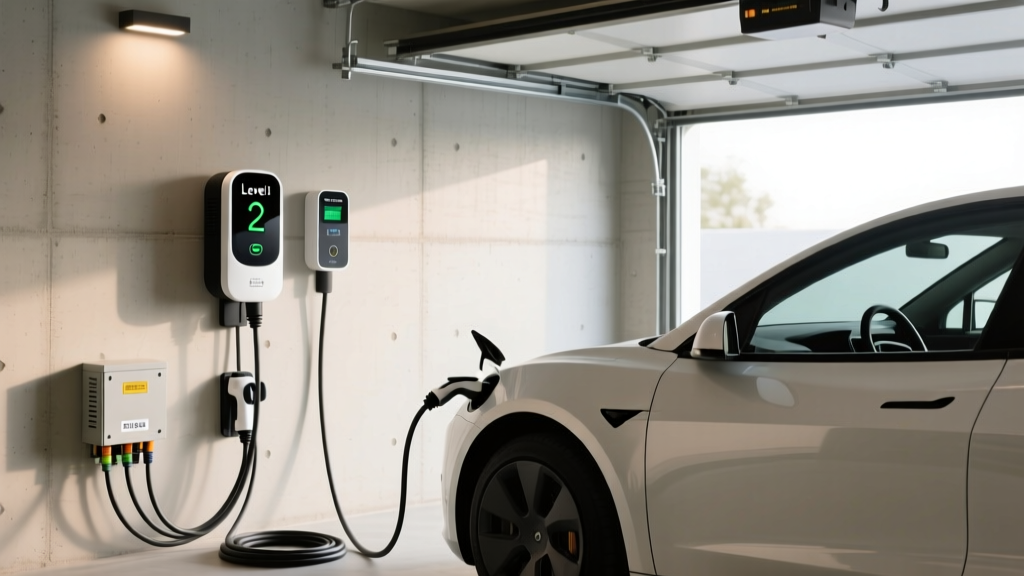
A typical Level 2 home charger runs on a 240-volt dedicated circuit, the same voltage as your electric dryer or oven. Common configurations:
- 40-amp circuit / 32A continuous: Delivers up to 7.7 kW. Good for most EVs with smaller packs or overnight charging.
- 50-amp circuit / 40A continuous: Delivers up to 9.6 kW. The sweet spot for most homes — handles a 75–100 kWh pack overnight.
- 60-amp circuit / 48A continuous: Delivers up to 11.5 kW. Ideal for larger packs (F-150 Lightning, Rivian) or multiple-EV households.
The National Electrical Code (NEC) requires that continuous loads not exceed 80% of a circuit breaker's rating, hence a 50A breaker supports 40A of continuous draw.
Installation Cost Breakdown
| Component | Low End | High End | Notes |
|---|---|---|---|
| Level 2 Charger (hardwired or NEMA 14-50) | $300 | $700 | Smart Wi-Fi chargers with load management cost more |
| Electrician labor (run 240V circuit, mount unit) | $400 | $1,500 | Varies by distance from panel to garage/carport |
| Electrical permit | $50 | $200 | Required in most jurisdictions; inspection included |
| Panel upgrade (if needed: 100A → 200A) | $1,500 | $4,000 | Older homes with 100A service may need this for a 50–60A EV circuit |
| Total (no panel upgrade) | $750 | $2,400 | Most homes with 200A service fall in this range |
| Total (with panel upgrade) | $2,250 | $6,400 | Common in pre-1990 homes |
The panel upgrade is the hidden cost that catches many buyers off guard. If your home has a 100-amp main panel that's already near capacity with HVAC, an electric range, and a dryer, adding a 50-amp EV circuit may push you over the limit. A licensed electrician can perform a load calculation to determine whether an upgrade is required. Some utilities offer rebates of $250–$1,000 toward panel upgrades when paired with EV charger installation.
Safety and Code Considerations
- Dedicated circuit: Your EV charger must have its own breaker — never share a circuit with other appliances.
- GFCI protection: NEC 2020 and later require ground-fault circuit interrupter protection for outdoor receptacles; hardwired units often include built-in GFCI.
- Outdoor rating: If your charger is mounted outside or in an unsealed carport, ensure it carries a NEMA 4 or IP65 weather rating.
- NEMA 14-50 vs. hardwired: A 14-50 outlet offers portability (take the charger when you move) but requires a GFCI breaker (~$100–$150 extra). Hardwired installations skip the receptacle and GFCI breaker, reducing cost and eliminating one failure point.
Connector Compatibility: NACS, CCS, and CHAdeMO in 2026
The connector landscape has consolidated significantly since 2023, when Ford and GM announced adoption of Tesla's North American Charging Standard (NACS). As of the 2026 model year, NACS is the dominant light-duty EV connector in North America.
| Connector | Brands Using It (Native) | Notes |
|---|---|---|
| NACS (Tesla / SAE J3400) | Tesla, Ford, GM, Rivian, Volvo, Polestar, Mercedes, Nissan (new models) | Access to Tesla Supercharger network; compact design |
| CCS1 (Combined Charging System) | Hyundai, Kia, BMW, VW, Stellantis (some), Lucid | Legacy standard; still widely supported at public stations |
| CHAdeMO | Nissan Leaf (legacy), Mitsubishi Outlander PHEV | Being phased out; new models adopt NACS or CCS |
If your EV has a CCS1 port (common on 2020–2025 models from Hyundai, Kia, and VW), you'll need a CCS-to-NACS adapter (~$150–$250) to access Tesla Superchargers. Ford and GM provide these adapters with new vehicles. Always verify adapter compatibility with your specific model year before purchasing.
For home Level 2 charging, all EVs use a J1772 connector (or the J3400/NACS equivalent for newer Teslas and adopters). Most Level 2 chargers ship with J1772; if your car has a native NACS port, look for a charger with an integrated NACS plug or use the vehicle's J1772-to-NACS adapter.
Charging Cost Per Mile vs. Gas: The Real Math
This is where the Hellcat Redeye comparison gets stark. Dodge rates the Redeye at 13 mpg combined on premium fuel. Let's compare against a representative EV on various electricity rates.
| Scenario | Cost Per Mile | Annual Cost (12,000 mi) |
|---|---|---|
| Hellcat Redeye (13 mpg, $4.20/gal premium) | $0.323 | $3,877 |
| EV — Home off-peak ($0.13/kWh, 3.5 mi/kWh) | $0.037 | $446 |
| EV — Home standard rate ($0.18/kWh, 3.5 mi/kWh) | $0.051 | $617 |
| EV — Public Level 2 ($0.35/kWh, 3.5 mi/kWh) | $0.100 | $1,200 |
| EV — DC Fast Charge ($0.48/kWh, 3.5 mi/kWh) | $0.137 | $1,646 |
Even at the most expensive DC fast-charging rates, the EV costs less than half per mile compared to the Redeye on premium. At home off-peak rates, the EV is nearly 9× cheaper per mile. Over five years and 60,000 miles, the fuel-cost gap exceeds $15,000 — enough to offset a significant portion of an EV's higher purchase price.
Efficiency note: EVs average roughly 3.0–4.0 miles per kWh depending on weight, aerodynamics, and driving style. Cold weather (below 32°F) reduces this by 15–30% due to cabin heating demands and increased battery internal resistance. Highway driving at 75+ mph also drops efficiency versus the EPA combined cycle.
Recommended Home Level 2 Chargers for 2026
Based on power output, build quality, smart features, and connector options, these are the chargers we recommend for most home installations:
ChargePoint Home Flex
- Power: Up to 12 kW (50A circuit) — configurable via DIP switches for 16A–50A
- Connector: J1772 (NACS adapter available)
- Cable length: 23 feet
- Smart features: Wi-Fi, scheduling, energy tracking, Alexa integration
- Price: ~$550
- Best for: Flexibility across circuit sizes; good app ecosystem
Emporia Level 2 EV Charger
- Power: Up to 11.5 kW (48A on a 60A circuit)
- Connector: J1772 or NACS (selectable at purchase)
- Cable length: 24 feet
- Smart features: Wi-Fi, solar integration, load management, energy monitoring
- Price: ~$400
- Best for: Budget-conscious buyers wanting full smart features and solar pairing
Tesla Wall Connector
- Power: Up to 11.5 kW (48A on a 60A circuit)
- Connector: Native NACS (J1772 adapter included for non-Tesla EVs)
- Cable length: 24 feet
- Smart features: Wi-Fi, power sharing (link up to 6 units on one circuit), OTA updates
- Price: ~$475
- Best for: NACS-native vehicles; cleanest install with no adapter needed
Grizzl-E Smart
- Power: Up to 10 kW (40A on a 50A circuit)
- Connector: J1772 or NACS
- Cable length: 24 feet
- Smart features: OCPP-compatible, adjustable amperage, extreme-cold rated (-40°F)
- Price: ~$500
- Best for: Cold climates and outdoor installations; built in Canada with rugged enclosure
Hellcat Redeye Ownership Costs vs. EV Performance Alternatives
If you're weighing a used Hellcat Redeye (MSRP was $92,000+ when available; used examples run $70,000–$110,000 in 2026) against an electric performance car, consider the full ownership picture:
- Hellcat Redeye: 13 mpg combined, premium fuel, ~$3,877/year in fuel. Insurance averages $3,500–$5,000/year. Supercharger (blower) replacement if failed: $3,000–$5,000+ for the IHI unit plus labor. HEMI production ended, so long-term parts availability is a consideration.
- Tesla Model S Plaid: 396-mile EPA range, 1,020 hp, 0–60 in 1.99s. MSRP from ~$89,990. Home charging cost: ~$450–$620/year. No supercharger blower to maintain — just an electric motor with far fewer moving parts.
- Dodge Charger Daytona EV (Scat Pack): 670 hp, 0–60 in 3.3s, EPA range ~317 miles. MSRP from ~$73,990. Dodge's electric muscle answer — the spiritual Redeye successor with zero forced-induction hardware to service.
The Hellcat Redeye's supercharger is an engineering marvel in the combustion world. But the "supercharger" you want for daily EV life is a Level 2 home unit delivering 9.6–11.5 kW — installed for $750–$2,400 and costing pennies per mile to operate.
Frequently Asked Questions
How much does it cost to install a home EV charger?
Expect $750–$2,400 for a standard Level 2 installation in a home with an adequate 200-amp electrical panel. This includes the charger unit ($300–$700), electrician labor ($400–$1,500), and a permit ($50–$200). If your home needs a panel upgrade from 100A to 200A service, add $1,500–$4,000. Always get a load calculation from a licensed electrician before committing.
How fast will each charging level add range?
Level 1 (120V) adds 3–5 miles of range per hour — adequate for plug-in hybrids with small batteries but impractical for full EVs. Level 2 (240V) adds 12–75 miles per hour depending on amperage and vehicle acceptance rate. DC fast charging can add 150–1,000+ miles per hour at peak rates, though real sessions average 20–35 minutes for a 10–80% charge due to the charging curve taper above 80% SoC.
Which connector and charger is compatible with my EV?
Check your vehicle's charge port. 2026 models from Tesla, Ford, GM, Rivian, Volvo, and others use NACS. Hyundai, Kia, BMW, and VW largely retain CCS1. For home Level 2 charging, match the charger's plug to your car's port — or use an adapter. For DC fast charging on the road, CCS vehicles need a CCS-to-NACS adapter (~$150–$250) to access Tesla Superchargers, which now comprise the largest fast-charging network in North America.
How much does charging cost per mile compared to gas?
At the US average residential electricity rate of ~$0.16/kWh and a typical EV efficiency of 3.5 miles/kWh, home charging costs roughly $0.046/mile. Compare that to a 25-mpg gas car on $3.50/gallon fuel at $0.14/mile, or a Hellcat Redeye at $0.32/mile on premium. Public DC fast charging at $0.45–$0.50/kWh raises EV cost to ~$0.13–$0.14/mile — still competitive with average gas vehicles and dramatically cheaper than high-performance ICE cars.
What electrical upgrades might I need for a home charger?
The most common upgrade is a panel replacement from 100-amp to 200-amp service, needed when your existing panel lacks headroom for a 50–60 amp dedicated EV circuit. Other potential upgrades include: running new conduit from the panel to the garage (if the panel is on the opposite side of the house), upgrading the meter socket if the utility requires it, and installing a sub-panel for a detached garage. Some utilities require a separate EV meter for time-of-use rate enrollment, which can save $200–$400/year by charging during off-peak hours.
Is the Hellcat Redeye supercharger the same as a Tesla Supercharger?
No. The Hellcat Redeye's supercharger is a 2.7L IHI twin-screw mechanical air compressor bolted to the engine that forces pressurized air into the combustion chambers to produce 797 hp. A Tesla Supercharger is a DC fast-charging station that delivers up to 350 kW of electrical power to an EV battery. They share a name but serve entirely different purposes in entirely different powertrain architectures.