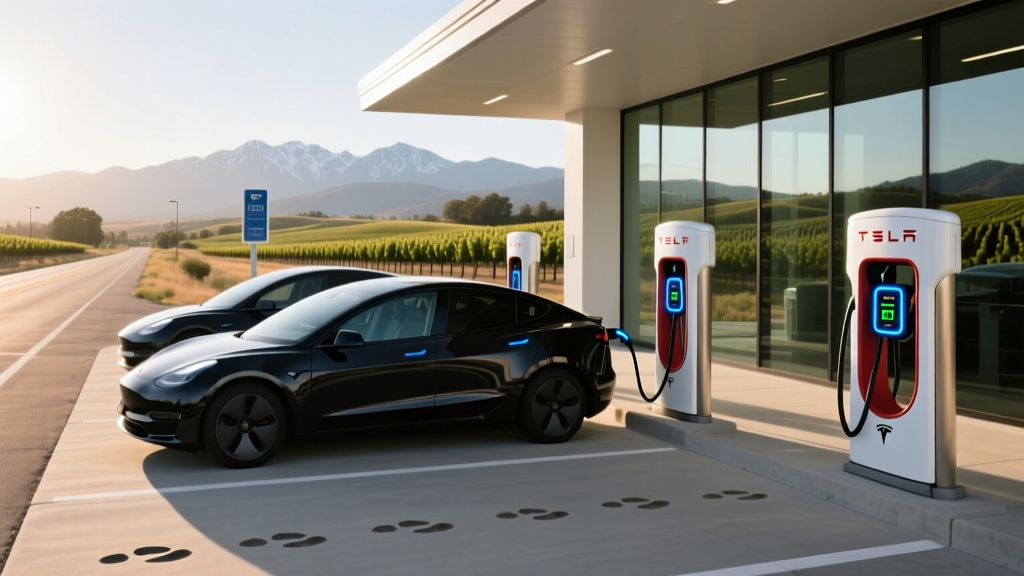
If you've driven an electric vehicle between Los Angeles and San Francisco on Interstate 5, you already know the name: Harris Ranch. Sitting roughly at the midpoint of the 380-mile Central Valley corridor, the Harris Ranch Tesla Supercharger is arguably the most famous EV charging stop in North America — a critical oasis in what was once a notorious charging desert.
Whether you're planning your first I-5 road trip in a Tesla, navigating the expanding Supercharger network in a non-Tesla EV with a NACS adapter, or simply curious about what makes this station legendary, this guide covers stall counts, peak charge rates, real-world charging times, on-site amenities, and route-planning strategies for 2026.
Why Harris Ranch Matters on the I-5 EV Corridor
The stretch of I-5 between the Grapevine (north of LA) and Kettleman City is roughly 170 miles of flat, high-speed, wind-blasted agricultural valley. There are few exits, few services, and for years, zero DC fast charging. Harris Ranch — located near Coalinga, CA at the Exit 399 interchange — broke that drought when Tesla installed Superchargers at the Harris Ranch restaurant and inn complex.
Today, the station serves as the primary midpoint charge stop for Tesla and NACS-equipped EVs traveling between Southern California and the Bay Area. Its importance can't be overstated: without it, many EVs with EPA ranges under 300 miles would need to detour through US-101 or charge at slower Level 2 stations in small towns, adding hours to the trip.
Harris Ranch Supercharger: Station Specs at a Glance
| Attribute | Detail |
|---|---|
| Location | Harris Ranch Restaurant & Inn, Coalinga, CA (I-5 Exit 399) |
| Total Stalls | ~98 (combined V2 and V3/V4 across multiple parking areas) |
| V2 Superchargers | 150 kW peak (shared pairs — stall lettering A/B matters) |
| V3 Superchargers | 250 kW peak (no shared power, dedicated per stall) |
| V4 Superchargers | Rolling deployment; up to 350 kW for compatible architectures |
| Connector | NACS (Tesla native); Magic Dock CCS adapter at select stalls |
| Open to Non-Teslas | Yes — via built-in Magic Dock CCS adapter at designated stalls |
| Amenities | Harris Ranch Restaurant, inn, gas station, convenience store, fast food |
| Cell Coverage | Generally reliable (Verizon, AT&T, T-Mobile) but can be spotty at peak load |
Stall counts and configurations change as Tesla expands the site. Check your in-car navigation or the Tesla app for real-time availability before departing.
Charging Speeds: What to Expect at Harris Ranch
Not all Supercharger stalls are created equal. Here's how the three generations at Harris Ranch translate to real charging time for common Tesla battery sizes:
| Supercharger Type | Peak kW | Miles Added in 15 Min* | 10–80% Time (75 kWh Battery) | Notes |
|---|---|---|---|---|
| V2 (150 kW) | 150 kW | ~100–120 mi | ~38–45 min | Shared pairs — odd/even stalls split power |
| V3 (250 kW) | 250 kW | ~150–175 mi | ~22–28 min | Full dedicated power per stall |
| V4 (up to 350 kW) | 350 kW | ~180–200 mi | ~18–22 min | Requires 800V architecture (Cybertruck, future models) |
*Miles added assumes ~3.5 mi/kWh efficiency (Model 3/Y RWD). AWD and Performance trims may see 10-15% fewer miles per kWh.
Charge curve reality check: Peak kW is just that — a peak. On a V3 stall, a Model 3 Long Range will hit ~250 kW between roughly 10-25% State of Charge (SoC), then taper progressively. By 60% SoC, you're typically seeing 80-100 kW, and above 80% SoC, speeds drop to 30-50 kW. This is why the 10-80% metric matters more than peak kW alone.
V2 Stall Pairing: The A/B Trap
At V2 Supercharger stalls, power is shared between paired stalls labeled with the same number (e.g., 1A and 1B). If you plug into 1A and someone plugs into 1B, your peak rate drops from 150 kW to roughly 75-90 kW each. Always check for adjacent stall occupancy before choosing a V2 spot — or better yet, head straight for the V3 section where every stall delivers full power independently.
Non-Tesla EVs: Using Harris Ranch with NACS or Magic Dock
As of 2026, the Supercharger network is increasingly accessible to non-Tesla EVs. Here's how connector compatibility breaks down:
| Connector Standard | Compatible Vehicles | Adapter Needed? | Harris Ranch Access |
|---|---|---|---|
| NACS (native) | Tesla (all), Ford F-150 Lightning, Rivian R1T/R1S (2025+), GM Ultium vehicles (2025+), Volvo EX30/EX90 | No | Full access, all stalls |
| CCS1 | Hyundai Ioniq 5/6, Kia EV6/EV9, BMW iX, VW ID.4, most pre-2025 non-Tesla EVs | Yes — use stall's built-in Magic Dock OR bring a NACS-to-CCS adapter (e.g., Lectron, A2Z) | Magic Dock stalls only; adapter users access all NACS stalls |
| CHAdeMO | Nissan Leaf, Mitsubishi Outlander PHEV (older) | No reliable adapter exists | Not compatible — use Electrify America or EVgo stations along I-5 |
Amenities and Downtime: Making the Most of Your Stop
Harris Ranch isn't just a charging station — it's a full-service rest stop that's been serving travelers since 1981. Here's what's available while you wait for your battery to reach 80%:
- Harris Ranch Restaurant: Upscale steakhouse and grill (sit-down meals, 45-60 min — best paired with a charge to 90%+ or an overnight stay)
- Fast-casual options: In-N-Out Burger (a California road-trip staple), Subway, and seasonal food trucks
- Harris Ranch Inn: On-site hotel with pool — useful for multi-day trips or if you arrive with very low SoC and want to charge overnight on Level 2
- Convenience store and gas station: Snacks, drinks, basic supplies
- Restrooms: Multiple facilities across the complex
- Wi-Fi: Available at the restaurant and inn (cellular data is usually sufficient for most travelers)
Pro tip: Arrive hungry. A 25-minute V3 charge session pairs perfectly with a quick In-N-Out run. Order on the app while pulling in, and your burger is ready as your car hits 75-80%.
Route Planning: LA to SF via Harris Ranch
Here's a practical route plan for the most common I-5 EV road trip, assuming a Tesla Model Y Long Range (EPA 310 mi, real-world highway ~260 mi at 75 mph):
Southbound: San Francisco → Los Angeles
- Depart SF at 90-95% SoC (~285 real-world miles available)
- Drive ~200 miles to Harris Ranch (via I-580 → I-5). Arrive with ~85 miles remaining (~30% SoC)
- Charge at V3 stall to 75-80% (~22-26 minutes). You now have ~200 miles of range
- Drive ~180 miles to LA basin. Arrive with ~20 miles buffer — sufficient for most LA destinations
Alternative Stops if Harris Ranch Is Full
During peak travel (Thanksgiving, summer Fridays), Harris Ranch can fill to capacity. Backup options along I-5 include:
- Kettleman City Supercharger (~50 miles north of Harris Ranch) — smaller station, fewer amenities
- Buttonwillow Supercharger (~70 miles south) — good secondary stop
- Electrify America at Lost Hills — CCS-native station, useful for non-Tesla EVs
Charging Cost at Harris Ranch vs. Home
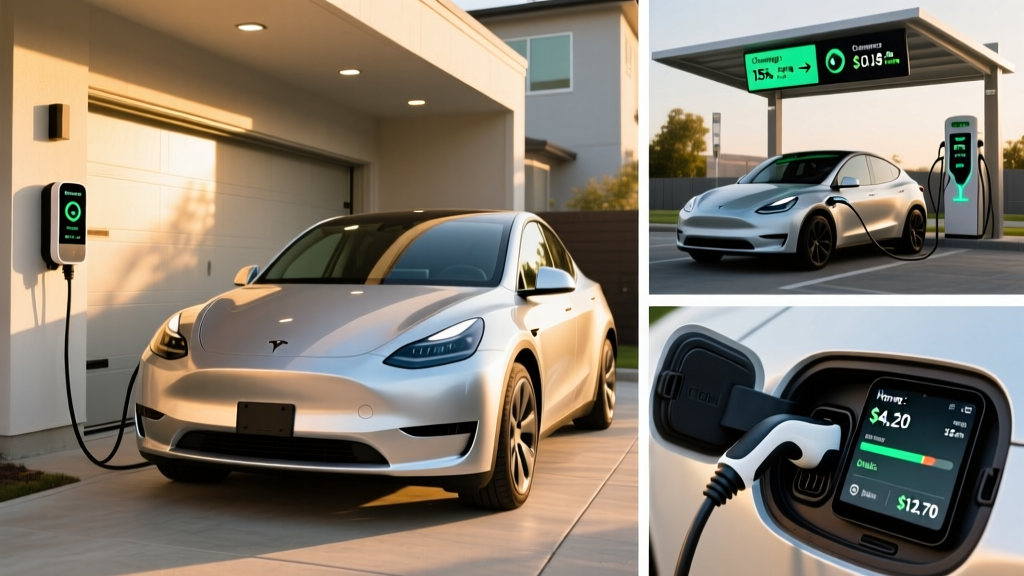
Tesla Supercharger pricing varies by time of day and demand. At Harris Ranch in 2026, expect the following:
| Scenario | $/kWh | Cost for 50 kWh (~175 mi) | Cost per Mile |
|---|---|---|---|
| Harris Ranch Supercharger (peak, summer afternoon) | $0.42–$0.48 | $21.00–$24.00 | $0.12–$0.14 |
| Harris Ranch Supercharger (off-peak, overnight) | $0.28–$0.33 | $14.00–$16.50 | $0.08–$0.09 |
| Home Level 2 (national avg residential, $0.16/kWh) | $0.16 | $8.00 | $0.046 |
| Gas car (28 MPG combined, $4.20/gal) | — | $7.50 (gas equiv.) | $0.15 |
The math is clear: home charging crushes every other option on cost. But for road trips, Supercharger pricing at Harris Ranch remains competitive with — and often cheaper than — the gas equivalent, especially during off-peak hours. If your schedule allows, arriving after 9 PM can cut your charge cost by 30-40%.
Source: fueleconomy.gov for efficiency benchmarks; Tesla in-app pricing for Supercharger rates (varies by date and demand).
Home Charging Setup: What You Need Beyond Road Trips
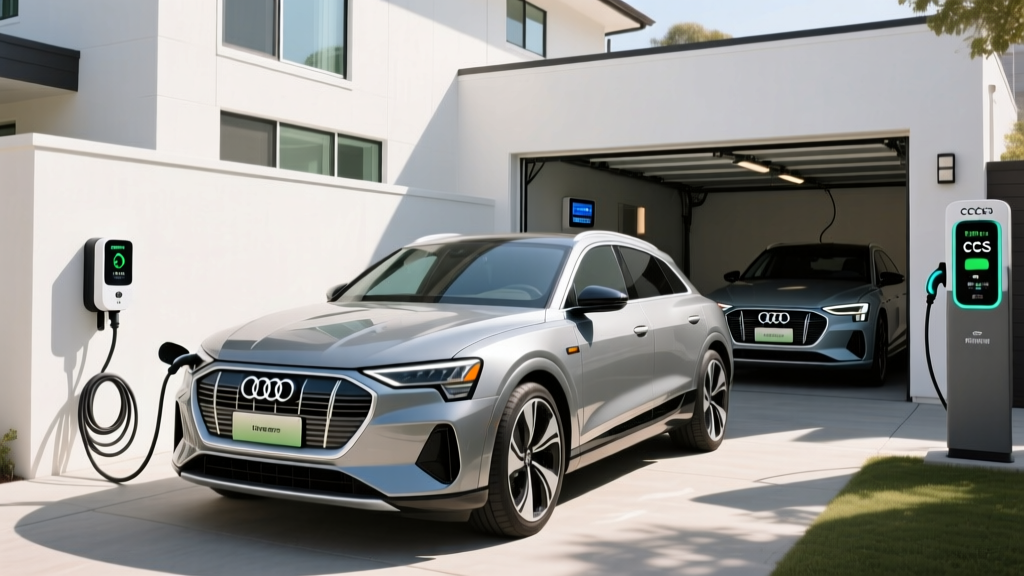
Road-trip charging at Harris Ranch is only part of the EV ownership equation. Most daily charging happens at home. Here's what a proper Level 2 home installation looks like:
Charging Levels Explained
| Level | Voltage | Max kW | Miles of Range per Hour | Best For |
|---|---|---|---|---|
| Level 1 | 120V AC | 1.4–1.9 kW | 3–5 mi/hr | PHEVs, overnight top-ups, emergency use |
| Level 2 | 240V AC | 7.2–19.2 kW | 20–60 mi/hr | Daily home charging (BEVs and PHEVs) |
| DC Fast Charge | 400–800V DC | 50–350 kW | 150–1,000+ mi/hr | Road trips, rapid top-ups (Superchargers, EA, EVgo) |
Electrical Requirements for Level 2
A typical Level 2 home charger requires a dedicated 240V circuit at 40-60 amps, depending on the charger's output:
- 32A charger (7.7 kW): Requires a 40A breaker (NEC rule: circuit must be rated 125% of continuous load)
- 40A charger (9.6 kW): Requires a 50A breaker
- 48A charger (11.5 kW): Requires a 60A breaker
- 80A charger (19.2 kW): Requires a 100A breaker — uncommon in residential panels
Installation Cost Breakdown
| Component | Cost Range | Notes |
|---|---|---|
| Level 2 charger (hardware) | $350–$700 | Wall connectors, ChargePoint, Emporia |
| Electrician labor (standard install) | $500–$1,500 | Short run from panel to garage; longer runs cost more |
| Permit and inspection | $50–$200 | Varies by municipality; required for code compliance |
| Electrical panel upgrade (if needed) | $1,500–$3,500 | Older 100A panels often need upgrade to 200A |
| Total (no panel upgrade) | $900–$2,400 | Most homes with 200A service |
| Total (with panel upgrade) | $2,400–$5,900 | Older homes, limited panel capacity |
Recommended Home Chargers for 2026
Tesla Wall Connector (Gen 4)
- Power: Up to 48A (11.5 kW on 240V/60A circuit)
- Connector: NACS native
- Cable: 24 ft
- Smart features: Wi-Fi, OTA updates, Power Sharing (load-balance multiple units), Tesla app integration
- Price: ~$475
- Best for: Tesla owners who want seamless integration
ChargePoint Home Flex
- Power: Configurable 16A–50A (up to 12 kW)
- Connector: NACS or J1772 (configurable)
- Cable: 23 ft
- Smart features: Wi-Fi, ChargePoint app, Alexa, scheduled charging, amperage adjustment via app
- Price: ~$550–$650
- Best for: Multi-EV households, non-Tesla EVs, renters who may move
Emporia Vue Level 2 Charger
- Power: Up to 48A (11.5 kW)
- Connector: J1772 or NACS
- Cable: 24 ft
- Smart features: Wi-Fi, Emporia energy monitoring integration, solar-aware scheduling, load management
- Price: ~$399
- Best for: Budget-conscious buyers, solar homes, energy monitoring enthusiasts
Safety, Code, and Installation Best Practices
EV charging is a continuous high-amperage load — it runs for hours at near-maximum circuit capacity. This is not the same as plugging in a power tool. Safety matters:
- Dedicated circuit: Your Level 2 charger must be on its own dedicated breaker. Never share a circuit with other high-draw appliances.
- GFCI protection: NEC 2020 and later requires GFCI protection for EV charging outlets in garages and outdoors. Hardwired installations may have different requirements — consult your electrician and local code.
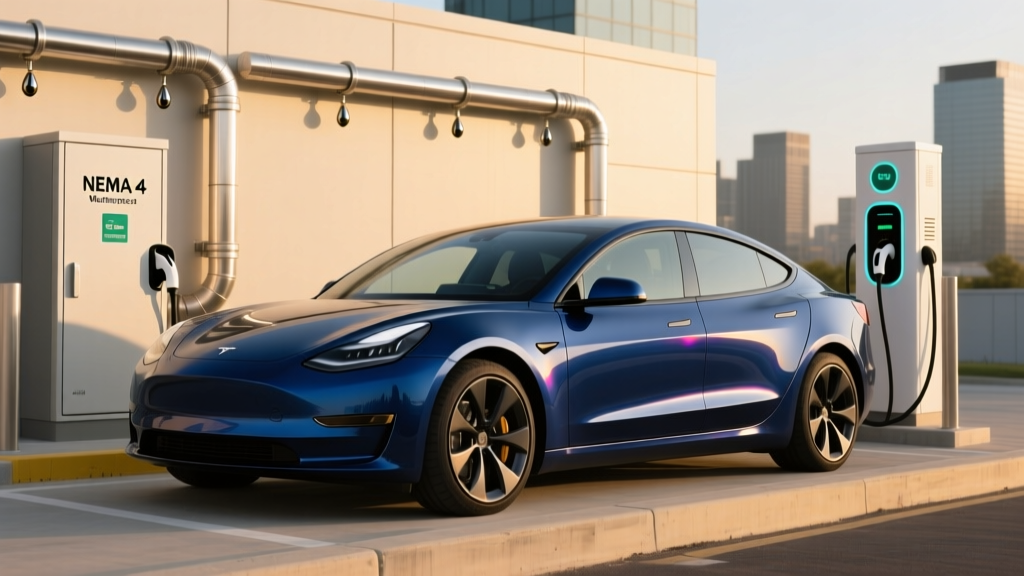
- Outdoor rating: If your charger is mounted outside, ensure it carries a NEMA 4 or IP65 rating for weather resistance. The Tesla Wall Connector and ChargePoint Home Flex are both outdoor-rated.
- Cable management: A 24-foot cable draped across a driveway is a tripping hazard and a code violation in many jurisdictions. Use a cable holster or retractable reel.
- Permit and inspection: Always pull an electrical permit. The inspection ensures your installation meets NEC and local code — it also protects your homeowner's insurance coverage in the event of an electrical fire.
Frequently Asked Questions
How much does it cost to install a home EV charger?
A standard Level 2 home charger installation (40A–48A, 240V, short wire run) typically costs $900–$2,400 including equipment, electrician labor, and permit. If your home needs an electrical panel upgrade (common in pre-1990 homes with 100A service), add $1,500–$3,500. Always get 2-3 quotes from licensed electricians.
How fast will each charging level add range?
Level 1 (120V) adds roughly 3–5 miles per hour — adequate for PHEVs but painfully slow for BEVs. Level 2 (240V, 48A) adds 30–45 miles per hour, fully recharging most BEVs overnight. DC fast charging (150–250 kW) can add 100–200 miles in 15–20 minutes, though charge speed tapers significantly above 80% SoC.
Which connector is compatible with my EV?
If you drive a Tesla, Rivian (2025+), Ford (2025+), or GM Ultium vehicle (2025+), your car uses NACS natively and plugs directly into Tesla Superchargers. If you drive a Hyundai, Kia, BMW, VW, or most pre-2025 non-Tesla EVs, you have CCS1 and need either a NACS-to-CCS adapter or a Magic Dock-equipped Supercharger stall. CHAdeMO vehicles (Nissan Leaf) cannot use Superchargers.
How much does charging cost per mile vs. gas?
At home on residential electricity ($0.16/kWh national average), an efficient EV costs roughly $0.04–$0.06 per mile. At a Supercharger ($0.30–$0.48/kWh), it's $0.08–$0.14 per mile. A comparable gas car at 28 MPG and $4.20/gallon costs about $0.15 per mile. Home charging is the cheapest option by a wide margin; road-trip DC fast charging is roughly cost-parity with gas.
What electrical upgrades might I need for a home charger?
The most common upgrade is a panel capacity increase from 100A to 200A, needed when your existing panel lacks spare capacity for a 40-60A EV circuit. Other potential upgrades include running new conduit (if the charger is far from the panel), upgrading wire gauge for longer runs, and installing a sub-panel if your main panel is full. A licensed electrician can assess your specific situation during a site visit.
Is Harris Ranch Supercharger open 24/7?
Yes, the Supercharger stalls operate 24 hours a day. However, the Harris Ranch Restaurant has posted hours (typically 11 AM–9 PM), and the In-N-Out closes around 1 AM. Overnight chargers should plan for limited food options — the convenience store and vending areas remain accessible.
Can I charge to 100% at Harris Ranch?
Yes, but it's not recommended for daily battery health. Charging from 80% to 100% is extremely slow due to the charge curve taper (often under 20 kW), adding 40-60 minutes for the last 20%. For road trips, charging to 85-90% is usually sufficient to reach your destination or next stop, and it's far better for long-term battery longevity. Tesla's navigation will automatically recommend the optimal SoC for your route.
For the latest Supercharger status, stall availability, and pricing, check the Tesla app or your vehicle's navigation system before departing. Station details can change with network upgrades. For federal tax credit eligibility on home charging equipment, consult IRS.gov residential clean energy credit guidelines — the §30D and 25C credits have specific equipment and installation requirements.