Grizzl-E V6 Charger: The Rugged 40A Workhorse for Home EV Charging
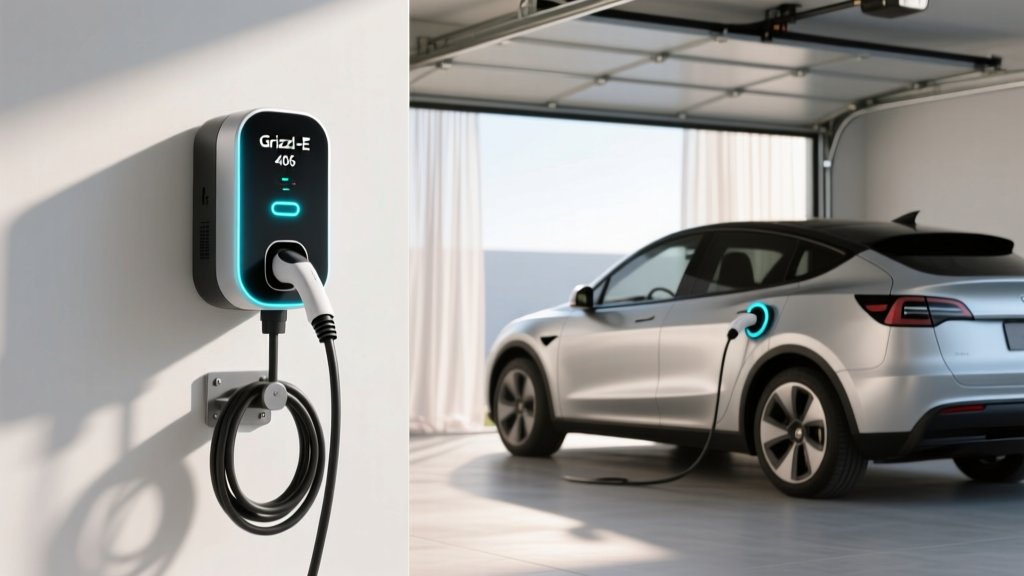
If you've searched for a durable, no-nonsense Level 2 home EV charger, you've likely encountered the Grizzl-E V6 charger. Built by United Chargers in Canada, the Grizzl-E V6 delivers up to 9.6 kW (40 amps at 240 volts) through a 24-foot cable, housed in an IP67-rated aluminum enclosure designed to survive Canadian winters and desert summers alike. At a street price around $499, it sits in the sweet spot between budget Amazon specials and $700+ smart chargers.
But a charger is only as good as its installation, your electrical panel's capacity, and its compatibility with your vehicle's inlet. This guide walks through the Grizzl-E V6's real-world performance, what it costs to install (including the panel upgrade scenario nobody warns you about), and how it stacks up against alternatives like the ChargePoint Home Flex and Tesla Wall Connector.
Understanding Charging Levels: What the V6 Actually Delivers
Before evaluating any charger, you need to understand the three charging tiers and where Level 2 fits. The Grizzl-E V6 is a Level 2 charger, meaning it uses 240V AC power (the same voltage as your dryer or oven) to deliver significantly faster charging than a standard wall outlet.
| Level | Voltage | Max Power (kW) | Miles of Range Added per Hour | Typical Use Case |
|---|---|---|---|---|
| Level 1 | 120V AC | 1.4 kW | 3–5 mi/hr | Overnight trickle; PHEV top-ups |
| Level 2 (Grizzl-E V6) | 240V AC | 9.6 kW (40A) | 25–38 mi/hr | Daily home charging; overnight full charge |
| Level 2 (48A) | 240V AC | 11.5 kW (48A) | 30–45 mi/hr | Larger batteries; faster overnight |
| DC Fast Charging | 400–800V DC | 50–350 kW | 150–1,200+ mi/hr | Road trips; 10–80% in 15–40 min |
Critical distinction: kW (kilowatts) measures power — the rate at which energy flows into your battery. kWh (kilowatt-hours) measures energy — the total capacity of your battery. A 9.6 kW charger delivers 9.6 kWh of energy in one hour of sustained charging (minus ~5% losses to heat and battery management). A 75 kWh battery charged from 10% to 80% (52.5 kWh needed) on the Grizzl-E V6 takes roughly 5.5–6 hours.
How Fast the Grizzl-E V6 Charges Popular 2026 EVs
Charging speed depends on your vehicle's onboard charger capacity and battery size. The Grizzl-E V6's 9.6 kW output is sufficient for most EVs, but vehicles with larger batteries or higher onboard charger limits may benefit from a 48A unit. Here's what to expect:
| Vehicle (2026) | Usable Battery (kWh) | Onboard Charger Limit | 10–80% Time on V6 (9.6 kW) | Mi Added/Hr |
|---|---|---|---|---|
| Tesla Model Y Long Range | 75 kWh | 11.5 kW | ~5.5 hours | ~35 mi/hr |
| Hyundai Ioniq 5 (84 kWh pack) | 77.4 kWh | 10.9 kW | ~5.7 hours | ~32 mi/hr |
| Ford F-150 Lightning (Std Range) | 98 kWh | 11.3 kW (optional 19.2) | ~7.2 hours | ~28 mi/hr |
| Chevrolet Equinox EV 3RS | 85 kWh | 11.5 kW | ~6.3 hours | ~30 mi/hr |
| Toyota RAV4 Prime (PHEV) | 14.9 kWh | 6.6 kW | ~1.6 hours | N/A (42 mi total EV range) |
Real-world caveat: Charging slows as the battery approaches full. The 10–80% window represents the "flat" portion of the charge curve where the battery accepts peak power. The final 80–100% can add another 1–2 hours as the BMS tapers current to protect cell health. For daily use, most owners set an 80% charge limit to preserve long-term battery health.
Connector Compatibility: NACS, J1772, and Adapter Needs
The Grizzl-E V6 ships in two connector configurations, and choosing the right one depends on your vehicle:
| Connector | Compatible Vehicles (2026) | Adapter Needed? |
|---|---|---|
| NACS (Tesla-style) | All Tesla vehicles; Ford, GM, Rivian, Volvo, Polestar, Mercedes (2025+ models with native NACS) | None for NACS-native; J1772-to-NACS adapter (~$200) for legacy J1772 vehicles |
| J1772 | Hyundai, Kia, BMW, VW, Subaru, Toyota bZ4X, Honda Prologue, legacy non-Tesla EVs | None for J1772-native; Tesla-to-J1772 adapter (included with most Teslas) for Tesla vehicles |
2026 landscape note: The North American Charging Standard (NACS) has become the dominant connector for new EVs sold in the US, with nearly every major automaker adopting it for 2025–2026 models. If you're buying a new EV in 2026, the NACS version of the Grizzl-E V6 is likely the future-proof choice. However, if you currently own a Hyundai Ioniq 5, Kia EV6, or any pre-2025 non-Tesla EV with a CCS1/J1772 inlet, the J1772 version avoids the need for an adapter.
CHAdeMO — the legacy DC fast-charge connector used by the Nissan LEAF and Mitsubishi Outlander PHEV — is not relevant to Level 2 home charging, as all CHAdeMO vehicles also accept J1772 for AC charging.
Home Installation: Electrical Requirements, Costs, and Panel Upgrades
The Grizzl-E V6 requires a dedicated 240V/50-amp circuit (hardwired) or a NEMA 14-50 outlet on a 50-amp breaker (plug-in version). National Electrical Code (NEC) requires that continuous loads (like EV charging, which runs for 3+ hours) not exceed 80% of the circuit's rated capacity. That means a 50A breaker supports a continuous 40A draw — matching the V6's output exactly.
What Your Electrician Will Evaluate
- Panel capacity: Does your main electrical panel have enough spare amperage? A 200-amp panel with existing loads (HVAC, electric range, dryer) may or may not support an additional 50A circuit. A licensed electrician will perform a load calculation per NEC Article 220.
- Available breaker spaces: You need two adjacent slots in your panel for a 240V double-pole breaker.
- Wire run distance: The V6 uses 6 AWG copper wire (or 4 AWG aluminum). Longer runs from the panel to the garage or driveway increase material cost.
- Permit requirements: Most jurisdictions require an electrical permit for EV charger installations, typically $50–$200.
| Component | Simple Install (Panel Adjacent) | Moderate Install (50–80 ft Run) | Complex Install (Panel Upgrade Needed) |
|---|---|---|---|
| Grizzl-E V6 Charger | $499 | $499 | $499 |
| Electrical Permit | $75–$150 | $100–$200 | $150–$300 |
| Electrician Labor (2–4 hrs) | $300–$600 | $600–$1,200 | $800–$1,500 |
| Wire, Conduit, Breaker | $100–$200 | $250–$500 | $300–$600 |
| Panel Upgrade (100A→200A or 200A→400A) | — | — | $2,000–$5,000 |
| Total Estimated Cost | $975–$1,450 | $1,450–$2,400 | $3,750–$7,900 |
Panel upgrade reality check: Homes built before 2000 often have 100-amp or 150-amp panels that are already near capacity. Adding a 50A EV circuit may require upgrading to a 200A or even 400A panel — the single largest cost variable in EV charger installation. Some homeowners opt for a smart load-management device like the Emporia V2 with load shedding ($150–$250 additional), which monitors panel load in real-time and throttles the charger if total draw approaches the panel's limit, avoiding the need for a full upgrade.
The IRS's Residential Clean Energy Credit (25C) covers 30% of qualified EV charger equipment and installation costs, up to $1,000 per year, through 2032. This can offset $150–$300 on a standard install. Consult a tax professional for eligibility.
Cost to Charge: Home vs. Public vs. Gas per Mile
The economic case for home Level 2 charging rests on electricity rates that are typically far lower than gasoline on a per-mile basis. Here's how the Grizzl-E V6 at home compares to public charging and gasoline:
| Scenario | Rate | Cost per Mile (3.5 mi/kWh EV) | Cost per Mile (28 MPG Gas Car at $3.40/gal) |
|---|---|---|---|
| Home off-peak (utility TOU rate) | $0.09/kWh | $0.026 | $0.121 |
| Home standard rate | $0.16/kWh | $0.046 | $0.121 |
| Public Level 2 (ChargePoint, EVgo) | $0.25–$0.39/kWh | $0.071–$0.111 | $0.121 |
| DC Fast Charging (Electrify America, Tesla Supercharger) | $0.35–$0.55/kWh | $0.100–$0.157 | $0.121 |
The takeaway: Charging at home on an off-peak utility rate with the Grizzl-E V6 costs roughly $0.03 per mile — about one-quarter the cost of gasoline. Even at standard residential rates, you're paying under $0.05/mile. Public DC fast charging, by contrast, can actually exceed gasoline costs on a per-mile basis in some markets, which is why home charging remains the economic backbone of EV ownership.
For a driver covering 12,000 miles per year, home charging on an off-peak rate saves roughly $1,140 annually versus a 28 MPG gas car at $3.40/gallon. Over five years, that's $5,700 in fuel savings — more than enough to cover the V6 and its installation.
Equipment Comparison: Grizzl-E V6 vs. Alternatives
The Grizzl-E V6 isn't the only 40A Level 2 charger on the market. Here's how it compares to two popular alternatives:
| Feature | Grizzl-E V6 | ChargePoint Home Flex | Tesla Wall Connector (Gen 3) |
|---|---|---|---|
| Max Power Output | 9.6 kW (40A) | 12 kW (50A, adjustable down) | 11.5 kW (48A) |
| Connector Options | NACS or J1772 | NACS or J1772 | NACS only |
| Cable Length | 24 ft | 23 ft | 24 ft |
| Wi-Fi / App | No (basic LED status) | Yes (scheduling, energy tracking) | Yes (firmware updates, power sharing) |
| Enclosure Rating | IP67 (fully sealed, outdoor rated) | IP56 (splash-proof, outdoor rated) | IP55 (outdoor rated) |
| Operating Temp Range | -40°C to +50°C | -30°C to +50°C | -30°C to +50°C |
| Smart Grid / TOU Scheduling | Requires vehicle-side scheduling | Built-in app scheduling | Built-in app scheduling |
| Price (2026) | ~$499 | ~$649 | ~$475 |
| Warranty | 3 years | 3 years | 4 years |
When the Grizzl-E V6 is the right pick: You want maximum durability in harsh climates (extreme cold, dust, humidity), you don't need app-based scheduling (your EV handles it), and you want a proven, simple unit with no software dependencies. Its IP67 rating exceeds competitors, and its -40°C operating range makes it the go-to for unheated garages in northern states.
When to choose the ChargePoint Home Flex instead: You want adjustable amperage (it can be set from 16A to 50A via internal DIP switches to match your circuit), built-in Wi-Fi scheduling for utility time-of-use rates, and detailed energy tracking — and you're willing to pay ~$150 more.
When to choose the Tesla Wall Connector: You drive a Tesla or NACS-equipped vehicle, want the lowest price among premium chargers, and value power-sharing (daisy-chaining two connectors on one circuit). Its limitation is NACS-only output — J1772 vehicles need an adapter.
Safety, Code, and Best Practices for Your V6 Installation
Level 2 chargers draw sustained high current for hours, making proper installation non-negotiable. Here's what the NEC and best practices require:
- Dedicated circuit: The V6 must be on its own dedicated 50A double-pole breaker — never shared with other appliances. NEC 210.23 prohibits sharing a circuit with loads exceeding 50% of the circuit rating.
- GFCI protection: NEC 2020 and later require GFCI (Ground Fault Circuit Interrupter) protection for all outdoor receptacles used for EV charging. Hardwired installations may be exempt depending on local code, but a GFCI breaker adds ~$50–$80 and meaningful safety. Note: some EV owners report nuisance GFCI trips with certain chargers — the Grizzl-E V6 has a strong track record here.
- Outdoor rating: The V6's IP67 rating means it's fully sealed against dust and submersion, making it suitable for uncovered outdoor mounting. Ensure the connector holster or dock protects the plug from debris when not in use.
- Wire gauge: 6 AWG copper THHN in conduit for runs up to 100 feet. For longer runs, your electrician may upsize to 4 AWG to minimize voltage drop (NEC recommends <3% drop).
- Cable management: The 24-foot cable needs a retraction hook or reel to prevent tripping hazards and protect the cable from abrasion on garage floors.
Pro tip: Install the V6 on the driver's side of your parking spot (or wherever your EV's charge port is located) to avoid stretching the cable across the vehicle's body. Check your vehicle's charge port location — Tesla and Ford place it on the driver's rear quarter; Hyundai/Kia on the passenger rear; GM varies by model.
Frequently Asked Questions
How much does it cost to install a Grizzl-E V6 home charger?
Expect $975–$2,400 for a typical installation including the $499 charger, permit, electrician labor, and materials. If your home needs a panel upgrade (common in pre-2000 homes with 100A or 150A service), costs can reach $3,750–$7,900. Get a load calculation from a licensed electrician before committing.
How fast will the Grizzl-E V6 add range to my EV?
The V6 delivers 9.6 kW (40A at 240V), adding approximately 25–38 miles of range per hour depending on your vehicle's efficiency. A Tesla Model Y (3.5 mi/kWh) gains ~35 mi/hr; a Ford F-150 Lightning (2.0 mi/kWh) gains ~28 mi/hr. A full 10–80% charge takes 5–7 hours for most EVs.
Which connector version should I buy — NACS or J1772?
Choose NACS if you drive a Tesla or a 2025+ Ford, GM, Rivian, Volvo, or Mercedes EV with a native NACS port. Choose J1772 if you drive a Hyundai, Kia, BMW, VW, Subaru, or any pre-2025 non-Tesla EV. The NACS connector is becoming the universal standard, so if you plan to switch vehicles soon, NACS is the more future-proof option.
How much does charging cost per mile compared to gasoline?
Home charging on off-peak utility rates costs about $0.03/mile — roughly 75% cheaper than gasoline at $3.40/gallon in a 28 MPG vehicle ($0.12/mile). Even at standard residential rates ($0.16/kWh), you pay under $0.05/mile. Public DC fast charging ($0.35–$0.55/kWh) can match or exceed gas costs, which is why home charging is essential to the EV value proposition.
What electrical upgrades might I need for a 40A Level 2 charger?
The most common upgrade is a panel capacity increase (100A→200A or 200A→400A) if your existing panel is near capacity. You'll also need two adjacent breaker slots for the 50A double-pole breaker, adequate wire gauge (6 AWG copper), and possibly a GFCI breaker for outdoor installations. A smart load-management device ($150–$250) can sometimes avoid a panel upgrade by dynamically limiting charger draw.
Does the Grizzl-E V6 support time-of-use scheduling?
No — the V6 has no built-in Wi-Fi or app. To charge during off-peak utility hours (when electricity is cheapest), use your vehicle's built-in scheduled charging feature, which nearly all 2026 EVs support. Plug in, set the schedule in your car's app, and the vehicle will delay charging until the rate window opens.
Is the Grizzl-E V6 safe for outdoor use in extreme weather?
Yes. Its IP67-rated aluminum enclosure is rated for full dust ingress protection and temporary submersion, with an operating range of -40°C to +50°C (-40°F to 122°F). It's one of the most weather-resistant chargers on the market, purpose-built for Canadian and northern US climates.
Sources: EPA Fuel Economy for vehicle efficiency data; IRS.gov for Residential Clean Energy Credit (25C) rules; National Electrical Code (NEC) Articles 210, 220, and 625 for EV charging circuit requirements. All pricing reflects 2026 market estimates and may vary by region and installer.