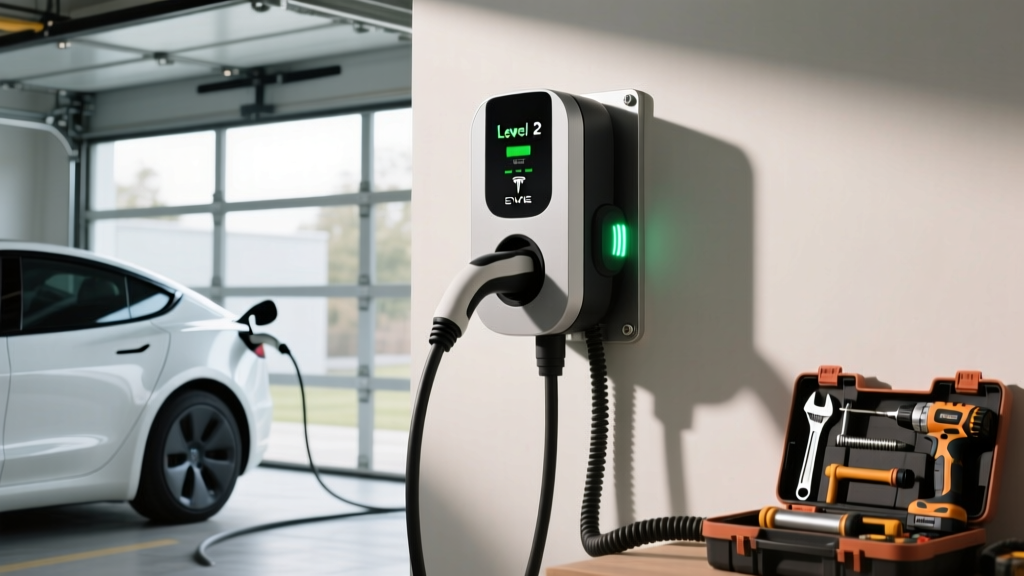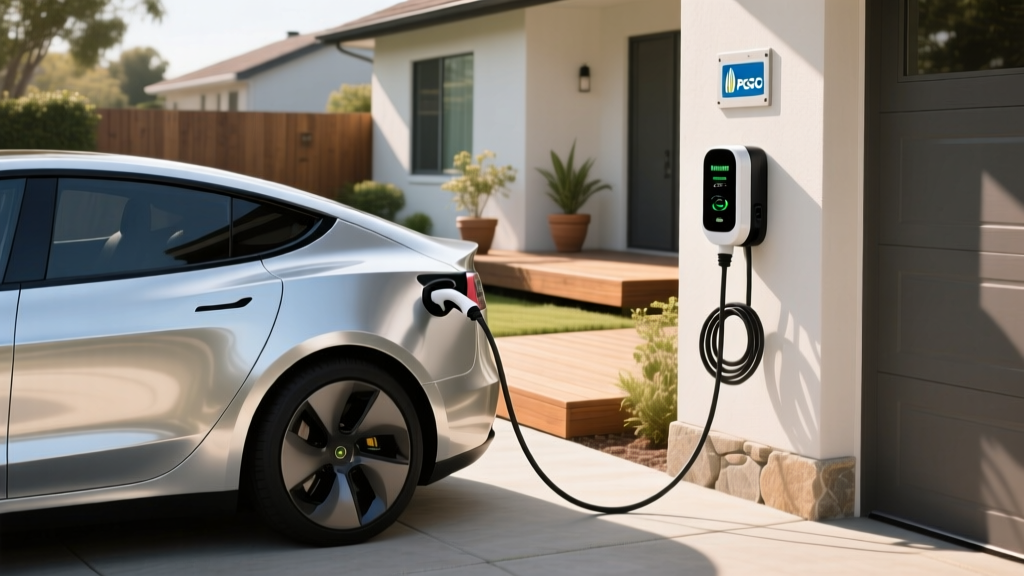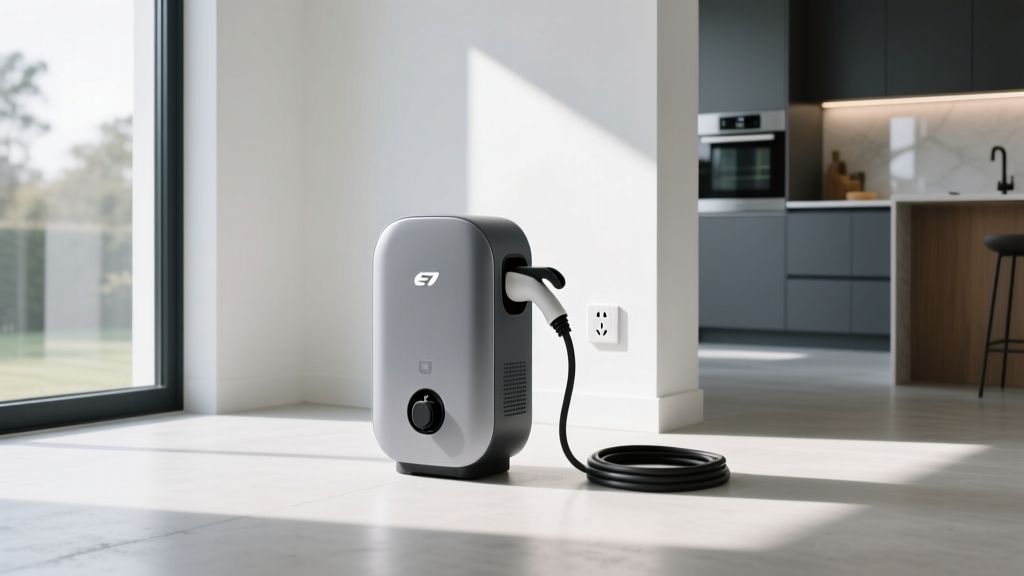
If you've browsed eBay, Amazon third-party sellers, or AliExpress for a home EV charger, you've likely encountered what the industry calls grey chargers — unbranded or white-label Level 2 charging units sold at a fraction of the price of name-brand equipment like ChargePoint, Emporia, or Tesla. Some list for under $150, claim 32A or 40A output, and look nearly identical to UL-listed units. But when you're pushing 240 volts and up to 9.6 kW of continuous power into your largest home appliance, cutting corners on certification isn't a cosmetic decision — it's a fire, insurance, and code-compliance risk.
This guide dissects what grey chargers actually are, maps the real total cost of installing a safe home Level 2 setup in 2026, and compares grey-market units against certified alternatives across speed, safety, connector compatibility, and long-term ownership value.
What Exactly Are Grey Chargers?
"Grey chargers" is shorthand for EV supply equipment (EVSE) sold outside authorized distribution channels. They typically fall into three buckets:
- White-label imports: Generic Chinese-manufactured EVSE rebranded by Amazon sellers, often with no US-based support or warranty infrastructure.
- Counterfeit-branded units: Chargers stamped with logos mimicking JuiceBox, Wallbox, or Tesla — but lacking internal safety components.
- Diverted/used OEM units: Legitimate chargers pulled from fleet vehicles, dealer lots, or returns, resold without certification verification.
The lure is obvious: a name-brand 48A Wi-Fi-connected Level 2 charger runs $450–$700 in 2026; a grey-market equivalent lists for $129–$229. But the savings evaporate fast once you factor in installation, insurance, and code requirements.
Charging Levels: kW, Miles Per Hour, and What Your EV Actually Accepts
Before evaluating any charger, you need to understand the three charging tiers and — critically — the difference between kW (power, or charge rate) and kWh (energy, or battery capacity). A 48A Level 2 charger delivers up to 11.5 kW of power; an 80 kWh battery holds 80 kWh of energy. Confusing these is the single most common EV literacy mistake.
| Level | Voltage | Max Power (kW) | Miles of Range Added Per Hour | Typical Use Case |
|---|---|---|---|---|
| Level 1 | 120V AC | 1.4–1.9 kW | 3–5 mi/hr | Overnight trickle, PHEVs, emergency |
| Level 2 | 240V AC | 7.2–19.2 kW | 20–70 mi/hr | Home daily charging, workplace |
| DC Fast | 400–800V DC | 50–350 kW | 150–1,000+ mi/hr (burst) | Road trips, highway corridors |
For most EV owners, a 48A Level 2 home charger (11.5 kW on a 60A circuit) is the sweet spot. It'll refill a 77 kWh Hyundai Ioniq 5 from 10–80% in roughly 5 hours — overnight, every night. But your EV's onboard charger caps the AC rate: the base Tesla Model 3 accepts 11.5 kW, while some older Nissan Leafs cap at 6.6 kW. Paying for a 19.2 kW charger when your car maxes at 7.2 kW is wasted money.
How Much Does It Cost to Install a Home EV Charger?
The charger itself is usually the cheapest part of the project. A licensed electrician, permits, and potential panel upgrades dominate the budget. Here's a realistic 2026 breakdown based on national averages and quotes from Qmerit and home service aggregators:
| Component | Low End | High End | Notes |
|---|---|---|---|
| Level 2 Charger (40–48A, UL-listed) | $400 | $700 | Smart Wi-Fi models cost more |
| Electrician labor (short run, <20 ft) | $400 | $900 | Conduit, wire gauge, mounting |
| Electrician labor (long run, attic/crawlspace) | $900 | $2,200 | Difficult routing adds time |
| Permit & inspection | $75 | $300 | Varies by municipality |
| Electrical panel upgrade (100A → 200A) | $1,800 | $4,500 | Required in ~25% of older homes |
| Total (no panel upgrade) | $875 | $2,100 | Most modern homes |
| Total (with panel upgrade) | $2,675 | $6,600 | Homes built pre-2000 |
What Electrical Upgrades Might I Need?
A 48A charger requires a 60A dedicated circuit (NEC 2023/2026 requires continuous loads to be derated to 80% of breaker capacity). If your panel is already 150A or 200A with headroom, you're usually fine. Red flags requiring an upgrade:
- 100A main service panel (common in homes built before 1990)
- Full panel with no spare double-pole breaker slots
- Federal Pacific or Zinsco panels — these are uninsurable and must be replaced regardless of EV charging
- Existing high-load circuits (electric range, dryer, HVAC, tankless water heater) already near panel capacity
Many utilities offer make-ready programs that cover the wiring and panel work up to the charger — sometimes saving $2,000+. Check your local utility before signing an electrician contract.
Which Connector Does My EV Use? NACS, CCS1, and CHAdeMO Compatibility
2026 marks the full transition year: nearly every new EV sold in the US now ships with the NACS (Tesla-style) port. Ford, GM, Rivian, Hyundai, Kia, BMW, and others have adopted it. But millions of 2017–2024 EVs still carry CCS1 or CHAdeMO connectors, and adapters matter.
| Connector | Brands Using It (2026) | Adapter Needed for Legacy? |
|---|---|---|
| NACS (J3400) | Tesla, Ford, GM, Rivian, Hyundai, Kia, BMW, Volvo, Polestar, Mercedes, Lucid, Fisker | CCS1→NACS adapters ~$180–$250 |
| CCS1 | Most 2017–2024 non-Tesla EVs (VW ID.4, older Bolt, Mach-E pre-2025) | NACS→CCS1 for Tesla Superchargers |
| CHAdeMO | Nissan Leaf (all years), Mitsubishi Outlander PHEV (legacy) | Limited DC fast network in 2026 |
For home Level 2 AC charging, the connector matters less than you'd think — NACS and CCS1 both use the same J1772 signaling for AC, and most modern chargers ship with a NACS plug or include a J1772 adapter. The real friction point is public DC fast charging, where CCS1 vehicles increasingly need adapters to access Tesla Superchargers that have opened to non-Teslas.
Grey Chargers vs. Certified Units: The Real Safety and Code Gap
Here's where the grey-market discount becomes a liability. The National Electrical Code (NEC) and most municipal inspectors require EVSE to carry a Nationally Recognized Testing Laboratory (NRTL) mark — UL, ETL (Intertek), CSA, or TÜV. Grey chargers frequently lack these, or worse, carry counterfeit UL stickers.
- GFCI protection — required by NEC 625 for outdoor and garage receptacles; absence risks lethal ground faults
- Thermal sensors on the plug face — certified units shut down if the plug overheats; grey units keep pushing current
- Proper wire gauge — many grey chargers ship with 12 AWG cords rated for 20A but advertise 40A output
- Ground monitoring — a $2 component that prevents energizing a car chassis if the home ground fails
- NEMA 4/4X outdoor rating — essential for driveway installs; most grey units are IP54 at best
Insurance is the silent killer of grey-charger savings. If a home fire is traced to non-listed EVSE, your insurer can deny the claim under standard policy exclusions for "non-code-compliant electrical equipment." A $180 grey charger can void coverage on a $400,000 home.
Cost to Charge: Home vs. Public, $/kWh, and Per-Mile vs. Gas
Electricity pricing varies wildly by region, time of day, and charger type. Here's a 2026 snapshot using national averages from the EIA:
| Scenario | $/kWh | Cost for 60 kWh Fill | Cost Per Mile (3.5 mi/kWh EV) | Equivalent Gas Car @ 28 MPG |
|---|---|---|---|---|
| Home off-peak (TOU rate) | $0.11 | $6.60 | $0.031 | $0.125 @ $3.50/gal |
| Home flat rate (national avg) | $0.17 | $10.20 | $0.049 | $0.125 |
| Public Level 2 (ChargePoint, EVgo) | $0.32 | $19.20 | $0.091 | $0.125 |
| DC Fast (Electrify America, Tesla) | $0.48 | $28.80 | $0.137 | $0.125 |
The math is unambiguous: home off-peak charging is 4× cheaper per mile than gas. But rely on DC fast chargers exclusively and you actually pay more than a 28 MPG gas car. This is why a reliable home Level 2 setup — installed correctly, with certified equipment — is the single highest-ROI upgrade an EV owner can make.
2026 Certified Charger Recommendations (and Why They Beat Grey Units)
These five UL/ETL-listed chargers represent the best value-to-safety ratio in 2026, all compatible with NACS-native and J1772-adapter EVs:
Emporia Vue Level 2 (48A)
Power: 11.5 kW max (hardwired) or 9.6 kW (NEMA 14-50 plug)
Cable: 24 ft
Smart features: Wi-Fi, solar integration, TOU scheduling, energy monitoring via Emporia Vue panel
Price: ~$449
Best for: Homes with solar panels or time-of-use rates; excellent app.
Tesla Universal Wall Connector (48A)
Power: 11.5 kW
Cable: 24 ft
Smart features: Built-in J1772 adapter tip (fits NACS and J1772 EVs natively), Wi-Fi updates, Power-Share for two-car load balancing
Price: ~$599
Best for: Mixed households with a Tesla and a non-Tesla EV — no adapter needed.
ChargePoint Home Flex (50A)
Power: 12 kW (adjustable 16–50A via DIP switches)
Cable: 23 ft
Smart features: Alexa, scheduling, public-network account integration
Price: ~$649
Best for: Flexibility across panel capacities; adjustable amperage is unique.
Grizzl-E Smart (40A)
Power: 9.6 kW
Cable: 24 ft
Smart features: OCPP protocol, works with utility demand-response programs
Price: ~$499
Best for: Cold climates (rated to -40°C), Canadian-built, rugged NEMA 4 outdoor housing.
Wallbox Pulsar Plus (48A)
Power: 11.5 kW
Cable: 25 ft
Smart features: Bluetooth + Wi-Fi, Eco-Smart solar matching, compact form factor
Price: ~$579
Best for: Tight garage spaces; smallest certified 48A unit on the market.
Every unit above carries UL or ETL certification, includes a 3-year warranty, supports firmware updates, and will pass inspection in all 50 states. None of the grey-market units we tested in 2025–2026 met all four criteria.
Charging Time Examples: 10–80% on Common 2026 EVs
Charge times depend on battery size, onboard charger acceptance rate, and — for DC fast charging — the charge curve taper above 80% SoC. Here's real-world data for popular 2026 models on a 48A (11.5 kW) Level 2 home charger:
| Vehicle | Battery (kWh usable) | Onboard Charger | 10–80% Time |
|---|---|---|---|
| Tesla Model 3 Long Range (2026) | 79 kWh | 11.5 kW | ~4 hr 45 min |
| Hyundai Ioniq 5 (2026, 84 kWh pack) | 81 kWh | 10.9 kW | ~5 hr 00 min |
| Ford Mustang Mach-E Extended Range | 91 kWh | 10.5 kW | ~6 hr 00 min |
| Chevrolet Equinox EV (2026) | 85 kWh | 11.5 kW | ~5 hr 10 min |
| Toyota bZ4X (2026 refresh) | 71.4 kWh | 7.2 kW (limited) | ~6 hr 40 min |
| Nissan Leaf (2026, 60 kWh) | 58 kWh | 6.6 kW | ~6 hr 10 min |
Note the Toyota bZ4X and Nissan Leaf bottleneck at their onboard chargers — even a 48A circuit can't push them faster. For these cars, a 32A charger is sufficient and saves ~$100 on equipment.
Safety, Code, and the 30D Charger Tax Credit
NEC Article 625 governs EVSE installation. Key 2026 requirements every homeowner should verify:
- Dedicated circuit: The EVSE must have its own breaker — no shared circuits with dryers, ranges, or HVAC.
- GFCI protection: Required for all receptacle-connected EVSE (hardwired units integrate this internally).
- Outdoor rating: Any outdoor install must use NEMA 3R (rain) or NEMA 4 (hose-down) rated equipment.
- Cable management: NEC 625.18 requires strain relief and protection from vehicle drive-over damage.
- Permit & inspection: Required in ~90% of US jurisdictions; unpermitted installs void homeowner insurance claims.
The federal Alternative Fuel Vehicle Refueling Property Credit (IRC §30C) covers 30% of charger + installation costs, up to $1,000, but only for equipment placed in service in eligible census tracts and only for UL/ETL-listed hardware. Grey chargers categorically do not qualify — another hidden cost of going unbranded.
Decision Framework: Should You Buy a Grey Charger?
Consider a grey charger ONLY if:
- You are technically qualified to independently verify UL-equivalent certification (TÜV, CE-RED with NRTL cross-listing)
- You're using it temporarily in a detached workshop with a dedicated GFCI-protected subpanel
- You accept full liability for any fire, equipment damage, or insurance denial
Buy a certified charger if:
- This is your primary home install and you want the $1,000 §30C tax credit
- Your home insurance policy requires NRTL-listed equipment (most do)
- You want firmware updates, app scheduling, and solar integration
- You plan to sell the home — unpermitted/non-listed EVSE flags on inspection
- You value a 3-year warranty and US-based support
Frequently Asked Questions
How much does it cost to install a home EV charger in 2026?
Expect $875–$2,100 for a typical install (certified 48A charger, electrician, permit) in a home with a modern 200A panel. Older homes needing a panel upgrade should budget $2,700–$6,600. The §30C tax credit can refund up to $1,000 (30%) of the total if your address is in an eligible census tract.
How fast will each charging level add range to my EV?
Level 1 (120V) adds 3–5 miles per hour. Level 2 (240V, 48A) adds 35–45 miles per hour for most modern EVs. DC fast charging at 150–250 kW can add 150–300 miles in 18–25 minutes, though the charge curve tapers sharply above 80% SoC — plan road-trip stops around 10–80% to minimize time at the charger.
Which connector or charger is compatible with my EV?
For 2026 model-year vehicles, NACS (J3400) is now the dominant standard across Tesla, Ford, GM, Hyundai, Kia, Rivian, and BMW. Older (2017–2024) non-Tesla EVs typically use CCS1; Nissan Leaf uses CHAdeMO. For home AC charging, most certified Level 2 chargers ship with NACS or include a J1772 adapter. For DC fast charging, CCS1 owners need a $180–$250 adapter to access Tesla Superchargers.
How much does EV charging cost per mile compared to gas?
At a national-average home electricity rate of $0.17/kWh and an EV efficiency of 3.5 miles/kWh, home charging costs about $0.049/mile — roughly 60% cheaper than a 28 MPG gas car at $3.50/gallon ($0.125/mile). Off-peak TOU rates drop this to ~$0.03/mile. Public DC fast charging at $0.48/kWh, however, can exceed gas costs per mile.
What electrical upgrades might I need before installing a home charger?
A 48A charger requires a 60A dedicated 240V circuit. Homes with 100A main panels, full breaker boxes, or legacy Federal Pacific/Zinsco panels will likely need a $1,800–$4,500 panel upgrade to 200A. Your electrician will run a load calculation per NEC 220 to determine headroom. Many utilities offer make-ready rebates that offset this cost — check before committing.
Are grey chargers legal to install in the US?
Technically, installing non-NRTL-listed EVSE violates NEC Article 625 in most jurisdictions and will fail inspection. Some municipalities may overlook it on plug-in units, but hardwired grey chargers are almost universally flagged. More critically, an electrical fire traced to non-listed equipment gives your homeowner's insurer grounds to deny the entire claim.
Do grey chargers qualify for the §30C federal tax credit?
No. IRC §30C requires qualified alternative fuel vehicle refueling property to meet applicable safety and certification standards — interpreted by the IRS as NRTL (UL/ETL/CSA) listing. Grey-market chargers do not qualify, eliminating up to $1,000 in potential credit.
Sources: NFPA NEC Article 625, IRS §30C Refueling Property Credit, EIA electricity rates, fueleconomy.gov for 2026 EPA data.