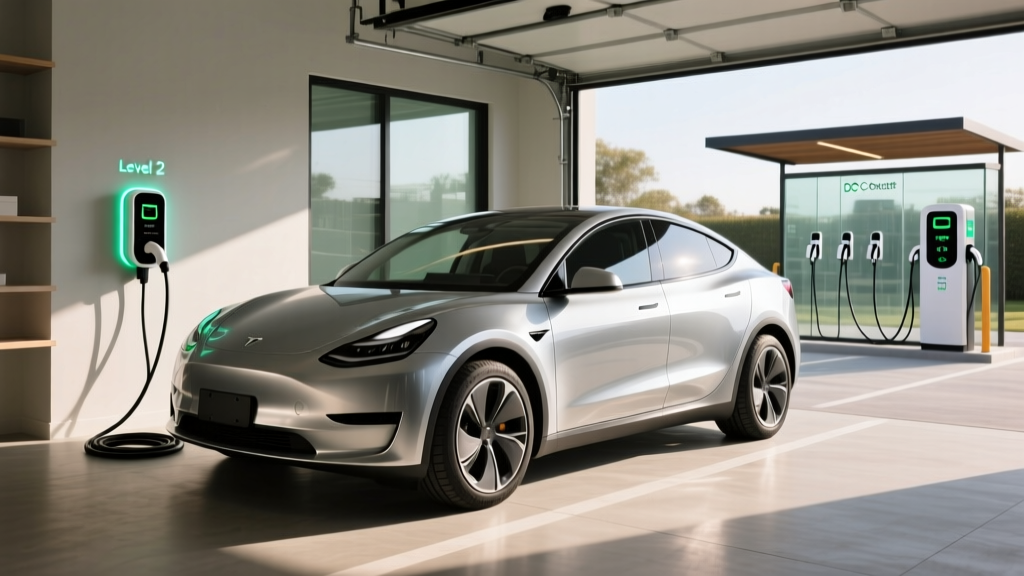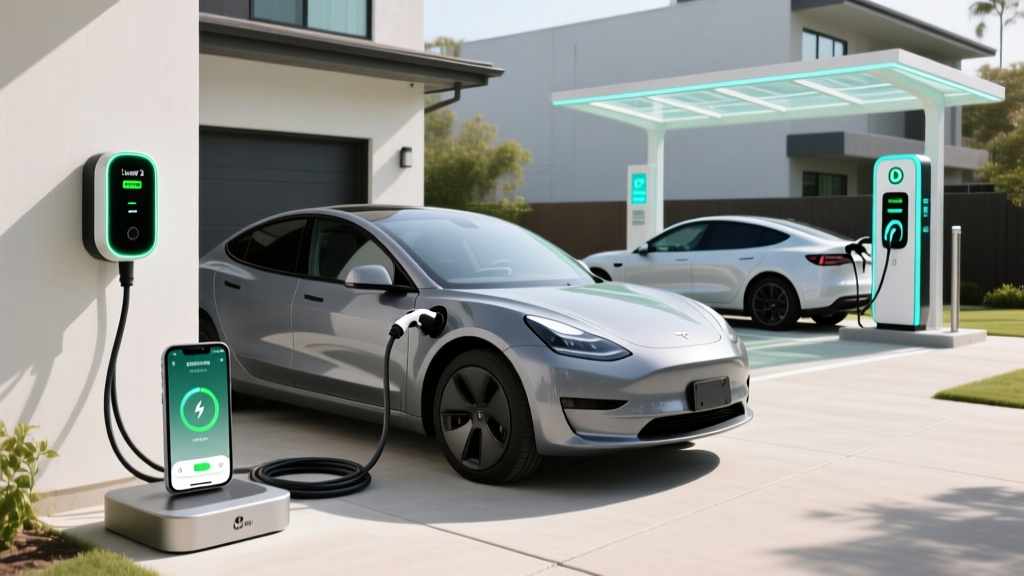
If you've recently purchased or are researching what enthusiasts sometimes call a "grey charger car" — an electric vehicle in a neutral grey or gunmetal finish that blends seamlessly with home and garage aesthetics — you've likely started wondering how to actually keep it charged. Whether your EV is a Storm Grey Ioniq 5, a Stealth Grey Tesla Model Y, or a Grey Metallic Ford Mustang Mach-E, the charging fundamentals are identical. What changes is how you set up your home infrastructure, which public networks serve your connector, and what you'll actually pay per mile.
This guide breaks down every layer of EV charging in 2026: the three charging levels and their real-world speeds, what your electrical panel can (and can't) handle, connector compatibility across every major brand, true cost-per-mile math versus gasoline, and specific Level 2 charger models worth buying right now.
The Three Charging Levels: kW Speeds and Range Added Per Hour
The single most important distinction in EV literacy is the difference between kW (kilowatts — a measure of power, or how fast energy flows) and kWh (kilowatt-hours — a measure of energy, or how much your battery holds). A 84 kWh battery charged at 11.5 kW takes roughly 7.3 hours from empty to full. That same battery on a 250 kW DC fast charger can go from 10% to 80% in about 18 minutes. The energy capacity stays the same; only the power delivery rate changes.
| Level | Voltage / Amperage | Power (kW) | Miles of Range Added Per Hour | Typical Use Case |
|---|---|---|---|---|
| Level 1 | 120V / 12A | ~1.4 kW | 3–5 miles | Overnight trickle; PHEV top-ups |
| Level 2 | 240V / 32–48A | 7.7–11.5 kW | 25–44 miles | Daily home charging; workplace |
| DC Fast (Level 3) | 400–900V DC | 50–350 kW | 150–1,200+ miles (peak rate) | Road trips; rapid top-ups |
A few real-world caveats: DC fast charging speeds are peak rates, not sustained. Most EVs hit their peak kW between 10–40% State of Charge (SoC), then taper significantly. A vehicle advertising "250 kW peak" may sustain that rate for only 3–5 minutes before dropping to 150 kW, then 100 kW, then 50 kW as it approaches 80%. This is the charge curve, and it's why 10–80% times matter more than peak kW numbers.
- 62 kWh battery (Nissan Leaf-style): ~45 min at 100 kW DCFC; ~5.5 hours at 11.5 kW Level 2
- 77 kWh battery (Model Y / Ioniq 5 class): ~18–22 min at 250 kW DCFC; ~6.5 hours at 11.5 kW Level 2
- 100 kWh battery (F-150 Lightning / large SUV): ~25–32 min at 350 kW DCFC; ~8.5 hours at 11.5 kW Level 2
Home Level 2 Charger Installation: Electrical Requirements and Cost Breakdown
Most EV owners install a 240V Level 2 charger at home, typically on a dedicated 40-amp or 60-amp circuit. Here's what that requires and what it costs.
Electrical requirements: A 48-amp charger (the most common high-power home unit) requires a dedicated 60-amp circuit breaker. NEC code mandates that continuous loads (like EV charging) cannot exceed 80% of a circuit's rated capacity — so a 60A breaker supports a maximum 48A continuous draw. A 40-amp charger needs a 50A breaker.
Panel capacity check: Your home's main electrical panel is typically 100A, 150A, or 200A. An electrician will perform a load calculation to determine if adding a 60A circuit exceeds your panel's safe capacity. Homes with 100A panels and existing heavy loads (electric range, dryer, HVAC) often need a panel upgrade to 200A — this is the single biggest variable in installation cost.
| Component | Simple Install (Panel Adjacent) | Complex Install (Long Run / Panel Upgrade) |
|---|---|---|
| Level 2 Charger Equipment | $400–$700 | $400–$700 |
| Electrician Labor (2–4 hrs simple; 6–12 hrs complex) | $300–$600 | $1,200–$2,500 |
| Conduit, Wiring (6 AWG or 4 AWG copper) | $50–$150 | $300–$800 |
| Permit & Inspection | $50–$150 | $100–$300 |
| Panel Upgrade (if needed — 200A service) | N/A | $1,500–$3,500 |
| Total Estimated Cost | $800–$1,600 | $3,500–$7,800 |
Key gotcha: The IRS Residential Clean Energy Credit (§25D) covers 30% of home charger equipment and installation costs, up to $1,000, for equipment placed in service through 2032. This credit is separate from the §30D vehicle purchase credit. Confirm eligibility with a tax professional, as income and location-based restrictions may apply.
Connector Compatibility: NACS, CCS1, CHAdeMO, and Adapters
The connector landscape in 2026 has largely consolidated around the North American Charging Standard (NACS), originally developed by Tesla. Most new EVs from 2025 onward ship with a native NACS port. Older vehicles and some remaining models use CCS1 (Combined Charging System). CHAdeMO is effectively legacy — still found on older Nissan Leafs and Mitsubishi Outlander PHEVs, but no longer adopted by new vehicles.
| Connector | Brands Using It (Native) | DC Fast Charging Network Access | Adapter Needed? |
|---|---|---|---|
| NACS (Tesla standard) | Tesla, Ford, GM, Rivian, Volvo, Polestar, Mercedes, Hyundai/Kia (2025+), Subaru, Lucid, Toyota (bZ new models) | Tesla Supercharger (20,000+ stalls), Electrify America (select), EVgo | CCS1→NACS adapter for older CCS vehicles (~$150–$200) |
| CCS1 | VW ID.4 (pre-2025), BMW iX/i4 (pre-2025), older Hyundai/Kia, Stellantis EVs | Electrify America, EVgo, ChargePoint, Ionity (EU) | NACS→CCS1 adapter for Supercharger access (~$175–$230) |
| CHAdeMO | Nissan Leaf (all years), Mitsubishi Outlander PHEV | Declining network; some Electrify America stalls | No practical adapter to NACS/CCS for DCFC |
Adapter reality check: If you own a CCS1-equipped vehicle and want Tesla Supercharger access, you'll need a NACS-to-CCS1 adapter. Ford and GM provide these to early adopters; aftermarket options from Lectron and A2Z cost $150–$230. Always verify that the adapter is rated for the full DC fast-charging amperage (typically 500A) and has proper thermal protection.
Cost to Charge: $/kWh Scenarios and Cost Per Mile vs. Gasoline
Charging cost varies enormously depending on where and when you plug in. Here's what 2026 electricity and gasoline prices look like in real terms.
| Scenario | Rate ($/kWh) | Cost to Add 200 Miles (at 3 mi/kWh efficiency) | Cost Per Mile |
|---|---|---|---|
| Home, off-peak (utility time-of-use rate) | $0.08–$0.12 | $5.33–$8.00 | $0.027–$0.040 |
| Home, standard rate (no TOU plan) | $0.14–$0.18 | $9.33–$12.00 | $0.047–$0.060 |
| Public Level 2 (ChargePoint, workplace) | $0.20–$0.35 | $13.33–$23.33 | $0.067–$0.117 |
| DC Fast Charging (Electrify America, EVgo) | $0.35–$0.55 | $23.33–$36.67 | $0.117–$0.183 |
| Gasoline baseline (30 MPG, $3.50/gal) | — | $23.33 | $0.117 |
The takeaway: home charging during off-peak hours delivers fuel costs at roughly one-quarter to one-third the price of gasoline. Exclusive reliance on DC fast charging, however, can push your per-mile cost to parity with or even above a fuel-efficient gas car. This is why home Level 2 access is the single most impactful ownership variable.
For the most accurate efficiency data on your specific vehicle, check the EPA's fueleconomy.gov listings, which provide kWh/100mi and MPGe ratings for every certified EV sold in the US.
Top Level 2 Home Chargers for 2026: Equipment Picks
Below are four widely recommended Level 2 chargers available in 2026, selected for reliability, smart features, and connector versatility.
Tesla Wall Connector (Gen 4)
- Power: Up to 11.5 kW (48A / 240V)
- Connector: Native NACS; CCS adapter included in box
- Cable length: 24 ft
- Smart features: Wi-Fi, OTA updates, load sharing (pair two units on one circuit), Powerwall integration
- Price: ~$475
- Best for: NACS-native vehicles; Tesla ecosystem owners
ChargePoint Home Flex (2nd Gen)
- Power: Up to 12 kW (50A / 240V)
- Connector: Available in NACS or CCS1 configurations
- Cable length: 23 ft
- Smart features: Wi-Fi, Alexa/Google Home, scheduling, energy tracking, utility demand-response
- Price: ~$550–$650
- Best for: Multi-EV households; utility rebate eligibility
Emporia Vue EV Charger
- Power: Up to 11.5 kW (48A / 240V)
- Connector: NACS (CCS adapter available)
- Cable length: 24 ft
- Smart features: Integrates with Emporia Vue energy monitor for whole-home load tracking, solar-aware scheduling
- Price: ~$400–$500
- Best for: Solar-equipped homes; budget-conscious buyers
Grizzl-E Smart (United Chargers)
- Power: Up to 10 kW (40A / 240V)
- Connector: NACS or J1772 (with adapter)
- Cable length: 24 ft
- Smart features: Wi-Fi, OCPP protocol (utility-managed charging), DIP-switch amperage adjustment
- Price: ~$450–$550
- Best for: Cold-climate durability (rated to -40°F); outdoor installs
What to prioritize: Look for UL or ETL certification (never buy an uncertified charger from an unknown brand), NEMA 4 outdoor rating if mounting outside, and a cable length of at least 20 feet for parking flexibility. Hardwired installations (no plug) are preferred for 48A+ chargers, as NEMA 14-50 receptacles can overheat under sustained high-amperage loads — a risk NHTSA and electrical safety boards have flagged in recalls of certain outlet installations.
Safety, Electrical Code, and Common Installation Mistakes
EV charging places a sustained, high-amperage load on your home's electrical system — far more demanding than a dryer or oven, which cycle on and off. Here's what safe installation requires:
- Dedicated circuit: Your Level 2 charger must be on its own dedicated breaker. Never share a circuit with other appliances.
- GFCI protection: NEC 2023 and later require GFCI (Ground Fault Circuit Interrupter) protection for all EV charging outlets. Hardwired chargers are exempt in many jurisdictions, which is one reason electricians prefer hardwired installs.
- Wire gauge: 6 AWG copper for 40A circuits; 4 AWG copper for 60A circuits. Aluminum wire requires larger gauge. Long wire runs (over 50 feet) may need upsized wire to prevent voltage drop.
- Outdoor rating: If your charger is mounted outdoors or in an unsealed garage, it must carry a NEMA 4 (splash-resistant) or NEMA 4X (corrosion-resistant) rating.
- Permit and inspection: Nearly all jurisdictions require an electrical permit for a new 240V circuit. The inspection ensures proper wire sizing, breaker rating, grounding, and GFCI compliance. Skipping the permit risks insurance claim denial in the event of an electrical fire.
Frequently Asked Questions
How much does it cost to install a home EV charger?
A straightforward Level 2 installation (short wire run, adequate panel capacity) typically costs $800–$1,600 including equipment, labor, and permit. Complex installations requiring long conduit runs or a panel upgrade to 200A can range from $3,500 to $7,800. The IRS §25D Residential Clean Energy Credit covers 30% of the cost, up to $1,000.
How fast will each charging level add range?
Level 1 (120V) adds roughly 3–5 miles per hour — adequate for PHEVs with small batteries but impractical for full-size BEVs. Level 2 (240V, 48A) adds 25–44 miles per hour depending on vehicle efficiency, replenishing most EVs overnight. DC fast charging adds 150–1,200+ miles per hour at peak rates, though sustained rates taper significantly above 50% SoC.
Which connector and charger is compatible with my EV?
If your EV is a 2025+ model from Ford, GM, Rivian, Tesla, Volvo, Hyundai, Kia, or most other major brands, it uses NACS. If it's an older VW ID.4, BMW, or pre-2025 Hyundai/Kia, it likely uses CCS1. Check your vehicle's charge port or the manufacturer's spec page. For home Level 2 charging, buy a charger matching your vehicle's native connector — or use a certified adapter.
How much does charging cost per mile compared to gasoline?
Home off-peak charging costs $0.03–$0.04 per mile — roughly one-third the cost of gasoline at $3.50/gal and 30 MPG ($0.12/mile). Public DC fast charging at $0.35–$0.55/kWh costs $0.12–$0.18 per mile, reaching parity with gas. The economics strongly favor home charging; if you cannot install a home charger, evaluate whether a PHEV might better suit your situation.
What electrical upgrades might I need?
Homes with 100A electrical panels often need an upgrade to 200A service ($1,500–$3,500) to safely support a 48A Level 2 charger alongside existing loads. Homes with 200A panels usually have sufficient capacity. An electrician's load calculation will determine this. Some utilities offer "make-ready" programs that cover the cost of panel upgrades for EV adopters — check with your local provider.