What Is GreenLots and Where Does It Fit in the EV Charging Landscape?
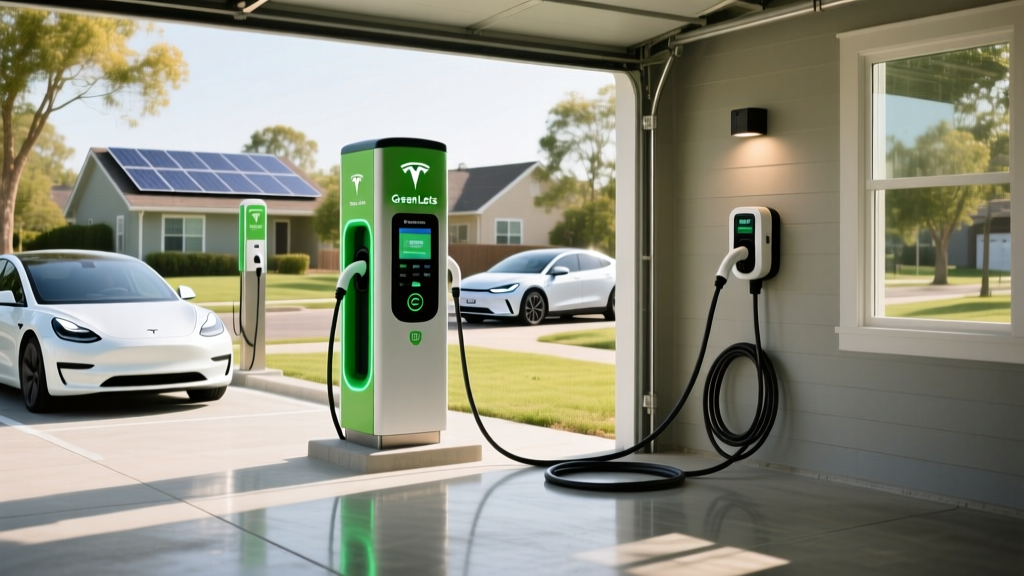
GreenLots is a public and commercial EV charging network now operating under the Shell Recharge Solutions brand. If you've pulled up to a shopping center, workplace garage, or highway rest stop and seen a GreenLots-branded station, you've encountered one of the roughly 4,000+ charging ports the company operates across North America. The network spans Level 2 destination chargers and DC fast chargers, accessible through the Shell Recharge app, RFID cards, or plug-and-charge on compatible vehicles.
For EV owners and shoppers considering their first electric vehicle, understanding how GreenLots fits into the broader charging ecosystem — alongside Electrify America, EVgo, ChargePoint, and Tesla Superchargers — is essential for trip planning and daily ownership. This guide breaks down the GreenLots network, the home charging equipment you'll actually need, installation costs with real numbers, and how charging economics compare to gasoline in 2026.
Charging Levels Explained: Speeds, kW, and Miles Per Hour
Before evaluating any specific network or charger, you need to understand the three charging tiers. The critical distinction: kW (kilowatts) measures power — how fast energy flows into your battery. kWh (kilowatt-hours) measures energy — the total capacity of your battery, like gallons in a fuel tank. Never confuse the two.
| Level | Voltage | Power (kW) | Miles of Range Added Per Hour | Typical Use Case |
|---|---|---|---|---|
| Level 1 | 120V AC | 1.2–1.9 kW | 3–5 miles/hr | Overnight top-up, PHEVs, low-mileage drivers |
| Level 2 | 240V AC | 3.3–19.2 kW | 12–75 miles/hr | Home daily charging, workplace, destination |
| DC Fast Charge | 400–800V DC | 50–350 kW | 150–1,000+ miles/hr (peak) | Road trips, highway corridors, quick top-ups |
Most GreenLots public locations offer either Level 2 (typically 7.2 kW or 19.2 kW) or DC fast charging (50 kW to 150 kW, with some newer sites reaching 180 kW). A 75 kWh battery pack — common in vehicles like the Ford Mustang Mach-E Extended Range or Hyundai Ioniq 5 — charging at a 50 kW GreenLots DC fast charger will go from 10% to 80% State of Charge (SoC) in roughly 55–65 minutes. At a 150 kW station, that same 10–80% session drops to approximately 22–28 minutes, depending on the vehicle's charge curve and battery temperature.
GreenLots Public Charging: Connectors, Pricing, and Reliability
GreenLots stations support the major connector standards used in North America. Here's what you'll find:
| Connector | Standard | Vehicle Brands Using It | GreenLots Availability |
|---|---|---|---|
| J1772 | Level 2 AC | All non-Tesla EVs (2011–present) | Widely available |
| CCS1 (Combo) | DC Fast | Ford, GM, Hyundai/Kia, VW, BMW, most non-Tesla | Available at DC fast sites |
| CHAdeMO | DC Fast | Nissan Leaf, Mitsubishi Outlander PHEV (older) | Limited — being phased out industry-wide |
| NACS (Tesla) | AC + DC Fast | Tesla (all), Ford/GM/Rivian/Volvo (2025+ with native or adapter) | Expanding — Shell Recharge adding NACS cables |
If you drive a 2025+ Ford, GM, Rivian, or Volvo that has adopted the NACS standard, you may need a CCS-to-NACS adapter at GreenLots DC fast chargers that haven't yet added NACS cables. Tesla-provided adapters and third-party options like the Lectron CCS-to-NACS adapter ($150–$200) handle this. Check the Shell Recharge app before your trip — it lists connector types and real-time availability for each station.
Pricing at GreenLots varies by location, utility, and time of day. Typical rates in 2026:
- Level 2 public: $0.15–$0.35/kWh, sometimes free at workplaces or retail partners
- DC Fast Charging: $0.30–$0.55/kWh depending on region and peak/off-peak timing
- Idle fees: $0.10–$0.20/minute if you remain plugged in after reaching your SoC limit
Some GreenLots locations require a Shell Recharge account, while others accept credit cards directly. Plug-and-charge (automatic billing when you plug in, no app needed) works on compatible vehicles like the Ford Mustang Mach-E and select Porsche/Audi models.
Home EV Charger Installation: Costs, Electrical Requirements, and Upgrades
Public networks like GreenLots are essential for road trips, but 80–90% of EV charging happens at home. Installing a Level 2 home charger is the single most impactful upgrade for daily EV ownership. Here's what it actually costs and requires.
Electrical Requirements for a Level 2 Home Charger
A Level 2 charger requires a 240-volt dedicated circuit, similar to what powers an electric dryer or oven. Common configurations:
- 40-amp circuit → delivers up to 32 amps continuous (9.6 kW) — NEC code requires circuits rated 125% above continuous load
- 50-amp circuit → delivers up to 40 amps continuous (9.6 kW)
- 60-amp circuit → delivers up to 48 amps continuous (11.5 kW) — needed for high-power chargers
Your home's electrical panel must have sufficient spare capacity. A typical 200-amp panel in a modern home can usually accommodate a 40–60 amp EV circuit. Older homes with 100-amp service or panels already near capacity may require a panel upgrade to 200 amps, which adds $1,500–$3,500 to the project.
Installation Cost Breakdown
| Component | Typical Cost Range | Notes |
|---|---|---|
| Level 2 Charger (Equipment) | $300–$750 | Varies by brand, power output, smart features |
| Electrician Labor | $400–$1,200 | Depends on run length, conduit, wall type |
| Electrical Permit | $50–$200 | Required in most jurisdictions — varies by city/county |
| Panel Upgrade (if needed) | $1,500–$3,500 | 100A → 200A upgrade; not always required |
| Total (No Panel Upgrade) | $750–$2,150 | Most common scenario for modern homes |
| Total (With Panel Upgrade) | $2,250–$5,650 | Older homes with 100A service |
Safety and Code Requirements
- Dedicated circuit: Your EV charger must be on its own breaker — no sharing with other outlets or appliances
- GFCI protection: NEC 2023 (and 2026 code adoptions) require GFCI protection for all EV charging outlets; most hardwired chargers include built-in GFCI
- NEMA 14-50 vs. hardwired: A NEMA 14-50 outlet offers portability (take the charger when you move), while hardwired installations can deliver higher amperage (up to 48A/11.5 kW) and avoid the GFCI breaker requirement at the panel
- Outdoor rating: If your charger mounts outside, ensure it carries a NEMA 4 or IP65 rating for weather resistance
- Permit and inspection: Most municipalities require an electrical permit and post-installation inspection — this protects your home insurance coverage
Recommended Home EV Chargers: Power, Features, and Price
The charger you buy should match your vehicle's onboard charger capacity. Most EVs accept 11.5 kW (48A) maximum on Level 2, though some — like the Chevrolet Silverado EV and certain Tesla configurations — can accept up to 19.2 kW (80A). Here are proven picks for 2026:
Emporia Vue Level 2 Charger
- Power: 48 amps / 11.5 kW (hardwired) or 40A / 9.6 kW (NEMA 14-50)
- Connector: J1772 (NACS adapter available)
- Cable length: 24 feet
- Smart features: Wi-Fi, app scheduling, energy monitoring, utility integration for off-peak rates
- Price: ~$399
- Best for: Budget-conscious buyers who want smart features and energy tracking
ChargePoint Home Flex
- Power: Configurable 16–50 amps / 3.8–12 kW (NEMA 14-50 or hardwired)
- Connector: J1772 (NACS version now available)
- Cable length: 23 feet
- Smart features: Wi-Fi, Alexa integration, app scheduling, amperage adjustable via dip switches
- Price: ~$549–$649
- Best for: Flexibility across different circuit sizes; strong app ecosystem
Tesla Wall Connector
- Power: 48 amps / 11.5 kW (hardwired, 60A circuit)
- Connector: NACS native (J1772 adapter included for non-Tesla EVs)
- Cable length: 24 feet
- Smart features: Wi-Fi, over-the-air updates, power sharing between two units, Tesla app integration
- Price: ~$475
- Best for: Tesla owners and households with NACS-equipped vehicles (2025+ Ford, GM, Rivian)
Grizzl-E Smart Level 2
- Power: 40 amps / 9.6 kW (NEMA 14-50) or 48A hardwired
- Connector: J1772 (NACS adapter compatible)
- Cable length: 24 feet
- Smart features: Wi-Fi, OCPP protocol, adjustable amperage, extreme cold rated (-40°F)
- Price: ~$449–$549
- Best for: Cold-climate owners and those wanting open-protocol flexibility
GreenLots also sells commercial-grade home chargers through the Shell Recharge Solutions lineup, including the Shell Recharge Home charger (40A / 9.6 kW, J1772, ~$599), which integrates directly with the Shell Recharge app and public network billing. It's a solid option if you want a unified ecosystem between home and public charging, though it offers less amperage than the Emporia or Tesla units.
Charging Cost Per Mile: EV vs. Gasoline in 2026
The economic case for EV charging hinges on your local electricity rates and how much you rely on public DC fast charging versus home charging. Here's a realistic comparison using a midsize EV averaging 3.0 miles/kWh (roughly 112 MPGe — typical of a Hyundai Ioniq 5 or Tesla Model Y) and a comparable gas vehicle averaging 28 MPG combined.
| Scenario | Rate | Cost Per Mile | Annual Cost (12,000 mi) |
|---|---|---|---|
| Home Level 2 — Off-Peak Utility Rate | $0.10/kWh | $0.033/mi | $400 |
| Home Level 2 — Average US Residential | $0.17/kWh | $0.057/mi | $680 |
| GreenLots Level 2 Public | $0.25/kWh | $0.083/mi | $1,000 |
| GreenLots DC Fast Charger | $0.42/kWh | $0.140/mi | $1,680 |
| Gasoline Vehicle (28 MPG, $3.40/gal) | $3.40/gallon | $0.121/mi | $1,457 |
The data tells a clear story: home charging at off-peak rates costs roughly 75% less per mile than gasoline. Even at average residential electricity rates, home-charged EVs save $750–$1,000 annually over a comparable gas car. However, exclusive reliance on DC fast charging at public rates like GreenLots' $0.42/kWh actually exceeds gasoline costs per mile. The financial advantage of EV ownership is maximized when you charge at home the majority of the time and use public DC fast charging only for road trips.
Many utilities offer time-of-use (TOU) plans with off-peak rates as low as $0.06–$0.10/kWh between 10 PM and 6 AM. Smart chargers from Emporia, ChargePoint, and Tesla let you schedule charging sessions to start automatically during these windows. According to the U.S. Department of Energy's fueleconomy.gov, EV owners who charge primarily at home save an average of $800–$1,200 per year in fuel costs compared to gasoline vehicles.
Charging Time Examples: 10–80% Sessions by Battery Size
Here's how long common EV battery sizes take to charge from 10% to 80% SoC across different charging scenarios. These times assume optimal battery temperature (preconditioned) and reflect the charge-curve taper that occurs above 50–60% SoC.
| Battery Size (kWh Usable) | Example Vehicles | Level 2 at 11.5 kW | DC Fast at 50 kW | DC Fast at 150 kW | DC Fast at 250+ kW |
|---|---|---|---|---|---|
| 60 kWh | Chevy Equinox EV, base Model 3 | ~3.6 hours | ~50 min | ~22 min | ~16 min |
| 77 kWh | Ford Mustang Mach-E ER, Model Y LR | ~4.6 hours | ~65 min | ~26 min | ~18 min |
| 84 kWh | Hyundai Ioniq 5, Kia EV6 | ~5.0 hours | ~70 min | ~18 min (800V) | ~18 min |
| 100 kWh | Tesla Model S, Rivian R1S | ~6.0 hours | ~85 min | ~32 min | ~22 min |
| 130 kWh | GMC Hummer EV, Silverado EV Max | ~7.8 hours | ~110 min | ~45 min | ~30 min |
Hyundai/Kia's E-GMP platform vehicles (Ioniq 5, EV6, GV60) deserve special mention: their 800-volt architecture allows them to sustain high charge rates at 350 kW chargers, achieving 10–80% in approximately 18 minutes — among the fastest in production. At a GreenLots 150 kW station, you'll still see strong performance (~25 min) but won't unlock the full 800V advantage.
Federal Tax Credits and Incentives for Home Charging Equipment
The IRS Residential Clean Energy Credit (IRC §25D) covers 30% of the cost of home EV charging equipment and installation, up to a maximum credit of $1,000. This applies to both the charger hardware and electrician labor. To qualify:
- The charger must be installed at your primary or secondary residence in the United States
- The equipment must be placed in service during the tax year (currently extended through 2032)
- You claim the credit on IRS Form 8911 (Alternative Fuel Vehicle Refueling Property Credit) — note: this is separate from the §30D new EV purchase credit
- There is no income cap for the home charging credit (unlike the §30D vehicle credit, which has AGI limits of $150K/$300K depending on filing status)
Example: If you spend $500 on an Emporia charger and $900 on electrician labor and permits ($1,400 total), you'd claim 30% × $1,400 = $420 as a federal tax credit. Check with a tax professional for your specific situation, as credit rules and forms are subject to legislative updates.
Additionally, many states and utilities offer separate rebates for home charger installation — ranging from $250 to $1,500 depending on your jurisdiction. Contact your local utility or check the Alternative Fuels Data Center for state-specific incentives.
GreenLots vs. Other Networks: When to Use Each
No single charging network covers every scenario. Here's how GreenLots (Shell Recharge) compares to the major alternatives:
- Tesla Supercharger: Largest and most reliable DC fast network (~6,500+ stalls in North America). Now open to non-Tesla NACS vehicles via the Tesla app at select locations. Best for road-trip reliability.
- Electrify America: Largest non-Tesla DC fast network. 350 kW chargers at many sites. CCS1 and NACS connectors. Variable reliability by location.
- EVgo: Urban-focused DC fast network, strong in metro areas. Partners with GM and Toyota. CCS1 and NACS.
- ChargePoint: Dominates Level 2 destination and workplace charging. Largest overall port count, but mostly Level 2 — limited DC fast presence.
- GreenLots / Shell Recharge: Mid-size network with a mix of Level 2 and DC fast. Strong at Shell gas station conversions, retail centers, and workplaces. Growing NACS support. Reliability generally above average for non-Tesla networks.
For daily driving, your home Level 2 charger handles the vast majority of charging. For road trips, a combination of Tesla Superchargers (if NACS-equipped) and Electrify America or GreenLots DC fast chargers covers most interstate corridors. Always check the Shell Recharge app or PlugShare before traveling to confirm station status, connector availability, and user-reported reliability.
Frequently Asked Questions
How much does it cost to install a home EV charger?
A typical Level 2 home charger installation costs $750–$2,150 total, including equipment ($300–$750), electrician labor ($400–$1,200), and permits ($50–$200). If your home needs an electrical panel upgrade from 100A to 200A service, add $1,500–$3,500. The federal Alternative Fuel Vehicle Refueling Property Credit covers 30% of costs up to $1,000.
How fast will each charging level add range?
Level 1 (120V) adds 3–5 miles of range per hour — adequate for PHEVs with small batteries. Level 2 (240V) at 11.5 kW adds roughly 30–40 miles per hour for a typical midsize EV. DC fast charging at 150 kW can add 150–300+ miles in 20–30 minutes, depending on battery size and charge-curve taper above 80% SoC.
Which connector and charger is compatible with my EV?
Non-Tesla EVs built before 2025 use CCS1 for DC fast charging and J1772 for Level 2. Tesla uses NACS for both. Starting in 2025, Ford, GM, Rivian, Volvo, and others have adopted NACS natively. Check your vehicle's charge port or owner's manual. For GreenLots stations, the Shell Recharge app lists connector types at each location. If your EV has NACS and the station only has CCS1, you'll need a CCS-to-NACS adapter.
How much does charging cost per mile compared to gas?
Home charging at the US average residential rate ($0.17/kWh) costs about $0.057 per mile for a typical EV — roughly half the $0.12/mile cost of a 28 MPG gas car at $3.40/gallon. Off-peak home rates ($0.10/kWh) drop to $0.033/mile. Public DC fast charging at $0.42/kWh costs roughly $0.14/mile — slightly more than gas. Home charging is where the savings live.
What electrical upgrades might I need for a home charger?
You'll need a dedicated 240V circuit (40–60 amps depending on charger power). Homes with a 200-amp electrical panel typically have sufficient capacity. Homes with 100-amp service — common in houses built before 1990 — often require a panel upgrade ($1,500–$3,500). A licensed electrician will perform a NEC load calculation to determine your panel's spare capacity before installation.
Can I use GreenLots stations without an account or app?
Most GreenLots/Shell Recharge stations accept contactless credit card payments directly at the charger. Some locations also support plug-and-charge for compatible vehicles. However, creating a Shell Recharge account gives you access to session history, off-peak pricing at select sites, and real-time station status before you arrive.