Why Long-Range EVs Demand a Serious Charging Strategy
If you've researched the greatest range electric car options for 2026, you already know the headline numbers: the Lucid Air Grand Touring pushes an EPA-estimated 512 miles, the Tesla Model S Long Range delivers 402 miles, and the Chevrolet Silverado EV 4WT tops 450 miles. But range is only half the ownership equation. A 118 kWh usable battery (like the Lucid Air's) is an enormous energy reservoir — and refilling it requires more planning than plugging into a standard wall outlet.
This guide breaks down exactly how to charge a long-range EV at home and on the road: the electrical requirements, real installation costs, connector compatibility, charging speeds by level, and the per-mile economics compared to gasoline. Whether you're charging a 400-mile luxury sedan or a 350-mile electric truck, the physics and infrastructure rules are the same.
Charging Levels Explained: kW, Speed, and What Each Adds
Before anything else, a critical distinction: kW (kilowatts) measures power — how fast energy flows into your battery. kWh (kilowatt-hours) measures energy — the total capacity of your battery. A 100 kWh battery charged at 10 kW takes roughly 10 hours from empty. Confusing these two units is the single most common EV mistake.
| Level | Voltage | Power (kW) | Miles of Range Added Per Hour | Typical Use Case |
|---|---|---|---|---|
| Level 1 | 120V AC | 1.0–1.4 kW | 3–5 miles | Overnight trickle, emergency top-up |
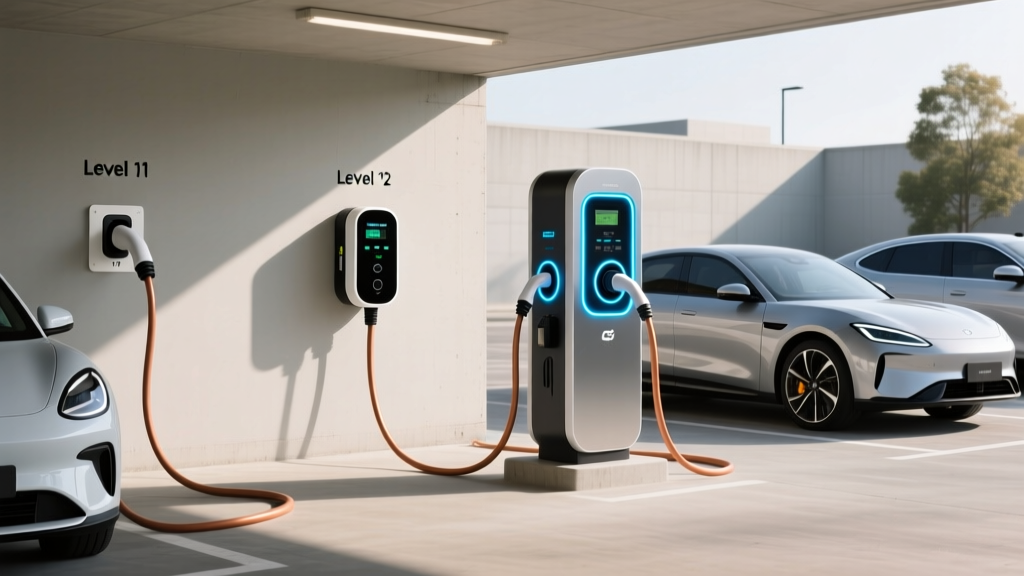
| Level 2 (Home/Public) | 240V AC | 3.3–19.2 kW | 12–75 miles | Daily home charging, workplace, shopping centers |
| DC Fast Charging | 400–900V DC | 50–350 kW | 150–1,000+ miles (equivalent rate) | Road trips, highway corridors |
For a long-range EV with a 100+ kWh battery, Level 1 charging is essentially impractical — recovering a full battery would take 4–5 days. Level 2 at 48 amps (11.5 kW) is the practical home standard, adding roughly 40–45 miles per hour. DC fast charging handles road trips, with modern long-range EVs accepting 200–350 kW peak rates on compatible infrastructure.
Home Level 2 Installation: Electrical Requirements and Real Costs
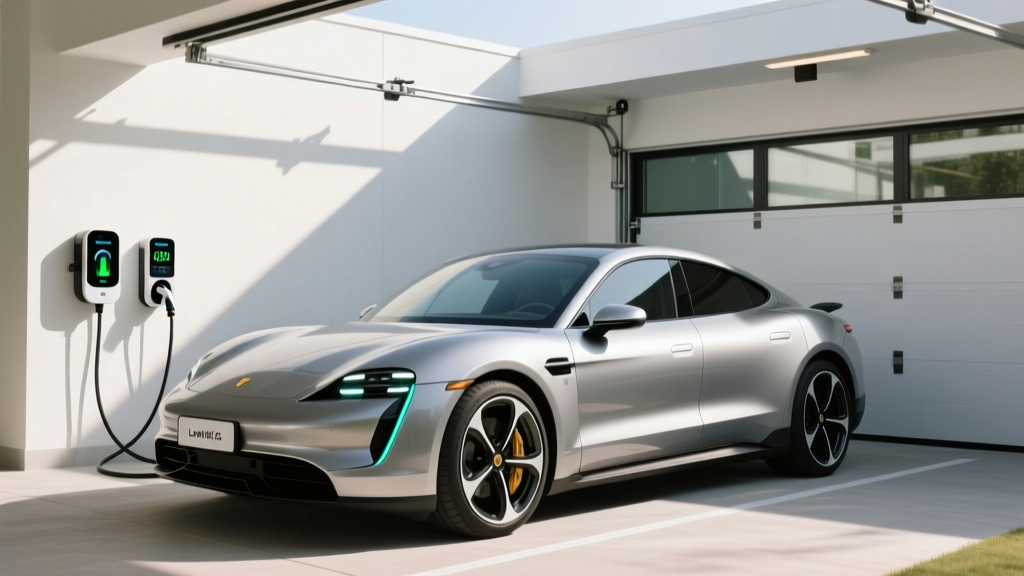
Installing a Level 2 home charger is the single most impactful upgrade for long-range EV ownership. Here's what's involved electrically and financially.
Electrical Requirements
A standard high-performance home Level 2 charger runs on a 240V dedicated circuit at 40 to 60 amps. Per the National Electrical Code (NEC), continuous loads like EV charging can only use 80% of a circuit's rated capacity, so a 60-amp circuit delivers a maximum of 48 amps (11.5 kW) to the vehicle. A 40-amp circuit delivers 32 amps (7.7 kW).
Your home's electrical panel must have sufficient spare capacity. Most modern homes with 200-amp service can accommodate a 60-amp EV circuit without issue. Older homes with 100-amp panels often require a panel upgrade to 200 amps — a significant added cost.
Installation Cost Breakdown
| Component | Low Estimate | High Estimate | Notes |
|---|---|---|---|
| Level 2 Charger (Equipment) | $350 | $750 | 40A–48A Wi-Fi-enabled units |
| Electrician Labor | $500 | $2,000 | Depends on panel-to-outlet distance, wall type |
| Electrical Permit | $50 | $300 | Varies by municipality |
| Panel Upgrade (if needed) | $1,500 | $4,000 | 100A → 200A service upgrade |
| Total (no panel upgrade) | $900 | $3,050 | Most homes with 200A service |
| Total (with panel upgrade) | $2,400 | $7,050 | Older homes with 100A service |
The national average for a straightforward Level 2 install (no panel upgrade, panel within 30 feet of the charger location) typically falls between $1,200 and $2,200 all-in. According to data from the U.S. Department of Energy, some utilities offer rebates of $250–$1,000 that can offset equipment or labor costs — check with your local provider.
Safety and Code Considerations
- Dedicated circuit: Your EV charger must be on its own breaker — never shared with other appliances.
- GFCI protection: NEC 2020 and later require GFCI (ground-fault circuit interrupter) protection for all EV charging outlets. Many hardwired chargers have built-in GFCI; receptacle installations need a GFCI breaker.
- Outdoor rating: If mounting outside, the charger must carry a NEMA 4 (or IP55+) weather-resistance rating. All major models listed below meet this standard.
- Wire gauge: 60-amp circuits require 4 AWG copper wire (or 2 AWG aluminum). Your electrician will spec this correctly.
Connector Compatibility: NACS, CCS, and CHAdeMO in 2026
The connector landscape has consolidated significantly. Here's where things stand for 2026 model-year vehicles:
| Connector | Brands Using It (Native) | Adapter Needed? |
|---|---|---|
| NACS (Tesla / SAE J3400) | Tesla, Ford, GM, Rivian, Volvo, Polestar, Hyundai, Kia, BMW, Mercedes-Benz, and most new 2025+ EVs | Older CCS vehicles need a NACS-to-CCS adapter (~$200–$250) |
| CCS1 (Combined Charging System) | Remaining 2024 and older models from VW, Audi, Porsche, Stellantis, Honda, some others | CCS vehicles can access Tesla Superchargers via Magic Dock or adapter |
| CHAdeMO | Nissan Leaf (legacy only — discontinued for new models) | Limited public infrastructure; no adapter to NACS/CCS for DC fast charging |
Bottom line for long-range EV buyers in 2026: NACS is the dominant standard. If you're buying new, your vehicle almost certainly has a native NACS port. If you own a 2023–2024 model with CCS1, a NACS adapter (sold by Ford, GM, and Tesla) gives you access to the Supercharger network's 19,000+ stalls.
For home Level 2 charging, all EVs use either a J1772 connector (CCS-era vehicles) or the J3400/NACS connector. Most Level 2 home chargers ship with J1772; NACS-equipped home chargers are now widely available from ChargePoint, Tesla, and Emporia.
Charging Times for Long-Range EVs: Real 10–80% Numbers
Long-range EVs carry large batteries, which means longer charge sessions even at high power. Here are realistic 10–80% charge times for popular long-range models on DC fast charging:
| Vehicle | Battery (kWh Usable) | Peak DC Rate (kW) | 10–80% Time (est.) | Architecture |
|---|---|---|---|---|
| Lucid Air Grand Touring | 118 kWh | ~300 kW | ~25 minutes | 900V |
| Tesla Model S Long Range | ~95 kWh | ~250 kW | ~28 minutes | 400V |
| Hyundai Ioniq 6 Long Range | 77.4 kWh | ~240 kW | ~18 minutes | 800V |
| Chevrolet Silverado EV 4WT | ~200 kWh | ~350 kW | ~40 minutes | 800V (Ultium) |
| Mercedes-Benz EQS 580 | 108.4 kWh | ~200 kW | ~31 minutes | 400V |
Critical nuance on charge curves: Peak kW is not sustained kW. A vehicle that peaks at 300 kW typically holds that rate only between roughly 10–40% state of charge, then tapers progressively. Above 80%, charging slows dramatically to protect battery health — sometimes to under 50 kW. This is why the industry standard metric is 10–80%, not 0–100%. For daily driving, charging to 80% is recommended for NMC (nickel-manganese-cobalt) batteries; LFP batteries can be charged to 100% regularly.
At home on Level 2 (48A / 11.5 kW), expect to add roughly 40–45 miles per hour of charging. A Lucid Air going from 20% to 80% (roughly 70 kWh) takes about 6–7 hours on Level 2 — easily handled overnight.
Cost to Charge: Per-Mile Economics vs. Gasoline
One of the strongest arguments for the greatest range electric car platforms is the fuel-cost advantage. Here's how the numbers break down across common charging scenarios:
| Scenario | Cost per kWh | Vehicle Efficiency | Cost per Mile |
|---|---|---|---|
| Home (off-peak utility rate) | $0.09–$0.14 | 3.0 mi/kWh (118 MPGe) | $0.03–$0.05 |
| Home (standard residential rate) | $0.15–$0.20 | 3.0 mi/kWh | $0.05–$0.07 |
| Public Level 2 (network pricing) | $0.25–$0.49 | 3.0 mi/kWh | $0.08–$0.16 |
| DC Fast Charging (EA, EVgo, Tesla) | $0.35–$0.55 | 3.0 mi/kWh | $0.12–$0.18 |
| Gasoline (25 MPG combined, $3.40/gal) | — | 25 MPG | $0.14 |
| Gasoline (18 MPG combined, $3.40/gal) | — | 18 MPG | $0.19 |
For a 400-mile EV charged primarily at home on off-peak rates, the annual fuel cost for 12,000 miles of driving is approximately $360–$600. A comparable 25 MPG gas car at $3.40/gallon costs roughly $1,632. That's a savings of $1,000–$1,270 per year on energy alone.
Even frequent DC fast charging at $0.48/kWh remains competitive with or cheaper than gasoline per mile for most vehicles. The economics strongly favor home charging — which is why the Level 2 installation investment pays back quickly.
Recommended Home Level 2 Chargers for Long-Range EVs
Long-range EVs with large batteries benefit from the highest practical Level 2 power. Here are top-rated 2026 home chargers with specific specs:
ChargePoint Home Flex
- Power Output: Up to 11.5 kW (48A) on a 60A circuit; configurable down to 16A
- Connector: J1772 (NACS adapter included in 2026 kit)
- Cable Length: 23 feet
- Smart Features: Wi-Fi, app scheduling, utility demand-response integration, Alexa/Google Home
- Price: ~$599 (charger only)
- Best For: Versatile installs, adjustable amperage for older panels
Tesla Wall Connector (Gen 4)
- Power Output: Up to 11.5 kW (48A)
- Connector: Native NACS (J3400) — no adapter needed for Tesla, Ford, GM, Rivian, and most 2025+ EVs
- Cable Length: 24 feet
- Smart Features: Wi-Fi, over-the-air updates, power sharing between multiple units, integrated cable management
- Price: ~$450
- Best For: NACS-native vehicles, multi-EV households (power sharing)
Emporia Vue EV Charger
- Power Output: Up to 11.5 kW (48A)
- Connector: J1772 (NACS version available)
- Cable Length: 24 feet
- Smart Features: Wi-Fi, integration with Emporia Vue whole-home energy monitor, solar-aware scheduling, time-of-use optimization
- Price: ~$399
- Best For: Solar-equipped homes, energy monitoring enthusiasts, budget-conscious installs
Grizzl-E Smart
- Power Output: Up to 9.6 kW (40A)
- Connector: J1772
- Cable Length: 24 feet
- Smart Features: Wi-Fi, OCPP-compatible, works with multiple energy management platforms
- Price: ~$499
- Best For: Extreme cold climates (rated to -40°F), rugged outdoor installs
For owners of 100+ kWh battery EVs, a 48-amp (11.5 kW) charger is strongly recommended over a 32-amp (7.7 kW) unit. The difference: roughly 6 hours to add 70 kWh vs. 9 hours. Overnight charging windows matter, especially if your utility offers super off-peak rates between midnight and 6 AM.
Frequently Asked Questions
How much does it cost to install a home EV charger?
A typical Level 2 home charger installation costs $1,200–$2,200 all-in (equipment, electrician labor, and permit) for homes with existing 200-amp electrical service. Homes needing a panel upgrade from 100A to 200A should budget an additional $1,500–$4,000, bringing the total to $2,700–$6,200. Utility rebates and the federal Residential Clean Energy Credit (IRS Form 5695) can offset up to 30% of equipment and installation costs, capped at $1,000 — consult a tax professional for eligibility.
How fast will each charging level add range?
Level 1 (120V) adds roughly 3–5 miles per hour — adequate only for overnight trickle on small batteries or plug-in hybrids. Level 2 at 48 amps (240V, 11.5 kW) adds approximately 40–45 miles per hour for efficient sedans like the Lucid Air or Hyundai Ioniq 6, and roughly 30–35 miles per hour for heavier trucks like the Silverado EV. DC fast charging at 250+ kW can add 150–300+ miles in 15–20 minutes, though the charge curve tapers significantly above 80% state of charge.
Which connector/charger is compatible with my EV?
For 2026 model-year EVs, the answer is almost certainly NACS (SAE J3400). Tesla, Ford, GM, Rivian, Hyundai, Kia, BMW, Mercedes-Benz, Volvo, and most other manufacturers have adopted NACS as their native charging port. If you own a 2023–2024 vehicle with a CCS1 port, you can access Tesla Superchargers using a manufacturer-approved NACS adapter ($200–$250). For home Level 2, match your charger's connector to your vehicle's port — or use an adapter. CHAdeMO is effectively discontinued for new vehicles.
How much does charging cost per mile vs gas?
Home charging on off-peak rates ($0.09–$0.14/kWh) costs approximately $0.03–$0.05 per mile for a typical long-range EV. Gasoline at $3.40/gallon and 25 MPG costs $0.14 per mile. Even public DC fast charging at $0.48/kWh ($0.16/mile) is competitive with gasoline. Over 12,000 annual miles, home-charged EV owners typically save $1,000–$1,270 per year compared to a 25 MPG gas vehicle. See the EPA's EV fuel cost calculator for vehicle-specific comparisons.
What electrical upgrades might I need?
The most common upgrade is a panel capacity check. If your home has 200-amp service and spare breaker slots, a 60-amp dedicated circuit can usually be added without panel work. Homes with 100-amp service (common in pre-1980 construction) will likely need a panel upgrade to 200 amps ($1,500–$4,000). Some utilities offer managed charging programs that allow you to install a higher-amperage charger with a smart panel that dynamically limits draw — this can sometimes avoid a full panel upgrade. Ask your electrician to perform a load calculation per NEC Article 220 before deciding.
Should I charge my long-range EV to 100% every day?
It depends on battery chemistry. Most long-range EVs use NMC or NCA (nickel-based) batteries, which degrade faster when held at 100% state of charge for extended periods. For daily driving, set your charge limit to 80% and only charge to 100% before long road trips. Vehicles with LFP (lithium iron phosphate) batteries — increasingly common in standard-range models — can and should be charged to 100% regularly. Check your owner's manual for the manufacturer's specific recommendation.