Why a Grand Prix GTP Owner Needs a Charging Plan Before Going Electric
If you've been driving a 2002 Pontiac Grand Prix GTP Supercharged — with its 240-hp 3.8L L67 V6 and 18/26 MPG EPA rating — you already know what supercharged torque feels like. What you might not know is that a modern electric vehicle can match or beat that thrill while cutting your per-mile fuel cost by 60% or more. But the transition from gas pump to plug requires a serious home charging setup.
This guide walks through every electrical and financial detail you need before buying an EV: charging levels explained in kW (power) and kWh (energy), real installation costs with panel-upgrade gotchas, connector compatibility, and a cost-per-mile breakdown compared to your GTP's fuel bill. We'll also recommend specific Level 2 chargers you can install today.
Charging Levels Explained: kW Power, kWh Energy, and Miles Per Hour
The single most important distinction in EV ownership: kW (kilowatts) measures power — how fast energy flows into the battery. kWh (kilowatt-hours) measures energy — the total capacity of the battery, like gallons in a fuel tank. A 75 kWh battery charged at 7.2 kW takes roughly 10.4 hours from empty to full.
| Level | Voltage / Amps | Power (kW) | Miles of Range Added Per Hour | Best Use Case |
|---|---|---|---|---|
| Level 1 | 120V / 12A | 1.4 kW | 3–5 mi/hr | Overnight top-off, PHEVs, low-mileage drivers |
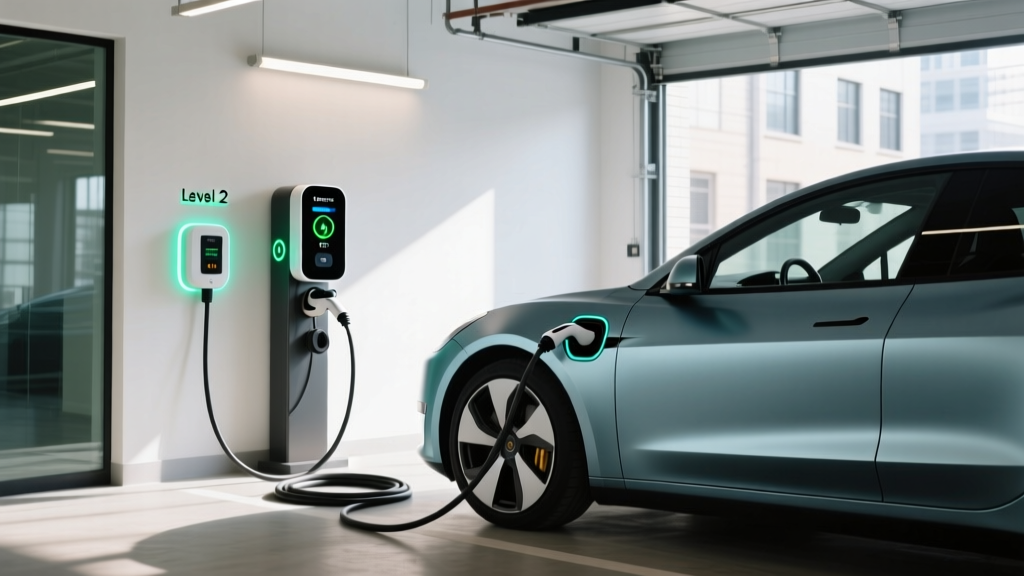
| Level 2 | 240V / 32–48A | 7.7–11.5 kW | 25–44 mi/hr | Daily home charging — the standard for BEV owners |
| DC Fast Charge | 400–800V DC | 50–350 kW | 150–1,000+ mi/hr (peak) | Road trips, quick top-ups on public networks |
For context, a Tesla Model Y Long Range (75 kWh usable battery, ~310 miles EPA) charging on a 48-amp Level 2 circuit at 11.5 kW adds roughly 44 miles of range per hour — enough to fully replenish overnight. On a 250 kW DC fast charger, that same vehicle can go from 10% to 80% in about 20–25 minutes, though the charge curve tapers significantly above 80% to protect the battery.
According to fueleconomy.gov, the average EV efficiency in the 2025–2026 model year is approximately 3–4 miles per kWh. Use that figure to estimate your own charging times: divide your battery's usable kWh by your charger's kW output.
Home Level 2 Installation: Electrical Requirements and Real Costs
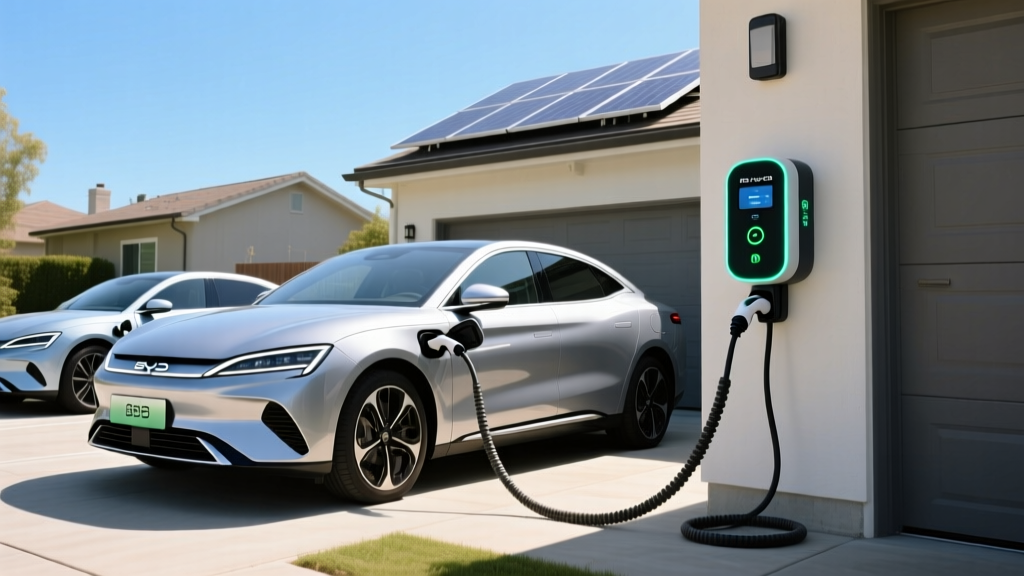
A Level 2 charger requires a dedicated 240-volt circuit, typically 40 to 60 amps, wired to a NEMA 14-50 outlet or hardwired directly to your panel. Here's what that looks like in practice:
- Circuit: 50-amp breaker for a 40-amp continuous charger (NEC requires 125% overhead for continuous loads)
- Wire: 6 AWG copper (THHN in conduit or NM-B Romex) for 40A; 4 AWG for 48A circuits
- Outlet: NEMA 14-50 (the same as an electric dryer or range) or hardwired connection
- GFCI: NEC 2020+ requires GFCI protection on 240V receptacles used for EV charging in garages
Do You Need a Panel Upgrade?
This is where costs can spike. Most homes built after 1990 have a 200-amp main panel, which usually supports a 40–60A EV circuit. But if your home has a 100-amp panel (common in houses built before the 1980s), or if your existing loads (electric range, dryer, HVAC, water heater) are already consuming most of your panel's capacity, you may need a service upgrade to 200 amps.
A panel upgrade from 100A to 200A typically costs $1,500–$3,500 including the new panel, utility coordination, and permits. Some utilities offer rebates for this work. Alternatively, a smart load-management device like the Sense Energy Monitor or chargers with built-in load sharing (e.g., Emporia Smart Charger with load management) can allow EV charging on a smaller panel by dynamically reducing charge rate when other appliances kick in.
| Component | Typical Cost Range | Notes |
|---|---|---|
| Level 2 Charger (Equipment) | $300–$700 | Smart Wi-Fi chargers at 40–48A |
| Electrician Labor | $400–$1,200 | Depends on run length from panel to garage |
| Permit & Inspection | $50–$200 | Required in most jurisdictions; varies by locality |
| Panel Upgrade (if needed) | $1,500–$3,500 | 100A to 200A service upgrade |
| Total (no panel upgrade) | $750–$2,100 | Most common scenario for 200A-panel homes |
| Total (with panel upgrade) | $2,250–$5,600 | Older homes or high-load households |
Always hire a licensed electrician and pull a permit. Unpermitted EV charger installs can void home insurance claims and create fire hazards. The National Electrical Contractors Association maintains a directory of qualified installers.
Connector Compatibility: NACS, CCS, and CHAdeMO in 2026
The connector landscape has shifted dramatically. As of the 2025–2026 model years, the North American Charging Standard (NACS) — originally Tesla's proprietary connector — has been adopted by Ford, GM, Hyundai/Kia, Rivian, BMW, and most major automakers. The legacy CCS1 connector remains on many vehicles sold from 2019–2024, and CHAdeMO is effectively discontinued for new vehicles (last seen on the Nissan Leaf).
| Connector | Brands Using It (2025–2026 Models) | Adapter Needed? |
|---|---|---|
| NACS (Tesla-style) | Tesla, Ford, GM, Hyundai/Kia, Rivian, BMW, Volvo, Polestar | No — native on most new EVs |
| CCS1 | VW ID.4 (through 2024), older Hyundai/Kia, BMW i4 (pre-2025) | CCS-to-NACS adapter (~$200) for Tesla Superchargers |
| CHAdeMO | Nissan Leaf (discontinued), Mitsubishi Outlander PHEV (older) | Limited DC fast network; plan charging carefully |
Home charging note: All Level 2 home chargers use the J1772 connector (or a NACS connector with J1772 compatibility). If your EV has a NACS port, you can buy a NACS home charger (like the Tesla Wall Connector) or use a J1772-to-NACS adapter. If your EV has a CCS port, any J1772 Level 2 charger works natively — CCS is simply J1772 with two extra DC pins.
Cost to Charge Per Mile vs. Your Grand Prix GTP's Gas Bill
The 2002 Grand Prix GTP Supercharged averages about 20 MPG combined in real-world driving (below its 18/26 EPA sticker once you factor in age and driving style). At $3.40/gallon, that's $0.17 per mile in fuel alone.
An average 2026 EV consuming 3.5 miles per kWh charged at different rates breaks down like this:
| Charging Scenario | Cost per kWh | Cost per Mile (at 3.5 mi/kWh) | Annual Fuel Cost (12,000 mi) |
|---|---|---|---|
| Home Off-Peak (utility rate) | $0.08–$0.12 | $0.023–$0.034 | $276–$408 |
| Home Standard Rate | $0.14–$0.18 | $0.040–$0.051 | $480–$612 |
| Public Level 2 (ChargePoint, etc.) | $0.25–$0.40 | $0.071–$0.114 | $852–$1,368 |
| DC Fast Charge (Electrify America) | $0.35–$0.55 | $0.100–$0.157 | $1,200–$1,884 |
| Grand Prix GTP (gas, 20 MPG) | $3.40/gal | $0.170 | $2,040 |
Even if you rely entirely on public DC fast charging — the most expensive scenario — you'll still spend less per mile than the GTP's supercharged V6 demands. But home off-peak charging is where the economics become dramatic: $300/year vs. $2,040/year, saving over $1,700 annually. Over five years, that's $8,500 in fuel savings alone.
Check your utility's time-of-use (TOU) rates. Many offer off-peak windows from 10 PM to 6 AM at rates as low as $0.06–$0.08/kWh. Smart chargers let you schedule charging within these windows automatically.
Charging Time Examples: 10–80% for Common EV Battery Sizes
DC fast charging speed depends on battery chemistry (LFP vs. NMC), thermal management, and the vehicle's charge curve. Peak kW is only sustained for a portion of the session — typically from 10% to about 50–60% SoC — before tapering to protect the cells. Here's what real-world 10–80% sessions look like:
- Hyundai Ioniq 5 (77.4 kWh, NMC, 800V architecture): Peaks at 240 kW, 10–80% in approximately 18 minutes on a 350 kW charger. Sustains above 200 kW through 55% SoC.
- Tesla Model Y Long Range (~75 kWh, NMC): Peaks at 250 kW at V4 Superchargers, 10–80% in roughly 22–25 minutes. Taper begins around 50%.
- Ford F-150 Lightning Extended Range (131 kWh, NMC): Peaks at 150 kW, 10–80% in about 41 minutes. Larger battery means longer sessions even at decent speeds.
- Chevrolet Equinox EV (85 kWh, NMC): Peaks at 150 kW, 10–80% in approximately 30 minutes.
- BMW iX xDrive50 (111.5 kWh, NMC): Peaks at 200 kW, 10–80% in roughly 31 minutes.
On a Level 2 home charger at 11.5 kW (48A), expect a full charge from 10% to 100% in 7–12 hours depending on battery size — easily accomplished overnight.
Recommended Level 2 Home Chargers for 2026
Emporia Smart EV Charger
- Power: 48A / 11.5 kW (hardwired) or 40A / 9.6 kW (NEMA 14-50 plug)
- Connector: J1772 (NACS adapter included)
- Cable Length: 24 feet
- Smart Features: Wi-Fi scheduling, energy monitoring, solar integration, load management
- Price: ~$399
- Best For: Budget-conscious buyers who want full smart features and load management for older panels
Tesla Wall Connector (Gen 4)
- Power: 48A / 11.5 kW
- Connector: NACS native (J1772 adapter available for non-Tesla EVs)
- Cable Length: 24 feet
- Smart Features: Wi-Fi, OTA updates, power sharing between multiple units, Tesla app integration
- Price: ~$475
- Best For: Tesla owners or households with NACS-equipped EVs
ChargePoint Home Flex
- Power: Up to 50A / 12 kW (configurable 16–50A to match circuit)
- Connector: J1772 (NACS adapter sold separately)
- Cable Length: 23 feet
- Smart Features: Wi-Fi, ChargePoint app scheduling, Alexa integration, flexible amperage
- Price: ~$699
- Best For: CCS1/J1772 EV owners wanting maximum flexibility and proven reliability
All three are UL-listed, rated for indoor and outdoor installation (NEMA 4 enclosure), and compatible with any US electrical panel. Hardwired installations are recommended for 48A+ chargers to avoid the 40A continuous-load limit of NEMA 14-50 receptacles.
Safety, Code Compliance, and Outdoor Installation
EV chargers draw sustained high current for hours — more than almost any other household appliance. Follow these safety essentials:
- Dedicated circuit only: Never share the EV charger circuit with other outlets or appliances.
- GFCI protection: Required by NEC 2020 and later for 240V receptacles in garages and outdoors. Hardwired chargers may have internal GFCI — verify with your electrician.
- Outdoor rating: If installing outside or in an unenclosed carport, ensure the charger is rated NEMA 4 (weather-resistant). All three recommendations above meet this standard.
- Cable management: Use a wall-mounted cable organizer to prevent tripping hazards and connector damage.
- Permit and inspection: Required in virtually all US jurisdictions. An unpermitted install can cause insurance claim denials and code violations at resale.
The National Fire Protection Association (NFPA) and your local building department provide specific requirements. Consult the National Electrical Code (NEC) Article 625 for the full EV charging installation standard.
Frequently Asked Questions
How much does it cost to install a home EV charger?
Most homeowners spend between $750 and $2,100 for a Level 2 installation when no panel upgrade is needed — that covers a $300–$700 smart charger, $400–$1,200 in electrician labor, and $50–$200 in permits. If your home needs a 100A-to-200A panel upgrade, add $1,500–$3,500 to that total. Get at least three quotes from licensed electricians.
How fast will each charging level add range?
Level 1 (120V) adds 3–5 miles per hour — fine for plug-in hybrids with small batteries but impractical for full EVs. Level 2 (240V, 48A) adds 25–44 miles per hour, fully replenishing most EVs overnight. DC fast charging (50–350 kW) can add 150–1,000+ miles per hour at peak, with typical 10–80% sessions taking 18–45 minutes depending on the vehicle.
Which connector and charger is compatible with my EV?
Check your vehicle's charge port. If it's NACS (Tesla-style, now standard on most 2025–2026 models from Ford, GM, Hyundai, Rivian, and others), buy a NACS charger like the Tesla Wall Connector or use a J1772 charger with a J1772-to-NACS adapter. If your EV has a CCS1 port (common on 2019–2024 models), any J1772 Level 2 charger works natively. CHAdeMO vehicles (older Nissan Leaf) are increasingly unsupported on public DC fast networks.
How much does charging cost per mile vs. gas?
Home off-peak charging costs roughly $0.02–$0.05 per mile. Public DC fast charging costs $0.10–$0.16 per mile. Compare that to a 20 MPG vehicle at $3.40/gallon, which costs $0.17 per mile. Even the most expensive public EV charging is cheaper than gasoline for most vehicles, and home charging cuts fuel costs by 70–85%.
What electrical upgrades might I need?
If your home has a 200-amp panel with available capacity, you likely need only a new 50-amp breaker and a wire run to the garage — no upgrade required. If your panel is 100 amps, nearly full, or uses outdated fuse-based protection, budget $1,500–$3,500 for a service upgrade. Smart load-management chargers can sometimes avoid a panel upgrade by dynamically adjusting charge rate.
Should I get a hardwired or plug-in charger?
Hardwired chargers support up to 48A continuous (on a 60A circuit), deliver faster charging, and eliminate the GFCI breaker requirement at the panel (many have internal GFCI). Plug-in (NEMA 14-50) chargers max out at 40A continuous and offer portability — useful if you might move. For maximum charge speed, go hardwired.