GMC Sierra EV Range: What the EPA Says vs. Real-World Driving
The GMC Sierra EV targets buyers who need full-size truck capability without the fuel pump. But range is the first question every truck shopper asks — and with a vehicle this heavy, the answer depends heavily on how you drive. Here's the breakdown by trim for the 2025-2026 model years:
| Trim | Battery (usable) | EPA Range | Real-World Highway | Real-World Cold (30°F) |
|---|---|---|---|---|
| Elevation (2WD) | ~200 kWh (NMC) | ~440 mi | ~350-380 mi | ~300-330 mi |
| AT4 (4WD) | ~200 kWh (NMC) | ~390 mi | ~310-340 mi | ~260-290 mi |
| Denali (4WD) | ~200 kWh (NMC) | ~400 mi | ~320-350 mi | ~270-300 mi |
For context, the EPA's fueleconomy.gov lists the Sierra EV's combined efficiency around 61 MPGe (Elevation), translating to roughly 49 kWh/100 miles — high for an EV but expected for a full-size truck.
Charging the Sierra EV: Levels, Speeds, and Times
Understanding charging requires distinguishing between kW (kilowatts = power, the rate of energy delivery) and kWh (kilowatt-hours = energy, the battery's capacity). Think of kW as the flow rate of a hose and kWh as the size of the tank. The Sierra EV's ~200 kWh battery is enormous — one of the largest in any consumer EV — so even fast charging takes meaningful time.
| Level | Power (kW) | Voltage/Amps | Miles of Range Added/Hour | 10-80% Time (Sierra EV ~200 kWh) |
|---|---|---|---|---|
| Level 1 (120V outlet) | 1.2-1.9 kW | 120V / 12-16A | ~2-4 mi/hr | Not practical (100+ hours) |
| Level 2 (240V home/public) | 7.7-19.2 kW | 240V / 32-80A | ~15-38 mi/hr | ~10-20 hours |
| DC Fast Charging | Up to 350 kW | 400-800V DC | ~100-200+ mi/hr (peak) | ~30-45 minutes |
The Sierra EV supports up to 350 kW peak DC fast charging on compatible 800V+ stations. GMC estimates a 10-80% charge in roughly 30-35 minutes at a 350 kW charger, though sustained rates taper significantly above 80% State of Charge (SoC) to protect the battery. On a typical 150 kW Electrify America or EVgo station, expect 10-80% in roughly 50-60 minutes.
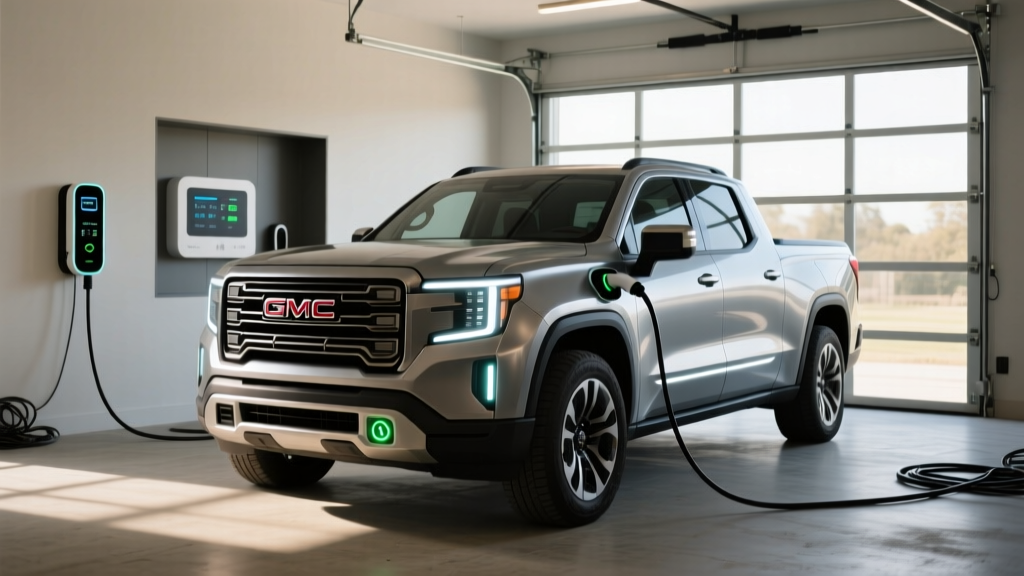
For home Level 2 charging, the Sierra EV's onboard charger accepts up to 19.2 kW (80 amps at 240V), which is among the highest in any consumer EV. This means a properly equipped home charger can add roughly 38 miles of range per hour — enough to fully replenish a daily commute overnight, though a full 10-100% charge still requires 10-12 hours.
Home Charger Installation: Electrical Requirements and Costs
Charging a truck with a ~200 kWh battery at home demands serious electrical infrastructure. Here's what a Sierra EV owner needs to know before calling an electrician.
Electrical Requirements
- Maximum home charge rate: 19.2 kW (80A continuous on a 100A dedicated circuit)
- Recommended minimum: 11.5 kW (48A continuous on a 60A dedicated circuit) — more achievable for most homes
- Voltage: 240V single-phase (standard US residential split-phase)
- Panel capacity: Minimum 200A main service panel recommended; older homes with 100A panels will likely need an upgrade
- Circuit breaker: Must be rated 125% of the continuous load (e.g., 60A breaker for a 48A charger, 100A breaker for an 80A charger)
Panel Upgrade Reality
Many homes built before 2000 have 100A or 150A main panels. Adding an 80A continuous EV load to a 200A panel that's already running HVAC, electric range, and dryer can exceed safe capacity. A licensed electrician will perform a load calculation per NEC Article 220 to determine if your panel can handle the circuit. If not, expect a panel upgrade to 200A or even 400A service — a significant cost but one that also benefits future home electrification.
| Item | Cost Range | Notes |
|---|---|---|
| Level 2 Charger (hardware) | $400 - $1,200 | Varies by power output and smart features |
| Electrician labor (standard install) | $600 - $2,000 | Depends on run length, wall type, conduit |
| Electrical permit | $50 - $300 | Varies by municipality |
| Panel upgrade (if needed) | $1,500 - $4,500 | 200A to 400A upgrade; not always required |
| Total (no panel upgrade) | $1,050 - $3,500 | Typical scenario for modern homes |
| Total (with panel upgrade) | $2,550 - $8,000 | Older homes or high-power 80A installs |
Always hire a licensed electrician and pull a permit. Unpermitted EV charger installations can void homeowner's insurance and create fire risk. The National Electrical Code (NEC) requires GFCI protection for outdoor receptacles and specific wire gauge for the circuit length.
Connector Compatibility: NACS, CCS, and What the Sierra EV Uses
The GMC Sierra EV comes equipped with the NACS (North American Charging Standard) connector — the Tesla-designed plug now adopted by GM and most major automakers. This is a significant advantage for charging network access in 2026.
| Connector | Brands Using It (2026) | Network Access | Adapter Needed for Sierra EV? |
|---|---|---|---|
| NACS (Tesla) | Tesla, GMC, Ford, Rivian, Hyundai, Kia, others | Tesla Supercharger, Electrify America (new stations), many others | Native — no adapter needed |
| CCS1 | Older VW ID.4, BMW iX, some legacy models | Electrify America, EVgo, ChargePoint | NACS-to-CCS adapter (~$200-250) if needed |
| CHAdeMO | Nissan Leaf (legacy); effectively discontinued | Limited and shrinking | Not recommended; adapters rare |
Because the Sierra EV uses NACS natively, it accesses Tesla's Supercharger network — over 25,000 stalls in North America — without any adapter. For older CCS-only public chargers still in service, GM offers a NACS-to-CCS adapter (available through dealers, typically $200-250). Check the GMC Sierra EV official page for the latest accessory compatibility.
Cost to Charge: Sierra EV vs. Gas Truck Per Mile
The Sierra EV's ~200 kWh battery is expensive to fill, but electricity still costs far less per mile than gasoline for a comparable full-size truck. Here's the math at 2026 average rates:
| Scenario | Rate | Full Charge Cost (~200 kWh) | Cost Per Mile (440 mi range) |
|---|---|---|---|
| Home (off-peak utility rate) | $0.09-0.13/kWh | $18 - $26 | $0.04 - $0.06/mi |
| Home (standard residential) | $0.14-0.18/kWh | $28 - $36 | $0.06 - $0.08/mi |
| Public Level 2 | $0.25-0.40/kWh | $50 - $80 | $0.11 - $0.18/mi |
| DC Fast Charging (350 kW) | $0.35-0.55/kWh | $70 - $110 | $0.16 - $0.25/mi |
For comparison, a gas GMC Sierra 1500 (4WD, 5.3L V8) averaging 17 MPG combined at $3.50/gallon costs roughly $0.21 per mile. Even on the most expensive DC fast chargers, the Sierra EV matches or beats gas cost per mile. Charging at home off-peak cuts fuel costs by 70-80%.
Best Home Chargers for the GMC Sierra EV
To take full advantage of the Sierra EV's 19.2 kW onboard charger, you need a high-amperage Level 2 unit. Here are three recommended chargers matched to different budgets and electrical setups:
ChargePoint Home Flex
- Power: Up to 12 kW (50A) / configurable down to 16A
- Connector: NACS (2025+ models) or J1772 with adapter
- Cable: 23 feet
- Smart features: Wi-Fi, app scheduling, Alexa, load sharing
- Price: ~$550-650
- Best for: Most homeowners; flexible amperage fits existing panels
Tesla Wall Connector
- Power: Up to 11.5 kW (48A) on NACS
- Connector: NACS native
- Cable: 24 feet
- Smart features: Wi-Fi, OTA updates, power sharing with multiple units
- Price: ~$425-475
- Best for: Budget-conscious NACS owners; excellent value
FLO Home X80
- Power: Up to 19.2 kW (80A) — maxes out the Sierra EV
- Connector: NACS (2025+ config) or J1772
- Cable: 25 feet
- Smart features: Wi-Fi, app, load management, utility integration
- Price: ~$900-1,100
- Best for: Maximum charge speed; requires 100A dedicated circuit
For Sierra EV owners with a 200A panel and adequate capacity, the FLO Home X80 at 80A / 19.2 kW delivers the fastest home charging — adding roughly 38 miles of range per hour and completing a full overnight charge in about 10-11 hours. If your panel can't support a 100A breaker, the ChargePoint Home Flex at 48-50A is the practical sweet spot.
Safety, Code, and Installation Best Practices
The Sierra EV draws serious current. Cutting corners on installation is a fire and insurance risk. Here's what the National Electrical Code (NEC) and common sense require:
- Dedicated circuit: Your EV charger must have its own dedicated breaker — never share a circuit with other appliances.
- GFCI protection: NEC 2023 and later require GFCI (Ground Fault Circuit Interrupter) protection for all outdoor EV charging receptacles. Hardwired chargers (no plug) may not require a GFCI breaker in all jurisdictions — ask your electrician.
- Wire gauge: For a 60A circuit, 6 AWG copper (THHN in conduit) is typical; for 80A, 4 AWG or 3 AWG depending on run length. Longer runs require upsizing to prevent voltage drop.
- Outdoor rating: If installing outside, the charger must carry a NEMA 3R or NEMA 4 rating for weather resistance. All recommended models above carry outdoor ratings.
- Permit and inspection: Most jurisdictions require an electrical permit for a new 240V circuit. The inspection ensures safe wiring, proper grounding, and code compliance. Budget $50-300 for the permit.
- Utility notification: Some utilities require notification before installing a high-power EV charger (especially 80A/19.2 kW). A few offer rebates or dedicated TOU meters that can offset costs.
Frequently Asked Questions
How much does it cost to install a home EV charger for the Sierra EV?
Expect $1,050 to $3,500 for a standard installation (charger + electrician + permit) if your electrical panel has adequate capacity. If a panel upgrade is needed, total costs can reach $2,550 to $8,000. The Sierra EV's high 19.2 kW acceptance rate may require a 100A dedicated circuit, which is more demanding than typical EV installs.
How fast will each charging level add range to the Sierra EV?
Level 1 (120V) adds roughly 2-4 miles per hour — impractical for a ~200 kWh battery. Level 2 at 48A (11.5 kW) adds about 23 miles per hour. At the Sierra EV's maximum 80A (19.2 kW), you'll see roughly 38 miles per hour. DC fast charging at 350 kW can add 100+ miles in 10 minutes during peak charge-curve rates.
Which connector is compatible with the GMC Sierra EV?
The Sierra EV uses the NACS connector natively. This gives direct access to Tesla Superchargers and the growing NACS public-charging ecosystem. For legacy CCS-only chargers, a NACS-to-CCS adapter (available from GMC dealers, ~$200-250) is required. CHAdeMO is effectively obsolete and not supported.
How much does charging the Sierra EV cost per mile vs. a gas truck?
At home off-peak rates ($0.09-0.13/kWh), the Sierra EV costs roughly $0.04-0.06 per mile — about 70-80% less than a gas Sierra 1500 at $0.21/mile (17 MPG, $3.50/gal). Even on expensive DC fast chargers ($0.35-0.55/kWh), the EV costs $0.16-0.25 per mile, competitive with or cheaper than gas.
What electrical upgrades might I need for the Sierra EV?
If your home has a 200A or larger main panel with available capacity, you may only need a new 60A-100A breaker and wiring run. Homes with 100A or 150A panels, or panels already near capacity, will likely need a service upgrade to 200A or 400A — costing $1,500 to $4,500. A licensed electrician's load calculation (per NEC Article 220) is the definitive answer. Some utilities offer rebates for panel upgrades tied to EV adoption; check with your local provider or consult IRS guidelines for related energy credits.
Does the Sierra EV qualify for the federal EV tax credit?
Under current IRS §30D rules, the Sierra EV's eligibility depends on battery sourcing, critical minerals requirements, buyer income caps ($300K joint / $150K single), and the MSRP cap for trucks ($80,000). Some Sierra EV trims exceed the MSRP cap. Point-of-sale transfer is available for eligible buyers. Always verify current-year eligibility with a tax professional before purchasing, as sourcing rules continue to evolve.