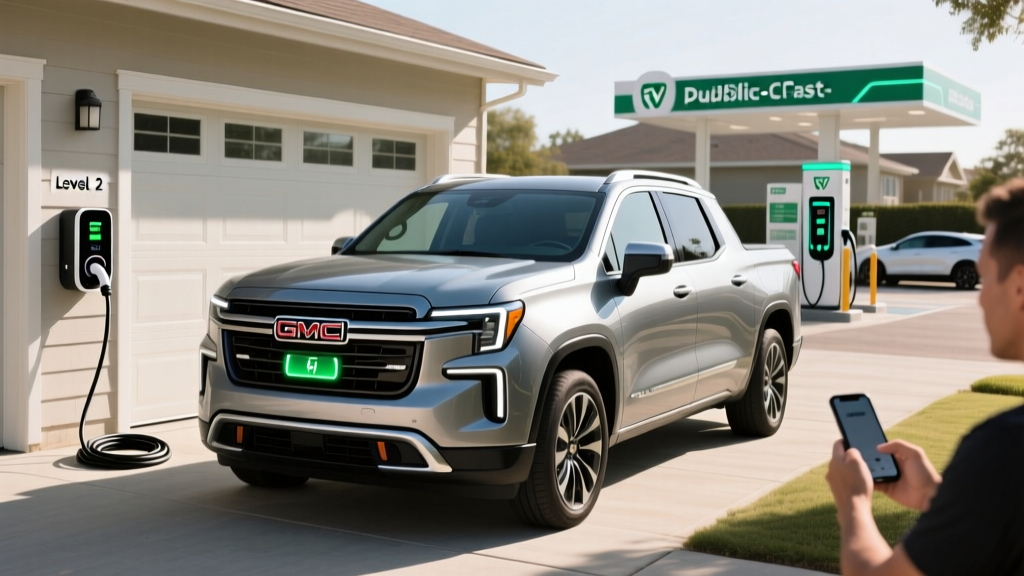
The GMC Sierra EV promises massive range and truck capability, but extracting every mile from its Ultium battery pack requires understanding the charging ecosystem. Whether you're looking at the 2025/2026 Denali Edition 1 or the Elevation trims, the Sierra EV's massive battery (up to 200+ kWh usable) presents unique charging challenges and opportunities that standard EV owners don't face. This guide maps out exactly how to charge a Sierra EV at home, on the road, and what it actually costs to keep this electric truck moving.
GMC Sierra EV Range: EPA Estimates vs. Real-World Expectations
The Sierra EV's headline number is its range. The Denali Edition 1 targets an EPA-estimated 440 miles from its ~200 kWh Ultium battery pack (NMC chemistry), while lower trims with smaller packs target 250–390 miles depending on configuration. But as with any EV — especially a heavy, aerodynamically challenged full-size pickup — the EPA sticker is a best-case starting point, not a guarantee.
EPA 440 mi (Denali Edition 1): Expect ~340–370 miles at sustained 70 mph highway speeds, and ~280–320 miles in cold weather (below 32°F) or when towing. The Sierra EV's boxy shape and 8,000+ lb curb weight hit efficiency hard at highway speeds. If you're towing a 5,000-lb trailer, plan for roughly 50% of EPA range — around 220 miles. Always plan road trips around the worst-case scenario, not the sticker.
For reference, the EPA rates the Sierra EV Denali Edition 1 at approximately 62 MPGe combined (~54 kWh/100mi). That's thirsty by EV standards — a direct consequence of moving a truck-sized mass. Source: fueleconomy.gov (search for the latest Sierra EV listings).
Charging Levels Explained: Speeds, Power, and Miles Per Hour
Understanding the three charging levels is critical for Sierra EV owners, because this truck's enormous battery means Level 1 charging is essentially useless for daily needs. Here's how each level breaks down — remember, kW (kilowatts) measures charging power (the rate), while kWh (kilowatt-hours) measures battery energy (the tank size).
| Level | Voltage / Amperage | Power (kW) | Miles of Range / Hour | 10–80% Time (200 kWh pack) |
|---|---|---|---|---|
| Level 1 (120V household) |
120V / 12A | ~1.4 kW | ~1.5–2 mi/hr | ~80+ hours (impractical) |
| Level 2 (240V home/public) |
240V / 32–80A | 7.7–19.2 kW | ~12–35 mi/hr | ~7–18 hours |
| DC Fast Charging (public stations) |
400–800V DC | 50–350 kW | ~90–350+ mi/hr (peak) | ~30–45 min (10–80%) |
The Sierra EV supports up to 19.2 kW Level 2 AC charging (80A onboard charger), which is among the fastest AC rates available in any EV. This is a major advantage: if your home electrical system can support an 80A circuit, you can add roughly 35 miles of range per hour at home. On DC fast charging, GM states the Sierra EV can accept up to 350 kW peak on compatible 800V architecture chargers, with a 10–80% charge in approximately 30–35 minutes under ideal conditions.
Charging curve reality: That 350 kW is a peak, not a sustained rate. Expect the Sierra EV to pull maximum power between roughly 10–40% SoC, then taper significantly. From 80–100%, charging slows dramatically to protect the battery — plan to charge to 80% on road trips and keep moving.
Home Charger Installation: Electrical Requirements, Costs, and Panel Upgrades
Installing a Level 2 home charger for the Sierra EV is more complex than for smaller EVs, because maximizing that 19.2 kW onboard charger requires serious electrical infrastructure. Here's what's involved.
Electrical Requirements
- For 19.2 kW (80A) charging: You need a 240V circuit rated at 100 amps (NEC code requires circuits be rated 125% of continuous load — 80A × 1.25 = 100A). This requires a dedicated double-pole breaker and 1/0 AWG copper or equivalent aluminum wire.
- For 11.5 kW (48A) charging: A 240V / 60A circuit is sufficient, using 6 AWG copper wire. This is the most common residential setup.
- For 7.7 kW (32A) charging: A 240V / 40A circuit with 8 AWG copper wire works — the minimum viable option for the Sierra EV's large battery.
Most homes built before 2010 have 100A or 150A main electrical panels. Adding a 60A or 100A dedicated EV circuit may exceed your panel's capacity — especially if you already run electric heat, a dryer, an oven, and AC. A panel upgrade to 200A or 400A service is a real possibility and can add $1,500–$5,000+ to your installation. Always have a licensed electrician perform a load calculation before committing to a charger circuit. Homes with 200A+ panels installed in the last 15 years are usually fine for a 60A EV circuit.
Installation Cost Breakdown
| Item | Low Estimate | High Estimate | Notes |
|---|---|---|---|
| Level 2 Charger (hardware) | $400 | $1,200 | Smart Wi-Fi chargers, 32–80A |
| Electrician labor (standard install) | $500 | $2,000 | Depends on run length, conduit, wall material |
| Electrical permit | $50 | $300 | Varies by municipality |
| Panel upgrade (if needed) | $1,500 | $5,000+ | 200A–400A service upgrade |
| Total (no panel upgrade) | $950 | $3,500 | Most homes with adequate panel capacity |
| Total (with panel upgrade) | $2,450 | $8,500+ | Older homes needing service upgrade |
The IRS §30D tax credit for home charging equipment (previously the Alternative Fuel Vehicle Refueling Property Credit, §30C) has been subject to legislative changes. As of 2026, check current IRS guidance for any available residential charging installation credits — eligibility and amounts vary. Some utilities also offer rebates of $250–$1,000 for Level 2 charger installation; check with your local provider.
Connector Compatibility: NACS, CCS, and the Sierra EV
GM made a pivotal decision for 2025+ models: the Sierra EV comes equipped with a NACS (North American Charging Standard / Tesla-style) charge port as its native connector. This is a significant advantage for public charging access in 2026.
| Connector Type | Sierra EV Native? | Adapter Needed? | Network Access |
|---|---|---|---|
| NACS (Tesla) | ✅ Yes — native port | None | Tesla Superchargers (20,000+ stalls), plus NACS-equipped Electrify America, EVgo, and others |
| CCS1 | ❌ No | NACS-to-CCS adapter (~$200–$250) | Legacy CCS stations (Electrify America, ChargePoint, EVgo older stalls) |
| CHAdeMO | ❌ No | Not recommended (adapters rare, expensive) | Declining network; largely irrelevant for Sierra EV owners |
| J1772 (Level 2 AC) | ❌ No (NACS handles AC natively) | NACS-to-J1772 adapter (often included with vehicle) | Public Level 2 stations with J1772 connectors |
Bottom line: The native NACS port gives the Sierra EV access to the most reliable and extensive fast-charging network in North America — Tesla Superchargers. GM owners can use Supercharger V3 (250 kW) and V4 stalls through the GM Energy app. Carry a NACS-to-CCS adapter for the remaining CCS-only stations you may encounter on rural routes.
Cost to Charge: Home vs. Public vs. Gas Comparison
One of the Sierra EV's strongest ownership arguments is fuel cost savings — but only if you charge smart. Let's break down real costs.
| Charging Scenario | $/kWh | Cost for 200 kWh Fill | Cost Per Mile (at 1.8 mi/kWh) |
|---|---|---|---|
| Home (off-peak utility rate) | $0.08–$0.14 | $16–$28 | $0.04–$0.08 |
| Home (standard rate, no TOU) | $0.15–$0.22 | $30–$44 | $0.08–$0.12 |
| Public Level 2 (ChargePoint, etc.) | $0.20–$0.35 | $40–$70 | $0.11–$0.19 |
| DC Fast Charging (Electrify America, EVgo) | $0.35–$0.55 | $70–$110 | $0.19–$0.31 |
| Tesla Supercharger (NACS) | $0.25–$0.40 | $50–$80 | $0.14–$0.22 |
| Gas equivalent (Silverado 1500, 19 MPG, $3.50/gal) | — | $92 (for ~500 mi) | $0.18/mile |
The takeaway: Home charging on off-peak rates is where the Sierra EV delivers massive savings — roughly $0.04–$0.08/mile vs. $0.18/mile for gas. That's a 55–78% per-mile fuel savings. However, if you rely exclusively on DC fast charging, the cost advantage shrinks considerably, and at some networks, you may actually pay more per mile than a gas truck. For Sierra EV owners who tow or road-trip frequently, budget for higher public charging costs.
Time-of-Use (TOU) tip: Many utilities offer EV-specific TOU rates with overnight prices as low as $0.05–$0.08/kWh. Schedule your Sierra EV to charge between midnight and 5 AM to capture these rates. A full 200 kWh overnight session at $0.07/kWh costs just $14 — enough for 360+ miles of range.
Best Home Chargers for the GMC Sierra EV: Equipment Picks
To take advantage of the Sierra EV's 19.2 kW onboard charger, you need a high-amperage Level 2 unit. Here are our top picks for 2026:
Grizzl-E Smart (80A)
- Power output: 19.2 kW (80A, 240V)
- Connector: NACS native
- Cable length: 24 ft
- Smart features: Wi-Fi, app scheduling, load sharing
- Price: ~$750–$850
- Best for: Sierra EV owners wanting max 19.2 kW home charging
ChargePoint Home Flex (up to 80A)
- Power output: Up to 19.2 kW (configurable 16–80A)
- Connector: NACS (2025+ models); J1772 with adapter
- Cable length: 23 ft
- Smart features: Wi-Fi, Alexa, detailed energy tracking
- Price: ~$650–$800
- Best for: Flexible amperage for panel-limited homes
Tesla Wall Connector (48A)
- Power output: 11.5 kW (48A, 240V)
- Connector: NACS native
- Cable length: 24 ft
- Smart features: Wi-Fi, OTA updates, power sharing
- Price: ~$450–$500
- Best for: Budget option; 48A still adds ~21 mi/hr to Sierra EV
Emporia Vue + Level 2 Charger
- Power output: Up to 11.5 kW (48A)
- Connector: NACS / J1772 options
- Cable length: 24 ft
- Smart features: Whole-home energy monitoring + EV scheduling
- Price: ~$400–$550 (charger); $350+ (monitoring panel)
- Best for: Energy-conscious owners wanting full-home visibility
For the Sierra EV's 200 kWh battery, we strongly recommend a 48A minimum (11.5 kW) home charger, with 80A (19.2 kW) being ideal if your electrical panel supports it. At 48A, a depleted 200 kWh pack charges in roughly 17 hours; at 80A, that drops to about 10 hours — the difference between needing two nights vs. one overnight session.
Safety, Code, and Installation Best Practices
Charging a Sierra EV draws sustained high current for hours — proper installation isn't optional, it's a fire-safety requirement. Key code and safety considerations:
- Dedicated circuit: NEC requires a dedicated breaker for EV charging — no sharing with other appliances.
- GFCI protection: 2023+ NEC revisions require GFCI protection for outdoor EV receptacles. Hardwired chargers (no plug) may bypass this requirement in some jurisdictions, but hardwiring is generally preferred for high-amperage (60A+) installations.
- Outdoor rating: If your charger is mounted outside or in an unconditioned garage, ensure it carries a NEMA 4 or NEMA 4X rating for weather resistance.
- Wire gauge: Undersized wire causes voltage drop and heat. Your electrician must size conductors to the circuit amperage — 6 AWG copper for 60A, 1/0 AWG for 100A.
- Permit and inspection: Every jurisdiction requires an electrical permit for new 240V circuits. The inspection verifies correct wire sizing, breaker rating, grounding, and bonding. Skip the permit and you risk voiding your homeowner's insurance in the event of an electrical fire.
- Connector holster and cable management: The Sierra EV's charging cable is thick and heavy at 80A ratings. Use a proper wall-mounted holster to prevent cable damage and tripping hazards.
Frequently Asked Questions
How much does it cost to install a home EV charger for the GMC Sierra EV?
Expect $950–$3,500 for a standard installation (charger hardware + electrician + permit) if your electrical panel has sufficient capacity. If a panel upgrade to 200A or 400A service is needed, total costs can reach $2,450–$8,500+. The Sierra EV's high onboard charger capacity (19.2 kW) may require heavier-gauge wiring and larger breakers than smaller EVs, increasing labor costs.
How fast will each charging level add range to the Sierra EV?
Level 1 (120V): ~1.5–2 miles per hour — essentially unusable for a 200+ kWh pack. Level 2 (240V, 48A): ~21 miles per hour. Level 2 (240V, 80A): ~35 miles per hour. DC Fast Charging (350 kW peak): up to ~200+ miles added in 20 minutes, though the rate tapers significantly above 50% SoC. The Sierra EV's efficiency of ~1.8 mi/kWh means charging speed in kW translates directly to miles added.
Which connector is compatible with the GMC Sierra EV?
The 2025+ GMC Sierra EV uses a native NACS (Tesla-style) charge port. This gives direct access to Tesla Superchargers and all NACS-equipped public stations without adapters. For legacy CCS1 stations, you'll need a NACS-to-CCS adapter (~$200–$250). For public Level 2 J1772 stations, GM typically includes a NACS-to-J1772 adapter with the vehicle.
How much does charging the Sierra EV cost per mile vs. gas?
At home on off-peak rates ($0.08–$0.14/kWh), the Sierra EV costs $0.04–$0.08 per mile — a 55–78% savings over a comparable gas Silverado 1500 at ~$0.18/mile. On DC fast chargers at $0.35–$0.55/kWh, costs rise to $0.19–$0.31/mile, which can exceed gas costs. Home charging is where the economics work best; plan road-trip budgets around higher public charging prices.
What electrical upgrades might I need for Sierra EV home charging?
The most common upgrade is a main electrical panel upgrade from 100A or 150A to 200A+ service ($1,500–$5,000). Other potential needs: a new dedicated 60A–100A double-pole breaker, conduit runs from panel to charger location (especially if the charger is far from the panel or in a detached garage), and possibly a utility service upgrade if your home's incoming service is below 200A. Always get a licensed electrician's load calculation before purchasing equipment.
Does the Sierra EV's battery warranty cover charging-related degradation?
GM's Ultium battery warranty covers 8 years / 100,000 miles with a capacity retention threshold (typically 60–70% of original capacity, per GM's warranty documentation). Normal degradation from DC fast charging is expected and generally not excluded, but abuse conditions (repeatedly charging to 100% and leaving the vehicle in extreme heat) could affect warranty claims. For daily use, charging to 80% and using DC fast charging only for road trips will maximize battery longevity.
Can I use a standard 120V outlet to charge the Sierra EV in a pinch?
Technically yes, but practically no. At ~1.4 kW (Level 1), adding range to a 200 kWh pack takes roughly 140+ hours for a full charge — that's nearly six days of continuous charging. Level 1 is only useful for maintaining charge on a parked Sierra EV or adding 15–20 miles overnight. For any real driving needs, a Level 2 home charger is mandatory for this vehicle.
Sources: EPA range and efficiency data via fueleconomy.gov; GMC Sierra EV specifications via GMC official site; IRS clean vehicle and charging credits via irs.gov. All pricing and availability current as of early 2026; verify with your dealer and electrician.