The GMC Sierra EV Denali Edition 1 and subsequent trims pack a massive Ultium battery — over 200 kWh of usable energy — enabling an EPA-estimated range above 400 miles. But extracting that GMC Sierra EV max range in real-world driving and keeping the battery healthy long-term depends entirely on how you charge it. This guide breaks down every charging scenario Sierra EV owners face: home Level 2 installation, public DC fast charging, connector standards, and the true cost per mile compared to a gas truck.
GMC Sierra EV Battery and Range: The Numbers That Matter
Before plugging in, understand what you're filling. The Sierra EV Denali Edition 1 carries a dual-layer Ultium battery with approximately 200+ kWh usable capacity (NMC chemistry). The EPA rates it at 440 miles of range on a full charge for the Denali Edition 1.
| Spec | Value |
|---|---|
| Battery Capacity (Usable) | ~200 kWh (NMC, Ultium dual-layer) |
| EPA Range | 440 miles |
| Max DC Fast Charge Rate | 350 kW (peak) |
| 10–80% DC Fast Charge Time | ~35–40 minutes (at 350 kW station) |
| Level 2 Onboard Charger | 19.2 kW (80A capable) |
| Level 2 Charge Time (0–100%) | ~10.5–11 hours |
| Native Connector (2025+) | NACS (Tesla-style) |
| Battery/Powertrain Warranty | 8 years / 100,000 miles |
| Base MSRP (Denali Edition 1) | $99,495 (incl. destination) |
That 19.2 kW onboard charger is a standout feature. Most EVs top out at 11.5 kW on Level 2, meaning the Sierra EV can absorb home power nearly 70% faster — if your home electrical system supports it.
Charging Levels Explained: Speeds, kW, and Miles Per Hour
EV charging comes in three tiers. Understanding the difference between kW (kilowatts, the rate of power delivery) and kWh (kilowatt-hours, the total energy stored in the battery) is essential. Think of kW as how fast water flows from a hose, and kWh as the size of the bucket.
| Level | Voltage / Amps | Power (kW) | Miles of Range Per Hour | Best For |
|---|---|---|---|---|
| Level 1 (120V) | 120V / 12A | ~1.4 kW | ~3–4 mi/hr | Emergency / trickle top-off only |
| Level 2 (240V) | 240V / 48A | 11.5 kW | ~28–32 mi/hr | Daily home charging (standard install) |
| Level 2 (240V, max) | 240V / 80A | 19.2 kW | ~47–52 mi/hr | Full-speed home charging (requires 100A circuit) |
| DC Fast Charge | 400–800V DC | Up to 350 kW | ~750–900 mi/hr (peak) | Road trips, rapid top-ups |
Level 1 is essentially useless for a 200 kWh battery. Adding 3 miles per hour means a full charge would take over 60 hours. Use it only for overnight maintenance or emergencies.
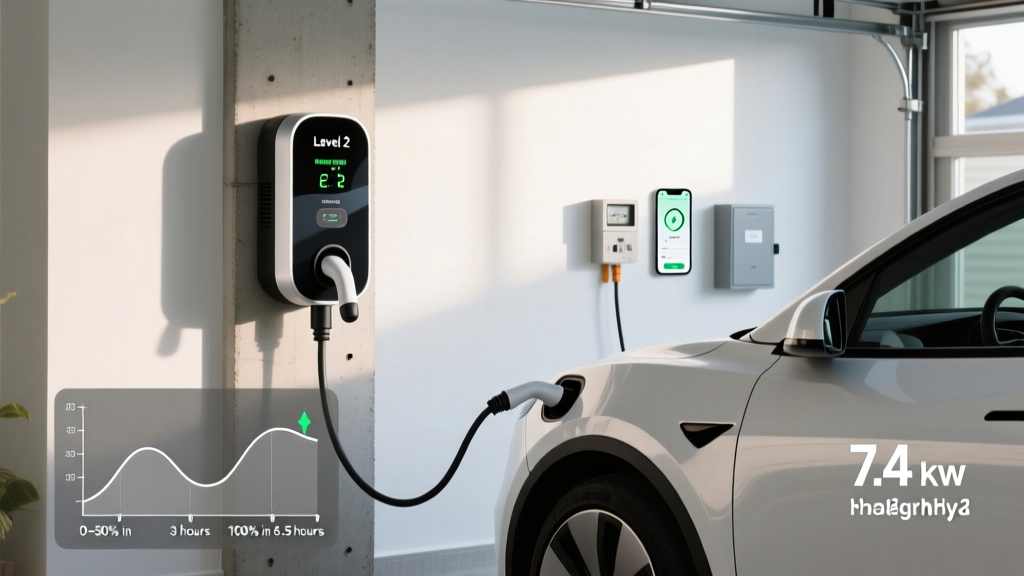
Level 2 is the backbone of daily EV ownership. At 11.5 kW (48 amps on a 60-amp circuit), you'll add roughly 30 miles of range per hour — enough to fully replenish a day's driving overnight. At the Sierra EV's maximum 19.2 kW (requiring an 80-amp continuous draw on a 100-amp circuit), you can add over 50 miles per hour, filling the entire battery in about 10–11 hours.
DC Fast Charging bypasses the onboard charger entirely, sending high-voltage DC straight to the battery. At a 350 kW station, the Sierra EV can add roughly 100 miles of range in about 10 minutes during peak charging. However, the charge curve tapers significantly above 80% state of charge — the last 20% can take as long as the first 70%. This is normal battery management to protect cell longevity.
Home Charger Installation: Electrical Requirements, Costs, and Panel Upgrades
Charging a Sierra EV at home is the cheapest and most convenient option — but installation costs vary enormously based on your home's electrical infrastructure.
What Electrical Service Do You Need?
To unlock the Sierra EV's 19.2 kW Level 2 capability, you need a dedicated 100-amp, 240-volt circuit with a NEMA 14-50 or hardwired connection. This is a substantial electrical load. Most homes built before 2010 have 100-amp or 150-amp main panels, which may not have enough spare capacity for a 100-amp EV circuit alongside existing loads (HVAC, electric oven, dryer).
For a more modest 11.5 kW setup (48A continuous on a 60A circuit), a 200-amp main panel usually has sufficient headroom. This is the practical sweet spot for most Sierra EV owners.
Installation Cost Breakdown
| Item | Standard Install (48A / 11.5 kW) | High-Power Install (80A / 19.2 kW) |
|---|---|---|
| Level 2 Charger Equipment | $500–$750 | $600–$1,200 |
| Electrician Labor (2–6 hrs) | $400–$1,200 | $800–$2,000 |
| Electrical Permit | $50–$200 | $50–$200 |
| Conduit, Wiring, Breaker | $100–$400 | $200–$600 |
| Panel Upgrade (if needed) | N/A (usually not needed) | $1,500–$3,500 |
| Total Estimated Cost | $1,050–$2,550 | $1,650–$7,500 |
The single biggest variable is whether your main electrical panel needs an upgrade. A panel upgrade from 100A to 200A typically costs $1,500–$3,500, including the new panel, breakers, and utility coordination. Homes already on 200A service usually skip this step.
Always hire a licensed electrician and pull a permit. The National Electrical Code (NEC) requires a dedicated circuit for EV charging, and your homeowner's insurance may deny claims related to unpermitted electrical work. For outdoor installations, ensure the charger carries a NEMA 4 or NEMA 4X rating for weather resistance.
Safety and Code Considerations
- Dedicated circuit: EV chargers must have their own breaker — no sharing with other appliances.
- GFCI protection: NEC 2020+ requires GFCI breakers for outdoor receptacles (NEMA 14-50). Hardwired chargers may exempt you from this requirement depending on local code.
- Wire gauge: 48A continuous requires 6 AWG copper wire; 80A requires 3 AWG or larger. Your electrician will size this correctly.
- Cable management: The Sierra EV's charge port is on the driver's side front fender. Mount your charger within cable reach (most units offer 18–25 ft cables) to avoid stretching across the driveway.
Connector Compatibility: NACS, CCS, and What the Sierra EV Uses
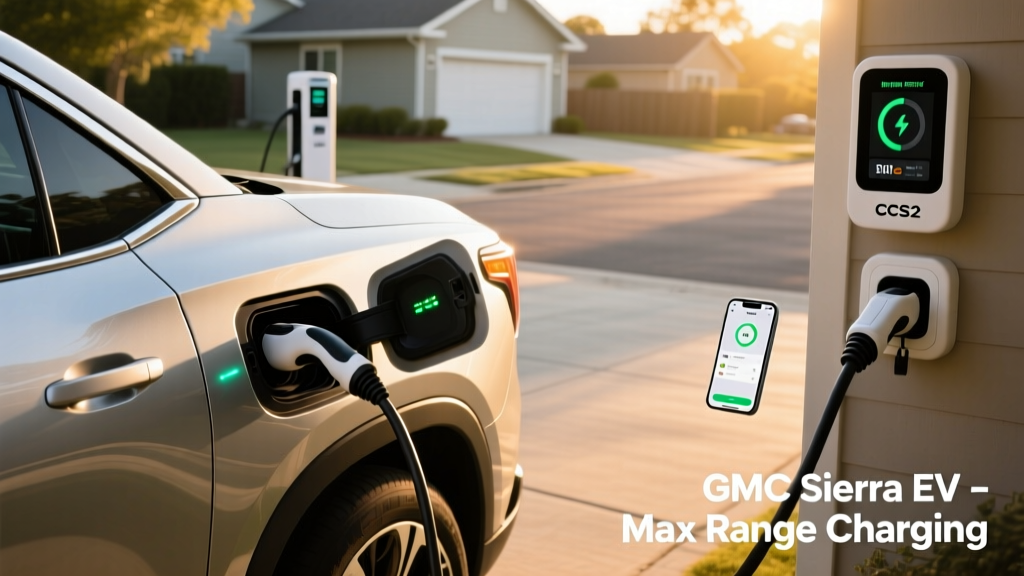
For the 2025 model year and beyond, GM has adopted the North American Charging Standard (NACS) — the connector originally developed by Tesla — across its EV lineup, including the Sierra EV. This is a major advantage for public charging access.
| Connector | Compatibility | Notes |
|---|---|---|
| NACS (Tesla-style) | Native — no adapter needed | Direct access to Tesla Supercharger network (17,000+ stalls) and growing NACS public stations |
| CCS1 | Adapter required | NACS-to-CCS1 adapters available (~$200–$300); needed for older Electrify America and some ChargePoint stations |
| CHAdeMO | Not recommended | Largely deprecated in North America; adapter availability limited |
The shift to NACS means Sierra EV owners get the best public charging experience available: plug-and-charge reliability at Tesla Superchargers, which consistently outperform CCS networks in uptime surveys. According to GM's official EV page, all new GM EVs include NACS ports as standard.
For home Level 2 charging, most wall connectors now ship with NACS plugs. If you purchase a CCS-equipped charger, a simple adapter resolves the mismatch.
Cost to Charge: Home vs. Public vs. Gas Truck
Charging cost is where the Sierra EV delivers its most compelling ownership advantage — especially if you can charge at home on off-peak electricity rates.
| Scenario | Rate | Cost to "Fill" (200 kWh / ~400 mi) | Cost Per Mile |
|---|---|---|---|
| Home (off-peak utility rate) | $0.10/kWh | $20.00 | $0.050/mi |
| Home (national avg residential) | $0.17/kWh | $34.00 | $0.085/mi |
| Public Level 2 (ChargePoint, EVgo) | $0.30/kWh | $60.00 | $0.150/mi |
| DC Fast Charge (Electrify America) | $0.48/kWh | $96.00 | $0.240/mi |
| Tesla Supercharger (avg) | $0.35/kWh | $70.00 | $0.175/mi |
| GMC Sierra 1500 Gas (18 MPG combined, $3.40/gal) | — | $75.56 (22.2 gal) | $0.189/mi |
At home on off-peak rates, the Sierra EV costs roughly 5 cents per mile to "fuel" — about one-quarter the cost of a comparable gas Sierra 1500. Even on DC fast chargers during road trips, you're paying roughly the same or less per mile as the gas equivalent. Data from the U.S. Department of Energy's fueleconomy.gov confirms that electricity costs per mile are consistently lower than gasoline in every U.S. state.
Pro tip: Many utilities offer time-of-use (TOU) plans with rates as low as $0.06–$0.10/kWh between midnight and 6 AM. Scheduling your Sierra EV to charge during these windows maximizes savings. The truck's built-in charge scheduling (via the myGMC app) makes this automatic.
Equipment Recommendations: Best Home Chargers for the Sierra EV
The Sierra EV's 19.2 kW onboard charger means you can benefit from higher-amperage wall units that would be wasted on most other EVs. Here are top picks across power tiers:
ChargePoint Home Flex (NACS) — Best All-Around
- Power Output: Up to 12 kW (50A) on a 60A circuit
- Connector: NACS (also available in J1772 with adapter)
- Cable Length: 23 feet
- Smart Features: Wi-Fi, app scheduling, Alexa integration, load sharing for dual units
- Price: ~$599
- Why it works: Reliable, UL-listed, works with most home panels without upgrade. Good match for 48A daily charging.
Tesla Wall Connector (NACS) — Best Value
- Power Output: Up to 11.5 kW (48A) on a 60A circuit
- Connector: NACS native
- Cable Length: 24 feet
- Smart Features: Wi-Fi, over-the-air updates, power sharing, access control
- Price: ~$475
- Why it works: Cleanest NACS integration, excellent build quality, competitively priced. Ideal if you also own a Tesla or want Supercharger-network familiarity at home.
FLO Home X80 (NACS) — Premium High-Power Option
- Power Output: Up to 19.2 kW (80A) on a 100A circuit
- Connector: NACS
- Cable Length: 25 feet
- Smart Features: Wi-Fi, app control, energy reporting, load management
- Price: ~$1,100–$1,300
- Why it works: One of the few residential chargers that can deliver the Sierra EV's full 19.2 kW. Requires 100A circuit and likely a 200A+ main panel.
For most Sierra EV owners, the ChargePoint Home Flex or Tesla Wall Connector at 48A/11.5 kW is the practical choice. You'll fully recharge overnight even after draining the battery to 20%, and you avoid the cost and complexity of a 100-amp dedicated circuit.
DC Fast Charging on the Road: Charge Curve and Practical Tips
The Sierra EV's 350 kW peak DC fast-charge capability is impressive, but understanding the charge curve is essential for realistic trip planning.
At a 350 kW charger (like a Tesla V4 Supercharger or Electrify America 350 kW station), the Sierra EV will:
- 10–40% SoC: Charge at or near peak 300–350 kW, adding roughly 100 miles in ~10 minutes
- 40–60% SoC: Taper to ~200–250 kW as battery temperature and voltage rise
- 60–80% SoC: Further taper to ~120–150 kW
- 80–100% SoC: Drop below 50 kW — charging the final 20% takes 30+ additional minutes
This means a 10–80% session takes approximately 35–40 minutes at a capable station. Plan road-trip stops around the 80% mark — staying longer to fill past 80% is almost never worth the time.
Preconditioning matters. Use the Sierra EV's navigation system to route to your charging stop. The truck will automatically warm or cool the battery to optimal temperature before you arrive, which can improve peak charge rates by 20–30% in cold weather. Without preconditioning, a cold battery in winter may peak at only 150–200 kW even at a 350 kW station.
Frequently Asked Questions
How much does it cost to install a home EV charger for the GMC Sierra EV?
A standard 48A / 11.5 kW Level 2 installation costs between $1,050 and $2,550 including equipment, electrician labor, permit, and wiring. If you opt for a full 80A / 19.2 kW setup and your home needs a panel upgrade, costs can reach $4,000–$7,500. Most Sierra EV owners find the 48A setup sufficient for overnight charging.
How fast will each charging level add range to the Sierra EV?
Level 1 (120V) adds roughly 3–4 miles per hour — impractical for daily use. Level 2 at 48A adds about 30 miles per hour. Level 2 at 80A adds roughly 50 miles per hour. DC fast charging at a 350 kW station can add 100+ miles in about 10 minutes at peak rate.
Which connector does the GMC Sierra EV use?
The 2025+ GMC Sierra EV uses the NACS (North American Charging Standard) connector natively. This provides direct access to the Tesla Supercharger network without an adapter. For older CCS1-equipped public stations, a NACS-to-CCS adapter (~$200–$300) is needed.
How much does charging the Sierra EV cost per mile vs. a gas truck?
At home on the national average electricity rate ($0.17/kWh), the Sierra EV costs about $0.085 per mile. A comparable gas GMC Sierra 1500 at 18 MPG and $3.40/gallon costs $0.189 per mile. Home charging on off-peak rates drops to roughly $0.05/mile — a 73% fuel cost reduction.
What electrical upgrades might I need for a Sierra EV home charger?
If your home has a 200-amp main panel, a 60-amp dedicated circuit (for 48A/11.5 kW charging) usually requires no panel upgrade. Homes with 100-amp or 150-amp panels may need an upgrade to 200A ($1,500–$3,500) if you want 80A high-power charging. A licensed electrician can perform a load calculation to determine your panel's spare capacity.
Does the Sierra EV qualify for the federal EV tax credit?
Federal tax credit eligibility under IRS §30D depends on MSRP caps ($80,000 for trucks/SUVs), buyer income limits, and battery component/critical mineral sourcing requirements. The Sierra EV Denali Edition 1 at $99,495 exceeds the MSRP cap and does not qualify. Lower-priced Sierra EV trims (as they become available) may qualify if they fall under the $80,000 truck cap and meet sourcing rules. Always consult a tax professional for current-year eligibility.
Charging the GMC Sierra EV is straightforward once you understand the infrastructure. For most owners, a 48A Level 2 home charger handles daily needs with overnight replenishment, while the NACS connector and 350 kW DC fast-charging capability make road trips practical. The truck's 440-mile EPA range — realistically 340–370 on the highway — means you'll stop to charge far less often than you'd stop for gas in a conventional Sierra.