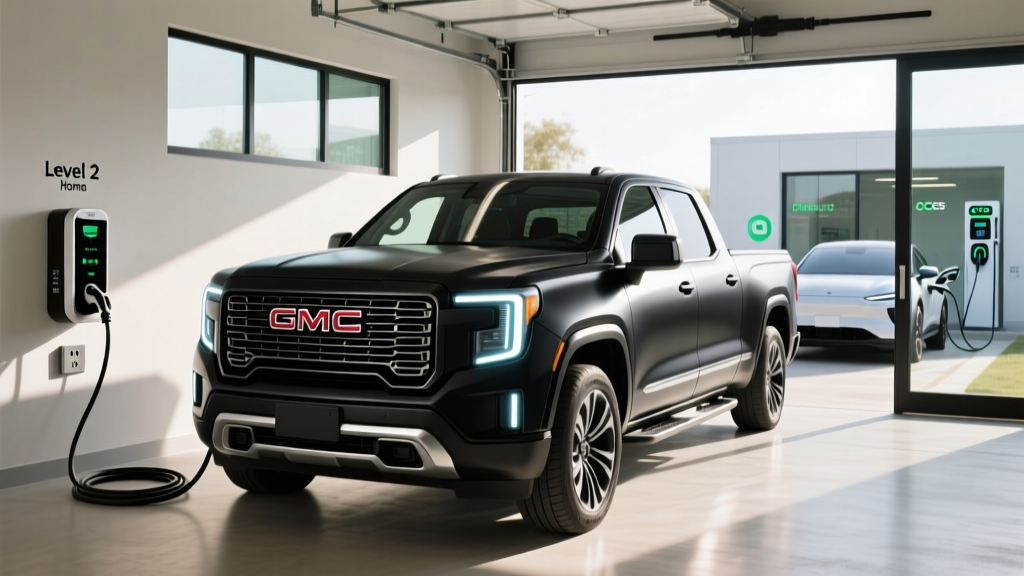
The GMC Sierra EV Denali Edition 1 arrives with a headline number that rewrites expectations for full-size electric pickups: an EPA-estimated 440 miles of range from a massive ~200 kWh usable Ultium battery pack. But a battery that large creates a unique charging challenge. Plug it into a standard 120V wall outlet and you'll be waiting days — literally — to go from empty to full. Getting the charging infrastructure right is arguably more critical for Sierra EV owners than for any other EV on the road in 2026.
This guide breaks down exactly how to charge the Sierra EV Denali's max-range battery at home and in public: the electrical work required, the real costs, which connectors and adapters you need, and which Level 2 chargers can actually handle this truck's appetite. Whether you're wiring up a garage or planning road trips, these numbers matter.
Sierra EV Denali Max Range: Battery and Charging Specs at a Glance
Before we get into chargers and electricians, let's anchor the numbers. The Sierra EV Denali Edition 1's energy capacity dictates everything downstream — from your home panel requirements to your road-trip stop strategy.
| Specification | Value |
|---|---|
| EPA Range | 440 miles (Edition 1, max-range pack) |
| Battery Capacity (usable) | ~200 kWh (NMC, Ultium platform) |
| Max DC Fast Charge Rate | 350 kW (peak) |
| DC Fast Charge 10–80% | ~34 minutes (optimal conditions) |
| Max Level 2 AC Charge Rate | 19.2 kW (80A capable onboard charger) |
| Native Connector (2025–2026) | NACS (Tesla-style) |
| 800V Architecture | Yes |
| Battery/Powertrain Warranty | 8 years / 100,000 miles |
Charging Levels Explained: Speeds in kW and Miles Per Hour
Understanding the three charging levels is essential — and the single most important distinction in EV literacy is between kW (kilowatts, the rate of power delivery) and kWh (kilowatt-hours, the total energy stored). Think of kW as how fast water flows through a hose, and kWh as the size of the bucket you're filling. The Sierra EV Denali's bucket is enormous at ~200 kWh, so flow rate matters enormously.
| Charging Level | Voltage / Amperage | Max Power (kW) | Miles of Range Added Per Hour | 0–100% Time (Sierra EV ~200 kWh) |
|---|---|---|---|---|
| Level 1 (Standard Outlet) | 120V / 12A | ~1.4 kW | ~3–4 mi/hr | ~60+ hours (not practical) |
| Level 2 (Home / Public AC) | 240V / 40–80A | 9.6–19.2 kW | ~25–55 mi/hr | ~10.5–21 hours |
| DC Fast Charging | 400–1000V DC | 50–350 kW | ~150–800+ mi/hr (peak) | 10–80% in ~34 min at 350 kW |
Level 1 is effectively a trickle for a 200 kWh battery — useful only for maintaining charge or adding ~30 miles overnight. Don't rely on it as a primary strategy.
Level 2 is where Sierra EV owners will do 90%+ of their charging. At the truck's maximum 19.2 kW AC acceptance rate, a full charge from empty takes about 10.5 hours — meaning overnight charging from a near-empty state is feasible, though most owners will plug in with 50–60% remaining and wake up full.
DC Fast Charging is for road trips. The Sierra EV's 800V architecture enables peak rates up to 350 kW, but remember: peak rate is not sustained rate. The charge curve tapers significantly above 80% State of Charge (SoC) to protect battery longevity. Expect roughly 34 minutes from 10–80% under ideal thermal conditions, but the final 80–100% could add another 25–35 minutes. For road trips, plan stops at 10–80% and skip topping off unless you're ending the day.
Home Level 2 Installation: Electrical Requirements and Costs
Here's where the Sierra EV Denali's massive battery translates into real-world electrical demands. The truck's onboard charger can accept up to 19.2 kW on Level 2 — that requires a 240V circuit rated at 80 amps (a 100A breaker, per NEC continuous-load rules requiring circuits to be rated 125% of the continuous draw). This is heavier than what most homes currently have set up for EV charging.
Electrical Requirements for Maximum Home Charging Speed
- Circuit: 240V dedicated, 100A breaker (for full 19.2 kW / 80A continuous)
- Wire gauge: 2 AWG copper or 1/0 AWG aluminum (run length dependent)
- Panel capacity: Minimum 200A main service; many homes with 100–150A panels will need an upgrade
- Alternative (lower cost): 60A breaker / 48A continuous = 11.5 kW — still adds ~33 miles per hour and fills the battery overnight in ~17 hours
- Permit: Required in nearly all US jurisdictions for new 240V circuits
How Much Does It Cost to Install a Home EV Charger?
| Cost Component | 48A / 60A Circuit (11.5 kW) | 80A / 100A Circuit (19.2 kW) |
|---|---|---|
| Level 2 Charger (hardware) | $500–$700 | $600–$1,200 |
| Electrician labor (run + install) | $600–$1,500 | $900–$2,200 |
| Electrical permit | $50–$200 | $50–$200 |
| Wire and conduit materials | $150–$400 | $250–$700 |
| Panel upgrade (if needed) | $1,500–$3,500 | $1,500–$3,500 |
| Total (no panel upgrade) | $1,300–$2,800 | $1,800–$4,300 |
| Total (with panel upgrade) | $2,800–$6,300 | $3,300–$7,800 |
These ranges reflect national averages as of early 2026. Costs vary significantly by region, run length from panel to garage, and local code requirements. Always get at least two quotes from licensed electricians and verify they have EV charger installation experience.
Connector Compatibility: NACS, CCS, and Adapter Needs
GM made a pivotal decision in 2024–2025: all new Ultium-based EVs, including the Sierra EV, ship with a NACS (North American Charging Standard) port — the Tesla-style connector. This gives Sierra EV owners native access to Tesla Superchargers (the largest fast-charging network in North America) without an adapter, while CCS stations now require an adapter in the opposite direction.
| Connector Type | Sierra EV Native? | Adapter Needed? | Network Examples |
|---|---|---|---|
| NACS (Tesla-style) | Yes — native port | No | Tesla Superchargers, Electrify America (new stalls), EVgo, Rivian Adventure Network |
| CCS1 | No | Yes — NACS-to-CCS adapter (~$200–$250) | Legacy Electrify America, ChargePoint DC stations, some utility-owned chargers |
| CHAdeMO | No | Not available (obsolete standard) | Older Nissan Leaf infrastructure — largely being phased out |
| J1772 (Level 2 AC) | No | Yes — NACS-to-J1772 adapter (often included with vehicle) | Public Level 2 stations, older home chargers |
Practical tip: Keep a NACS-to-CCS adapter in the truck at all times. While the industry is migrating to NACS, thousands of CCS chargers remain in service, and you'll encounter them on road trips through charging deserts or older installations. GM includes a J1772 adapter with the Sierra EV for compatibility with public Level 2 stations that haven't upgraded connectors.
Charging Cost Per Mile: Sierra EV vs Gas Truck
One of the strongest ownership arguments for the Sierra EV is cost-per-mile — but only if you charge smart. Electricity pricing varies wildly depending on where and when you charge.
| Charging Scenario | Avg Cost per kWh | Cost to Add 100 Miles | Cost per Mile |
|---|---|---|---|
| Home — off-peak utility rate | $0.10–$0.14 | $3.50–$4.90 | $0.035–$0.049 |
| Home — standard residential rate | $0.14–$0.20 | $4.90–$7.00 | $0.049–$0.070 |
| Public Level 2 (network pricing) | $0.25–$0.49 | $8.75–$17.15 | $0.088–$0.172 |
| DC Fast Charging (public) | $0.35–$0.65 | $12.25–$22.75 | $0.123–$0.228 |
| Gas Truck (20 MPG combined, $3.50/gal) | — | $17.50 | $0.175 |
The Sierra EV Denali's efficiency is approximately 2.8–3.0 kWh per mile (roughly 69 MPGe combined per fueleconomy.gov). At home off-peak rates, you'll spend roughly $0.04 per mile — a fraction of what a comparable gas-powered Sierra 1500 Denali costs at 16–18 MPG combined.
The math for a 200 kWh battery: A full home charge at $0.13/kWh costs about $26. That same 440 miles in a gas Sierra at 17 MPG and $3.50/gallon costs about $90. Over 15,000 miles annually, home charging saves roughly $2,000–$2,500 per year in energy costs alone.
However — if you rely primarily on DC fast charging at $0.50/kWh, your per-mile cost climbs to $0.15, which is only marginally cheaper than gas. Home charging access is the economic linchpin of EV truck ownership.
Best Level 2 Chargers for the Sierra EV Denali Max Range
Not all Level 2 chargers can deliver the 19.2 kW / 80A that the Sierra EV can accept. Most residential chargers top out at 48A (11.5 kW). If your electrical panel supports it and you want maximum home charging speed, you'll need an 80A-capable unit. Here are the top options for Sierra EV owners in 2026:
Tesla Wall Connector (NACS)
- Max Output: 48A (11.5 kW) on 60A circuit
- Connector: NACS — native fit for Sierra EV
- Cable Length: 24 ft
- Smart Features: Wi-Fi, OTA updates, power sharing between two units
- Price: ~$475
- Best For: Most homes; reliable, native NACS, no adapter needed
ChargePoint Home Flex (NACS version)
- Max Output: Up to 80A (19.2 kW) on 100A circuit (configurable via DIP switches)
- Connector: NACS (2025+ models)
- Cable Length: 23 ft
- Smart Features: Wi-Fi, app scheduling, Alexa, utility demand-response
- Price: ~$699
- Best For: Sierra EV owners wanting max 19.2 kW home speed
Emporia Level 2 EV Charger
- Max Output: 48A (11.5 kW) on 60A circuit
- Connector: J1772 (NACS adapter needed) or NACS version
- Cable Length: 24 ft
- Smart Features: Wi-Fi, solar integration, real-time energy monitoring, load management
- Price: ~$399
- Best For: Budget-conscious buyers with solar panels; excellent app
For Sierra EV Denali owners with a 200A panel and the budget for a 100A circuit, the ChargePoint Home Flex at 80A is the strongest match — it's one of the few consumer units that can deliver the truck's full 19.2 kW AC rate, cutting overnight charge time from ~17 hours (at 48A) to ~10.5 hours.
Public DC Fast Charging: Road Trip Strategy for 440 Miles of Range
The Sierra EV Denali's 350 kW peak DC fast-charge capability is only achievable at stations equipped with 350 kW+ dispensers — primarily newer Tesla Supercharger V4 stalls, Electrify America 350 kW units, and select EVgo locations. At a 350 kW stall, expect this charge curve behavior:
- 10–30% SoC: Near-peak 300–350 kW — adds roughly 150+ miles in 10 minutes
- 30–60% SoC: Sustained 200–280 kW — steady, fast accumulation
- 60–80% SoC: Tapers to 120–180 kW — still brisk but noticeably slower
- 80–100% SoC: Drops below 50 kW — avoid unless necessary
This taper is why the 10–80% time (~34 minutes) is the standard benchmark — and why road-trip strategy should center on 10–80% stops. With 440 miles of range, most Sierra EV owners can realistically drive 250–300 miles between stops (accounting for highway and weather losses) and still arrive with a comfortable buffer.
Cold-weather fast charging note: The Sierra EV's battery thermal management system includes preconditioning — if you set a DC fast charger as your navigation destination, the truck will warm the battery to optimal temperature before you arrive, enabling faster charge acceptance. Always use this feature in temperatures below 50°F. Without preconditioning, cold-soaked batteries can see charge rates reduced by 30–50%.
Safety, Code, and Installation Best Practices
EV charging involves sustained high-current draw — unlike a dryer or oven that cycles on and off, a Level 2 charger can run at full load for 10+ hours straight. This makes proper installation non-negotiable.
- Dedicated circuit: Your Level 2 charger must be on its own dedicated breaker — never shared with other appliances.
- GFCI protection: NEC 2023+ requires GFCI protection for all EV charging receptacles (not hardwired units in most jurisdictions). Hardwiring your charger avoids the nuisance-tripping issues that GFCI breakers sometimes cause with EVSEs.
- Outdoor rating: If installing outside, ensure the charger is rated NEMA 4 (weatherproof). All recommended units above carry outdoor ratings.
- Hardwire vs. plug: For 48A+ chargers, hardwiring is strongly recommended over a NEMA 14-50 receptacle. Receptacles can overheat under sustained 40–48A loads if not installed to exacting standards. For 80A units, hardwiring is mandatory — no standard receptacle is rated for 80A continuous.
- Cable management: With the Sierra EV's large bed and high charge port, ensure your cable length (23–25 ft) reaches comfortably. Consider a cable management hook or retractor to keep the cord off the garage floor.
- Utility incentives: Many utilities offer rebates of $250–$1,000 for Level 2 charger installation, and some offer time-of-use (TOU) rate plans that slash off-peak electricity costs. Check with your local utility before installation.
Federal Tax Credit and Incentive Considerations
Under current IRS §30D rules, the Sierra EV Denali Edition 1's eligibility for the federal clean vehicle credit depends on battery sourcing, critical minerals requirements, MSRP caps ($80,000 for trucks/vans), and buyer income limits ($300,000 joint / $150,000 single). The Edition 1's MSRP exceeds $90,000, which likely disqualifies it from the $7,500 credit. Lower Sierra EV trims (when available) may qualify. Additionally, the §25C Energy Efficient Home Improvement Credit can cover up to 30% of home charger hardware and installation costs (up to $1,000). Consult a tax professional for eligibility specifics.
Frequently Asked Questions
How much does it cost to install a home EV charger for the GMC Sierra EV?
Between $1,300 and $4,300 for a standard installation without a panel upgrade, depending on whether you choose a 48A or 80A circuit. If your home needs a panel upgrade to 200A service, add $1,500–$3,500. The Sierra EV's 19.2 kW onboard charger means you'll benefit most from an 80A circuit, but a 48A circuit still provides adequate overnight charging for most use cases.
How fast will each charging level add range to the Sierra EV Denali?
Level 1 (120V) adds roughly 3–4 miles per hour — impractical for a 200 kWh battery. Level 2 at 48A adds about 33 miles per hour, while 80A adds roughly 55 miles per hour. DC fast charging at 350 kW can add 150+ miles in 10 minutes at peak rates, though the charge curve tapers significantly above 80% SoC.
Which connector is compatible with the GMC Sierra EV?
The 2025–2026 Sierra EV uses a native NACS (Tesla-style) connector. This gives direct access to Tesla Superchargers without an adapter. For CCS1 stations, you'll need a NACS-to-CCS adapter (typically $200–$250). A J1772 adapter is included with the vehicle for older public Level 2 stations.
How much does charging the Sierra EV cost per mile compared to gas?
At home off-peak rates ($0.12/kWh), the Sierra EV costs approximately $0.04 per mile — compared to roughly $0.175 per mile for a gas Sierra 1500 Denali at 17 MPG and $3.50/gallon. However, DC fast charging at public rates ($0.45–$0.65/kWh) brings the cost to $0.13–$0.23 per mile, narrowing the advantage. Home charging is where the savings materialize.
What electrical upgrades might I need for the Sierra EV's 19.2 kW charger?
The Sierra EV's maximum Level 2 rate of 19.2 kW requires a 240V/80A continuous circuit (100A breaker). This demands a 200A main electrical panel with sufficient spare capacity. Homes with 100A or 150A service, or those with high existing loads (HVAC, electric range, pool), will likely need a panel upgrade or a load-management device. Always get a professional load calculation from a licensed electrician before purchasing equipment.