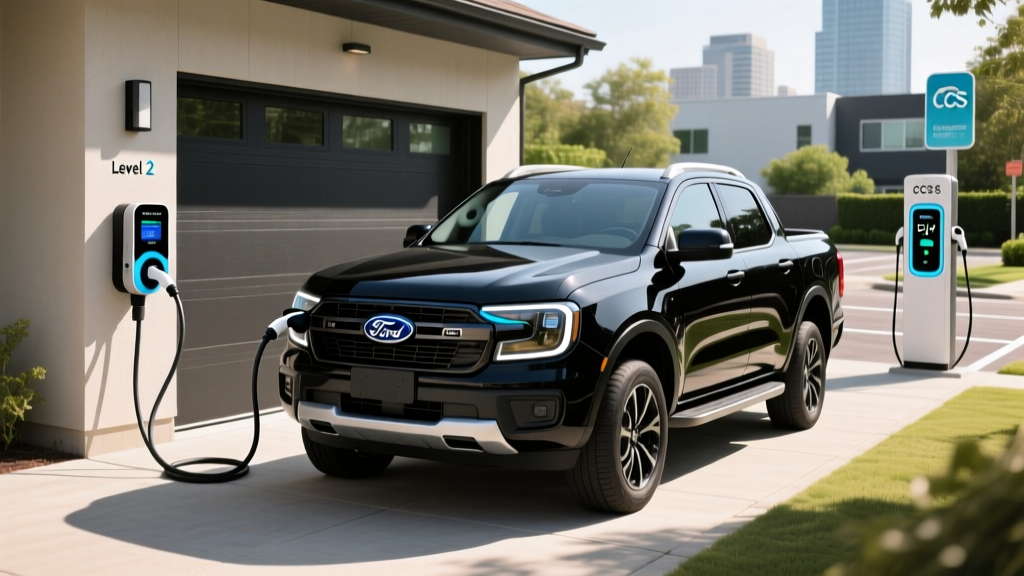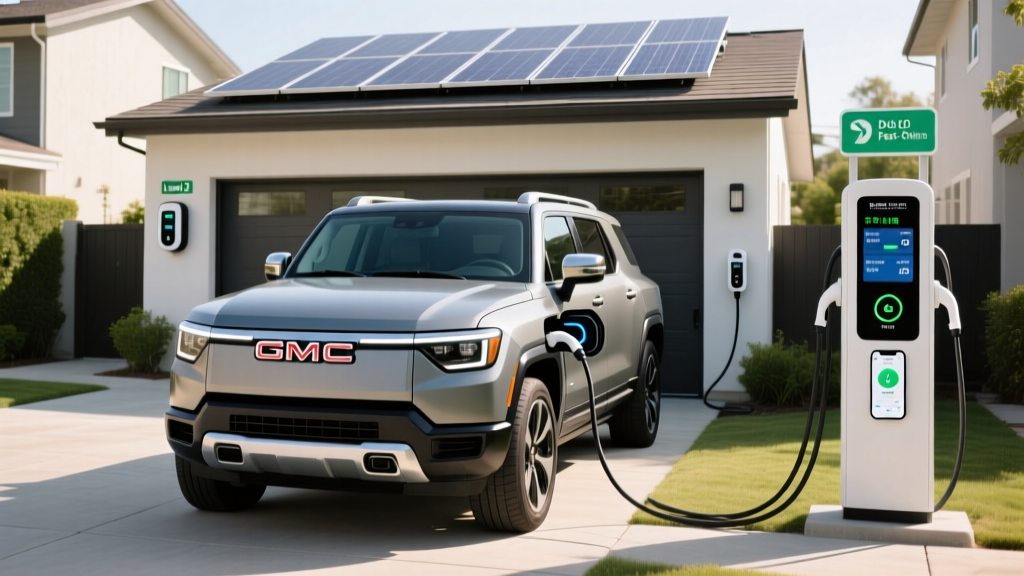
The GMC Hummer EV is an engineering marvel — a 9,000-pound electric supertruck with up to 1,000 horsepower. But its massive 246 kWh Ultium battery pack (the largest in any production passenger vehicle) creates unique charging challenges that most EV guides simply don't address. If you're researching the GMC Hummer EV range and how to keep this beast charged at home and on the road, this guide covers the exact infrastructure, equipment, and costs you'll face.
With an EPA-estimated 329 miles of range (Edition 1, 3X trim), the Hummer EV can handle road trips — but only if you understand its charging curve, connector needs, and the serious electrical upgrades a home setup demands. Let's break down every charging scenario with real numbers.
GMC Hummer EV Range: EPA vs. Real-World Expectations
Real-World Highway (70 mph, moderate weather): ~260–285 miles
Cold Weather (below 30°F, highway): ~210–245 miles
Efficiency: 47 MPGe combined / 72 kWh per 100 miles
Source: EPA fueleconomy.gov
The Hummer EV's efficiency is its Achilles' heel. At 72 kWh/100mi, it consumes roughly 2.5 times the energy of a Tesla Model Y (28 kWh/100mi). This means every charging session — whether at home or on a DC fast charger — takes longer and costs more per mile added. Understanding this is essential before you invest in home charging equipment.
The 2X trim with the smaller battery pack offers approximately 292 miles EPA, with similar real-world reductions. Towing cuts range dramatically — expect 150–180 miles when pulling a 7,500-lb trailer.
Charging Levels Explained: Speeds, kW, and Miles Per Hour
Before we get into equipment, let's clarify the most important distinction in EV charging: kW (kilowatts) measures charging power — how fast energy flows. kWh (kilowatt-hours) measures battery capacity — how much energy the battery holds. Confusing these two is the most common EV mistake. The Hummer EV has a 246 kWh battery; charging it at 19.2 kW (Level 2) is like filling a swimming pool with a garden hose.
| Level | Voltage / Amps | Max Power (kW) | Miles Added Per Hour | Hummer EV 10–80% Time |
|---|---|---|---|---|
| Level 1 (Standard Outlet) | 120V / 12A | 1.4 kW | ~2 mi/hr | ~123 hours (impractical) |
| Level 2 (Home/Public AC) | 240V / 48A | 11.5 kW | ~16 mi/hr | ~15 hours |
| Level 2 (High-Power AC) | 240V / 80A | 19.2 kW | ~27 mi/hr | ~9 hours |
| DC Fast Charging | 350–800V DC | ~200–350 kW (peak) | ~100+ mi in 12 min | ~34 min (10–80%) |
Critical note on the Hummer EV's DC fast charging: GMC quotes a peak charge rate of approximately 350 kW on compatible CCS chargers. However, the charge curve tapers significantly above 60% State of Charge (SoC). Expect the sustained average from 10–80% to be closer to 180–220 kW, which is why the 10–80% session takes roughly 34 minutes rather than the theoretical minimum. Battery preconditioning — which the Hummer EV initiates when you navigate to a charger — is essential for hitting peak rates in cold weather.
Home Charger Installation: Electrical Requirements and Costs
This is where Hummer EV ownership diverges sharply from owning a smaller EV. The 246 kWh battery means Level 2 charging at standard 11.5 kW (48A) requires roughly 15 hours for a 10–80% session. For daily driving of 40–60 miles, that's manageable — you plug in overnight and recover 160–240 miles of range by morning. But if you regularly deplete the battery on road trips, you'll want the fastest Level 2 setup your home can support.
Electrical Requirements by Charger Size
The Hummer EV's onboard charger accepts up to 19.2 kW on AC power (80A circuit). To unlock this, you need:
- 100A dedicated circuit (NEC requires circuits rated 125% of continuous load — 80A × 1.25 = 100A breaker)
- 240V service with 2/0 AWG copper or 4/0 AWG aluminum wire
- 200A main electrical panel minimum — many older homes with 100A or 150A panels will need a full service upgrade
- Hardwired connection (no NEMA outlet at 80A continuous; a NEMA 14-50 outlet supports up to 40A continuous / 48A breaker)
For a more practical and affordable 48A / 11.5 kW setup, you need a 60A dedicated circuit with 6 AWG copper wire, which most 200A panels can accommodate without a full upgrade.
| Item | 48A / 11.5 kW Setup | 80A / 19.2 kW Setup |
|---|---|---|
| EVSE Equipment (charger) | $500–$750 | $700–$1,200 |
| Electrician Labor (4–8 hrs) | $600–$1,600 | $1,000–$2,500 |
| Wire & Conduit Materials | $200–$500 | $400–$900 |
| Permit & Inspection | $100–$300 | $150–$400 |
| Panel Upgrade (if needed) | $0–$2,500 | $0–$2,500 |
| Total Estimated Cost | $1,400–$5,650 | $2,250–$7,500 |
Panel upgrade reality check: If your home has a 100A main panel, adding a 60A or 100A EV circuit will almost certainly require a service upgrade to 200A or 320A. This costs $2,000–$4,500 depending on your utility and local rates. Some utilities offer rebates of $500–$1,500 for panel upgrades tied to EV adoption — check with your provider. Always hire a licensed electrician and pull permits; unpermitted EV charger work can void homeowner's insurance and create fire hazards.
Safety and Code Requirements
- GFCI protection: NEC 2020+ requires GFCI breakers for outdoor receptacles (NEMA 14-50). Hardwired chargers have internal ground-fault protection.
- Outdoor rating: If your charger is mounted outside, the EVSE must carry a NEMA 4 or NEMA 4X weatherproof rating.
- Dedicated circuit: EV chargers must be on their own dedicated circuit — never shared with dryer, HVAC, or other appliances.
- Cable management: For 80A hardwired setups, ensure the cable run from panel to charger is as short as practical to minimize voltage drop (keep under 3% drop per NEC recommendation).
Connector Compatibility: CCS1, NACS, and Adapters
The GMC Hummer EV ships with a CCS1 (Combined Charging System) port, which is the standard for most non-Tesla EVs in North America. However, the charging landscape has shifted dramatically — Tesla's NACS connector is now the dominant standard, and GM has committed to transitioning its EV lineup to NACS.
| Connector | Compatibility | Network Access | Adapter Needed? |
|---|---|---|---|
| CCS1 (native) | Hummer EV built-in | Electrify America, EVgo, ChargePoint DC | No |
| NACS (Tesla) | Via GM-approved adapter | Tesla Supercharger network (17,000+ stalls) | Yes — CCS-to-NACS adapter ($200–$300) |
| CHAdeMO | Not compatible | Limited legacy stations | N/A — avoid |
| J1772 (Level 2 AC) | Hummer EV built-in | Home chargers, public Level 2 | No (for non-Tesla); Tesla Destination requires J1772 adapter |
The NACS adapter is essential for Hummer EV owners in 2026. Tesla's Supercharger network offers the most reliable and widespread DC fast charging infrastructure in the US. GM provides a CCS-to-NACS adapter (or has made one available through dealerships) for Hummer EV owners. With this adapter, you can access Supercharger V3 stalls (up to 250 kW) and V4 stalls. Note that Supercharger V3 stalls may not deliver the Hummer EV's full 350 kW peak — for maximum DC speed, Electrify America's 350 kW CCS stations remain the best option.
Charging Cost Per Mile: Hummer EV vs. Gas Trucks
The Hummer EV's poor efficiency (72 kWh/100mi) means charging costs are higher than most EVs — but still significantly lower than fueling a comparable gas-powered supertruck. Here's the math across common scenarios:
| Scenario | Rate | Cost Per 100 Miles | Cost Per Mile |
|---|---|---|---|
| Home Charging (off-peak utility rate) | $0.12/kWh | $8.64 | $0.086 |
| Home Charging (average US rate) | $0.17/kWh | $12.24 | $0.122 |
| Public Level 2 (ChargePoint, etc.) | $0.30/kWh | $21.60 | $0.216 |
| DC Fast Charging (Electrify America) | $0.48/kWh | $34.56 | $0.346 |
| Tesla Supercharger (with adapter) | $0.35/kWh | $25.20 | $0.252 |
| Gas equivalent (Ford F-150, 18 MPG, $3.50/gal) | — | $19.44 | $0.194 |
Key takeaway: Home charging on off-peak rates delivers massive savings — roughly $0.09/mile vs. $0.19/mile for a gas truck. But exclusive reliance on DC fast charging ($0.35–$0.48/kWh) can actually exceed gas costs per mile. The Hummer EV economics work best when 80%+ of charging happens at home. Plan your road-trip budget accordingly: a 300-mile trip on DC fast chargers will cost roughly $75–$105 in electricity.
For a full 10–100% charge at home (approximately 220 kWh usable from 10–100%), expect to pay $26.40 at $0.12/kWh or $37.40 at $0.17/kWh. This takes 12–19 hours on Level 2 depending on your charger's output.
Recommended Home Chargers for the GMC Hummer EV
Given the Hummer EV's massive battery and 19.2 kW onboard charger capability, here are the top Level 2 EVSE options ranked by suitability:
ChargePoint Home Flex (Up to 50A / 12 kW)
- Power Output: Up to 50A (12 kW) on 240V, adjustable down to match your circuit
- Connector: J1772 (compatible with Hummer EV's AC port)
- Cable Length: 23 feet
- Smart Features: Wi-Fi, app scheduling, utility rate optimization, Alexa integration
- Connection: Hardwired or NEMA 14-50 plug
- Price: ~$650
- Verdict: Best value for daily Hummer EV charging. A 10-hour overnight session adds ~160 miles — enough for most daily needs.
Grizzl-E Smart (48A / 11.5 kW)
- Power Output: 48A (11.5 kW) on 240V
- Connector: J1772
- Cable Length: 24 feet
- Smart Features: Wi-Fi, OCPP-compatible, load balancing, energy tracking
- Connection: Hardwired or NEMA 14-50
- Price: ~$550
- Verdict: Rugged Canadian-built unit rated to -40°F. Excellent for cold-climate Hummer EV owners and outdoor installation.
Ford Charge Station Pro (80A / 19.2 kW)
- Power Output: 80A (19.2 kW) on 240V — maxes out the Hummer EV's onboard charger
- Connector: J1772
- Cable Length: 25 feet
- Smart Features: Wi-Fi, FordPass integration (works with any J1772 vehicle)
- Connection: Hardwired only (requires 100A dedicated circuit)
- Price: ~$1,000–$1,200
- Verdict: The fastest Level 2 option. Cuts overnight charge to ~9 hours for a 10–80% session. Requires serious electrical infrastructure — best for new construction or homes with 320A service.
Emporia Level 2 Smart Charger (48A / 11.5 kW)
- Power Output: 48A (11.5 kW) on 240V
- Connector: J1772
- Cable Length: 24 feet
- Smart Features: Real-time energy monitoring, solar integration, TOU scheduling, app control
- Connection: Hardwired or NEMA 14-50
- Price: ~$400
- Verdict: Budget pick with excellent smart features. Ideal if you have solar panels and want to charge exclusively on excess solar production.
Important: None of these Level 2 chargers will fully recharge a depleted Hummer EV overnight. The 246 kWh battery is simply too large. Plan your charging around your driving patterns — if you regularly drive 200+ miles in a day, you'll need DC fast charging to supplement.
Public DC Fast Charging: Maximizing Speed on the Road
When road-tripping in the Hummer EV, your DC fast charging strategy matters enormously. Here's how to optimize:
- Precondition the battery: Always navigate to your charging stop using the Hummer EV's built-in navigation. This triggers battery thermal preconditioning, warming or cooling the pack to optimal temperature for peak charge rates. Without preconditioning, especially in cold weather, your peak charge rate may drop from 350 kW to under 150 kW.
- Charge to 80%, not 100%: The charge curve tapers sharply above 80% SoC. Charging from 80–100% can take as long as 10–80%. Plan shorter, more frequent stops at 10–80% rather than waiting for a full charge.
- Target 350 kW stations: Electrify America's 350 kW CCS chargers deliver the fastest speeds for the Hummer EV's CCS port. Use the PlugShare or A Better Routeplanner apps to identify 350 kW stations along your route.
- Expect real-world 10–80% times of 30–40 minutes: While GMC's peak rate is impressive, the sustained average and charge curve taper mean a typical highway stop takes about 35 minutes.
Tax Credits and Incentives for Home Charging Equipment
The federal Alternative Fuel Vehicle Refueling Property Credit (IRS §30C) was reinstated and modified under the Inflation Reduction Act. For 2026, eligible taxpayers can claim up to $1,000 (30% of cost, capped) for home EV charger equipment and installation. Key rules per IRS.gov:
- The charger must be installed at your primary residence
- The property must be located in an eligible census tract (non-urban or low-income community — check the IRS eligibility tool)
- The credit covers both equipment and installation labor
- Income caps and other restrictions may apply — consult a tax professional
Some states and utilities offer additional rebates of $250–$1,500 for Level 2 charger installation. Check your utility's EV program page and your state energy office for current offerings.
Frequently Asked Questions
How much does it cost to install a home EV charger for the GMC Hummer EV?
For a standard 48A / 11.5 kW setup, expect $1,400–$5,650 total (equipment, electrician, permit, and potential panel upgrade). For a high-power 80A / 19.2 kW setup, budget $2,250–$7,500. The biggest variable is whether your electrical panel needs an upgrade from 100A to 200A service, which adds $2,000–$4,500.
How fast will each charging level add range to the Hummer EV?
Level 1 (120V) adds roughly 2 miles per hour — essentially useless for this vehicle. Level 2 at 11.5 kW adds ~16 miles per hour. Level 2 at 19.2 kW adds ~27 miles per hour. DC fast charging at peak rate can add 100+ miles in approximately 12 minutes, though sustained rates are lower.
Which connector does the GMC Hummer EV use, and do I need an adapter?
The Hummer EV has a CCS1 port for DC fast charging and a J1772 port for Level 2 AC charging. To access Tesla Superchargers, you need a CCS-to-NACS adapter ($200–$300), which GM has made available for Hummer EV owners. This adapter is highly recommended for road trips.
How much does charging the Hummer EV cost per mile compared to gas?
At home on off-peak rates ($0.12/kWh), the Hummer EV costs about $0.09/mile — roughly half the cost of fueling a gas truck at $0.19/mile. However, exclusive use of DC fast chargers ($0.35–$0.48/kWh) can push costs to $0.25–$0.35/mile, which exceeds gas. Home charging is essential for favorable economics.
What electrical upgrades might I need for a Hummer EV home charger?
If your home has a 100A main electrical panel, you will almost certainly need a service upgrade to 200A or 320A, costing $2,000–$4,500. For a 48A charger, you need a 60A dedicated circuit. For an 80A charger, you need a 100A dedicated circuit. Homes built after 2000 typically have 200A panels and may not need an upgrade for a 48A setup.
Can I charge the Hummer EV with solar panels?
Yes, but you'll need a substantial solar array. At 11.5 kW charging power, you need roughly 15–20 kW of solar capacity to charge at full speed during peak sun hours. A smart charger like the Emporia Level 2 can automatically adjust charging rate to match excess solar production, avoiding grid draw.
How does the GMC Hummer EV's range hold up in cold weather?
Expect a 25–35% range reduction in sustained below-freezing temperatures. The 329-mile EPA rating drops to approximately 210–245 real-world miles in winter highway driving. The Hummer EV's battery thermal management system helps mitigate this, but the physics of lithium-ion cells in cold weather cannot be fully eliminated. Preconditioning while plugged in recovers some range.
For official EPA range and efficiency data, consult fueleconomy.gov. For federal tax credit rules on charging equipment, see IRS §30C guidelines. Always verify local electrical codes with a licensed electrician before installation.