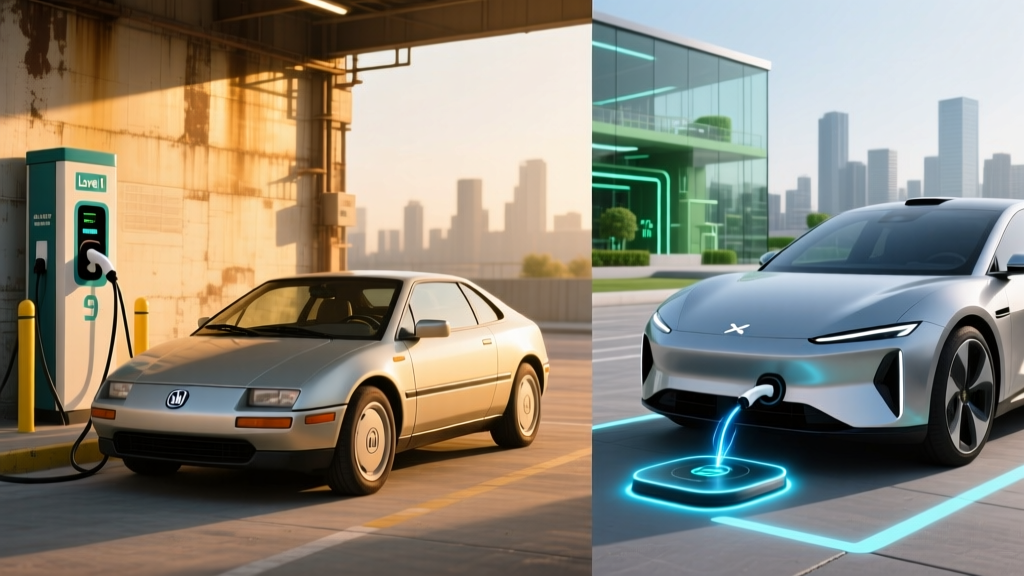
If you've ever searched for GM EV1 range, you've stumbled onto one of the most important origin stories in electric mobility. Introduced in 1996, the GM EV1 managed roughly 60 miles on its lead-acid battery and about 80–100 miles after the 1999 nickel-metal hydride (NiMH) upgrade — a figure that defined the limits of early electric cars. Fast-forward to 2026, and modern EVs routinely deliver 250–400+ EPA-rated miles on a single charge, supported by a home and public charging infrastructure the EV1's engineers could only dream of.
This guide uses that dramatic leap — from the EV1's constrained range to today's long-range battery packs — as the backdrop for a complete, numbers-driven walkthrough of modern EV charging: levels, speeds, home installation costs, connectors, and the real cost per mile versus gasoline.
The GM EV1 Range in Context: Then vs. Now
The EPA's EV history archives note that the GM EV1's lead-acid pack stored just 16.5 kWh of energy, yielding about 55–70 real-world miles. The later NiMH version bumped capacity to 26.4 kWh, pushing range toward 80–100 miles under ideal conditions. By comparison, a 2026 Chevrolet Equinox EV with an 85 kWh usable NMC battery delivers an EPA-estimated 315 miles, while the Hyundai Ioniq 6 Long Range hits 361 miles from 77.4 kWh.
Now (2026): Chevy Equinox EV 3RS — 85 kWh battery, 315 miles EPA (~260–280 mi highway real-world), 150 kW DC fast charging (10–80% in ~25 min).
The charging story has evolved just as dramatically. The EV1 relied on the now-obsolete Magne Charge inductive paddle. Today's EVs use standardized conductive connectors (NACS, CCS1) and can accept up to 350 kW at public DC fast chargers. Understanding these levels is the first step to confident EV ownership.
Charging Levels Explained: kW, Speed, and Miles Per Hour
The single most common point of confusion for new EV owners is the difference between kW (kilowatts) and kWh (kilowatt-hours). Think of kW as the flow rate of electricity — how fast energy enters your battery. Think of kWh as the tank size — how much total energy the battery holds. A 75 kWh battery charged at 7.5 kW takes roughly 10 hours from empty to full (minus charging-curve taper near the top).
| Level | Voltage | Max Power (kW) | Miles of Range Added Per Hour | Best For |
|---|---|---|---|---|
| Level 1 (120V) | 120V AC | 1.2–1.9 kW | 3–5 miles | Overnight top-ups, PHEVs, low daily mileage |
| Level 2 (240V) | 240V AC | 3.3–19.2 kW | 12–75 miles | Daily home charging, workplace, destinations |
| DC Fast Charge | 400–800V DC | 50–350 kW | 150–1,200+ miles/hr (peak) | Road trips, rapid top-ups, commercial fleets |
Real-world nuance: DC fast charging doesn't sustain peak kW for the entire session. A vehicle rated for 250 kW peak might only sustain that rate between 10–30% State of Charge (SoC), then taper to 150 kW, then 75 kW, and finally under 30 kW above 85%. This is the charging curve, and it's why we measure fast-charge performance as 10–80% time, not peak kW alone.
Charging Time Examples for Common 2026 Battery Sizes
| Vehicle (2026) | Battery (kWh usable) | Level 2 at 11.5 kW (0–100%) | DC Fast 10–80% |
|---|---|---|---|
| Chevy Equinox EV | 85 kWh (NMC) | ~8.5 hours | ~25 min (150 kW peak) |
| Tesla Model Y Long Range | 75 kWh (NMC) | ~7.5 hours | ~20 min (250 kW peak) |
| Ford F-150 Lightning Ext. Range | 131 kWh (NMC) | ~13 hours | ~38 min (150 kW peak) |
| Hyundai Ioniq 5 | 77.4 kWh (NMC) | ~7 hours | ~18 min (240 kW peak, 800V) |
Vehicles on 800V architectures (Hyundai Ioniq 5/6, Kia EV6, Porsche Taycan) sustain higher charge rates longer, making them the road-trip champions. If you road-trip frequently, prioritize 800V capability over a slightly larger battery.
Home Charger Installation: Electrical Requirements, Costs, and Gotchas
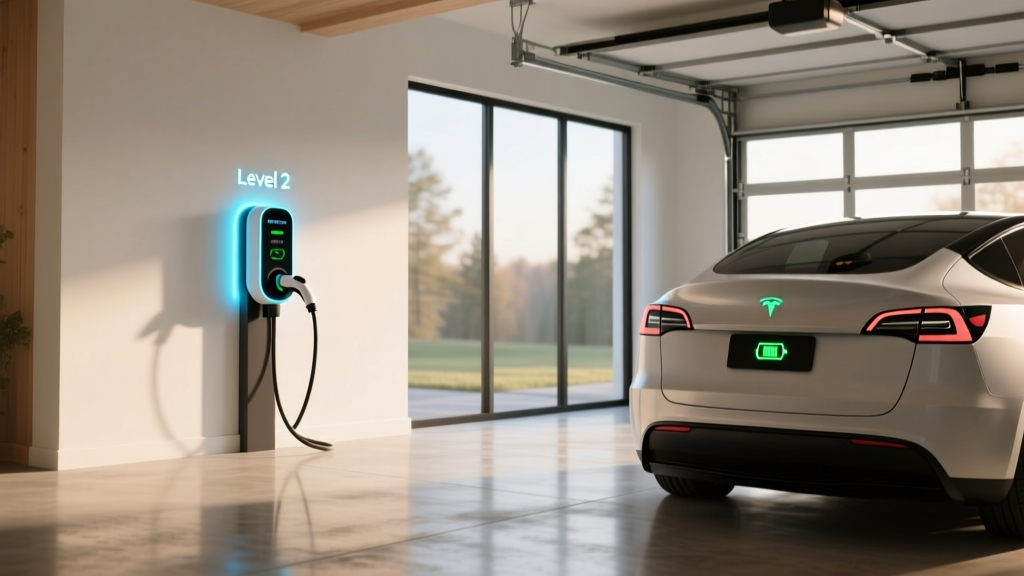
Installing a Level 2 home charger is the single highest-impact upgrade an EV owner can make. It transforms charging from a chore into something that happens automatically while you sleep. But costs vary enormously based on your electrical panel, distance from panel to charger location, and local permitting.
Electrical Requirements
A typical Level 2 home charger runs on a 240V dedicated circuit at 40A or 48A, delivering 9.6 kW or 11.5 kW respectively. The National Electrical Code (NEC) requires the circuit breaker to be rated at 125% of the continuous load, meaning a 48A charger needs a 60A breaker. Your home's main electrical panel must have sufficient spare capacity — usually at least 200A total service for modern homes with an EV, heat pump, and electric range.
Do You Need a Panel Upgrade?
Homes built before 1990 often have 100A or 150A main service. Adding a 60A EV circuit to a panel already near capacity can require a panel upgrade to 200A, which costs $1,500–$3,500 on its own. Some utilities offer load-management devices (like the Sense monitor or Span smart panel) that allow EV charging without a panel upgrade by dynamically throttling the charger when other loads spike. Ask your electrician about this option before committing to a full panel swap.
| Component | Low End | High End | Notes |
|---|---|---|---|
| Level 2 Charger (hardware) | $350 | $700 | 40A–48A smart charger, 25-ft cable, NACS or J1772 |
| Electrician labor (standard install) | $500 | $1,500 | Panel to garage, <30 ft run, conduit, wiring |
| Permit & inspection | $50 | $300 | Varies by municipality; some waive for EV circuits |
| Panel upgrade (if needed) | $1,500 | $3,500 | 100A→200A service upgrade; not needed in most newer homes |
| Total (no panel upgrade) | $900 | $2,500 | Most common scenario for homes built after 2000 |
| Total (with panel upgrade) | $2,400 | $6,000 | Older homes, long wire runs, or detached garages |
Federal incentive: The IRS Residential Clean Energy Credit (25C) covers 30% of home EV charger hardware and installation costs, up to $1,000. Confirm current-year eligibility with a tax professional, as incentive rules and caps can change.
Connector Compatibility: NACS, CCS1, CHAdeMO, and Adapters
The connector landscape has consolidated significantly since 2024, when Ford, GM, Rivian, Volvo, and others committed to adopting Tesla's North American Charging Standard (NACS). By 2026, NACS is the dominant connector for new vehicles sold in North America. CCS1 remains on many 2022–2025 models, and CHAdeMO is effectively legacy (Nissan Leaf being the last holdout).
| Connector | Brands Using (2026 Models) | DC Fast Charging Access | Adapter Needed? |
|---|---|---|---|
| NACS (Tesla standard) | Tesla, Ford, GM, Rivian, Volvo, Polestar, Hyundai (new models) | Tesla Supercharger network natively; growing open networks | None for Superchargers; CCS adapter for Electrify America, etc. |
| CCS1 | VW ID.4 (prior model years), BMW iX, older Hyundai/Kia, Stellantis | Electrify America, EVgo, ChargePoint, Ionity (EU) | NACS-to-CCS adapter for Tesla Supercharger access (~$200–$250) |
| CHAdeMO | Nissan Leaf (legacy) | Limited and shrinking network | No reliable adapter to NACS/CCS; avoid for new purchases |
Adapter reality check: Ford and GM owners with NACS ports can use Tesla Superchargers directly but need a NACS-to-CCS adapter (sold by Tesla, Ford, and third parties like Lectron for ~$200–$250) to access Electrify America or older CCS stations. Always carry the appropriate adapter on road trips.
Cost to Charge: Home, Public, and DC Fast — Per Mile vs. Gasoline
One of the most compelling arguments for going electric is the per-mile fuel cost. But the savings depend heavily on where and when you charge. Here's a realistic breakdown using 2026 national averages.
| Charging Scenario | Avg. Cost ($/kWh) | Cost Per Mile (3.0 mi/kWh EV) | Equiv. Gas MPG at $3.40/gal |
|---|---|---|---|
| Home (off-peak utility rate) | $0.10–$0.14 | $0.033–$0.047 | 72–103 MPG |
| Home (standard residential rate) | $0.15–$0.18 | $0.050–$0.060 | 57–68 MPG |
| Public Level 2 (workplace/destination) | $0.20–$0.35 | $0.067–$0.117 | 29–51 MPG |
| DC Fast Charging (public) | $0.35–$0.55 | $0.117–$0.183 | 19–29 MPG |
The takeaway: If you charge primarily at home on off-peak rates, your EV costs roughly $0.04/mile to "fuel" — equivalent to driving a 90 MPG gas car. Even at DC fast-charging prices, most EVs still undercut a 25 MPG gasoline car at $0.14/mile. But if you rely entirely on public DC fast chargers (no home or workplace access), the cost advantage narrows significantly. Home charging access is the single biggest factor in EV economics.
For context, the GM EV1 would have cost about $0.03/mile to charge at 1999 electricity rates — remarkably similar to modern home-charging costs per mile, because the EV1 was so light and efficient (~4–5 mi/kWh). The difference is that today's EVs offer 4× the range, 5× the power, and full highway capability.
Recommended Home Chargers for 2026
Not all Level 2 chargers are created equal. Here are three proven options across budget tiers, all compatible with the dominant NACS connector standard (J1772 versions also available for CCS-port vehicles).
Budget Pick: Emporia Vue Smart Charger
- Power: 48A / 11.5 kW (240V, hardwired) or 40A / 9.6 kW (NEMA 14-50 plug)
- Connector: NACS or J1772
- Cable: 24 ft
- Smart features: Wi-Fi, app scheduling, solar integration, load management
- Price: ~$399
- Best for: Budget-conscious buyers who want smart scheduling and energy monitoring
Best Overall: ChargePoint Home Flex (2nd Gen)
- Power: Up to 50A / 12 kW (adjustable via dip switch for panel flexibility)
- Connector: NACS or J1772
- Cable: 25 ft
- Smart features: Wi-Fi, Alexa/Google Home, app scheduling, amperage adjustment
- Price: ~$599
- Best for: Most homeowners — flexible amperage avoids panel-upgrade costs
Premium Pick: Tesla Wall Connector
- Power: Up to 48A / 11.5 kW (hardwired, 60A circuit)
- Connector: NACS native (J1772 adapter included)
- Cable: 24 ft
- Smart features: Wi-Fi, OTA updates, power sharing (multiple units on one circuit), vehicle integration
- Price: ~$475
- Best for: Tesla and NACS-adopting owners who want seamless vehicle-charger communication
Pro tip: If your electrical panel is tight on capacity, choose a charger with adjustable amperage (like the ChargePoint Home Flex). You can dial it down to 32A or 24A to avoid a costly panel upgrade while still getting 20–30 miles of range per hour — more than enough for overnight charging.
Safety, Code, and Installation Best Practices
EV charging is a high-draw, continuous electrical load. The NEC treats it seriously, and so should you. Here are the non-negotiable safety requirements:
- Dedicated circuit: Your Level 2 charger must be on its own dedicated breaker — no sharing with outlets, lights, or other appliances.
- GFCI protection: NEC 2020 and later require GFCI (Ground Fault Circuit Interrupter) protection for all EV charging circuits. Most modern hardwired chargers have built-in GFCI; plug-in units require a GFCI breaker.
- Outdoor rating: If mounting outdoors, the charger must carry a NEMA 4 or IP55+ rating. All three chargers recommended above are outdoor-rated.
- Wire gauge: A 48A charger on a 60A breaker requires 6 AWG copper wire for runs under 50 feet. Longer runs may need 4 AWG to prevent voltage drop. Your electrician will calculate this.
- Permit and inspection: Most jurisdictions require an electrical permit and post-installation inspection. Don't skip this — it protects you and is required for insurance claims and home sales.
- NEMA 14-50 outlet caution: If using a plug-in charger with a NEMA 14-50 receptacle, ensure it's installed by a licensed electrician with a torque screwdriver. Loose 14-50 outlets have been linked to overheating incidents. Many electricians now recommend hardwiring instead.
The National Fire Protection Association (NFPA) maintains the NEC code that governs EV circuit installation. Your local jurisdiction may adopt the 2020, 2023, or 2026 NEC edition — each has progressively stricter EV charging requirements.
Frequently Asked Questions
How much does it cost to install a home EV charger?
A standard Level 2 home charger installation runs $900–$2,500 including hardware, electrician labor, and permits — assuming your electrical panel has sufficient capacity. If a panel upgrade from 100A to 200A is needed, add $1,500–$3,500. The 30% federal tax credit under IRS §25C can offset up to $1,000 of the total.
How fast will each charging level add range?
Level 1 (120V) adds 3–5 miles per hour. Level 2 (240V) adds 12–75 miles per hour depending on amperage (a 48A/11.5 kW charger adds roughly 35–45 miles per hour for a typical EV). DC fast charging adds 150–1,200+ miles per hour at peak, but tapers significantly above 80% SoC — that's why 10–80% time is the standard metric.
Which connector/charger is compatible with my EV?
For 2026 models: Tesla, Ford, GM, Rivian, and new Hyundai/Kia/Volvo models use NACS. Older VW, BMW, Stellantis, and 2022–2025 Hyundai/Kia models use CCS1. The Nissan Leaf uses CHAdeMO (legacy). Check your vehicle's charge port or owner's manual, then buy a matching home charger. If you have a CCS1 vehicle, a NACS-to-CCS adapter (~$200–$250) unlocks Tesla Supercharger access.
How much does charging cost per mile vs. gas?
Home charging on off-peak rates costs roughly $0.04/mile — equivalent to a 90 MPG gas car at $3.40/gallon. Standard residential rates push it to ~$0.05–$0.06/mile. Public DC fast charging costs $0.12–$0.18/mile, still cheaper than most gas cars. The key variable is home charging access: without it, EV fuel-cost savings shrink considerably.
What electrical upgrades might I need?
Homes with 200A service (most homes built after 2000) typically need no panel upgrade. Homes with 100A or 150A service may need a panel upgrade ($1,500–$3,500) or a load-management device to avoid one. Long wire runs from panel to garage (100+ feet) may require thicker-gauge wire, adding $200–$500. Detached garages may need a sub-panel ($500–$1,200). Always get a site assessment from a licensed electrician before purchasing equipment.
What was the GM EV1's range, and how does it compare to modern EVs?
The GM EV1 achieved roughly 60–70 miles on its original lead-acid battery (16.5 kWh) and 80–100 miles with the 1999 NiMH upgrade (26.4 kWh). A 2026 Chevy Equinox EV stores 85 kWh and delivers 315 EPA-rated miles — roughly 4× the range with 5× the battery capacity. Modern EVs also charge 10–15× faster on DC fast chargers and operate in all weather conditions the EV1 struggled with.
The arc from the GM EV1's 80-mile range to today's 300+ mile EVs isn't just a battery story — it's a charging-infrastructure story. The EV1 was cancelled in part because drivers couldn't charge quickly or conveniently. In 2026, a $900–$2,500 home charger installation, combined with a growing NACS Supercharger network and 800V DC fast-charging capability, has largely solved the problem that doomed the EV1. The range is there. The charging is there. The math works.