The Electrified G80 is Genesis's flagship electric sedan — a luxury EV with a 87.2 kWh battery pack, 282 miles of EPA-estimated range, and a refined driving experience. But luxury EV ownership lives or dies on charging convenience. Whether you're researching the Genesis G80 charging port before purchase or you've just taken delivery and need to set up home charging, this guide covers every connector, speed, cost, and installation detail you need to know.
Genesis G80 Charging Port: Connector Type and Location
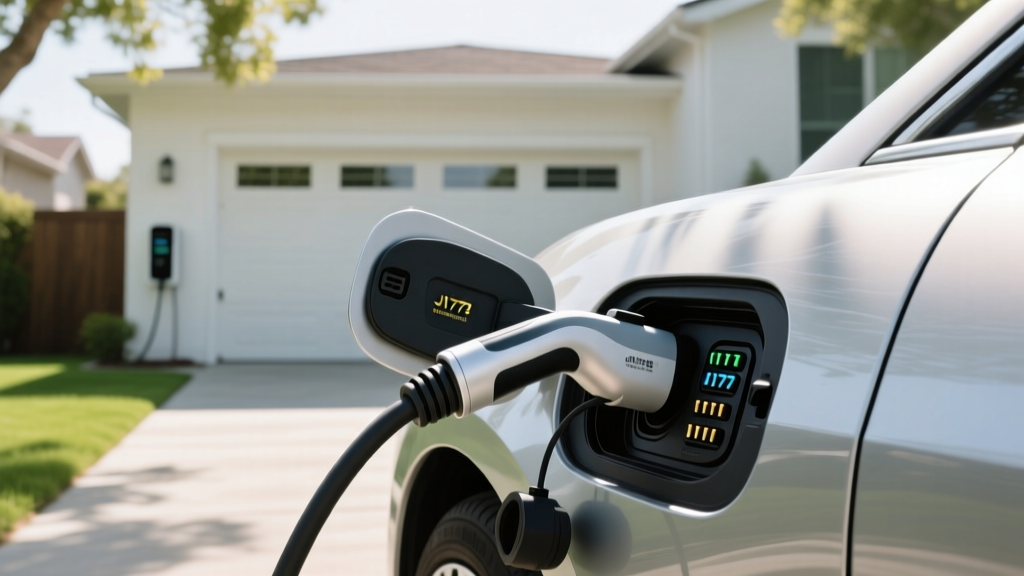
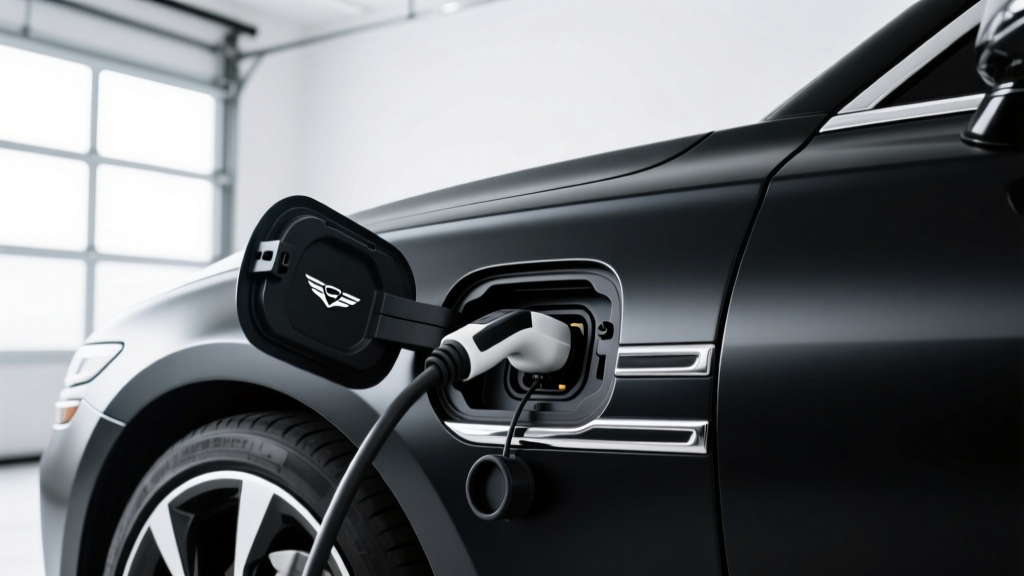
The Electrified G80 uses a CCS1 (Combined Charging System) port, located on the driver-side rear quarter panel. This is the same connector standard used by most legacy automakers selling EVs in North America through the 2024-2025 model years, including Hyundai, Kia, BMW, and Volkswagen.
The CCS1 port handles both AC charging (Level 1 and Level 2) through the upper J1772 section and DC fast charging through the two additional DC pins below. One physical port, two charging modes.
| Connector | Used By (2026) | Genesis G80 Compatibility |
|---|---|---|
| CCS1 | Hyundai, Kia, BMW, VW, Rivian (pre-2025) | Native — built-in port |
| NACS (Tesla) | Tesla, Ford, GM, Rivian (2025+), Hyundai/Kia (2025+) | Requires CCS1-to-NACS adapter for Tesla Superchargers |
| CHAdeMO | Nissan Leaf (legacy) | Not compatible — no adapter available |
Adapter note for 2026: As Hyundai Motor Group (Genesis's parent) transitions to NACS ports on new models starting with the 2025 model year, the Electrified G80 — originally launched with CCS1 — may require a CCS1-to-NACS adapter to access Tesla Supercharger stations. Hyundai has offered complimentary or discounted adapters to existing owners in some programs. Check with your Genesis dealer for current adapter availability and Supercharger network access policies, which have been expanding through Hyundai's agreement with Tesla.
Charging Levels Explained: How Fast Will Each Level Add Range?
Understanding charging speed requires distinguishing between kW (kilowatts) — the rate of power delivery, like water pressure from a hose — and kWh (kilowatt-hours) — the total energy stored in the battery, like the size of the tank. The Genesis G80's battery holds 87.2 kWh of usable energy. How quickly you fill it depends on the charger's kW output.
| Charging Level | Power Output | Voltage / Amperage | Miles of Range Added per Hour | Typical Use Case |
|---|---|---|---|---|
| Level 1 | 1.2–1.9 kW | 120V / 12–16A | ~3–5 miles/hour | Overnight trickle; emergency top-ups |
| Level 2 | 7.2–11.5 kW | 240V / 30–48A | ~22–35 miles/hour | Home daily charging; workplace; hotels |
| DC Fast Charge | 50–350 kW (G80 peaks ~240 kW) | 400–800V DC | ~150–350+ miles/hour (at peak) | Road trips; rapid top-ups on highways |
Real-world context for the G80: At Level 2 (11.5 kW, the G80's onboard charger maximum), a full 0–100% charge takes roughly 8.5 hours. For DC fast charging, Genesis rates the Electrified G80 at a peak of approximately 240 kW under ideal conditions, enabling a 10–80% charge in roughly 22 minutes. However, charging speed is not linear — the battery management system tapers power significantly above 80% State of Charge (SoC) to protect battery health. Expect 80–100% to take an additional 15–20 minutes, which is why most EV road-trippers charge to 80% and move on.
Home Charger Installation: Electrical Requirements and Costs
Most Electrified G80 owners will want a dedicated Level 2 home charger. This is where 80–90% of daily charging happens, and it's the single biggest ownership convenience upgrade over relying on public infrastructure.
Electrical Requirements
To unlock the G80's full 11.5 kW AC charging capability, you need a 240-volt circuit rated at 48 amps or higher (a 60-amp breaker with the charger set to draw 48A continuous, per NEC 80% rule). The G80's onboard charger can accept up to 11.5 kW, so a 48A charger (240V × 48A = 11.5 kW) is the sweet spot.
- Minimum viable setup: 240V / 32A circuit (7.7 kW) — charges in ~12 hours
- Recommended setup: 240V / 48A circuit (11.5 kW) — charges in ~8.5 hours
- Future-proof setup: 240V / 60A circuit with a 48A charger — allows headroom for a second EV
Panel Upgrade Considerations
Most modern homes with a 200-amp electrical panel can accommodate a 60-amp EV circuit without a panel upgrade. However, older homes with 100-amp or 150-amp service may require an upgrade to 200A, especially if you're also running electric heat, a dryer, and an electric range simultaneously. A licensed electrician will perform a load calculation (per NEC Article 220) to determine if your panel has sufficient capacity.
Panel upgrades typically cost $1,500–$3,500 and may require coordination with your utility company. Don't skip this assessment — overloading a panel is a fire hazard and a code violation.
| Cost Component | Simple Install (panel nearby, no upgrade) | Complex Install (long run, panel upgrade) |
|---|---|---|
| Level 2 Charger (hardware) | $400–$750 | $400–$750 |
| Electrical permit | $50–$200 | $50–$200 |
| Electrician labor (2–4 hrs) | $300–$800 | $800–$2,000 |
| Wiring/conduit materials | $100–$300 | $300–$800 |
| Panel upgrade (if needed) | $0 | $1,500–$3,500 |
| Total estimated cost | $850–$2,050 | $3,050–$7,250 |
Federal incentive: The Residential Clean Energy Credit (IRS §25D) previously covered 30% of home EV charger equipment and installation costs (up to $1,000). Check current-year IRS guidance for availability, as this credit has specific expiration and eligibility rules that differ from the §30D vehicle purchase credit. Some states and utilities also offer rebates for charger installation — check your local utility's EV program page.
Charging Cost Per Mile: Genesis G80 vs Gas Equivalent
The Electrified G80 achieves an EPA-rated 97 MPGe combined (miles per gallon equivalent), consuming roughly 35 kWh per 100 miles driven, per fueleconomy.gov. That efficiency figure is the basis for calculating your real charging costs.
| Charging Scenario | Cost per kWh | Cost per 100 Miles | Cost per Mile | Annual Cost (12,000 mi) |
|---|---|---|---|---|
| Home (off-peak utility rate) | $0.12 | $4.20 | $0.042 | $504 |
| Home (average U.S. rate) | $0.17 | $5.95 | $0.060 | $714 |
| Public Level 2 (ChargePoint, EVgo) | $0.30 | $10.50 | $0.105 | $1,260 |
| DC Fast Charge (Electrify America) | $0.48 | $16.80 | $0.168 | $2,016 |
| Gas equivalent (Genesis G80 2.5T AWD, 25 MPG combined) | $3.40/gal | $13.60 | $0.136 | $1,632 |
The bottom line: Home charging at off-peak rates makes the Electrified G80 roughly 70% cheaper per mile than its gas-powered G80 2.5T sibling. Even public DC fast charging is only modestly more expensive than gasoline on a per-mile basis, though relying exclusively on DC fast charging is both costly and suboptimal for long-term battery health. Most owners who charge at home 80%+ of the time will see annual fuel costs well under $700.
Recommended Home Chargers for the Genesis G80
Because the G80's onboard charger maxes out at 11.5 kW (48A at 240V), there's no benefit to buying a charger rated above 48A for this specific vehicle. However, investing in a 48A charger with a NACS connector option or a universal setup can future-proof your garage for your next EV.
ChargePoint Home Flex
- Power output: Up to 12 kW (50A) — adjustable via DIP switches
- Connector: J1772 (CCS1-compatible for AC); NACS version now available
- Cable length: 23 feet
- Smart features: Wi-Fi, app scheduling, Alexa integration, energy tracking
- Price: ~$550–$650
- Best for: G80 owners wanting smart scheduling to exploit off-peak utility rates
Emporia Vue Level 2 Charger
- Power output: Up to 11.5 kW (48A)
- Connector: J1772 (CCS1-compatible for AC)
- Cable length: 24 feet
- Smart features: Wi-Fi, app control, integrates with Emporia energy monitoring, solar-aware charging
- Price: ~$400–$500
- Best for: Budget-conscious buyers who still want app control and energy data
Wall Connector (Tesla, Gen 4)
- Power output: Up to 11.5 kW (48A)
- Connector: NACS native — requires CCS1-to-NACS adapter for G80 AC charging, or use for future NACS EVs
- Cable length: 24 feet
- Smart features: Wi-Fi, over-the-air updates, Power Sharing for multi-charger setups
- Price: ~$450–$500
- Best for: Households planning a future switch to a NACS-native EV
Key selection criteria: Ensure any charger you buy is UL-listed (or ETL-listed) for safety certification. Hardwired installations are preferred over plug-in NEMA 14-50 outlets for chargers above 40A, as they eliminate the receptacle as a failure point and satisfy most local electrical codes without requiring a GFCI breaker (the charger itself provides ground-fault protection).
Public DC Fast Charging: Networks and the G80 Experience
The Electrified G80's ~240 kW peak DC fast-charge rate puts it among the faster-charging luxury EVs, though it doesn't quite match the 350 kW peaks of the Hyundai Ioniq 5 or Kia EV6 (which share the E-GMP platform but use an 800V architecture optimized for ultra-fast charging). The G80 operates on a 400V architecture, which limits its ceiling but still delivers strong real-world performance.
On a road trip, plan your charging stops around the 10–80% window. At an Electrify America 350 kW station, you can expect the G80 to:
- Charge from 10% to 80% in approximately 22 minutes under optimal conditions (battery preconditioned, ambient temperature 65–80°F)
- Add roughly 180–200 miles of range in that session
- See charge rates taper from ~240 kW (at low SoC) down to ~80–100 kW by the time you reach 65% SoC, and further to ~40 kW by 80%
Cold-weather caveat: In freezing temperatures (below 32°F), expect DC fast-charge speeds to drop by 20–35% unless the battery is preconditioned. The G80's battery thermal management system will warm the pack during navigation to a DC charger, but preconditioning is less aggressive than in some competitors. Plan for 28–35 minute 10–80% sessions in winter conditions.
Network compatibility in 2026:
- Electrify America, EVgo, ChargePoint: Native CCS1 plug — plug and charge with no adapter needed
- Tesla Supercharger: Requires CCS1-to-NACS adapter; verify your specific G80 model year is approved on Tesla's Supercharger compatibility list
- IONNA (formerly Ionity U.S. expansion): CCS1 native where available
Safety, Code Compliance, and Installation Best Practices
EV charging involves sustained high-current draw — often 8+ hours at a time. This is fundamentally different from typical household appliance use, and the electrical code reflects that.
- Dedicated circuit: Your Level 2 charger must be on its own dedicated breaker — never shared with other appliances. A 60A breaker serving a 48A charger is standard.
- GFCI protection: NEC 2020 and later require GFCI protection for EV charging outlets (NEMA 14-50 receptacles). However, hardwired chargers typically have built-in ground-fault protection and don't require a GFCI breaker — which is good, because GFCI breakers on EV circuits are a common source of nuisance tripping.
- Outdoor rating: If your charger is mounted outside (driveway or exterior wall), ensure the unit is rated for outdoor use (NEMA 4 or IP55 minimum). The ChargePoint Home Flex, Emporia Vue, and Tesla Wall Connector all carry outdoor ratings.
- Wire gauge: A 60A circuit requires 6 AWG copper wire (or 4 AWG aluminum). Your electrician will size this based on the run length — longer runs may require upsizing to prevent voltage drop.
- Permits: Virtually all jurisdictions require an electrical permit for a new 240V circuit. The permit fee is typically $50–$200, and a final inspection ensures the work meets code. Do not skip this step — unpermitted work can void your homeowner's insurance in the event of an electrical fire.
Genesis G80 Charging FAQ
Can I charge the Genesis Electrified G80 at a Tesla Supercharger?
Yes, but only with a CCS1-to-NACS adapter. The G80's native port is CCS1, while Tesla Superchargers use the NACS connector. Hyundai Motor Group has been working with Tesla to enable Supercharger access for CCS1-equipped vehicles via approved adapters. Check with your Genesis dealer for the latest adapter availability and compatibility confirmation for your specific model year.
How long does a full home charge take for the G80?
At the G80's maximum AC rate of 11.5 kW on a 48A Level 2 charger, a full 0–100% charge of the 87.2 kWh battery takes approximately 8.5 hours. On a 32A (7.7 kW) charger, expect closer to 12 hours. Most owners charge from 20–80% overnight, which takes roughly 4.5 hours at 11.5 kW.
Does the G80 support vehicle-to-load (V2L) or vehicle-to-home (V2H)?
The Electrified G80 does not currently offer V2L or V2H capability in the U.S. market. Some E-GMP platform siblings (Ioniq 5, EV6) support V2L via an interior or exterior adapter, but this feature has not been extended to the G80. If bidirectional power is a priority, consider the Ioniq 5 or the Ford F-150 Lightning (V2H capable).
What is the real-world range of the Electrified G80?
The EPA rates the Electrified G80 at 282 miles. In real-world highway driving at 70 mph with mild temperatures, expect approximately 245–260 miles. In cold weather (below 30°F), range can drop to 200–225 miles due to battery chemistry limitations and cabin heating demand. The G80 uses a heat pump, which helps mitigate cold-weather losses compared to resistive heating, but range reduction is unavoidable.
Is DC fast charging bad for the G80's battery?
Occasional DC fast charging is fine and is accounted for in the battery warranty. However, exclusive reliance on DC fast charging (daily or near-daily) accelerates battery degradation over time compared to predominantly Level 2 home charging. Genesis covers the battery pack for 10 years / 100,000 miles against capacity loss below 70% of original capacity. For optimal longevity, charge to 80% daily and save 100% fills for road trips.
How much does it cost to install a home EV charger for the G80?
A straightforward installation (panel has capacity, short wire run, hardwired charger) typically costs $850–$2,050 all-in, including the charger hardware, electrician labor, materials, and permit. Complex installations requiring a panel upgrade, long conduit runs, or trenching can reach $3,000–$7,250. Always get at least two quotes from licensed electricians and verify they perform a load calculation before quoting.