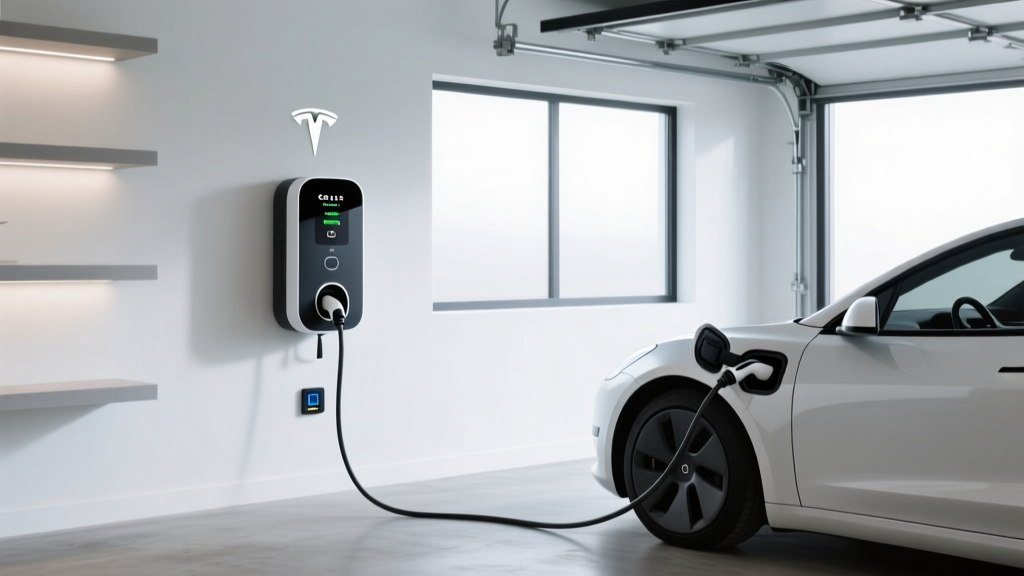
If you own a Tesla—or any EV with a NACS charge port in 2026—the Gen 3 Tesla Wall Connector remains one of the most practical Level 2 home chargers on the market. It delivers up to 11.5 kW (48 amps) on a 60-amp dedicated circuit, adding roughly 44 miles of range per hour of charging. But hardware is only half the equation. Installation costs, your home's electrical panel capacity, and whether you need an adapter for non-Tesla EVs all determine whether this charger is the right fit.
This guide covers the Gen 3 Tesla Wall Connector's real-world performance, exact installation requirements, total cost breakdowns, and how it compares to alternatives like the ChargePoint Home Flex or Emporia Level 2.
What the Gen 3 Tesla Wall Connector Actually Delivers
The Gen 3 Tesla Wall Connector (officially the "Wall Connector" in Tesla's current lineup) is a hardwired Level 2 charger with an integrated NACS (North American Charging Standard) connector. Here's what you're working with:
- Max power output: 11.5 kW (48A continuous on a 60A breaker)
- Voltage: 240V single-phase
- Connector: NACS (native Tesla); J1772 adapter included in-box for non-Tesla EVs
- Cable length: 24 feet
- Wi-Fi: Yes — enables over-the-air firmware updates and power-sharing between multiple units
- Outdoor rating: NEMA 3R (suitable for outdoor installation)
- Current MSRP: ~$475 (direct from Tesla)
At 11.5 kW, the Gen 3 charges most EVs from 10% to 80% State of Charge (SoC) overnight. A Tesla Model Y Long Range (75 kWh usable battery) goes from 10% to 80% in roughly 6.5 hours. A larger-battery vehicle like the Ford F-150 Lightning Extended Range (131 kWh usable) takes closer to 11 hours for the same swing—still manageable for overnight charging if you plug in by early evening.
Charging Levels Explained: Speeds in kW and Miles Per Hour
Before evaluating any home charger, it helps to understand the three charging tiers and what they mean for your daily routine. The distinction between kW (kilowatts, a measure of power or charge rate) and kWh (kilowatt-hours, a measure of energy or battery capacity) is critical: your charger's kW rating determines how fast energy flows into your battery's kWh capacity.
| Level | Voltage | Max Power (kW) | Miles of Range/Hour | Best For |
|---|---|---|---|---|
| Level 1 | 120V (standard outlet) | 1.2–1.9 kW | 3–5 mi/hr | PHEVs, overnight top-ups, emergency use |
| Level 2 | 240V (dryer-style outlet or hardwired) | 3.3–19.2 kW | 12–70 mi/hr | Daily home charging (Gen 3 = 11.5 kW / ~44 mi/hr) |
| DC Fast Charging | 400–800V DC | 50–350+ kW | 150–1,000+ mi/hr | Road trips, rapid top-ups (10–80% in 15–30 min) |
The Gen 3 Tesla Wall Connector sits firmly in Level 2 territory. For most EV owners who drive 30–50 miles daily, Level 2 home charging fully replenishes overnight use in 1–2 hours. You rarely need DC fast charging unless you're on a road trip or lack home charging access.
How Much Does It Cost to Install a Gen 3 Tesla Charger at Home?
The charger itself costs around $475, but installation is where the real variable lies. Total cost depends on your electrical panel's capacity, the distance from panel to charger location, and local permitting fees. Here's a realistic breakdown based on 2026 electrician rates:
| Component | Simple Install (panel nearby, spare capacity) | Moderate Install (50+ ft run, conduit) | Complex Install (panel upgrade needed) |
|---|---|---|---|
| Gen 3 Wall Connector | $475 | $475 | $475 |
| Electrician labor (licensed) | $300–$500 | $600–$1,200 | $1,000–$2,000 |
| Materials (conduit, wire, breaker) | $50–$150 | $200–$500 | $300–$600 |
| Permit & inspection | $50–$150 | $100–$250 | $150–$350 |
| Panel upgrade (if needed) | N/A | N/A | $1,500–$3,500 |
| TOTAL RANGE | $875–$1,275 | $1,375–$2,425 | $3,425–$6,925 |
The panel upgrade wildcard: Homes built before 2000 often have 100A or 150A main service panels. Adding a 60A dedicated circuit for the Gen 3 Wall Connector can push you over your panel's safe load limit, especially if you already run electric heat, an electric dryer, and an electric oven. A licensed electrician will perform a load calculation (per NEC Article 220) to determine if you have spare capacity. If not, upgrading to a 200A panel typically costs $1,500–$3,500 depending on your utility and local labor rates.
Alternative if panel capacity is tight: You can configure the Gen 3 Wall Connector to draw less current—as low as 16A (3.8 kW) or 32A (7.7 kW)—via its internal DIP switches. This reduces charging speed but may eliminate the need for a panel upgrade entirely. At 32A, you still get roughly 30 miles of range per hour, which is sufficient for most daily driving.
Connector Compatibility: Will the Gen 3 Work with Non-Tesla EVs?
The Gen 3 Tesla Wall Connector ships with a native NACS (North American Charging Standard) connector—the same plug used on all Tesla vehicles. As of 2025–2026, nearly every major automaker has adopted NACS for new EV models, including Ford, GM, Rivian, Hyundai, Kia, and BMW. However, many EVs on the road still use the older CCS1 or CHAdeMO connectors.
| Connector Type | Vehicles Using It | Gen 3 Compatibility |
|---|---|---|
| NACS (Tesla) | All Teslas; 2025+ Ford, GM, Rivian, Hyundai, Kia NACS models | Native — plug directly in |
| J1772 | Non-Tesla EVs/PHEVs (Level 2 standard pre-NACS adoption) | Included Tesla-to-J1772 adapter works for Level 2 |
| CCS1 | 2018–2024 GM, Ford, VW, Hyundai, Kia EVs | Adapter needed (e.g., Tesla J1772 adapter + CCS adapter, or third-party NACS-to-CCS adapter ~$150–$250) |
| CHAdeMO | Nissan Leaf, Mitsubishi Outlander PHEV (legacy) | Not recommended — no reliable adapter; use a J1772-native charger instead |
If your household has a mix of Tesla and non-Tesla EVs, the Gen 3's included J1772 adapter handles most Level 2 charging needs. For CCS1 vehicles, you'll need an additional adapter. If CHAdeMO is your primary connector (e.g., you own a Nissan Leaf), a universal Level 2 charger like the ChargePoint Home Flex with a native J1772 plug is a better fit.
Cost to Charge: Home vs. Public vs. Gas Per Mile
One of the strongest arguments for home Level 2 charging is cost. Electricity rates vary by state and utility, but the per-mile fuel cost of an EV charged at home consistently undercuts gasoline. Here's a comparison using a vehicle averaging 3.5 miles per kWh (typical for a mid-size EV like the Tesla Model Y or Hyundai Ioniq 5):
| Charging Scenario | Rate | Cost per kWh | Cost per Mile |
|---|---|---|---|
| Home off-peak (utility time-of-use rate) | $0.08–$0.12/kWh | $0.10 avg | $0.029 |
| Home standard rate (no TOU plan) | $0.14–$0.18/kWh | $0.16 avg | $0.046 |
| Public Level 2 (ChargePoint, EVgo L2) | $0.25–$0.49/kWh | $0.35 avg | $0.100 |
| DC Fast Charging (Electrify America, Tesla Supercharger) | $0.30–$0.55/kWh | $0.40 avg | $0.114 |
| Gasoline (28 MPG avg, $3.40/gal) | $3.40/gallon | N/A | $0.121 |
Charging at home on an off-peak rate costs roughly one-quarter what gasoline costs per mile. Even DC fast charging on a road trip is competitive with gas. The key is establishing a home charging routine—plug in every night, charge during off-peak hours (typically 10 PM–6 AM), and reserve public DC fast charging for road trips.
According to fueleconomy.gov, the average EV owner who charges primarily at home saves $800–$1,200 annually on fuel compared to a comparable gasoline vehicle, depending on local electricity and gas prices.
Equipment Comparison: Gen 3 Tesla vs. Top Alternatives
The Gen 3 Tesla Wall Connector is purpose-built for Tesla/NACS owners, but it's not the only strong Level 2 option. Here's how it stacks up against two popular competitors:
Tesla Gen 3 Wall Connector
- Max output: 11.5 kW (48A)
- Connector: NACS (+ J1772 adapter included)
- Cable: 24 ft
- Smart features: Wi-Fi OTA updates, power-sharing (up to 6 units on one circuit), Tesla app integration
- Price: ~$475
- Best for: Tesla owners, households going all-NACS
ChargePoint Home Flex
- Max output: 12 kW (50A) configurable down to 16A
- Connector: J1772 (NACS adapter sold separately)
- Cable: 23 ft
- Smart features: Wi-Fi, ChargePoint app, Alexa integration, scheduling, energy reports
- Price: ~$599
- Best for: Multi-EV households with J1772/CCS vehicles
Emporia Vue Level 2
- Max output: 11.5 kW (48A)
- Connector: J1772 (NACS adapter available)
- Cable: 24 ft
- Smart features: Wi-Fi, Emporia app, integration with Emporia home energy monitor, solar-aware charging
- Price: ~$399
- Best for: Budget-conscious buyers, solar-panel households
If you drive a Tesla and plan to stay within the Tesla/NACS ecosystem, the Gen 3 Wall Connector offers the cleanest experience: native plug, Tesla app integration, and competitive pricing. If your household includes a non-Tesla EV with J1772 or CCS1, the ChargePoint Home Flex's native J1772 connector and flexible amperage settings (16A–50A) make it more versatile.
Safety, Code, and Electrical Requirements
Installing a Level 2 charger is electrical work that must comply with the National Electrical Code (NEC) and your local jurisdiction's amendments. Key requirements:
- Dedicated circuit: The Gen 3 at 48A continuous draw requires a 60A double-pole breaker. NEC 210.20(A) requires the breaker to be rated at 125% of the continuous load (48A × 1.25 = 60A). Do not share this circuit with other appliances.
- Wire gauge: 6 AWG copper (THHN in conduit) or 4 AWG aluminum for a 60A circuit. Your electrician will size wire based on run length and local code.
- GFCI protection: NEC 2023 (625.54) requires GFCI protection for EV charging outlets. Since the Gen 3 is hardwired (not plug-in), GFCI requirements may differ by jurisdiction—your electrician and local inspector will confirm.
- Outdoor rating: The Gen 3 carries a NEMA 3R rating, meaning it's rated for outdoor installation and protected against rain and sleet. If mounting in a location exposed to hose-directed water (e.g., near a car wash area), NEMA 4 would be preferable.
- Permit required: Virtually all jurisdictions require an electrical permit for a new 240V circuit. The permit triggers an inspection, which protects you and is typically required for insurance claims related to electrical fires.
Charging Time Examples: What to Expect Overnight
Here's how long the Gen 3 Tesla Wall Connector takes to charge popular EVs from 10% to 80% SoC at its full 11.5 kW output:
| Vehicle | Usable Battery (kWh) | 10–80% Energy Needed | Time at 11.5 kW |
|---|---|---|---|
| Tesla Model 3 Long Range | 75 kWh | ~52.5 kWh | ~4.6 hours |
| Tesla Model Y Long Range | 75 kWh | ~52.5 kWh | ~4.6 hours |
| Ford F-150 Lightning Ext. Range | 131 kWh | ~91.7 kWh | ~8.0 hours |
| Hyundai Ioniq 5 (84 kWh pack) | 77.4 kWh | ~54.2 kWh | ~4.7 hours |
| Chevrolet Equinox EV | 85 kWh | ~59.5 kWh | ~5.2 hours |
Every vehicle above charges fully from 10% to 80% within a single overnight session. For daily driving of 30–50 miles, you'll typically need only 1–2 hours of charging to replenish what you used—meaning the Gen 3 provides substantial headroom for even high-mileage days.
Frequently Asked Questions
How much does it cost to install a Gen 3 Tesla home charger?
Total installed cost ranges from roughly $875 for a simple install (panel has spare capacity, charger is near the panel) to $6,900+ if you need a full panel upgrade. The most common scenario—a moderate install with a 30–50 foot wire run—lands between $1,400 and $2,400 all-in, including the $475 charger, electrician labor, materials, and permit. Always get 2–3 quotes from licensed electricians and confirm they include permit costs.
How fast will the Gen 3 Tesla charger add range compared to Level 1 or DC fast charging?
At full 11.5 kW output, the Gen 3 adds approximately 44 miles of range per hour for an efficient EV like the Model 3. Level 1 (120V) adds only 3–5 miles per hour—barely enough for daily driving. DC fast charging at a Tesla Supercharger (150–250 kW) adds 150–250+ miles in 15–20 minutes but costs 3–4x more per kWh and isn't suitable for daily use due to battery stress from repeated high-rate charging.
Is the Gen 3 Tesla charger compatible with non-Tesla EVs?
Yes, with adapters. The Gen 3 includes a Tesla-to-J1772 adapter, which works for Level 2 charging on any J1772-equipped vehicle. For CCS1 vehicles, you'll need an additional NACS-to-CCS adapter ($150–$250). CHAdeMO vehicles (Nissan Leaf) have no reliable adapter path—use a J1772-native charger like the ChargePoint Home Flex instead.
How much does charging cost per mile compared to gasoline?
Home charging on an off-peak utility rate (~$0.10/kWh) costs about $0.03 per mile for an average EV. Gasoline at $3.40/gallon in a 28 MPG vehicle costs about $0.12 per mile. That's a 75% per-mile fuel savings when charging at home. Even public DC fast charging (~$0.40/kWh) costs roughly the same per mile as gasoline. The savings are maximized when you charge at home overnight on a time-of-use rate plan.
What electrical upgrades might I need for a Gen 3 Wall Connector?
The most common upgrade is a panel upgrade from 100A or 150A to 200A service, costing $1,500–$3,500. This is needed when your existing panel doesn't have enough spare capacity for a new 60A circuit. Alternatives include derating the charger to 32A or 40A (which reduces speed but may avoid the upgrade), or installing an automatic load management device (e.g., Emporia Smart Load Manager) that dynamically limits charger draw when other appliances are running. A licensed electrician will perform a NEC Article 220 load calculation to determine your exact situation.
Does the Gen 3 Tesla Wall Connector qualify for a tax credit?
Possibly. The IRS §30D Alternative Fuel Vehicle Refueling Property Credit covers 30% of home charger equipment and installation costs up to $1,000, but only if your home is located in an eligible census tract (typically non-urban or low-income areas). Check current eligibility on irs.gov and consult a tax professional. This credit is separate from the vehicle purchase tax credit and has its own geographic and income requirements.
Sources: fueleconomy.gov (EV efficiency and cost data), irs.gov (§30D refueling property credit), Tesla Wall Connector product specifications (shop.tesla.com). Installation cost ranges based on 2026 licensed electrician rate surveys. Always confirm exact costs and code requirements with a licensed electrician in your jurisdiction.