Wireless EV charging has been a concept-car promise for years, but Freewire is one of the companies pushing it toward residential reality. If you have searched for Freewire charging and found more press releases than practical answers, this guide breaks down exactly what the system delivers in 2026: power output, installation requirements, real costs, and whether it makes sense compared to a conventional plug-in Level 2 charger.
Before we get to Freewire specifically, we need to establish the baseline every EV owner should know — the three charging levels, what they actually deliver, and the critical difference between kW (power, or how fast energy flows) and kWh (energy, or how much your battery stores). Confusing the two is the most common EV mistake online.
The Three Charging Levels: Speeds and Range Added
Every EV charging scenario falls into one of three categories. Here is what each level delivers in practical terms:
| Level | Voltage | Power (kW) | Miles of Range per Hour | Typical Use Case |
|---|---|---|---|---|
| Level 1 | 120V AC | 1.2–1.9 kW | 3–5 miles/hr | Overnight trickle, PHEVs, low-mileage drivers |
| Level 2 (Plug-in) | 240V AC | 7.2–19.2 kW | 25–65 miles/hr | Daily home charging, workplace |
| Level 2 (Wireless/Freewire) | 240V AC | 7.2–11 kW | 25–40 miles/hr | Premium home charging, fleet depots |
| DC Fast Charging | 400–900V DC | 50–350 kW | 150–300+ miles/30 min | Road trips, highway corridors |
kW vs kWh, plainly: Your EV battery holds energy measured in kWh (for example, a Tesla Model Y Long Range has roughly 75 kWh usable). A charger's output is measured in kW. A 7.2 kW charger running for one hour delivers approximately 7.2 kWh of energy. A 11 kW wireless pad running for 8 hours overnight delivers about 88 kWh — enough to refill most EV batteries from near-empty.
What Is Freewire Charging and How Does It Work?
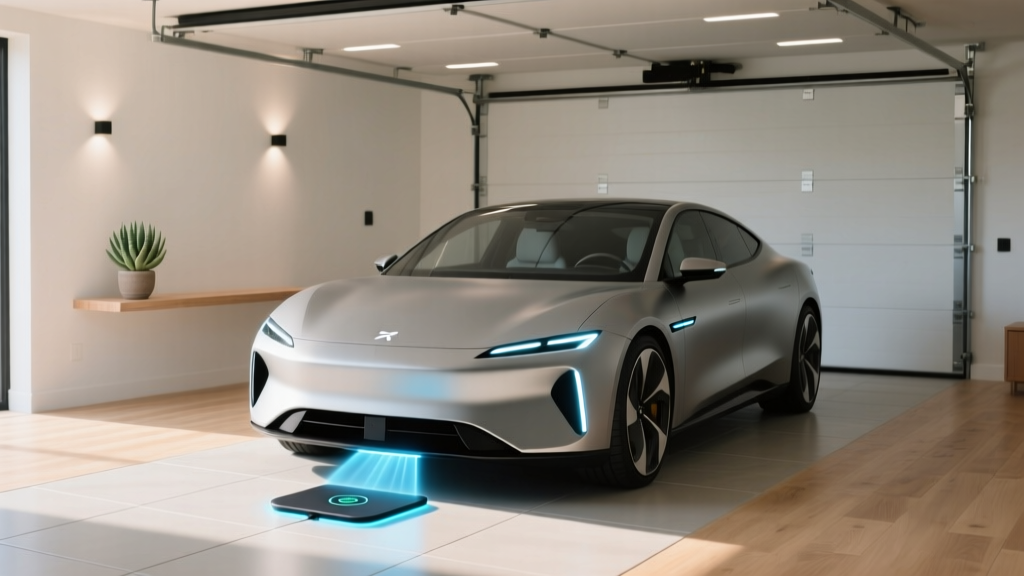
Freewire (not to be confused with FreeWire Technologies, the DC fast-charging infrastructure company) develops inductive wireless charging pads for EVs. The system uses two components:
- Ground pad (transmitter): A flat, weather-sealed unit installed on your garage floor or driveway, connected to a 240V wall-mounted control box.
- Vehicle pad (receiver): A unit mounted to the underside of your EV, aligned with the ground pad. Energy transfers through magnetic resonance across an air gap of approximately 4–7 inches.
When you park over the ground pad, the system detects the vehicle pad, confirms alignment (usually via a smartphone app or in-dash display), and begins charging automatically — no cable to handle, no connector to plug in. This is the core appeal: true park-and-walk-away convenience.
As of 2026, Freewire-compatible vehicle pads are available as aftermarket installations for select models, with OEM integration in limited vehicles. The most common compatible platforms include certain BMW, Mercedes-Benz, and Genesis EVs that support the SAE J2954 wireless charging standard. Tesla vehicles do not natively support wireless charging, though third-party aftermarket receiver kits exist.
Home Installation: Electrical Requirements, Panel Upgrades, and Costs
This is where wireless charging gets real — and where many buyers are surprised. Installing a Freewire ground pad is not a DIY weekend project. It requires a dedicated 240V circuit, professional electrical work, permitting, and potentially a panel upgrade if your home's electrical service is insufficient.
Electrical Requirements
A typical Freewire home system rated at 7.2–11 kW requires:
- Circuit: Dedicated 40A or 50A, 240V breaker
- Wire gauge: 6 AWG or 8 AWG copper (depending on run length and local code)
- Outlet or hardwire: Hardwired connection to the wall-mounted control unit (no plug — the ground pad cable runs from the control box to the floor pad)
- Ground pad placement: Embedded in or surface-mounted on concrete/asphalt, with conduit run from the control box
Panel Upgrade Reality
If your home has a 100A electrical panel (common in homes built before 2000), adding a 40–50A EV circuit may exceed your panel's capacity. An electrician will perform a load calculation to determine if your panel can handle the additional draw. If not, you will need a panel upgrade to 200A — a significant cost that many wireless charging guides conveniently omit.
| Component | Cost Range | Notes |
|---|---|---|
| Wireless charging equipment (ground pad + control box) | $2,500–$4,500 | Vehicle receiver pad: additional $1,500–$3,000 |
| Electrician labor (standard install) | $800–$2,000 | Varies by run length, conduit, and local rates |
| Permit and inspection | $100–$400 | Required by most jurisdictions for 240V circuits |
| Panel upgrade (100A → 200A) | $1,500–$3,500 | Only if load calculation requires it |
| Concrete cutting/patching (driveway pad) | $500–$1,500 | If embedding pad in existing driveway |
| Total (no panel upgrade) | $3,400–$8,400 | Equipment + install + permit |
| Total (with panel upgrade) | $4,900–$11,900 | Full turnkey with electrical service upgrade |
For comparison, a conventional plug-in Level 2 charger (like a ChargePoint Home Flex or Wallbox Pulsar Plus) typically costs $500–$750 for equipment and $600–$1,800 for installation — $1,100–$2,550 total without a panel upgrade. The wireless premium is substantial.
Connector Compatibility: Which EVs Support Wireless Charging?
Wireless charging sidesteps the NACS/CCS/CHAdeMO connector debate entirely — there is no physical plug. But vehicle compatibility is still a critical question, and it is more limited than plug-in charging.
| System | Connector/Standard | Compatible Vehicles | Wireless Support? |
|---|---|---|---|
| NACS (Tesla) | North American Charging Standard | Tesla (all), Ford, GM, Rivian, Volvo, others adopting 2025+ | No OEM support; aftermarket kits only |
| CCS1 | Combined Charging System | Hyundai, Kia, VW, BMW, Mercedes, most non-Tesla EVs | Select BMW, Mercedes, Genesis models (SAE J2954) |
| CHAdeMO | CHAdeMO | Nissan Leaf (legacy), Mitsubishi Outlander PHEV | No |
| SAE J2954 Wireless | Inductive (no connector) | BMW iX (optional), Mercedes EQS (select markets), Genesis GV60 (Korea/pilot programs) | Yes — this is the standard Freewire follows |
The bottom line: unless your EV came from the factory with a wireless charging receiver pad, or you install an aftermarket receiver (typically $1,500–$3,000 plus labor), a wireless ground pad will not charge your vehicle. This is the single biggest adoption barrier in 2026. Always confirm your specific vehicle's compatibility before purchasing a wireless system.
Charging Time Examples: Wireless vs Plug-In Level 2
Here is how Freewire wireless charging stacks up against a conventional Level 2 plug-in charger for common EV battery sizes, from 10% to 80% State of Charge:
| EV / Battery Size | Freewire Wireless (11 kW) | Plug-in Level 2 (11.5 kW) | Plug-in Level 2 (7.7 kW) |
|---|---|---|---|
| Tesla Model Y LR (~75 kWh usable) | ~5 hours 15 min | ~5 hours | ~7 hours 30 min |
| Hyundai Ioniq 5 (~77.4 kWh usable) | ~5 hours 25 min | ~5 hours 10 min | ~7 hours 45 min |
| BMW iX xDrive50 (~105 kWh usable) | ~7 hours 20 min | ~7 hours | ~10 hours 15 min |
| Ford F-150 Lightning Ext (~131 kWh usable) | ~9 hours 10 min | ~8 hours 40 min | ~12 hours 45 min |
The wireless penalty is real but modest — roughly 5–10% longer charge times due to transfer inefficiency. For overnight charging, this rarely matters. Your car will reach 80%+ by morning regardless. Where it does matter: if you arrive home at 6 PM with a near-empty battery and need to leave again at 9 PM, a wired charger at 11.5 kW will get you further, faster.
Cost to Charge: Wireless Home vs Public vs Gas
One of the strongest arguments for any home charging setup — wireless or wired — is the per-mile cost advantage over gasoline. Here is a realistic breakdown:
| Scenario | Rate | Cost per kWh | Cost per Mile (at 3.5 mi/kWh) |
|---|---|---|---|
| Home Level 2 (off-peak utility rate) | $0.09–$0.14/kWh | $0.12 avg | $0.034 |
| Home Wireless (off-peak, accounting for ~8% efficiency loss) | $0.09–$0.14/kWh | $0.13 effective | $0.037 |
| Public Level 2 (network pricing) | $0.25–$0.49/kWh | $0.35 avg | $0.10 |
| DC Fast Charging (Electrify America, EVgo, Tesla Supercharger) | $0.35–$0.58/kWh | $0.48 avg | $0.14 |
| Gasoline (30 MPG combined, $3.40/gal) | $3.40/gallon | — | $0.113 |
At home off-peak rates, wireless EV charging costs roughly $0.037 per mile — about one-third the cost of gasoline. Even with the small wireless efficiency penalty, you are saving $0.07–$0.08 per mile versus gas. Over 12,000 miles per year, that is roughly $840–$960 in annual fuel savings.
However, if you rely primarily on DC fast charging at public stations, your per-mile cost can actually exceed gasoline. This is why home charging access — whether wireless or wired — is the single biggest factor in EV ownership economics.
Equipment Recommendations: Wireless and Plug-In Alternatives
If you are committed to wireless charging, Freewire is not the only option. Here is a landscape of what is available in 2026, alongside the best plug-in alternatives for comparison:
Freewire Home Pad (11 kW)
- Power: 11 kW (7.2 kW option available)
- Standard: SAE J2954
- Ground pad: 24" × 18", surface-mount or embedded
- Smart features: App-based alignment, scheduling, energy monitoring
- Price: ~$3,500–$4,500 (ground pad + control box)
- Best for: Drivers with OEM wireless-compatible EVs who value cable-free convenience
WiTricity Halo (11 kW)
- Power: 11 kW
- Standard: SAE J2954
- Ground pad: 24" × 24", embedded installation
- Smart features: Auto-alignment, fleet management API
- Price: ~$3,000–$4,000
- Best for: Fleet and commercial deployments; limited residential availability
ChargePoint Home Flex (Plug-in Alternative)
- Power: Up to 12 kW (50A circuit) or 9.6 kW (40A)
- Connector: NACS or J1772 (CCS adapter available)
- Cable: 23 ft
- Smart features: App scheduling, Alexa, energy reports
- Price: ~$550–$650
- Best for: Most EV owners — best value per kW, proven reliability
Wallbox Pulsar Plus (Plug-in Alternative)
- Power: Up to 11.5 kW (48A circuit)
- Connector: NACS or J1772
- Cable: 25 ft
- Smart features: Wi-Fi/Bluetooth, Power Sharing for dual installs
- Price: ~$500–$600
- Best for: Tight garages, dual-EV households with shared circuit
Safety, Code, and Practical Considerations
Any 240V EV charging installation — wireless or wired — must comply with the National Electrical Code (NEC) and local building codes. Key requirements:
- Dedicated circuit: Your EV charger must have its own breaker — no sharing with other appliances. A 40A charger requires a 50A breaker (NEC requires 125% overhead for continuous loads).
- GFCI protection: Required for outdoor installations and many jurisdictions now require it for garages as well. Your electrician will specify the correct breaker type.
- Outdoor rating: If your ground pad is installed in an open driveway, the control box must be rated for outdoor use (NEMA 4 or IP65 minimum). The ground pad itself is sealed to withstand rain, snow, and vehicle tire rollover.
- Permitting: Most municipalities require an electrical permit for new 240V circuits. Expect $100–$400 for the permit, plus a post-installation inspection. Skipping permits risks insurance denial if an electrical fire occurs.
- Ground pad durability: Freewire and WiTricity pads are rated for vehicle weight rollover (typically 5,000+ lbs). Snow and ice on the pad surface can reduce efficiency slightly but do not prevent charging — the magnetic field transfers through non-metallic barriers.
Is Freewire Wireless Charging Worth It? Decision Framework
Choose Freewire Wireless If:
- Your EV has an OEM SAE J2954 wireless receiver (BMW iX, select Mercedes EQS, Genesis GV60)
- You value cable-free convenience and are willing to pay a $2,000–$4,000 premium over plug-in
- You charge overnight at home and do not need rapid top-ups
- You have a garage or driveway where a ground pad can be permanently installed
Choose a Plug-in Level 2 Charger If:
- Your EV does not have a wireless receiver (most EVs on the road in 2026)
- You want the fastest Level 2 speeds at the lowest cost ($1,100–$2,550 installed)
- You drive multiple EVs with different connectors (a single NACS or J1772 plug-in charger with adapters covers everything)
- You may move or rent — a plug-in charger is portable; a ground pad is a permanent installation
Frequently Asked Questions
How much does it cost to install a Freewire home EV charger?
Expect $3,400–$8,400 for equipment and professional installation if your electrical panel can handle the load. If you need a panel upgrade from 100A to 200A, add $1,500–$3,500. The vehicle receiver pad (if not OEM-equipped) adds another $1,500–$3,000.
How fast will each charging level add range?
Level 1 (120V): 3–5 miles per hour. Level 2 plug-in (240V, 11.5 kW): 35–40 miles per hour. Freewire wireless (11 kW): 30–37 miles per hour. DC fast charging (150–350 kW): 150–300+ miles in 20–30 minutes.
Which connector or charger is compatible with my EV?
For wireless charging, your EV must support SAE J2954 — currently limited to select BMW, Mercedes, and Genesis models. For plug-in charging, check your vehicle's charge port: NACS (Tesla and adopting brands), CCS1 (most non-Tesla EVs), or CHAdeMO (Nissan Leaf legacy). Adapters exist for cross-compatibility (e.g., J1772-to-NACS), but wireless has no adapter workaround.
How much does charging cost per mile compared to gas?
Home wireless charging at off-peak rates costs approximately $0.037 per mile. A comparable gas vehicle at 30 MPG and $3.40/gallon costs $0.113 per mile. Home charging saves roughly $0.076 per mile, or about $912 annually at 12,000 miles/year.
What electrical upgrades might I need?
The most common upgrade is a panel increase from 100A to 200A service ($1,500–$3,500). Older homes may also need updated wiring from the meter to the panel, a new grounding rod, or conduit runs through finished walls. Always get a professional load calculation before committing to equipment.
Does wireless charging degrade my EV battery faster?
No. Battery degradation is driven by heat, charge rate, and time spent at extreme SoC levels. An 11 kW wireless charge generates comparable battery thermal load to an 11.5 kW wired charge. Freewire systems include thermal monitoring in both pads. Standard best practices apply: charge to 80% daily, avoid frequent 100% charges, and precondition your battery in cold weather.
Sources: IRS Alternative Fuel Vehicle Refueling Property Credit, fueleconomy.gov (EPA efficiency data), SAE International J2954 standard documentation.