You've seen the listing: a used Tesla Model S or Model X advertised with "free unlimited Supercharging" — a perk that sounds like fueling for life at zero cost. Before you wire the deposit, you need to understand what that transfer actually covers, what it doesn't, and how the math changes if you're charging at home versus on the road. This guide breaks down the real economics of buying a free-Supercharging Tesla, alongside a complete home and public charging setup playbook for any EV buyer in 2026.
What "Free Supercharging" Actually Means on a Used Tesla
Free unlimited Supercharging is a legacy promotional perk Tesla offered primarily on Model S and Model X vehicles ordered before January 2017, and briefly reinstated for new inventory in select promotional windows. The critical detail for used-car buyers: some of these perks are transferable to subsequent owners, and some are not.
- Transferable Free Supercharging: Tied to the VIN. Survives private-party sales and some dealer sales. These vehicles command a $3,000–$7,000 premium on the used market.
- Non-Transferable (Owner-Tied): The perk was attached to the original buyer's Tesla account. When the car is sold, the free Supercharging disappears and the new owner pays standard rates.
- Model 3 / Model Y: Free Supercharging was almost never offered on these models. If a listing claims it, verify the VIN with Tesla directly before purchasing.
Always confirm transferability by providing the VIN to Tesla support before closing a private-party deal. Do not rely solely on the seller's claim.
Even with legitimate transferable free Supercharging, you'll still need a home charging solution. Superchargers are designed for road trips, not daily use — relying exclusively on them means driving to a station multiple times per week, dealing with peak-hour congestion, and subjecting your battery to repeated high-power DC fast charging, which accelerates long-term degradation.
Charging Levels Explained: Speeds, Power, and Range Added
EV charging operates across three tiers. The critical distinction every buyer must internalize: kW (kilowatts) measures power — how fast energy flows into your car. kWh (kilowatt-hours) measures energy — how much your battery holds. Think of kW as the width of a hose and kWh as the size of the bucket.
| Level | Voltage | Power (kW) | Miles of Range Added per Hour | Typical Use Case |
|---|---|---|---|---|
| Level 1 | 120V AC | 1.0–1.9 kW | 3–5 miles/hr | Overnight trickle; PHEVs; emergency backup |
| Level 2 | 240V AC | 3.3–19.2 kW | 12–75 miles/hr | Daily home/workplace charging |
| DC Fast Charging | 400–800V DC | 50–350+ kW | 150–1,000+ miles/hr (peak) | Road trips; rapid top-ups |
A Tesla Model 3 Long Range with an 82 kWh battery (roughly 75 kWh usable) charging at a 48-amp Level 2 station (11.5 kW) will go from 10% to 80% in approximately 5 hours. That same 10–80% session on a 250 kW V3 Supercharger takes roughly 25–30 minutes, though the charge curve tapers significantly above 60% state of charge — you won't sustain peak power for the full session.
For context, a Chevrolet Equinox EV with a ~85 kWh battery on a 150 kW public DC fast charger peaks around 150 kW but averages closer to 90–100 kW across a 10–80% session, completing in roughly 40 minutes. Peak kW ratings on spec sheets are not sustained rates.
Home Charger Installation: Electrical Requirements and Real Costs
Most EV owners do 80–90% of their charging at home. A proper Level 2 installation requires a dedicated 240V circuit, typically 40 to 60 amps, installed by a licensed electrician with a permit. Here's what that actually costs:
| Component | Low End | High End | Notes |
|---|---|---|---|
| Level 2 Charger (hardware) | $300 | $700 | 32A–48A smart charger; Wi-Fi enabled |
| Electrician labor | $400 | $1,200 | Depends on run length from panel to garage |
| Electrical permit | $50 | $200 | Required by most jurisdictions; varies by city/county |
| Panel upgrade (if needed) | $1,500 | $4,000+ | Required if your panel is 100A or near capacity |
| Total (no panel upgrade) | $750 | $2,100 | Most homes with 200A panels fall here |
| Total (with panel upgrade) | $2,250 | $6,300+ | Older homes with 100A service |
The Panel Upgrade Gotcha
Homes built before the 1990s often have 100-amp electrical panels. A 48-amp EV charger draws roughly 11.5 kW continuously — that's a major load on a panel already serving an electric dryer, oven, HVAC, and water heater. Your electrician will perform a load calculation per NEC Article 220 to determine if your panel can handle the addition. If not, upgrading to a 200-amp panel is mandatory and adds $1,500–$4,000+ to the project.
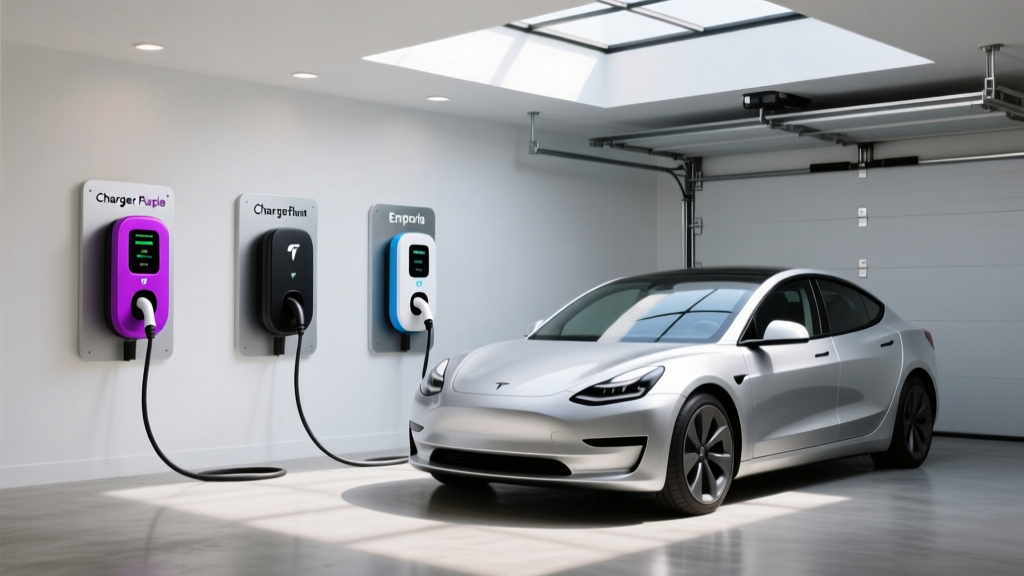
An alternative for panel-constrained homes: a smart panel-level device like the Sense energy monitor or a load-management system such as the Emporia VUE with EV charger integration, which dynamically throttles charger amperage to prevent panel overload. This can avoid a full panel upgrade in some cases.
Connector Compatibility: NACS, CCS, and CHAdeMO in 2026
The North American connector landscape has consolidated significantly. Tesla's NACS (North American Charging Standard, SAE J3400) is now the dominant plug, adopted by Ford, GM, Rivian, Hyundai, Kia, BMW, and most major automakers starting in the 2025–2026 model years.
| Connector | Brands Using It (Native) | Adapter Needed? |
|---|---|---|
| NACS (Tesla / J3400) | Tesla, Ford, GM, Rivian, Hyundai, Kia, BMW, Volvo, Polestar, Mercedes (2026+) | Legacy CCS vehicles need a NACS-to-CCS adapter (~$200–$300) for Supercharger access |
| CCS1 | VW ID.4 (2024 and earlier), older BMW i4/iX, legacy Hyundai Ioniq 5 (pre-2025) | CCS-to-NACS adapter required for Tesla Supercharger network |
| CHAdeMO | Nissan Leaf (discontinued), Mitsubishi Outlander PHEV | Limited future support; CHAdeMO infrastructure declining |
If you're buying a used Tesla with free Supercharging, you're already on NACS — no adapter issues. But if you're cross-shopping a non-Tesla EV, verify whether the model year you're buying has native NACS or requires an adapter for Supercharger access. Per the IRS §30D guidelines, home charger equipment may qualify for a separate federal credit (up to $1,000 under §30C, subject to income and location requirements).
Cost to Charge: Home vs. Public vs. Supercharger Per-Mile Economics
Even with free Supercharging, understanding per-mile charging costs is essential — because most of your electrons will come from your home panel, not a Supercharger stall.
| Scenario | Rate ($/kWh) | Vehicle Efficiency | Cost Per Mile | Annual Cost (12,000 mi) |
|---|---|---|---|---|
| Home, off-peak utility rate | $0.08–$0.12 | 3.5 mi/kWh (Tesla Model 3) | $0.023–$0.034 | $275–$410 |
| Home, average US rate | $0.16 | 3.5 mi/kWh | $0.046 | $550 |
| Tesla Supercharger (paid) | $0.25–$0.40 | 3.5 mi/kWh | $0.071–$0.114 | $855–$1,370 |
| Electrify America / 3rd-party DCFC | $0.30–$0.55 | 3.0 mi/kWh (larger EV) | $0.10–$0.183 | $1,200–$2,200 |
| Free Supercharging (legacy perk) | $0.00 | 3.5 mi/kWh | $0.00 (road trips only) | $0 for DCFC portion |
| Gasoline baseline (28 MPG, $3.40/gal) | — | 28 MPG | $0.121 | $1,457 |
The math is clear: home charging at off-peak rates is roughly 75–85% cheaper per mile than gasoline. Free Supercharging eliminates road-trip fuel costs entirely, but if you drive 12,000 miles per year and 85% of that is local, you'll still pay $275–$550 annually for home electricity. The free Supercharging perk saves the most value for high-mileage road warriors — potentially $1,000–$2,000 per year if you take frequent long trips.
According to fueleconomy.gov, the average EV owner saves $600–$1,200 annually on fuel compared to a 27 MPG gasoline vehicle, with savings heavily dependent on local electricity rates and driving patterns.
Equipment Recommendations: Best Home Level 2 Chargers in 2026
Tesla Wall Connector (Gen 4)
- Power: Up to 48A / 11.5 kW (on a 60A circuit)
- Connector: NACS native
- Cable length: 24 ft
- Smart features: Wi-Fi, OTA updates, power sharing (link up to 6 units on one circuit), access control
- Price: ~$475
- Best for: Tesla owners; cleanest integration with Tesla app
ChargePoint Home Flex (NACS)
- Power: Up to 50A / 12 kW (on a 60A circuit); adjustable down to 16A
- Connector: NACS (2025+ models); CCS1 available for older EVs
- Cable length: 23 ft
- Smart features: Wi-Fi, app scheduling, utility demand-response integration, Alexa
- Price: ~$550
- Best for: Multi-EV households; utility rebate eligible in many regions
Emporia Level 2 EV Charger
- Power: Up to 48A / 11.5 kW (on a 60A circuit)
- Connector: J1772 (NACS adapter included with newer models)
- Cable length: 24 ft
- Smart features: Integrates with Emporia VUE panel monitor for load management; real-time cost tracking
- Price: ~$400
- Best for: Homes with panel constraints; budget-conscious buyers wanting smart features
For any charger you select, the National Electrical Code (NEC) requires that continuous loads (including EV charging) not exceed 80% of the circuit rating. A 48-amp charger requires a 60-amp breaker. A 40-amp charger requires a 50-amp breaker. Do not undersize the circuit.
Safety, Code, and Installation Best Practices
EV charging is a high-draw, continuous electrical load — it runs for hours at near-maximum circuit capacity. This makes code compliance non-negotiable:
- Dedicated circuit: Your EV charger must have its own breaker — no sharing with other outlets or appliances.
- GFCI protection: NEC 2020 and later require GFCI (Ground Fault Circuit Interrupter) protection for all outdoor EV charging receptacles. Hardwired units with built-in GFCI are preferred over plug-in setups for outdoor installations.
- Outdoor rating: If your charger is mounted outside or in an open carport, ensure it carries a NEMA 4 (weatherproof) rating. Most quality chargers (Tesla Wall Connector, ChargePoint Home Flex) meet this standard.
- Permit and inspection: Most jurisdictions require an electrical permit for a new 240V circuit. The inspection ensures proper wire gauge, breaker sizing, grounding, and GFCI compliance. Skipping the permit risks insurance denial in the event of an electrical fire.
- Wire gauge: A 60-amp circuit typically requires 6 AWG copper wire (THHN in conduit) or 4 AWG for longer runs to mitigate voltage drop. Your electrician will size this based on run distance.
Is a Free Supercharging Tesla Worth the Premium?
A used Tesla Model S or Model X with verified transferable free unlimited Supercharging typically commands a $3,000–$7,000 premium over an identical vehicle without the perk. Whether that premium pays for itself depends on your driving profile:
- High road-trip driver (10,000+ Supercharger miles/year): At $0.30/kWh average Supercharger pricing and 3.5 mi/kWh efficiency, you'd spend roughly $857/year on Supercharging. The perk pays back a $5,000 premium in ~6 years.
- Mostly local driver (2,000 Supercharger miles/year): You'd spend ~$171/year. The payback period stretches to 29 years — not worth the premium.
- Resale value hedge: Transferable free Supercharging may preserve resale value as the pool of eligible vehicles shrinks, partially offsetting the upfront premium.
The bottom line: free Supercharging is a genuine perk for road warriors, but it doesn't eliminate the need for a home Level 2 charger, and it doesn't justify overpaying for a used vehicle with higher mileage or an older battery. Always check the vehicle's battery State of Health (accessible through the Tesla service menu or third-party tools like Tessie) before purchasing.
Frequently Asked Questions
How much does it cost to install a home EV charger?
A typical Level 2 home charger installation costs $750–$2,100 if your electrical panel has sufficient capacity. This includes the charger ($300–$700), electrician labor ($400–$1,200), and permit ($50–$200). If your home needs a panel upgrade from 100A to 200A service, add $1,500–$4,000+ to the total.
How fast will each charging level add range?
Level 1 (120V) adds 3–5 miles per hour. Level 2 (240V, 48A) adds roughly 35–45 miles per hour for a Tesla Model 3, or 25–35 for less efficient vehicles. DC fast charging at 150–250 kW can add 150–250 miles in 15–25 minutes, though the charge curve tapers above 60–80% SoC, so sustained rates are lower than peak rates.
Which connector/charger is compatible with my EV?
All Teslas use NACS natively. For 2025–2026 model years, Ford, GM, Rivian, Hyundai, Kia, and BMW have switched to NACS. Older non-Tesla EVs may have CCS1 and require a $200–$300 adapter for Supercharger access. CHAdeMO is limited to the discontinued Nissan Leaf and Mitsubishi Outlander PHEV. Check your vehicle's charge port or the manufacturer's spec sheet to confirm.
How much does charging cost per mile vs gas?
Home charging at the US average rate ($0.16/kWh) costs roughly $0.046 per mile in a Tesla Model 3 — about 60% less than a 28 MPG gas car at $3.40/gallon ($0.121/mile). Off-peak home rates ($0.08–$0.12/kWh) drop the cost to $0.023–$0.034/mile. Public DC fast charging ($0.30–$0.55/kWh) can approach or exceed gas costs per mile, which is why home charging is the economic backbone of EV ownership.
What electrical upgrades might I need?
If your home has a 100-amp electrical panel, you'll likely need a panel upgrade to 200A ($1,500–$4,000+). If your panel is already 200A but near capacity, your electrician may recommend a load-management device ($200–$500) that dynamically reduces charger amperage when other appliances are running. Homes with 200A panels and moderate existing loads typically need no upgrade beyond the dedicated 60A circuit.
Can I use free Supercharging as my only charging method?
Technically yes, but practically no. Relying exclusively on Superchargers means multiple trips per week to a charging station, exposure to peak-hour congestion and stall unavailability, and accelerated battery degradation from repeated high-power DC charging. Tesla's own battery management guidance recommends daily charging to 80% on Level 2 for NMC batteries and periodic 100% sessions only for road trips. Home Level 2 charging preserves long-term battery State of Health far better than exclusive DC fast charging.