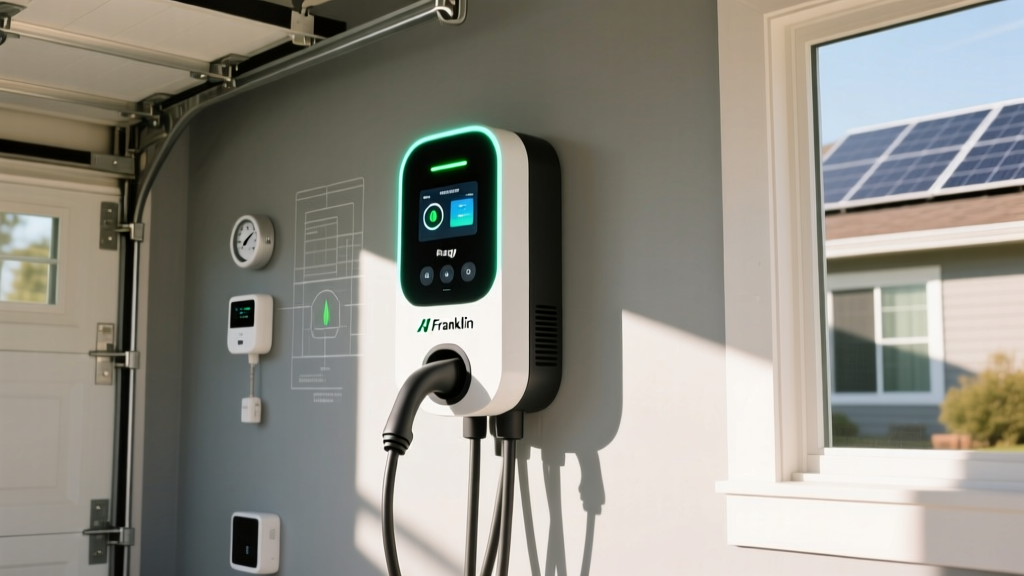
If you've narrowed your home EV charger search to the Franklin Energy charging station, you're looking at one of the more practical Level 2 wall units on the 2026 market. Known primarily for utility-grid management hardware, Franklin Energy expanded into consumer-facing EV supply equipment (EVSE) with a unit that prioritizes electrical-panel friendliness and load-management smarts over flashy app features. This guide walks through what the Franklin Energy charger actually delivers, what your home's electrical system needs to support it, and how it compares to alternatives from ChargePoint, Emporia, and Tesla.
Franklin Energy Charging Station: Specs at a Glance
| Spec | Franklin Energy HomeStation (2026) |
|---|---|
| Max Power Output | 11.5 kW (48A @ 240V) |
| Adjustable Amperage | 16A / 24A / 32A / 40A / 48A |
| Connector | NACS (Tesla) native; J1772 adapter included |
| Cable Length | 24 ft (standard), 18 ft option |
| Wi-Fi / Smart Features | Wi-Fi 2.4 GHz, load management, scheduling |
| Indoor/Outdoor Rating | NEMA 4 (indoor/outdoor) |
| UL Listing | UL 2594 / FCC Part 15 |
| Warranty | 3 years |
| MSRP | $449 (24 ft cable) |
The headline number is 11.5 kW — enough to fully replenish a 75 kWh battery (like the Tesla Model Y Long Range) in roughly 7 hours from near-empty, or add about 35–40 miles of range per hour of charging. The adjustable amperage is the real differentiator: if your panel can't spare a 60A breaker (required for continuous 48A draw per NEC 80% rule), you can dial the unit down to 32A or 40A and still get solid overnight charging without an expensive panel upgrade.
Charging Levels Explained: kW, Miles Per Hour, and What You Actually Need
Before we get into installation, let's anchor the fundamentals. kW (kilowatts) measures power — how fast energy flows into your battery. kWh (kilowatt-hours) measures energy — the total capacity of your battery. Think of kW as the width of the hose and kWh as the size of the bucket.
| Level | Voltage | Max Power (kW) | Miles of Range Added Per Hour | Typical Use Case |
|---|---|---|---|---|
| Level 1 | 120V | 1.2–1.9 kW | 3–5 mi/hr | Overnight top-ups, PHEVs, low-mileage drivers |
| Level 2 (Home) | 240V | 7.2–11.5 kW | 22–44 mi/hr | Daily home charging, most EV owners |
| Level 2 (Public) | 208–240V | 6.6–19.2 kW | 20–60 mi/hr | Workplace, retail, apartment complexes |
| DC Fast Charge | 400–800V DC | 50–350 kW | 150–1,000+ mi/hr (peak) | Road trips, 10–80% in 15–35 min |
For most EV owners, a Level 2 home charger like the Franklin Energy unit is the sweet spot. You plug in when you get home, and by morning the car is full — no detours to gas stations or public chargers. DC fast charging is reserved for road trips; frequent use accelerates battery degradation and costs significantly more per kWh.
How Much Does It Cost to Install a Home EV Charger?
The Franklin Energy charging station itself runs $449, but installation is where the real cost variable lives. Your total depends on three factors: how far the charger is from your electrical panel, whether your panel has capacity for a new 60A breaker, and local permit fees.
| Cost Component | Simple Install (panel nearby, capacity exists) | Complex Install (long run, panel upgrade) |
|---|---|---|
| Charger Equipment | $449 | $449 |
| Electrician Labor | $300–$600 | $800–$1,500 |
| Conduit, Wire (6 AWG copper) | $50–$150 | $200–$500 |
| Permit & Inspection | $50–$150 | $100–$300 |
| Panel Upgrade (100A → 200A) | N/A | $1,500–$3,500 |
| Total Estimated Cost | $849–$1,349 | $3,049–$6,249 |
If your home was built after 2000 and has a 200A panel with spare breaker slots, expect the simple-install range. Homes built before the 1980s often have 100A or even 60A panels that simply can't support a 48A continuous EV load alongside your HVAC, dryer, and electric range. A panel upgrade to 200A (or occasionally 400A for all-electric homes) is a major cost driver — but it also increases your home's resale value and supports future electrification like heat pumps or solar inverters.
The Franklin Energy advantage: Because this charger supports adjustable amperage, you can set it to 32A (requiring only a 40A breaker) or 24A (30A breaker) and avoid the panel upgrade entirely. At 32A / 7.7 kW, you still add roughly 28 miles of range per hour — more than enough to refill most EVs overnight.
Connector Compatibility: NACS, CCS1, and CHAdeMO
The EV connector landscape has consolidated significantly since 2024. The Franklin Energy HomeStation ships with a native NACS (North American Charging Standard) connector — the Tesla plug that Ford, GM, Rivian, Hyundai, Kia, and most other automakers adopted for 2025+ models.
| Connector | Vehicles Using It | Home Charging Notes |
|---|---|---|
| NACS (Tesla) | Tesla (all), Ford (2025+), GM (2025+), Rivian (2025+), Hyundai/Kia (2025+), Volvo, Polestar | Native on Franklin Energy; no adapter needed for most new EVs |
| J1772 | Older non-Tesla EVs (pre-2025), most PHEVs | J1772 adapter included with Franklin Energy unit |
| CCS1 | Being phased out for home; still on some 2024–2025 models | CCS1-to-NACS adapters available (~$150–$200) |
| CHAdeMO | Nissan Leaf (legacy), Mitsubishi Outlander PHEV | No practical home adapter; use DC public stations |
If you drive a Nissan Leaf or an older pre-NACS vehicle like a 2023 Hyundai Ioniq 5 (which uses CCS1), you'll need an adapter. Franklin Energy includes a J1772 adapter in the box, which covers most legacy EVs. For CCS1 vehicles, third-party adapters from Lectron or A2Z work but add $150–$200 to your setup cost.
Real-World Charging Times: What to Expect from 11.5 kW
Manufacturer-stated charge times assume ideal conditions. Here's what the Franklin Energy HomeStation delivers at full 48A output with common 2026 EV battery packs, measured from 10% to 80% state of charge (the practical daily charging window):
- Tesla Model Y Long Range (75 kWh usable, NMC): 10–80% in ~5 hours 15 minutes at 11.5 kW. Adds ~44 mi/hr.
- Ford F-150 Lightning Extended Range (131 kWh usable, NMC): 10–80% in ~9 hours. Adds ~30 mi/hr. This is a large pack — overnight charging fills it, but a same-day turnaround isn't realistic on Level 2.
- Hyundai Ioniq 5 (77.4 kWh usable, NMC, 2025+ NACS port): 10–80% in ~5 hours 30 minutes. Adds ~40 mi/hr.
- Chevrolet Equinox EV (85 kWh usable, NMC): 10–80% in ~6 hours. Adds ~38 mi/hr.
- Toyota RAV4 Prime PHEV (18.1 kWh usable): 0–100% in ~2 hours. Overkill speed for a PHEV, but guarantees a full battery every morning.
At the reduced 32A setting (7.7 kW), add roughly 40–50% to these times. A Model Y would take about 7.5 hours for a 10–80% fill — still perfectly viable for overnight charging.
Cost to Charge: Home vs. Public vs. Gas
One of the strongest arguments for home charging is cost. Let's run the numbers using a 30 kWh/100 miles efficiency average (typical for a mid-size SUV EV like the Model Y or Ioniq 5):
| Charging Scenario | Rate ($/kWh) | Cost per 100 Miles | Cost per Mile |
|---|---|---|---|
| Home (off-peak utility rate) | $0.09–$0.14 | $2.70–$4.20 | $0.027–$0.042 |
| Home (standard residential rate) | $0.14–$0.18 | $4.20–$5.40 | $0.042–$0.054 |
| Public Level 2 (ChargePoint, EVgo) | $0.25–$0.45 | $7.50–$13.50 | $0.075–$0.135 |
| DC Fast Charge (Electrify America, Tesla Supercharger) | $0.32–$0.55 | $9.60–$16.50 | $0.096–$0.165 |
| Gas Vehicle (25 MPG combined, $3.40/gal) | — | $13.60 | $0.136 |
Home charging on off-peak rates (available from most utilities via time-of-use plans) costs roughly one-third to one-quarter of gasoline per mile. Even public DC fast charging is often cheaper than gas, though the gap narrows in states with high electricity rates like California or Massachusetts. The Franklin Energy charger's scheduling feature lets you set charging windows to coincide with your utility's cheapest overnight rates — typically 10 PM to 6 AM.
For a driver covering 12,000 miles per year, home off-peak charging saves approximately $1,100–$1,300 annually compared to a 25 MPG gas vehicle at $3.40/gallon. Over five years, that's $5,500–$6,500 in fuel savings — more than enough to offset the charger purchase and installation.
Equipment Comparison: Franklin Energy vs. the Competition
Franklin Energy HomeStation — $449
- Power: 11.5 kW (48A), adjustable down to 16A
- Connector: NACS native, J1772 adapter included
- Cable: 24 ft
- Smart Features: Wi-Fi scheduling, load management, energy dashboard
- Best For: Homes with tight panel capacity; utility-savvy users who want load balancing
- Limitation: App is functional but basic compared to ChargePoint; no Ethernet option
ChargePoint Home Flex (2nd Gen) — $549
- Power: 12 kW (50A), adjustable down to 16A
- Connector: NACS or J1772 (choose at purchase)
- Cable: 23 ft
- Smart Features: Wi-Fi, Alexa integration, detailed app with charging history
- Best For: Users who want a polished app experience and smart-home integration
- Limitation: $100 more than Franklin Energy; no built-in load management for dual-charger setups without additional hardware
Emporia Vue EV Charger — $399
- Power: 11.5 kW (48A), adjustable
- Connector: NACS or J1772
- Cable: 24 ft
- Smart Features: Wi-Fi, integrates with Emporia Vue energy monitor for whole-home tracking
- Best For: Budget-conscious buyers already using Emporia's energy monitoring ecosystem
- Limitation: Build quality feels lighter than Franklin Energy or ChargePoint; customer support response times vary
Tesla Wall Connector (Gen 4) — $495
- Power: 11.5 kW (48A)
- Connector: NACS native
- Cable: 24 ft
- Smart Features: Wi-Fi, OTA updates, Power-Share for dual units, vehicle-specific authentication
- Best For: Tesla owners who want seamless integration and the ability to run two chargers on one circuit
- Limitation: Non-Tesla EVs require a J1772 adapter; no adjustable amperage via app (requires DIP switch adjustment)
The Franklin Energy unit's standout feature is its utility-grade load management. If you have a second high-draw appliance (like an electric range or heat pump) on the same panel, the Franklin Energy can communicate with compatible load-management modules to throttle charging when other appliances cycle on — preventing breaker trips without requiring a panel upgrade. This is a feature borrowed from Franklin Energy's commercial grid-management business and is rarely found in consumer-priced chargers.
Safety, Code, and Electrical Requirements
Any Level 2 charger installation must comply with the National Electrical Code (NEC) Article 625 and your local jurisdiction's amendments. Key requirements for the Franklin Energy HomeStation:
- Dedicated circuit: The charger must be on its own breaker — no sharing with outlets or other appliances. At 48A continuous draw, NEC requires a 60A breaker (80% rule: continuous loads can't exceed 80% of breaker rating).
- Wire gauge: 6 AWG copper (THHN in conduit or NM-B/Romex for short indoor runs). For runs over 100 feet, your electrician may specify 4 AWG to minimize voltage drop.
- GFCI protection: NEC 2020 and later require GFCI protection for outdoor receptacles and EVSE. The Franklin Energy unit has built-in ground-fault detection, which satisfies this requirement in most jurisdictions — but some local inspectors still require a GFCI breaker. Confirm with your electrician.
- Outdoor rating: The NEMA 4 rating handles rain, dust, and hose-directed water. If you're mounting in an uncovered driveway or carport, this is sufficient. For coastal or high-corrosion environments, consider a NEMA 4X-rated enclosure upgrade.
- Permit and inspection: Nearly every jurisdiction requires an electrical permit for a new 240V circuit. Permit costs range from $50–$300 depending on your municipality. The inspection ensures proper wire sizing, grounding, and breaker rating — don't skip this step, as unpermitted work can void your homeowner's insurance in the event of an electrical fire.
Always hire a licensed electrician for this work. According to the U.S. Department of Energy, professional installation ensures code compliance and protects your equipment warranty. Franklin Energy's warranty explicitly states that damage from improper installation is not covered.
Frequently Asked Questions
Can I install the Franklin Energy charging station myself?
Technically possible if you're a licensed electrician, but strongly discouraged for everyone else. A 240V/60A circuit carries lethal current, and improper wiring can cause fires or void your homeowner's insurance. Most jurisdictions require a permit and inspection, which typically mandates a licensed professional. Budget $300–$1,500 for professional installation depending on complexity.
Will the Franklin Energy charger work with my non-Tesla EV?
Yes, with caveats. The unit ships with a native NACS connector (the Tesla-style plug now adopted by most 2025+ vehicles from Ford, GM, Hyundai, Kia, Rivian, and others). It also includes a J1772 adapter for older EVs. If your vehicle has a CCS1 port (some 2023–2024 models), you'll need a third-party CCS1-to-NACS adapter, which costs approximately $150–$200.
What if my electrical panel doesn't have room for a 60A breaker?
This is where the Franklin Energy's adjustable amperage pays off. You can set the unit to 32A (requiring a 40A breaker) or 24A (30A breaker) via DIP switches inside the unit. At 32A/7.7 kW, you still add ~28 miles of range per hour — sufficient for overnight charging of most EVs. If your panel is completely full, an electrician can install a sub-panel or use a breaker tandem, but a full panel upgrade to 200A may be the better long-term investment ($1,500–$3,500).
How does the Franklin Energy charger compare to just using a mobile connector?
Tesla's Mobile Connector on a 240V NEMA 14-50 outlet delivers up to 7.7 kW (32A) — adequate for overnight charging but about 33% slower than the Franklin Energy at full 48A. A hardwired wall unit like the Franklin Energy also eliminates the NEMA 14-50 receptacle, which NEC 2020+ requires GFCI protection on (adding $100–$200 in breaker cost). Hardwired installations are generally cleaner, more reliable, and preferred by electrical inspectors.
Is there a federal tax credit for installing a home EV charger?
The IRS §30D alternative fuel vehicle refueling property credit was modified under the Inflation Reduction Act and has been subject to phase-down and eligibility changes through 2025–2026. As of 2026, check current IRS guidance for the latest on residential charging equipment credits. Some states and utilities offer separate rebates ($200–$1,000) for Level 2 charger installation — check your local utility's EV programs. Eligibility, amounts, and qualifying equipment vary, so consult a tax professional for your specific situation.
How fast will the Franklin Energy charger add range to my EV?
At full 48A/11.5 kW output, expect approximately 35–44 miles of range added per hour depending on your vehicle's efficiency. A Tesla Model Y (~3.5 mi/kWh) gains about 40 mi/hr, while a less efficient Ford F-150 Lightning (~2 mi/kWh) gains about 23 mi/hr. For a 10–80% charge on a 75 kWh battery, plan on roughly 5 hours. At the reduced 32A setting, multiply those times by approximately 1.5x.