Florida Power & Light (FPL) serves over 5 million customer accounts across Florida, and with Tesla's Supercharger network now open to non-Tesla EVs via NACS adapters, the phrase "FPL Tesla charger" covers a lot of ground in 2026. Whether you're a Tesla owner looking to optimize home charging on FPL's EV rate plan, a non-Tesla EV driver eyeing Tesla's Wall Connector, or someone planning a road trip using Superchargers across Florida, this guide maps every variable: electrical requirements, real installation costs, FPL's time-of-use rates, and the equipment that actually delivers.
Charging Levels Explained: Speeds, kW, and Miles Per Hour
Before evaluating any FPL Tesla charger setup, you need to understand the three charging tiers available to Florida EV owners. Each level differs in voltage, power delivery, and practical use case.
| Level | Voltage | Max Power (kW) | Miles of Range Added/Hour | Best Use Case |
|---|---|---|---|---|
| Level 1 | 120V AC | 1.4–1.9 kW | 3–5 miles | Overnight trickle; PHEVs; emergency backup |
| Level 2 | 240V AC | 7.2–19.2 kW | 20–75 miles | Daily home/work charging; primary EV fueling |
| DC Fast Charging | 400–800V DC | 50–350 kW | 150–1,000+ miles (equivalent rate) | Road trips; rapid top-ups; 10–80% in 15–40 min |
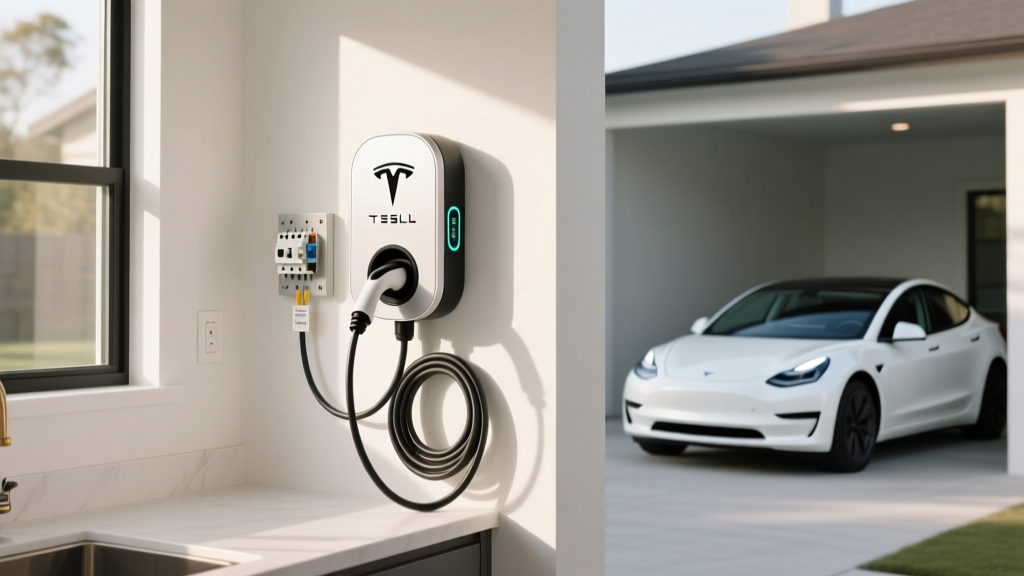
For home charging on FPL service, Level 2 is the standard. A Tesla Wall Connector on a 60-amp circuit delivers up to 11.5 kW (48 amps continuous), adding roughly 44 miles of range per hour to a Model Y. That's enough to fully replenish a depleted 75 kWh battery in about 7 hours — ideal for overnight charging during FPL's off-peak rate window.
DC fast charging is what you'll find at Tesla Supercharger stations across Florida. A V4 Supercharger cabinet delivers up to 250 kW to compatible vehicles. A Tesla Model 3 Long Range (75 kWh battery) can charge from 10% to 80% in approximately 25–30 minutes at a 250 kW stall, though the charge curve tapers significantly above 80% to protect battery health. Expect the final 20% to take as long as the first 70%.
Home Installation: Electrical Requirements and Real Costs
Installing a Level 2 FPL Tesla charger at home means running a dedicated 240-volt circuit from your electrical panel to the charger location. Here's what that involves in practical terms.
Electrical Specifications
A Tesla Wall Connector configured for maximum output requires a 60-amp dedicated circuit (breaker rated at 60A, continuous load at 48A per NEC 80% rule). The circuit uses 6 AWG copper wire for runs up to 50 feet; longer runs may require 4 AWG to minimize voltage drop. The connector terminates in a NEMA 14-50 receptacle (if using a plug-in configuration) or is hardwired directly (recommended for 60A circuits, as NEMA 14-50 receptacles are technically rated for 50A maximum).
Panel Upgrade Reality
Many Florida homes built before 2000 have 100-amp or 150-amp main service panels. Adding a 60-amp EV circuit to a panel already running central A/C (30–40A), electric range (40–50A), and electric dryer (30A) may exceed the panel's capacity. A load calculation performed by a licensed electrician will determine whether you need a panel upgrade to 200 amps — a common requirement in older Florida homes.
| Cost Component | Low Estimate | High Estimate | Notes |
|---|---|---|---|
| Tesla Wall Connector (hardware) | $420 | $475 | Gen 3 Wall Connector, 24-ft cable, Wi-Fi enabled |
| Electrician labor (standard install) | $600 | $1,500 | Assumes panel is nearby, conduit run under 30 ft |
| Electrical permit (Florida) | $50 | $150 | Varies by county; required for new circuits |
| Panel upgrade (if needed) | $1,500 | $3,500 | 100A to 200A service upgrade; not always required |
| Additional wiring/conduit (long runs) | $200 | $800 | Over 50 ft from panel; underground conduit adds cost |
| Total (no panel upgrade) | $1,070 | $2,925 | Most common scenario for newer homes |
| Total (with panel upgrade) | $2,570 | $6,425 | Common in pre-2000 Florida homes |
Florida law requires a licensed electrician to pull a permit for any new 240V circuit. Do not skip this step — unpermitted electrical work can void your homeowner's insurance and create fire risk. FPL does not install chargers directly, but they do offer guidance on electrical readiness through their EV program page.
FPL EV Rate Plans: Maximizing Off-Peak Savings
FPL offers an EV Time-of-Use (TOU) rate plan that can dramatically reduce your home charging cost. Under this plan, electricity rates vary by time of day, incentivizing overnight charging when grid demand is lowest.
As of 2026, FPL's EV TOU rate structure (approximate, subject to regulatory adjustment) breaks down as follows:
- Off-peak (midnight–6 AM, weekends): ~$0.08–$0.10/kWh
- On-peak (6 AM–midnight weekdays): ~$0.16–$0.22/kWh
- Standard residential rate (no TOU): ~$0.13–$0.15/kWh blended average
The Tesla Wall Connector's built-in Wi-Fi and scheduling features let you program charging to begin automatically at midnight, ensuring you always hit the cheapest rate window. Combined with the Tesla app, you can monitor exact kWh consumed per session.
Cost Per Mile: FPL Home Charging vs. Gas vs. Public DC Fast
The economics of EV ownership in Florida hinge on where and when you charge. Here's a direct comparison using a Tesla Model Y Long Range (310 miles EPA, ~75 kWh usable battery, ~3.6 miles/kWh efficiency) as the baseline.
| Charging Scenario | Rate ($/kWh) | Cost for Full 75 kWh Charge | Cost Per Mile |
|---|---|---|---|
| FPL Off-Peak Home (TOU plan) | $0.09 | $6.75 | $0.022 |
| FPL Standard Home Rate | $0.14 | $10.50 | $0.034 |
| FPL On-Peak Home (TOU plan) | $0.19 | $14.25 | $0.046 |
| Tesla Supercharger (Florida avg.) | $0.32–$0.38 | $24.00–$28.50 | $0.078–$0.092 |
| Electrify America / EVgo (DCFC) | $0.36–$0.48 | $27.00–$36.00 | $0.087–$0.117 |
| Gasoline equivalent (25 MPG, $3.30/gal) | — | $40.92 | $0.132 |
At FPL's off-peak rate, driving a Model Y costs roughly 2.2 cents per mile — about one-sixth the cost of gasoline at $3.30/gallon in a 25 MPG vehicle. Even at Supercharger rates, you're paying less per mile than gas. The savings compound: a driver covering 12,000 miles/year saves approximately $1,100–$1,300 annually charging at home on FPL's off-peak plan versus fueling a comparable gas car.
Connector Compatibility: NACS, CCS1, and Adapters in 2026
Florida's charging landscape in 2026 has largely standardized around NACS (North American Charging Standard), the connector Tesla pioneered and which most major automakers have adopted. But connector compatibility still depends on your vehicle's model year and brand.
| Connector | Native Vehicles (2025–2026 models) | Tesla Supercharger Access | Adapter Needed? |
|---|---|---|---|
| NACS (Tesla) | Tesla (all), Ford F-150 Lightning (2025+), Rivian (2025+), GM Ultium vehicles (2025+), Hyundai/Kia (2026 models) | Direct plug-in | None |
| CCS1 | VW ID.4, BMW iX, older Ford Mustang Mach-E (pre-2025), Hyundai Ioniq 5 (pre-2026) | Yes, via Tesla CCS-to-NACS adapter | Tesla CCS Adapter (~$250) or third-party |
| CHAdeMO | Nissan Leaf (legacy); effectively discontinued for new models | No — Superchargers do not support CHAdeMO | No adapter available; use Electrify America/EVgo |
If you drive a non-Tesla EV with a CCS1 port, Tesla sells a CCS-to-NACS adapter (approximately $250) that enables access to the Supercharger network. Before purchasing, confirm your vehicle is listed as compatible in the Tesla app — not all CCS vehicles are approved for Supercharger access as of early 2026. The Tesla CCS adapter page maintains the current compatibility list.
For home charging, the Tesla Wall Connector features a native NACS plug. If your EV uses CCS1, you'll need the same adapter for home use — or consider a universal Level 2 charger like the ChargePoint Home Flex, which ships with a J1772/NACS connector and includes a NACS-to-J1772 adapter in the box.
Equipment Picks: Best Level 2 Chargers for FPL Customers
These three Level 2 chargers cover the most common FPL Tesla charger setups in 2026, from Tesla-native installations to universal options for multi-EV households.
Tesla Wall Connector (Gen 3)
- Power Output: Up to 11.5 kW (48A on 60A circuit)
- Connector: NACS (native Tesla plug)
- Cable Length: 24 feet
- Smart Features: Wi-Fi scheduling, OTA firmware updates, power sharing with second Wall Connector, Tesla app integration
- Price: ~$420–$475
- Best For: Tesla-only households; seamless app ecosystem; clean aesthetic
- Limitation: Not natively compatible with CCS vehicles without adapter
ChargePoint Home Flex
- Power Output: Up to 12 kW (50A on 60A circuit); configurable down to 16A for lower-capacity panels
- Connector: NACS (2025+ models); J1772 with included adapter for older stock
- Cable Length: 23 feet
- Smart Features: Wi-Fi, Alexa integration, detailed energy reporting via ChargePoint app, flexible amperage dip-switch configuration
- Price: ~$550–$650
- Best For: Multi-EV households (Tesla + non-Tesla); panel-limited homes needing lower amp config
- Limitation: Slightly higher cost than Tesla Wall Connector
Emporia Vue Level 2 Charger
- Power Output: Up to 11.5 kW (48A on 60A circuit)
- Connector: NACS (2025+ models); J1772 available
- Cable Length: 24 feet
- Smart Features: Wi-Fi, solar integration (pairs with Emporia Vue energy monitor for solar-aware charging), scheduling, load management
- Price: ~$350–$400
- Best For: Solar-equipped Florida homes; budget-conscious buyers wanting smart features
- Limitation: Smaller brand; fewer public charging network integrations
Charging Time Examples: 10–80% for Common Battery Sizes
Charge times depend on battery capacity, charger power, and the vehicle's onboard charge management. Here are real-world estimates for common scenarios FPL customers encounter:
- Tesla Model Y Long Range (75 kWh, NMC battery) on Tesla Wall Connector at 11.5 kW: 10–80% in approximately 4.5 hours (adding ~52.5 kWh)
- Tesla Model 3 RWD (57.5 kWh, LFP battery) on Wall Connector at 11.5 kW: 10–80% in approximately 3.5 hours. Note: LFP batteries tolerate regular 100% charges better than NMC — Tesla recommends periodic 100% charges for LFP to maintain calibration.
- Ford F-150 Lightning Extended Range (131 kWh, NMC) on a 48A Level 2 charger at 11.5 kW: 10–80% in approximately 9 hours — plan for extended overnight sessions
- Tesla Model Y at a 250 kW Supercharger: 10–80% in approximately 25–30 minutes, with peak charge rate sustained to roughly 50% SoC before tapering
DC fast charging always slows above 80% State of Charge. This is intentional battery protection — charging at high C-rates near full capacity generates excess heat and accelerates degradation. For road trips, plan your stops around 10–80% increments rather than waiting for a full charge.
Safety, Code, and Florida-Specific Considerations
Florida's electrical code (based on NEC 2023 with state amendments) and the state's climate create specific requirements for EV charger installations:
- Dedicated circuit: Your Level 2 charger must be on its own dedicated breaker — no sharing with other appliances. This is a NEC requirement, not optional.
- GFCI protection: NEC 2023 requires GFCI (Ground Fault Circuit Interrupter) protection for all EV charging receptacles. Hardwired installations may be exempt depending on local interpretation, but GFCI breakers add ~$30–$50 and improve safety.
- Outdoor rating: If your charger is mounted outdoors (common in Florida where garages are often used for storage), ensure the unit is rated NEMA 4 (weatherproof). The Tesla Wall Connector and ChargePoint Home Flex both carry NEMA 4 ratings.
- Hurricane/flood considerations: In flood-prone areas, mount the charger at least 12 inches above the base flood elevation. Use stainless steel hardware to resist salt-air corrosion in coastal counties.
- Load management: If your panel is near capacity but you want to avoid a costly upgrade, consider a smart load-management system like the Emporia Vue or a Tesla Powerwall integration that dynamically throttles charger amperage based on real-time household draw.
Frequently Asked Questions
How much does it cost to install a home EV charger with FPL service?
A standard Tesla Wall Connector installation on an adequate 200-amp panel typically costs $1,070–$2,925 including hardware, electrician labor, and permit. If your home needs a panel upgrade from 100A to 200A, add $1,500–$3,500. Always get at least two quotes from licensed Florida electricians.
Does FPL offer any rebates for EV charger installation?
FPL has periodically offered EV charger rebates and incentives, but program availability changes. Check FPL's official EV page for current offerings. Additionally, the federal §30D alternative fuel vehicle refueling property credit may cover up to 30% of home charger installation costs (maximum $1,000) if you live in an eligible census tract — consult a tax professional and review IRS guidelines.
Can I use a Tesla Supercharger with a non-Tesla EV in Florida?
Yes. As of 2026, Tesla has opened a significant portion of its Supercharger network to non-Tesla EVs via the "Charge Your Non-Tesla" feature in the Tesla app. You'll need a CCS-to-NACS adapter (sold by Tesla for ~$250) and your vehicle must be on Tesla's approved compatibility list. Expect slightly higher per-kWh pricing for non-Tesla vehicles compared to Tesla owners at the same station.
How fast will a Tesla Wall Connector charge my EV at home?
On a 60-amp circuit, the Tesla Wall Connector delivers up to 11.5 kW (48 amps continuous). For a Tesla Model Y Long Range (~3.6 mi/kWh), that translates to roughly 44 miles of range per hour of charging. A full overnight session (8 hours) adds approximately 350 miles — more than enough for any daily driving need.
What electrical upgrades might my Florida home need for a Level 2 charger?
The most common upgrade is a panel replacement from 100A or 150A to 200A service, costing $1,500–$3,500. Homes with older aluminum wiring may need circuit rewiring. Some homeowners opt for a 40-amp circuit instead of 60-amp, which still delivers 9.6 kW — sufficient for most daily needs and less demanding on the panel. A licensed electrician's load calculation is the definitive answer.
Is it cheaper to charge at home on FPL or use Tesla Superchargers?
Home charging on FPL's off-peak TOU rate (~$0.09/kWh) costs about $0.022/mile for a Model Y. Tesla Superchargers in Florida average $0.32–$0.38/kWh, or roughly $0.08–$0.09/mile. Home charging is 3–4x cheaper per mile. Superchargers are best reserved for road trips, while daily charging should happen at home overnight.