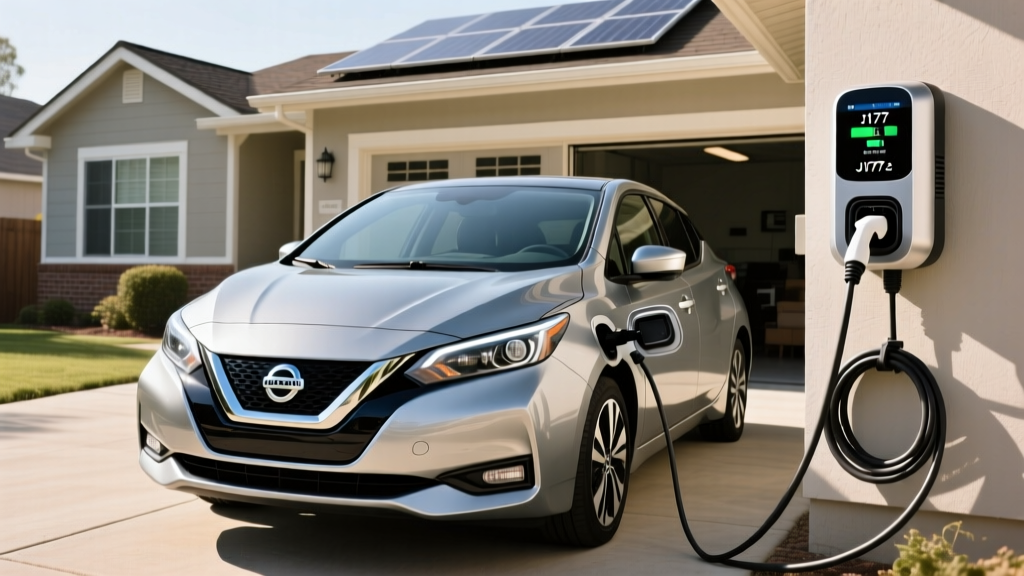
If you drive an electric vehicle in Florida Power & Light territory, the sticker price of electricity is only half the equation. The other half — when you charge, how fast you charge, and whether your home electrical panel can handle a Level 2 circuit — determines whether you're paying 3 cents a mile or 14 cents a mile. FPL's rate structure rewards off-peak home charging heavily, but public DC fast charging tells a very different cost story. This guide breaks down the real numbers behind FPL EV charging rates in 2026, what a home charger actually costs to install, and how your per-mile cost compares to a gasoline car.
FPL's Rate Structure: What You Actually Pay per kWh
FPL offers residential customers a time-of-use framework that applies to EV charging. As of early 2026, the key rate tiers for most FPL residential accounts (Schedule RS or the optional Time-of-Use rate) break down as follows:
- Off-Peak (overnight, typically 10 PM – 6 AM weekdays, plus weekends/holidays): roughly $0.08–$0.10 per kWh
- On-Peak (weekday daytime and evening): roughly $0.12–$0.15 per kWh
- Base residential average (no TOU election): approximately $0.12–$0.13 per kWh blended
These figures include base energy charges, fuel cost recovery, and applicable riders. Your exact rate depends on your specific tariff schedule, municipality (some cities have franchise fees), and whether you've elected FPL's optional Time-of-Use plan. Check your latest FPL bill for the precise $/kWh — the line items are listed under "Energy Charge" and "Fuel Charge."
For EV owners, the practical takeaway: charging a 75 kWh battery overnight at off-peak rates costs roughly $6.00–$7.50 for a full fill. Charging that same battery at on-peak rates costs $9.00–$11.25. That's a meaningful spread, and it's why scheduling your charge matters.
Charging Levels Explained: kW, Speed, and Miles Added per Hour
Before calculating cost, you need to understand the three charging levels available to EV owners. The distinction between kW (kilowatts — the rate of power delivery) and kWh (kilowatt-hours — the total energy stored in your battery) is critical. Think of kW as the flow rate of a hose and kWh as the size of the bucket.
| Level | Power (kW) | Voltage / Amps | Miles of Range Added per Hour | Best For |
|---|---|---|---|---|
| Level 1 | 1.0–1.9 kW | 120V / 12–16A | 3–5 mi/hr | Overnight top-ups, PHEVs, low-mileage drivers |
| Level 2 | 3.3–19.2 kW | 240V / 16–80A | 12–60+ mi/hr | Daily home charging, workplace, hotels |
| DC Fast Charge | 50–350 kW | 200–800V DC | 150–1,000+ mi/hr (peak) | Road trips, quick top-ups away from home |
Real-world context: A 10.5 kW Level 2 home charger (the most common residential setup on a 48-amp circuit) will fully replenish a Tesla Model Y Long Range (78.1 kWh usable battery) in about 8–9 hours — perfect for overnight. A 150 kW DC fast charger will take that same battery from 10% to 80% in roughly 25–30 minutes, though the charge rate tapers significantly above 80% to protect battery health.
Cost to Charge per Mile: FPL Home vs. Public vs. Gasoline
The most useful metric for EV economics isn't $/kWh — it's dollars per mile. That number depends on your vehicle's efficiency (measured in kWh per 100 miles or MPGe) and what you pay for electricity or gasoline. Here's how FPL home charging stacks up against public networks and a comparable gas car:
| Scenario | Rate / Price | Vehicle Assumption | Cost Per Mile |
|---|---|---|---|
| FPL Off-Peak Home (Level 2) | ~$0.09/kWh | EV at 30 kWh/100mi (e.g., Hyundai Ioniq 5) | $0.027/mi |
| FPL On-Peak Home (Level 2) | ~$0.14/kWh | EV at 30 kWh/100mi | $0.042/mi |
| Public Level 2 (network avg) | ~$0.25–$0.35/kWh | EV at 30 kWh/100mi | $0.075–$0.105/mi |
| Public DC Fast (EA/EVgo avg) | ~$0.35–$0.55/kWh | EV at 30 kWh/100mi | $0.105–$0.165/mi |
| Tesla Supercharger (avg FL) | ~$0.30–$0.42/kWh | EV at 28 kWh/100mi (Tesla) | $0.084–$0.118/mi |
| Gasoline car (30 MPG avg) | ~$3.20/gal | 30 MPG combined | $0.107/mi |
The math is stark. Charging at home on FPL's off-peak rate costs roughly one-quarter what a gasoline car costs per mile. Even at on-peak home rates, you're paying less than half the per-mile cost of gas. Public DC fast charging, however, can approach or exceed gasoline costs — which is why home charging access is the single biggest economic factor in EV ownership.
For a driver covering 12,000 miles per year in an Ioniq 5-class EV:
- 100% FPL off-peak home: ~$324/year in electricity
- 100% FPL on-peak home: ~$504/year
- 100% public DC fast: ~$1,260–$1,980/year
- Gasoline equivalent: ~$1,284/year
Home Charger Installation: Electrical Requirements, Costs, and Panel Upgrades
Installing a Level 2 home charger is the single best investment an EV owner in FPL territory can make. But the total cost depends heavily on your home's existing electrical infrastructure. Here's what's involved:
Electrical Requirements
A typical Level 2 home charger runs on a 240-volt dedicated circuit, the same voltage as your electric dryer or oven. The most common residential setups are:
- 40-amp circuit / 32-amp continuous draw: Delivers up to 7.7 kW. Good for most EVs with overnight charging.
- 48-amp circuit / 40-amp continuous: Delivers up to 9.6 kW. Recommended for larger batteries (100+ kWh trucks/SUVs).
- 60-amp circuit / 48-amp continuous: Delivers up to 11.5 kW. Best for dual-motor or large-battery vehicles that accept higher AC rates.
The National Electrical Code (NEC) requires EV chargers to be on a dedicated circuit — you cannot share it with other appliances. The circuit must be protected by a GFCI breaker if the charger is outdoors or in a garage (per NEC 2020/2023, Article 625). Your electrician will also pull a permit from your local jurisdiction (county or city), and the installation must pass inspection.
Panel Upgrade: The Hidden Cost
Many Florida homes built before 2000 have 100-amp or 150-amp main panels. Adding a 40–60 amp dedicated EV circuit may exceed the panel's remaining capacity — especially if you already run electric A/C, an electric water heater, and an electric range. A licensed electrician will perform a load calculation (NEC Article 220) to determine if your panel can handle the additional draw.
If your panel is at capacity, you'll need a panel upgrade to 200 amps, which in South and Central Florida typically costs $1,800–$3,500 including permit and utility coordination. Some homeowners opt for a smart load-management device (like the Emporia Smart Load Center or a charger with built-in load sharing) to avoid a panel upgrade — these devices throttle the charger when other high-draw appliances kick on.
Installation Cost Breakdown
| Component | Low End | High End | Notes |
|---|---|---|---|
| Level 2 charger (hardware) | $300 | $750 | 32A–48A, NACS or J3400 connector, Wi-Fi smart features |
| Electrician labor (simple run) | $500 | $1,200 | Short wire run from panel to garage, no panel upgrade |
| Electrician labor (complex run) | $1,200 | $2,500 | Long conduit run, attic/crawlspace routing, outdoor mount |
| Permit and inspection | $75 | $250 | Varies by county (Miami-Dade, Broward, Orange, etc.) |
| Panel upgrade (if needed) | $1,800 | $3,500 | 100A/150A → 200A upgrade, includes new breakers |
| Total (no panel upgrade) | $875 | $2,200 | Most homes with adequate panel capacity |
| Total (with panel upgrade) | $2,675 | $5,700 | Older homes or high-load households |
FPL incentive note: FPL has historically offered rebates for residential EV charger installations. Check FPL's EV program page for current 2026 rebate availability, as these programs change annually and may have enrollment caps.
Connector Compatibility: NACS, CCS, and What Your EV Needs
The EV connector landscape shifted dramatically in 2024–2025 when most major automakers adopted the North American Charging Standard (NACS), originally developed by Tesla. As of the 2026 model year, here's where things stand:
| Connector | Brands Using It (Native) | Notes |
|---|---|---|
| NACS (J3400) | Tesla, Ford, GM, Rivian, Volvo, Polestar, Mercedes-Benz, Nissan, Honda, Fisker, Lucid, Toyota (bZ series) | Now the dominant standard; SAE standardized as J3400 |
| CCS1 | Hyundai, Kia, BMW, VW, Audi, Porsche, Stellantis (some) | Still widely used; adapters to NACS available from several manufacturers |
| CHAdeMO | Nissan Leaf (legacy), Mitsubishi Outlander PHEV (legacy) | Effectively discontinued for new vehicles; infrastructure declining |
Adapter reality: If you drive a CCS-equipped EV (e.g., 2025 Hyundai Ioniq 5) and want access to Tesla Superchargers, you'll need a CCS-to-NACS adapter. Tesla sells an official adapter for ~$250, and third-party options (Lectron, A2Z) are available for $150–$200. Conversely, newer NACS-equipped vehicles can use CCS stations with a NACS-to-CCS adapter. For home charging, most Level 2 chargers now ship with NACS connectors, but CCS-terminated units remain available.
For home Level 2 charging, connector choice matters less because you're buying the charger to match your car. For public DC fast charging, having the right adapter expands your network access significantly — especially in Florida, where Tesla Supercharger stations outnumber most CCS networks.
Equipment Recommendations: Best Home Chargers for FPL Customers
Here are three Level 2 home chargers well-suited to Florida EV owners, selected for reliability, smart features (essential for scheduling off-peak FPL charging), and value:
Emporia Vue Level 2 EV Charger
- Power output: Up to 11.5 kW (48A) on a 60A circuit
- Connector: J1772 (NACS adapter available)
- Cable length: 24 feet
- Smart features: Wi-Fi scheduling, solar integration, energy monitoring via Emporia app, load management
- Price: ~$350–$400
- Best for: Budget-conscious buyers who want full smart scheduling to exploit FPL off-peak rates
ChargePoint Home Flex
- Power output: Configurable 16A–50A (up to 12 kW on a 60A circuit)
- Connector: J1772 or NACS (selectable at purchase)
- Cable length: 23 feet
- Smart features: Wi-Fi, Alexa/Google Home integration, scheduled charging, ChargePoint app with cost tracking
- Price: ~$550–$700
- Best for: Flexible amperage for homes with limited panel capacity; set to 32A or 40A without a new circuit
Tesla Wall Connector
- Power output: Up to 11.5 kW (48A) on a 60A circuit
- Connector: NACS (J1772 adapter included for non-Tesla EVs)
- Cable length: 24 feet
- Smart features: Wi-Fi scheduling, Tesla app integration, load sharing between multiple Wall Connectors
- Price: ~$420–$475
- Best for: Tesla owners or households with NACS-equipped vehicles; cleanest integration with Tesla's ecosystem
Charging Time Examples: What to Expect with Common Battery Sizes
Charging time depends on your battery's usable capacity (in kWh), the charger's power output (in kW), and your vehicle's onboard charger limit. Most EVs accept 7.2–11.5 kW on Level 2. Here are real-world estimates for popular models on a 48A / 11.5 kW home charger:
- Tesla Model 3 Long Range (78 kWh usable): 10%–80% in ~5.5 hours on Level 2; 10%–80% in ~22 minutes on a 250 kW Supercharger
- Hyundai Ioniq 5 (77.4 kWh usable): 10%–80% in ~5.7 hours on Level 2; 10%–80% in ~18 minutes on a 350 kW DC fast charger (peak 240 kW sustained)
- Ford F-150 Lightning Extended Range (131 kWh usable): 10%–80% in ~9 hours on Level 2 (limited to 19.2 kW onboard); 15%–80% in ~40 minutes on a 150 kW DC charger
- Chevrolet Equinox EV (85 kWh usable): 10%–80% in ~6 hours on Level 2; 10%–80% in ~30 minutes on a 150 kW DC charger
Charge curve reality: DC fast chargers don't deliver peak kW for the entire session. A charger rated at 250 kW may only sustain that rate between 10%–40% State of Charge (SoC), then taper to 150 kW, then 75 kW, then 25 kW above 80%. That's why 10%–80% time is the standard benchmark — charging above 80% is slow and generally not worth the wait on a road trip.
Safety, Code, and Florida-Specific Considerations
Florida's electrical code follows the NEC with state-specific amendments. Key requirements for a safe, code-compliant home EV charger installation:
- Dedicated circuit: Your EV charger must have its own breaker — no sharing with outlets, lights, or other appliances (NEC 625.40).
- GFCI protection: Required for all outdoor receptacles and garage installations where the charger is plug-connected (NEC 625.54). Hardwired chargers may not require an additional GFCI breaker if the unit includes ground-fault protection internally.
- Outdoor rating: If your charger is mounted outside (carport, driveway), it must be rated for outdoor use — look for NEMA 4 or IP65 enclosure ratings. Florida's humidity and afternoon storms make this non-negotiable.
- Surge protection: Florida leads the nation in lightning strikes. A whole-panel surge protective device (SPD), typically $150–$300 installed, protects your charger and vehicle from voltage spikes.
- Wire gauge: A 48A charger on a 60A breaker requires 4 AWG copper wire (or 6 AWG if using the 75°C column and the equipment is rated for it). Your electrician will size wire based on run length and ambient temperature derating.
Always hire a licensed Florida electrical contractor. Verify their license at myfloridalicense.com and confirm they pull permits — unpermitted work can void your homeowner's insurance and create fire risk.
Frequently Asked Questions
How much does it cost to install a home EV charger with FPL?
Expect $875–$2,200 for a straightforward installation (charger hardware + electrician labor + permit) if your panel has adequate capacity. If you need a 200-amp panel upgrade, the total rises to $2,675–$5,700. Get at least two quotes from licensed electricians, and ask specifically whether the quote includes permit, inspection, and a load calculation.
How fast will each charging level add range?
Level 1 (120V standard outlet) adds 3–5 miles of range per hour — adequate for PHEVs or drivers covering under 30 miles daily. Level 2 (240V home charger) adds 12–60 miles per hour depending on amperage, fully replenishing most EVs overnight. DC Fast Charging adds 150–1,000+ miles per hour at peak rates, but tapers significantly above 80% SoC.
Which connector does my EV use?
For 2026 model-year vehicles: Tesla, Ford, GM, Rivian, Volvo, Toyota (bZ), and most others use NACS (J3400). Hyundai, Kia, BMW, and VW Group vehicles still use CCS1. Check your vehicle's charge port or owner's manual. For home charging, buy a charger with the matching connector. For public charging, an adapter (~$150–$250) expands your network options.
How much does FPL home charging cost per mile vs. gasoline?
At FPL's off-peak rate (~$0.09/kWh) and a typical EV efficiency of 30 kWh/100 miles, you'll pay about $0.027 per mile. A gasoline car at 30 MPG and $3.20/gallon costs $0.107 per mile. That's roughly a 75% per-mile savings with home EV charging. Over 12,000 miles/year, that's approximately $960 in annual fuel savings.
What electrical upgrades might I need for a home charger?
The most common upgrade is a panel capacity increase from 100A or 150A to 200A, costing $1,800–$3,500. You may also need a new dedicated circuit run with appropriate wire gauge, a GFCI breaker, and possibly a surge protector. Some homeowners avoid a panel upgrade by installing a smart load-management device that throttles charger amperage when other appliances draw heavily. A licensed electrician's load calculation will determine what's required for your home.
Sources: Rate information reflects FPL residential tariff structures as published on fpl.com/rates. Vehicle efficiency and battery data sourced from fueleconomy.gov (EPA). Electrical code references per NEC 2023 Article 625 and Florida Building Code. Tax and incentive information per IRS §30D guidelines.