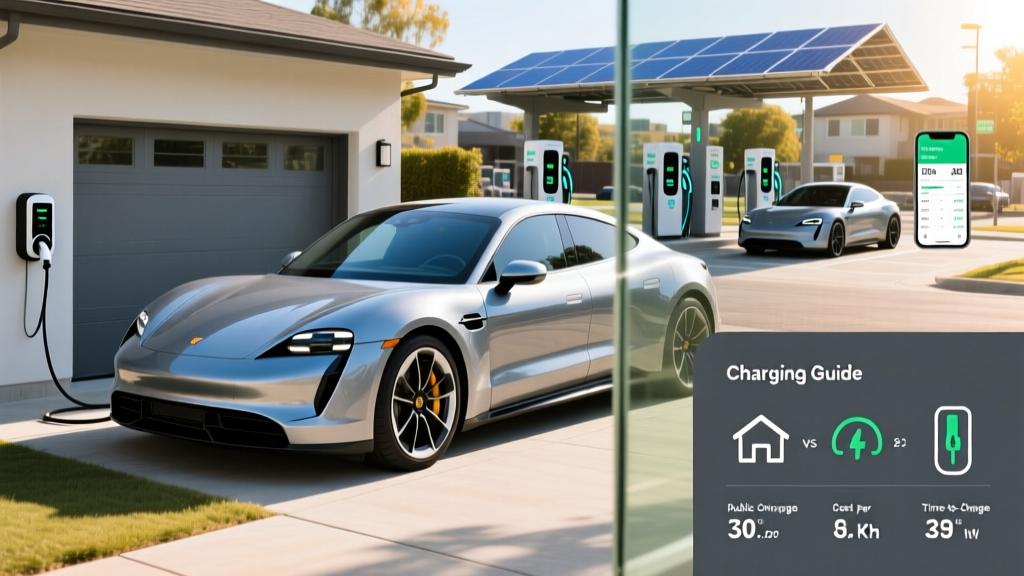
If you own an electric vehicle in Florida — or are about to buy one — Florida Power & Light's EV charging programs can significantly affect what you pay to charge at home. The FPL EV charger program encompasses time-of-use electricity rates, home charging rebates, and public infrastructure investments that every Florida EV driver should understand before plugging in.
This guide breaks down exactly how FPL's EV programs work, what it costs to install a home Level 2 charger, which equipment to buy, and how FPL's off-peak rates compare to gasoline on a cost-per-mile basis. All figures reflect 2026 program terms and are cross-referenced with FPL's official EV resources.
Understanding FPL's EV Rate Plans and Rebates
FPL offers a dedicated Residential Electric Vehicle Time-of-Use (EV-TOU) rate plan that rewards overnight charging with substantially lower per-kWh prices. As of 2026, the structure works like this:
- Off-peak (overnight, typically 10 PM – 6 AM): approximately $0.08–$0.10/kWh
- On-peak (daytime/evening): approximately $0.14–$0.18/kWh
- Standard residential rate (no EV plan): approximately $0.13–$0.15/kWh blended
The savings are meaningful. Charging an 80 kWh battery (like a Ford Mustang Mach-E Extended Range or Hyundai Ioniq 5) from 10% to 90% off-peak costs roughly $5.10–$6.40. On the standard rate, that same session runs $8.30–$9.60. Over a year of 12,000 miles, the EV-TOU plan can save Florida drivers $300–$500 versus standard rates.
FPL has also periodically offered home charger rebates — typically $250–$500 toward the purchase of a qualifying Level 2 charger — though availability rotates and may require enrollment in the EV-TOU plan. Check FPL's current EV rebate page for active offers before purchasing equipment.
Charging Levels Explained: Speeds, Power, and Range Added
A common source of confusion is the difference between kW (kilowatts) and kWh (kilowatt-hours). Think of kW as the flow rate of water through a hose (how fast energy moves), and kWh as the total volume of water in the bucket (how much energy your battery stores). Your charger's kW rating determines how quickly it fills your battery's kWh capacity.
| Level | Voltage | Power (kW) | Miles of Range Added per Hour | Typical Use Case |
|---|---|---|---|---|
| Level 1 | 120V AC | 1.0–1.4 kW | 3–5 mi/hr | Overnight top-ups, PHEVs, emergency |
| Level 2 | 240V AC | 7.2–19.2 kW | 25–70 mi/hr | Home daily charging, workplaces |
| DC Fast Charging | 400–800V DC | 50–350 kW | 150–1,000+ mi/hr | Road trips, highway corridors |
For most EV owners, Level 2 is the home standard. A 48-amp (11.5 kW) Level 2 charger will fully replenish a Tesla Model Y Long Range (75 kWh usable battery, ~310 miles EPA) in about 7–8 hours — perfect for overnight sessions on FPL's off-peak window.
DC fast charging is for road trips. At an Electrify America or Tesla Supercharger station along I-95 or the Florida Turnpike, a vehicle like the Hyundai Ioniq 5 (peak 240 kW DC capability) can charge from 10% to 80% in approximately 18 minutes. However, charging speed tapers significantly above 80% to protect battery health — expect 80–100% to take nearly as long as 10–80%.
How Much Does It Cost to Install a Home EV Charger?
This is the question every prospective EV owner asks, and the honest answer spans a wide range depending on your home's electrical panel, the distance from panel to charger location, and local permitting. Here's a realistic 2026 breakdown:
| Component | Typical Cost Range | Notes |
|---|---|---|
| Level 2 Charger (Equipment) | $350 – $750 | Smart Wi-Fi chargers, 32A–48A, 240V |
| Electrician Labor | $500 – $2,000 | Depends on run distance, conduit, drywall work |
| Permit & Inspection | $50 – $250 | Varies by Florida county |
| Electrical Panel Upgrade (if needed) | $1,500 – $3,500 | Required if panel is 100A or at capacity |
| Total (no panel upgrade) | $900 – $3,000 | Most newer homes with 200A service |
| Total (with panel upgrade) | $2,400 – $6,500 | Older homes, 100A panels |
The Panel Upgrade Gotcha
Many Florida homes built before 2000 have 100-amp or 150-amp electrical panels. A 48-amp Level 2 charger draws roughly 11.5 kW continuously — that's a significant new load. If your panel is already near capacity (running central A/C, electric range, dryer, pool pump), a licensed electrician may recommend upgrading to 200A service. This is the single largest variable in installation cost and is non-negotiable for safety.
Federal tax note: The IRS Residential Clean Energy Credit does not cover EV charger equipment for most taxpayers post-2023 (the alternative fuel vehicle refueling property credit expired for residential use). However, the §30D Clean Vehicle Credit of up to $7,500 for qualifying new EVs (subject to MSRP caps, buyer income limits, and battery sourcing requirements) can help offset your overall transition cost. Always consult a tax professional and check current-year IRS rules.
Which Connector and Charger Is Compatible with My EV?
The connector landscape has shifted dramatically. As of 2025–2026, nearly all major automakers have adopted or committed to NACS (North American Charging Standard) — the Tesla-designed connector — for new vehicles. However, millions of CCS1-equipped EVs remain on the road, and adapters bridge the gap.
| Connector | Brands Using It (Native) | Adapter Needed For |
|---|---|---|
| NACS (Tesla plug) | Tesla (all), Ford (2025+), GM (2025+), Rivian (2025+), Hyundai/Kia (2026+), Volvo/Polestar | CCS1 public stations (adapter included or ~$200) |
| CCS1 | VW, BMW, older Ford/GM/Hyundai/Kia (pre-adoption), Honda Prologue (early) | Tesla Superchargers (CCS-to-NACS adapter, ~$200–$250) |
| CHAdeMO | Nissan LEAF (legacy) | Largely deprecated; limited public availability |
Home charger recommendation: Most Level 2 home chargers ship with a J1772 connector (the legacy standard for AC charging). If your EV has a native NACS port, you'll use the NACS-to-J1772 adapter that comes with most new NACS vehicles, or purchase a NACS-terminated home charger. Tesla's Wall Connector now ships with a NACS plug and includes a J1772 adapter in the box.
Level 2 Home Charger Recommendations for FPL Customers
For Florida EV owners leveraging FPL's off-peak TOU rates, a smart (Wi-Fi-connected) Level 2 charger is essential — it lets you schedule charging sessions to start at 10 PM automatically, ensuring you always charge at the lowest rate. Here are three proven options:
Tesla Wall Connector (Gen 4)
- Power: Up to 11.5 kW (48A) at 240V
- Connector: NACS native, J1772 adapter included
- Cable length: 24 feet
- Smart features: Wi-Fi, OTA updates, power sharing between multiple units, load management
- Price: ~$475
- Best for: Tesla owners and NACS-equipped Fords, GMs, Rivians
ChargePoint Home Flex
- Power: Up to 12 kW (50A) at 240V
- Connector: J1772 (works with all EVs; NACS vehicles use included adapter)
- Cable length: 23 feet
- Smart features: Wi-Fi, scheduling, Alexa/Google integration, detailed energy tracking
- Price: ~$550–$650
- Best for: Mixed-garage households, CCS1 vehicles, detailed app users
Emporia Level 2 Smart Charger
- Power: Up to 11.5 kW (48A) at 240V
- Connector: J1772
- Cable length: 24 feet
- Smart features: Wi-Fi, solar integration, energy monitoring, scheduling
- Price: ~$350–$400
- Best for: Budget-conscious buyers, solar-panel homes
All three chargers are hardwired (no plug — required for 48A+ circuits) and require a dedicated 60-amp breaker. If you opt for a plug-in NEMA 14-50 configuration, you'll be limited to 40 amps (9.6 kW), which is still plenty for overnight charging.
Cost to Charge: FPL Off-Peak vs. Public vs. Gasoline
The economic case for home charging on FPL's EV-TOU plan is compelling when compared to gasoline and public DC fast charging. Here's a realistic comparison using a mid-size electric SUV (3.0–3.5 miles per kWh efficiency) versus a comparable gasoline SUV (25 MPG combined):
| Scenario | Rate / Cost | Cost Per Mile | Annual Cost (12,000 mi) |
|---|---|---|---|
| Home — FPL Off-Peak (EV-TOU) | ~$0.09/kWh | $0.027 | $324 |
| Home — FPL Standard Rate | ~$0.14/kWh | $0.042 | $504 |
| Public Level 2 (e.g., ChargePoint) | ~$0.25–$0.35/kWh | $0.08–$0.11 | $960–$1,320 |
| DC Fast Charging (Electrify America, EVgo) | ~$0.35–$0.55/kWh | $0.11–$0.17 | $1,320–$2,040 |
| Gasoline SUV (25 MPG, $3.30/gal) | $3.30/gallon | $0.132 | $1,584 |
The takeaway: charging at home on FPL's off-peak rate is roughly 5× cheaper per mile than gasoline. Even public DC fast charging is competitive with or cheaper than gas. The key is maximizing home charging — which is why the upfront investment in a Level 2 installation pays back quickly.
For a concrete charging-time example, consider a Hyundai Ioniq 5 (84 kWh usable battery, NMC chemistry, 303 miles EPA combined range):
- Level 1 (120V, 1.2 kW): 10% → 80% in approximately 50+ hours (impractical for daily use)
- Level 2 home (240V, 11.5 kW): 10% → 80% in approximately 5.5–6 hours
- DC Fast (350 kW station, peak 240 kW): 10% → 80% in approximately 18–20 minutes
Safety, Code, and Installation Requirements
Florida follows the National Electrical Code (NEC), and EV charger installations must meet specific requirements:
- Dedicated circuit: Your Level 2 charger must be on its own dedicated breaker — no sharing with other appliances. A 48A charger requires a 60A breaker (NEC requires circuits to be rated at 125% of continuous load).
- GFCI protection: NEC 2020 and later require ground-fault circuit interrupter protection for EV charging outlets. Hardwired installations typically satisfy this at the breaker; receptacle installations may need a GFCI breaker (adds $50–$100).
- Outdoor rating: If your charger is mounted outside (carport, driveway wall), it must carry a NEMA 4 or NEMA 4X weather-resistance rating. All three chargers recommended above are outdoor-rated.
- Permit and inspection: Most Florida counties require an electrical permit for EV charger installation. Your electrician typically pulls this. The inspection ensures proper grounding, wire gauge, and breaker sizing. Do not skip this — unpermitted work can void homeowner's insurance claims.
- Wire gauge: A 60A circuit typically requires 6 AWG copper wire (THHN in conduit) or 4 AWG if the run exceeds 100 feet to minimize voltage drop.
Hire a licensed Florida electrician familiar with EV charger installs. Ask whether they've installed chargers before, whether they'll pull the permit, and whether they've evaluated your panel's available capacity. A reputable electrician will perform a load calculation before recommending a circuit size.
Frequently Asked Questions
How much does it cost to install a home EV charger with FPL?
Expect $900–$3,000 for a standard installation in a home with a 200A panel and a short wire run. If your home needs a panel upgrade (common in pre-2000 construction), total costs can reach $2,400–$6,500. Equipment (the charger itself) is $350–$750 of that total. FPL may offer rebates of $250–$500 that offset equipment cost — check their current promotions.
How fast will each charging level add range to my EV?
Level 1 (120V) adds 3–5 miles per hour — suitable only for plug-in hybrids or emergency top-ups. Level 2 (240V, 48A) adds 30–45 miles per hour for most EVs, fully replenishing overnight. DC fast charging adds 150–1,000+ miles per hour at peak, enabling 10–80% charges in 18–35 minutes depending on the vehicle's maximum charge rate and battery chemistry.
Do I need to upgrade my electrical panel for an EV charger?
Not always. If your home has a 200A panel with available capacity (your electrician will calculate this), a 60A dedicated circuit for a Level 2 charger is straightforward. Homes with 100A or 150A panels — especially those running electric A/C, range, dryer, and pool equipment — frequently need a panel upgrade to 200A, which costs $1,500–$3,500.
Which connector do I need for my EV?
For 2026 model-year vehicles, check your EV's charge port: Teslas, newer Fords, GMs, Rivians, and Hyundai/Kia models use NACS. Most pre-2025 EVs from VW, BMW, Honda, and older Hyundai/Kia models use CCS1. Home Level 2 chargers typically use J1772, and your vehicle either accepts it directly or via a supplied adapter. For DC fast charging on the road, NACS vehicles can access Tesla Superchargers natively, while CCS1 vehicles need a CCS-to-NACS adapter (~$200) for Supercharger access.
Is FPL's EV time-of-use rate worth switching to?
If you charge primarily at home and can schedule sessions between 10 PM and 6 AM, the EV-TOU plan typically saves $300–$500 annually versus standard rates. The trade-off is slightly higher on-peak rates during daytime hours — but since most EV owners do the bulk of charging overnight, the math strongly favors enrollment. Contact FPL or check your online account to compare your specific usage pattern.
How does charging cost per mile compare to gasoline?
On FPL's off-peak rate (~$0.09/kWh), a typical EV costs $0.025–$0.03 per mile — roughly one-fifth the cost of a 25 MPG gasoline SUV at $3.30/gallon ($0.13/mile). Even at FPL's standard rate, EV charging costs $0.04–$0.05 per mile. The savings are most dramatic for high-mileage drivers: at 15,000 miles per year, off-peak home charging saves approximately $1,500–$1,600 annually versus gasoline.