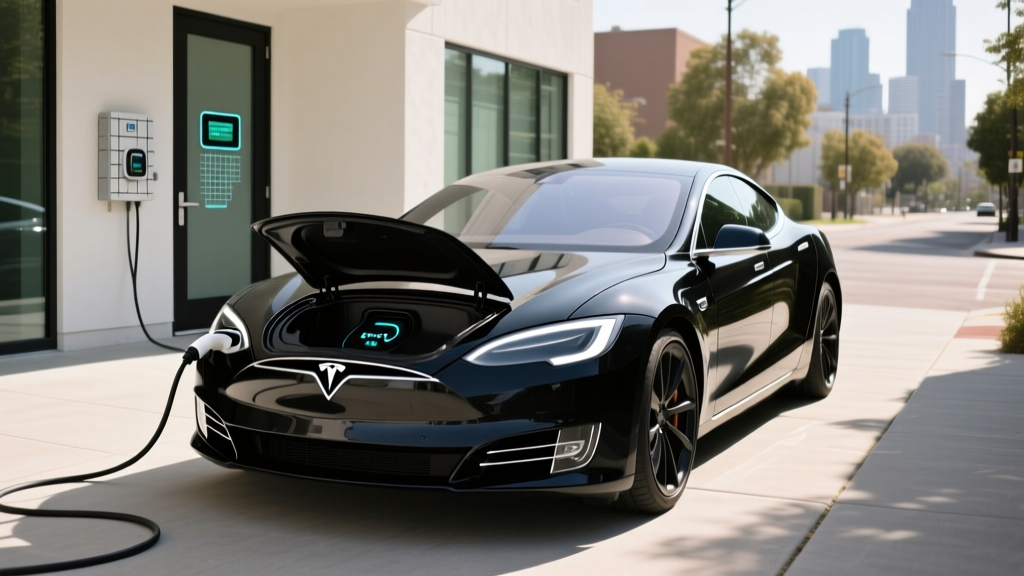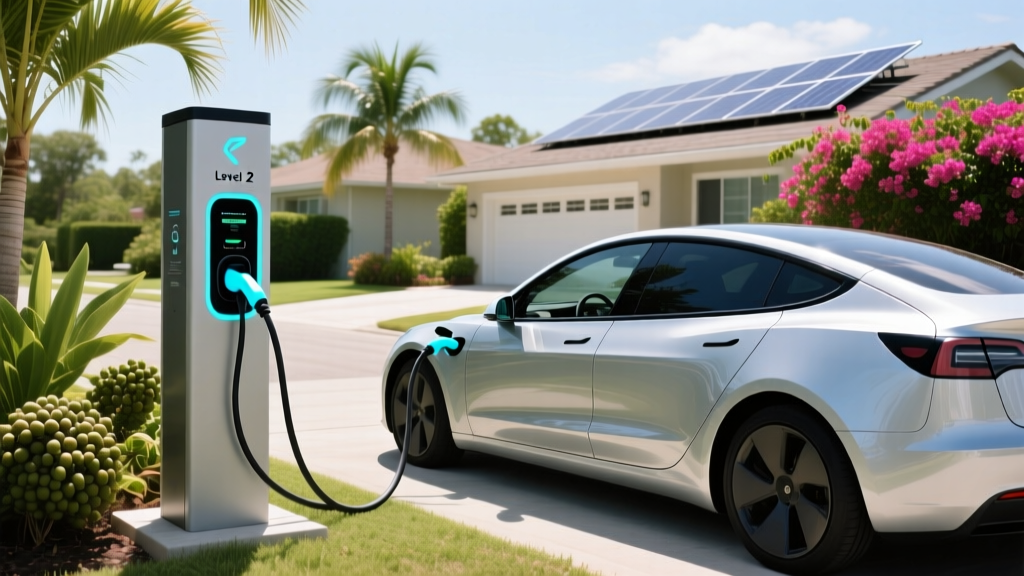
If you own or are considering an electric vehicle in Florida, the FPL charging program could significantly reduce your fuel costs. Florida Power & Light's EV rate plans and incentives are designed to make home charging affordable—especially when you shift charging to off-peak hours. This guide breaks down exactly how the program works, what home charger installation costs, which equipment to buy, and how your per-mile cost stacks up against gasoline.
Understanding EV Charging Levels: Speed and Range Added
Before diving into FPL's specific programs, it's critical to understand the three charging levels and what each delivers. Power (measured in kilowatts, or kW) determines how fast energy flows into your battery. Energy (measured in kilowatt-hours, or kWh) is the total capacity stored—think of kW as the flow rate of a hose and kWh as the size of the bucket.
| Level | Voltage | Power (kW) | Miles of Range Added/Hour | Typical Use |
|---|---|---|---|---|
| Level 1 | 120V AC | 1.2–1.9 kW | 3–5 miles | Overnight top-ups, PHEVs, low-mileage drivers |
| Level 2 | 240V AC | 3.3–19.2 kW | 12–75 miles | Primary home charging, workplace, public destinations |
| DC Fast Charging | 400–800V DC | 50–350 kW | 150–1,200+ miles (equivalent rate) | Road trips, highway corridors, rapid top-ups |
For most EV owners, Level 2 is the daily workhorse. A 48-amp Level 2 charger delivering 11.5 kW can add roughly 40–45 miles of range per hour—enough to fully replenish a 75-kWh battery (like the Tesla Model Y Long Range) in about 7–8 hours overnight. DC fast chargers are for road trips: a 250-kW Tesla Supercharger or Electrify America station can take a Hyundai Ioniq 5 from 10% to 80% in roughly 18 minutes under ideal conditions, though real-world speeds taper significantly above 80% state of charge.
FPL's EV Rate Plan: Off-Peak Savings Explained
Florida Power & Light offers an optional EV Time-of-Use (TOU) rate that provides dramatically lower electricity prices during off-peak hours—typically overnight. As of 2026, FPL's off-peak residential rate hovers around $0.06–$0.08 per kWh during super-off-peak windows (roughly midnight to 6 AM), compared to $0.12–$0.14/kWh during peak afternoon hours.
To participate, FPL requires you to either install a qualified smart Level 2 charger that can communicate with their system or enroll in a whole-home TOU plan. The smart-charger route is usually simpler: the charger automatically delays charging to off-peak hours based on your schedule, and FPL tracks the EV-specific load through the charger's metering capability.
A Tesla Model Y Long Range (75 kWh usable battery, EPA 310-mile range) charged from 10% to 90% (60 kWh) at $0.07/kWh costs approximately $4.20—for roughly 250 real-world miles. That's $0.017 per mile, compared to $0.12–$0.15/mile for a 30-MPG gas car at $3.50/gallon.
Home Charger Installation: Electrical Requirements and Costs
Installing a Level 2 home charger requires a dedicated 240-volt circuit, typically 40 to 60 amps, depending on the charger's power output. Here's what determines your installation complexity and cost:
- Electrical panel capacity: Most modern homes have 200-amp service panels with spare breaker slots. Older homes (pre-1990s) may have 100-amp panels that lack room for a new 40–60 amp double-pole breaker—requiring a panel upgrade ($1,500–$3,000).
- Wiring distance: The run from your panel to the charger location (garage or exterior wall) affects cost. A 10-foot run through an attached garage is far cheaper than a 60-foot underground conduit run to a detached carport.
- Permitting: Florida requires an electrical permit for EV charger installation, typically $50–$150 depending on your county (Miami-Dade, Broward, Palm Beach, Orange, etc.).
- GFCI protection: The 2023 NEC (adopted by Florida) requires GFCI protection for outdoor receptacles and many indoor EV installations—your electrician will factor this into the breaker or charger selection.
| Component | Simple Install (Attached Garage, Panel Has Room) | Complex Install (Long Run, Panel Upgrade Needed) |
|---|---|---|
| Level 2 Charger (Equipment) | $400–$700 | $400–$700 |
| Electrician Labor | $500–$1,200 | $1,500–$3,500 |
| Electrical Permit | $50–$150 | $50–$200 |
| Panel Upgrade (if needed) | $0 | $1,500–$3,000 |
| Wiring/Conduit Materials | $100–$300 | $300–$800 |
| Total Estimated Cost | $1,050–$2,350 | $3,750–$8,200 |
The federal Residential Clean Energy Credit (IRS §25D) does not cover EV chargers for most taxpayers as of 2026. The older §30C alternative fuel infrastructure credit expired for residential use. However, FPL occasionally offers rebates or incentives for smart charger installation—check their current program page for active offers.
Connector Compatibility: NACS, CCS, and CHAdeMO
As of 2026, the North American EV connector landscape has consolidated heavily around NACS (the Tesla connector), which most major automakers have adopted for new vehicles. Here's what you need to know for matching a home charger to your EV:
| Connector | Brands Using It | Home Charger Availability |
|---|---|---|
| NACS (J3400) | Tesla (all), Ford (2025+), GM (2025+), Rivian (2025+), Hyundai/Kia (2026+), most others | Tesla Wall Connector, ChargePoint Home Flex (NACS config), Emporia, Lectron |
| CCS1 | Older VW/Audi, BMW (pre-2025), some Stellantis models, legacy EVs | ChargePoint Home Flex, Emporia, Grizzl-E, Enel X JuiceBox (discontinued but supported) |
| CHAdeMO | Nissan Leaf (all years), Mitsubishi Outlander PHEV (older) | Limited—most home chargers don't offer CHAdeMO; use CCS-to-CHAdeMO adapter if needed |
If you own a 2024–2025 CCS-equipped EV (such as a Volkswagen ID.4 or pre-transition BMW iX), you can purchase a CCS-to-NACS adapter ($150–$300) to use Tesla Superchargers and NACS-equipped public stations. For home charging, simply buy a Level 2 charger with the connector matching your vehicle's native port—no adapter needed for daily use.
Recommended Level 2 Chargers for FPL Customers
For FPL's EV rate program, you benefit most from a smart charger with Wi-Fi connectivity and scheduled charging capability—this lets the charger automatically delay charging to off-peak hours. Here are the top picks as of 2026:
Tesla Wall Connector (Gen 4)
- Power Output: Up to 11.5 kW (48A on 60A circuit)
- Connector: NACS native; J1772 adapter included
- Cable Length: 24 feet
- Smart Features: Wi-Fi, OTA updates, Tesla app scheduling, load sharing between multiple units
- Price: ~$450
- Best For: Tesla owners and NACS-equipped 2025+ Ford/GM/Rivian vehicles
ChargePoint Home Flex
- Power Output: Up to 12 kW (50A, configurable from 16A–50A)
- Connector: NACS or CCS1 (select at purchase)
- Cable Length: 23 feet
- Smart Features: Wi-Fi, Alexa/Google integration, ChargePoint app scheduling, FPL DR program compatible
- Price: ~$550–$650
- Best For: Multi-EV households, non-Tesla owners wanting flexible amperage
Emporia Vue EV Charger
- Power Output: Up to 11.5 kW (48A on 60A circuit)
- Connector: NACS or J1772
- Cable Length: 24 feet
- Smart Features: Wi-Fi, energy monitoring integration with Emporia Vue panel monitor, TOU scheduling
- Price: ~$400–$500
- Best For: Budget-conscious buyers wanting whole-home energy visibility
All three chargers are NEMA 4 rated for outdoor installation and support hardwired or NEMA 14-50 plug-in mounting. Hardwired installations are preferred for 48A+ chargers because a NEMA 14-50 receptacle is limited to 40A continuous draw under NEC rules—meaning a plug-in charger on a 14-50 outlet maxes out at 9.6 kW, not 11.5 kW.
Cost Per Mile: EV Charging vs. Gasoline in Florida
The FPL charging program's off-peak rates make EVs dramatically cheaper to fuel than gasoline vehicles. Here's a realistic comparison based on 2026 Florida averages:
| Scenario | Cost Per kWh / Gallon | Vehicle Efficiency | Cost Per Mile |
|---|---|---|---|
| Home charging (FPL off-peak) | $0.07/kWh | 3.5 miles/kWh (avg EV) | $0.020 |
| Home charging (FPL peak) | $0.14/kWh | 3.5 miles/kWh | $0.040 |
| Public Level 2 (ChargePoint/EVgo) | $0.25–$0.35/kWh | 3.5 miles/kWh | $0.071–$0.100 |
| DC Fast Charging (EA/Supercharger) | $0.35–$0.50/kWh | 3.5 miles/kWh | $0.100–$0.143 |
| Gas car (30 MPG combined) | $3.40/gallon | 30 MPG | $0.113 |
| Gas car (22 MPG combined, truck/SUV) | $3.40/gallon | 22 MPG | $0.155 |
The takeaway: charging at home on FPL's off-peak rate is roughly 5–6× cheaper per mile than fueling a gas car. Even public DC fast charging at $0.45/kWh is competitive with a 22-MPG SUV on gasoline. The economics strongly favor home charging—making the Level 2 installation investment worthwhile for any driver covering more than 8,000 miles per year.
Charging Time Examples for Common EV Battery Sizes
How long a full charge takes depends on your battery's usable capacity (kWh) and your charger's sustained power output (kW). Note that peak charge rates are never sustained for the full session—the charge curve tapers as the battery fills, especially above 80% state of charge to protect battery longevity.
- Tesla Model Y Long Range (75 kWh usable): 10%→80% on an 11.5 kW Level 2 home charger in ~6.5 hours. On a 250 kW DC Supercharger, 10%→80% in ~22 minutes (peak rate ~200 kW tapering to ~60 kW near 80%).
- Hyundai Ioniq 5 (77.4 kWh usable, 800V architecture): 10%→80% on 11.5 kW Level 2 in ~7 hours. On a 350 kW Electrify America station, 10%→80% in ~18 minutes thanks to its ultra-fast charge curve sustaining ~230 kW through 60% SoC.
- Ford F-150 Lightning Extended Range (131 kWh usable): 10%→80% on 11.5 kW Level 2 in ~11 hours—plan for overnight charging. On a 150 kW DC charger, 10%→80% in ~50 minutes; on a 350 kW station, ~35 minutes (limited by the truck's ~170 kW peak acceptance rate).
- Chevrolet Equinox EV (85 kWh usable): 10%→80% on 11.5 kW Level 2 in ~7.5 hours. DC fast charge at 150 kW, 10%→80% in ~35 minutes.
Safety, Code, and Installation Best Practices
A Level 2 charger draws significant continuous current for hours at a time—making proper installation non-negotiable. Key requirements under the Florida Building Code (based on 2023 NEC):
- Dedicated circuit: Your EV charger must have its own dedicated double-pole breaker—no sharing with other appliances.
- 80% continuous load rule: A 60-amp breaker supports 48 amps continuous (the charger's maximum draw). A 50-amp breaker supports 40 amps continuous. Never undersize the breaker relative to the charger's rated amperage.
- GFCI protection: Required for all outdoor installations and recommended for garages. Many hardwired chargers have built-in GFCI; if yours doesn't, your electrician will install a GFCI breaker.
- Outdoor rating: If mounting outdoors, ensure the charger carries a NEMA 4 (weather-resistant) rating. All chargers listed above meet this standard.
- Wire gauge: 6 AWG copper for 48A circuits; 4 AWG for 60A circuits over longer runs. Your electrician will calculate voltage drop based on run length.
- Permit and inspection: Required in all Florida counties. An unpermitted installation may void homeowner's insurance coverage for electrical fires.
Frequently Asked Questions
How much does it cost to install a home EV charger with FPL?
For a straightforward installation in an attached garage with adequate panel capacity, expect $1,050–$2,350 total (charger, electrician, permit). If your home needs a panel upgrade or has a long wiring run, costs can reach $3,750–$8,200. Get quotes from at least two licensed electricians and confirm they pull the required county permit.
How fast will each charging level add range to my EV?
Level 1 (120V standard outlet) adds 3–5 miles per hour—fine for PHEVs with 30-mile batteries but impractical for full EVs. Level 2 (240V) adds 12–75 miles per hour depending on amperage—a 48A/11.5 kW charger adds roughly 40–45 miles per hour for most EVs. DC fast charging adds 150–300+ miles in 15–30 minutes on compatible vehicles.
Which connector and charger is compatible with my EV?
If you drive a 2025+ Tesla, Ford, GM, Rivian, Hyundai, or Kia EV, your vehicle uses the NACS (J3400) connector—buy a NACS-configured Level 2 charger. Older EVs from VW, BMW, and Stellantis may still use CCS1. The Nissan Leaf uses CHAdeMO. Check your vehicle's charge port or owner's manual if unsure.
How much does FPL charging cost per mile compared to gas?
On FPL's off-peak EV rate (~$0.07/kWh), the average EV costs $0.02 per mile—roughly 5–6× cheaper than a 30-MPG gasoline car at $3.40/gallon ($0.11/mile). Even peak-rate home charging ($0.14/kWh = $0.04/mile) significantly undercuts gasoline. The savings compound: a driver covering 12,000 miles/year saves approximately $1,080–$1,560 annually by charging at home off-peak versus buying gas.
What electrical upgrades might I need for a Level 2 charger?
Homes built after 2000 with 200-amp service usually have sufficient panel capacity. Older homes with 100-amp panels may need a panel upgrade to 200 amps ($1,500–$3,000) before adding a 40–60 amp EV circuit. Additionally, if your garage lacks a nearby 240V outlet, you'll need a new circuit run with proper wire gauge and conduit. A licensed electrician can assess your panel's available amperage and spare breaker slots during a site visit—most offer free estimates.
Does FPL offer any rebates or incentives for EV charger installation?
FPL periodically offers rebates for purchasing and installing qualified smart Level 2 chargers through their EV program. These change frequently—visit FPL's official EV page or call their EV customer service line for current offers. Note that the federal §30C EV charger tax credit is generally no longer available for residential installations as of 2026.
Can I use a standard 120V outlet instead of installing a Level 2 charger?
Yes, but Level 1 charging (1.2–1.9 kW) only adds 3–5 miles of range per hour. For a 75-kWh battery, a 10%→80% charge would take roughly 40+ hours—only practical if you drive under 30 miles daily and can charge every night. For any driver covering typical American mileage (35–40 miles/day), Level 2 is strongly recommended.