Ford Trucks at Tesla Superchargers: What F-150 Lightning Owners Need to Know
If you own or are considering a Ford F-150 Lightning, the charging landscape has shifted dramatically. As of 2026, Ford electric truck owners have full access to the Tesla Supercharger network using the North American Charging Standard (NACS) port — no adapter required on 2025+ models, and a simple adapter for 2022–2024 trucks. This guide breaks down exactly how fast you can charge, what it costs, and how to set up the optimal home charging system for your Ford electric truck.
Charging Levels Explained: Speeds, Power, and Range Added Per Hour
Before we map out where and how to charge your Ford truck, let's establish the three charging levels and what each delivers. Remember: kW (kilowatts) measures the rate of power delivery — think of it as how fast water flows through a hose. kWh (kilowatt-hours) measures total energy stored — the size of the tank. A higher kW charge rate fills your battery faster, but the battery's capacity in kWh determines total range.
| Level | Voltage | Max Power (kW) | Miles of Range Added Per Hour | Typical Use Case |
|---|---|---|---|---|
| Level 1 | 120V AC | 1.4 kW | ~3–4 miles/hr | Emergency/trickle only |
| Level 2 | 240V AC | 11.5–19.2 kW | ~25–55 miles/hr | Home daily charging |
| DC Fast Charge | 400V+ DC | Up to 150–250 kW | ~150–300+ miles/hr (peak) | Road trips, rapid top-ups |
For an F-150 Lightning Extended Range (131 kWh battery), Level 1 charging is effectively useless for daily needs — it would take over 90 hours to fill the pack. Level 2 at 11.5 kW (the truck's onboard charger limit on Standard Range models) adds enough range overnight for most drivers. The Extended Range model supports up to 19.2 kW Level 2 charging with the optional 80-amp Charge Station Pro, cutting a full charge to roughly 7–8 hours.
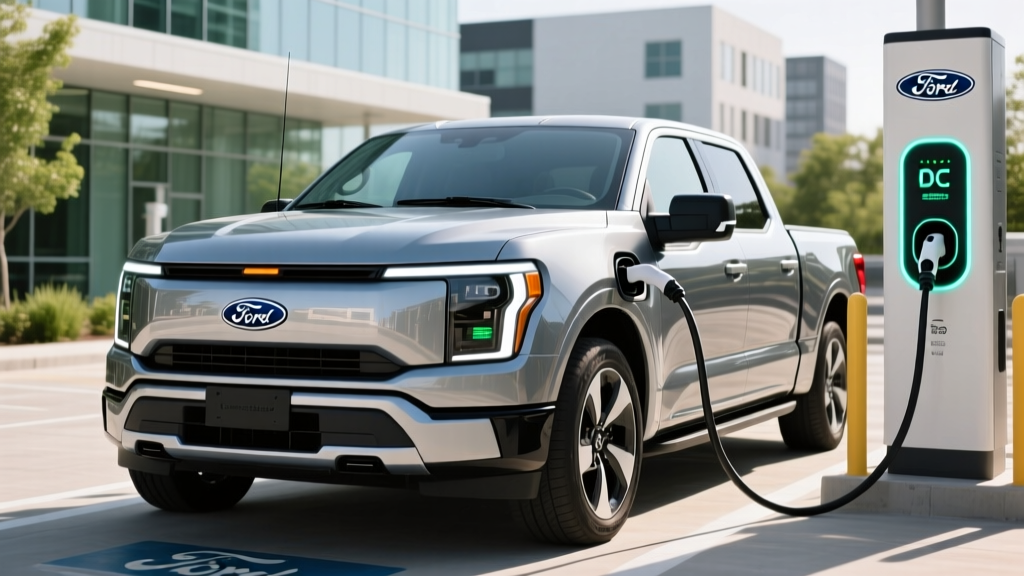
DC fast charging is where the Supercharger network matters. The 2025–2026 F-150 Lightning with its native NACS port can peak at approximately 150 kW on V3 Superchargers, though sustained rates average closer to 100–120 kW across the 10–80% window. Expect a 10–80% charge in roughly 38–45 minutes depending on battery temperature and starting state of charge.
Ford Truck Superchargers: Network Access and Connector Compatibility
The phrase "Ford truck Superchargers" reflects a new reality: Ford was the first legacy automaker to secure full Tesla Supercharger network access for its EVs. Here's how compatibility breaks down by model year:
| Model Year | Built-In Port | Supercharger Access | CCS Network Access | Adapter Needed? |
|---|---|---|---|---|
| 2022–2024 F-150 Lightning | CCS1 | Yes (via Ford-provided NACS adapter) | Native | NACS-to-CCS adapter for Tesla stalls |
| 2025–2026 F-150 Lightning | NACS (native) | Yes (direct plug-in) | Via NACS-to-CCS adapter | CCS adapter for Electrify America, etc. |
| 2022–2024 E-Transit | CCS1 | Yes (via adapter) | Native | NACS adapter for Tesla stalls |
If you own a 2022–2024 F-150 Lightning, Ford offers a NACS adapter (approximately $230) that allows you to use Tesla Supercharger V3 and V4 stalls. For 2025+ models with the native NACS port, you'll instead want a NACS-to-CCS adapter (~$200–$300 from third-party suppliers like Lectron or A2Z) to maintain access to Electrify America, EVgo, and other CCS-equipped networks.
On Tesla Superchargers, the experience is seamless: plug in and charging begins automatically via the FordPass app integration. V3 Superchargers deliver up to 250 kW peak, though the Lightning's charge curve limits it to roughly 150 kW maximum intake. V4 Superchargers (expanding through 2026) offer similar performance with improved cable reach for non-Tesla vehicles.
Home Charging Setup: Electrical Requirements and Installation Costs
Most Ford truck owners will do 80–90% of their charging at home. Getting this right is critical — both for convenience and for preserving battery health through consistent, moderate-rate charging.
Electrical Requirements for Level 2 Home Charging
The F-150 Lightning's onboard charger accepts up to 19.2 kW on Extended Range models (requiring an 80-amp dedicated circuit) or 11.5 kW on Standard Range models (requiring a 50-amp circuit). Here's what your electrical system needs to support:
- 50-amp circuit (11.5 kW charging): Requires a 240V outlet (NEMA 14-50) or hardwired connection with 6 AWG copper wire. This is the most common residential setup.
- 80-amp circuit (19.2 kW charging): Requires a hardwired connection with 3 AWG copper wire. Many homes need a panel upgrade to support this.
- Panel capacity: Most modern homes with 200-amp service can accommodate a 50-amp EV circuit. Older homes with 100-amp panels frequently need a service upgrade ($1,500–$3,500) or a smart panel load-management device.
Installation Cost Breakdown
| Component | Cost Range | Notes |
|---|---|---|
| Level 2 Charger (Equipment) | $400–$800 | Varies by brand, power output, smart features |
| Electrician Labor (Standard Install) | $500–$1,500 | Depends on run length from panel to garage |
| Permit & Inspection | $50–$250 | Required in most jurisdictions; varies by locality |
| Electrical Panel Upgrade (if needed) | $1,500–$3,500 | 100A to 200A service upgrade; not always required |
| Conduit, Wire, Hardware | $100–$400 | Longer runs from panel increase cost |
| Total (No Panel Upgrade) | $1,050–$2,950 | Typical scenario for modern homes |
| Total (With Panel Upgrade) | $2,550–$6,450 | Older homes or 80-amp circuit installs |
Always hire a licensed electrician familiar with EV charging installations. The National Electrical Contractors Association maintains a directory of certified installers. Permits are not optional — unpermitted electrical work can void homeowner's insurance and create fire hazards. A dedicated circuit with GFCI protection is required by the National Electrical Code (NEC Article 625) for all EV charging equipment.
Cost to Charge: Home vs. Public vs. Supercharger — Per Mile Compared to Gas
One of the strongest arguments for the F-150 Lightning is fuel cost savings, but the math depends heavily on where and when you charge. Here's a realistic breakdown using 2026 electricity rates and the Lightning Extended Range's efficiency of approximately 2.0 kWh/mile (or roughly 70 MPGe combined per fueleconomy.gov):
| Charging Scenario | Rate ($/kWh) | Cost Per Mile | Cost for 300-Mile Trip |
|---|---|---|---|
| Home (Off-Peak Utility Rate) | $0.08–$0.12 | $0.16–$0.24 | $48–$72 |
| Home (Standard Residential Rate) | $0.14–$0.18 | $0.28–$0.36 | $84–$108 |
| Tesla Supercharger (Avg. 2026) | $0.28–$0.36 | $0.56–$0.72 | $168–$216 |
| Electrify America / Public DCFC | $0.32–$0.48 | $0.64–$0.96 | $192–$288 |
| Gas Truck (Ford F-150 3.5L EcoBoost, 20 MPG) | $3.40/gal (avg.) | $0.17 per mile × 2 = $0.17* | $51 (at 20 MPG) |
*Gas comparison: F-150 3.5L EcoBoost 4WD averages ~20 MPG combined. At $3.40/gallon, that's $0.17/mile or $51 for 300 miles.
The takeaway: home charging on off-peak rates delivers the best economics, undercutting even an efficient gas truck. Public DC fast charging at Supercharger rates is roughly 3–4× more expensive than home charging, and on some networks can approach or exceed the cost of gasoline per mile. Plan road trips around Supercharger stops for the best balance of cost and speed, but maximize home charging for daily use.
Best Home Chargers for Ford F-150 Lightning: Equipment Picks
Choosing the right Level 2 charger matters for charging speed, reliability, and smart features. Here are our top recommendations matched to the Lightning's capabilities:
Ford Charge Station Pro (80A)
- Power Output: 19.2 kW (max for Extended Range)
- Connector: NACS (2025+) / CCS1 (2022–2024)
- Cable Length: 25 feet
- Smart Features: FordPass integration, scheduled charging, Pro Power Onboard coordination
- Price: ~$1,200–$1,400 (equipment only)
- Best For: Extended Range owners wanting maximum Level 2 speed; requires 100-amp breaker and hardwired install
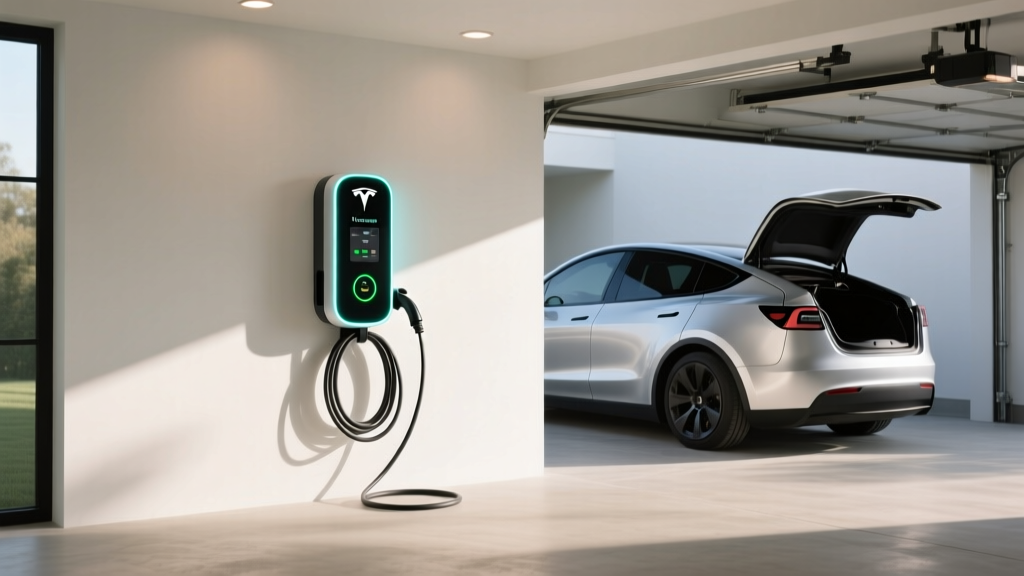
Wall Connector (Tesla, NACS)
- Power Output: Up to 11.5 kW (48A) on most home circuits
- Connector: NACS native
- Cable Length: 24 feet
- Smart Features: Wi-Fi updates, load sharing (two units on one circuit), access control
- Price: ~$475
- Best For: 2025+ Lightning owners with native NACS; affordable, reliable, excellent build quality
ChargePoint Home Flex
- Power Output: Up to 12 kW (50A) adjustable down to 16A
- Connector: J1772 (CCS adapter included) or NACS version available
- Cable Length: 23 feet
- Smart Features: App scheduling, Alexa integration, energy tracking, flexible amperage
- Price: ~$550–$700
- Best For: Owners wanting adjustable amperage for older panels; strong app experience
Emporia Vue Level 2 Charger
- Power Output: Up to 11.5 kW (48A)
- Connector: J1772 or NACS
- Cable Length: 24 feet
- Smart Features: Energy monitoring integration, solar-aware charging, scheduling
- Price: ~$400–$500
- Best For: Budget-conscious buyers; pairs with Emporia home energy monitor for solar optimization
For most F-150 Lightning Extended Range owners with adequate panel capacity, the Ford Charge Station Pro at 19.2 kW is the performance choice — it adds roughly 55 miles of range per hour, meaning a full overnight charge even after heavy use. Standard Range owners or those with 50-amp circuits will be well-served by the Tesla Wall Connector or ChargePoint Home Flex at 11.5 kW, which still adds ~30 miles per hour — more than enough for daily driving patterns.
DC Fast Charging Times: What to Expect on the Road
When you pull up to a Tesla Supercharger or Electrify America station, your actual charging time depends on battery size, starting state of charge, battery temperature, and the station's power output. Here are realistic 10–80% charge times for the F-150 Lightning based on real-world testing patterns:
- Standard Range (98 kWh) at a 150 kW Supercharger: 10–80% in approximately 35–40 minutes. Peak rate ~130 kW, tapering significantly above 65% SoC.
- Extended Range (131 kWh) at a 150 kW Supercharger: 10–80% in approximately 38–45 minutes. The larger battery sustains higher charge rates longer but takes more total energy to reach 80%.
- Extended Range at a 350 kW Electrify America station: The Lightning's charge architecture caps at ~150 kW, so you won't see meaningful speed gains on ultra-fast 350 kW chargers. Times are similar to the Supercharger scenario.
A critical concept: charge curve taper. DC fast chargers deliver peak power only at lower states of charge (typically 10–40% SoC). As the battery fills, the charge rate drops to protect cell health. Charging from 80–100% on DC fast charging is painfully slow and wasteful — plan to charge to 80% and move on unless you specifically need a full pack.
Preconditioning matters: the Lightning's battery thermal management system will warm the pack when you navigate to a charging station via the built-in Ford navigation. This can reduce 10–80% charge times by 5–10 minutes in cold weather. Always use the truck's navigation to route to chargers rather than a phone app to trigger preconditioning.
Safety, Electrical Code, and Smart Installation Practices
EV charging involves sustained high-current draw that stresses home electrical systems more than typical appliances. Follow these non-negotiable safety practices:
- Dedicated circuit: Your Level 2 charger must have its own dedicated breaker — never share a circuit with other appliances. A 50-amp charger needs a 50-amp breaker; an 80-amp charger needs a 100-amp breaker.
- GFCI protection: NEC Article 625 requires ground-fault circuit interrupter protection for all EV supply equipment. Most modern Level 2 chargers have built-in GFCI; confirm with your electrician.
- Outdoor rating: If your charger is mounted outdoors (driveway, exterior wall), it must carry a NEMA 4 or NEMA 4X rating for weather resistance. All chargers recommended above meet this standard.
- Wire gauge: Undersized wire is a fire hazard. 50-amp circuits require minimum 6 AWG copper; 80-amp circuits require 3 AWG copper. Your electrician will size appropriately — do not cut corners here.
- Load management: If your panel is near capacity, consider a smart load-management system (like the Emporia Smart Panel or Span drive) that dynamically reduces charger draw when other circuits are active, avoiding a costly panel upgrade.
- Permit and inspection: Permitted work is inspected by your local authority having jurisdiction (AHJ). This protects you from liability and ensures the installation meets code. Unpermitted work can void insurance claims in the event of an electrical fire.
Frequently Asked Questions
How much does it cost to install a home EV charger for my Ford F-150 Lightning?
A typical Level 2 home installation runs $1,050–$2,950 total (equipment + electrician + permit) if your electrical panel has adequate capacity. If you need a panel upgrade from 100-amp to 200-amp service, add $1,500–$3,500. The Ford Charge Station Pro at 80 amps requires a 100-amp breaker and hardwired connection, which may push costs toward the higher end. Always get 2–3 quotes from licensed electricians.
How fast will each charging level add range to my F-150 Lightning?
Level 1 (120V) adds roughly 3–4 miles per hour — impractical for daily use. Level 2 at 11.5 kW adds ~25–30 miles per hour. Level 2 at 19.2 kW (Charge Station Pro on Extended Range) adds ~50–55 miles per hour. DC fast charging at a Tesla Supercharger adds roughly 150–200 miles in 30 minutes, though the rate tapers as the battery fills above 60% SoC.
Which connector and charger is compatible with my Ford electric truck?
Model year 2022–2024 F-150 Lightnings have a CCS1 port and need a Ford-supplied NACS adapter (~$230) to use Tesla Superchargers. Model year 2025–2026 trucks have a native NACS port and plug directly into Superchargers but need a NACS-to-CCS adapter for Electrify America and other CCS networks. For home charging, choose a charger matching your truck's port — Tesla Wall Connector (NACS) for 2025+ trucks, or a J1772/CCS charger like the ChargePoint Home Flex for 2022–2024 models.
How much does charging cost per mile compared to gas?
Home charging at off-peak rates ($0.10/kWh) costs approximately $0.20 per mile in the Lightning Extended Range. Tesla Superchargers average $0.56–$0.72 per mile. A comparable gas F-150 EcoBoost at 20 MPG costs about $0.17 per mile at $3.40/gallon. Home charging is competitive with or cheaper than gas; public DC fast charging is typically more expensive per mile. Maximize home charging to realize the Lightning's fuel-cost advantage.
What electrical upgrades might I need for a home charger?
Homes with 200-amp panels typically support a 50-amp EV circuit without upgrades. Homes with 100-amp service often need a panel upgrade ($1,500–$3,500) for any Level 2 charging. If you want the full 80-amp Ford Charge Station Pro, you'll likely need a 200-amp panel minimum, and possibly a 300-amp or 400-amp service in homes with heavy existing loads (electric heat, pool, workshop). A smart load-management device ($300–$600) can sometimes avoid a panel upgrade by dynamically limiting charger draw.
Does the F-150 Lightning charge faster at Tesla Superchargers or Electrify America?
Charge speeds are similar on both networks because the Lightning's onboard charge architecture caps at approximately 150 kW regardless of the station's maximum output. Tesla V3 Superchargers (250 kW capable) and Electrify America 350 kW stations will both deliver roughly 150 kW peak to the Lightning. Real-world 10–80% times are approximately 38–45 minutes on either network. Superchargers tend to offer better reliability and simpler plug-and-charge billing, which is why many Lightning owners prefer them for road trips.
For current federal tax credit information on home charger installation — the Residential Clean Energy Credit under IRS §25D may cover 30% of equipment costs up to $1,000 through 2032 — consult a tax professional to confirm your eligibility based on your specific tax situation.