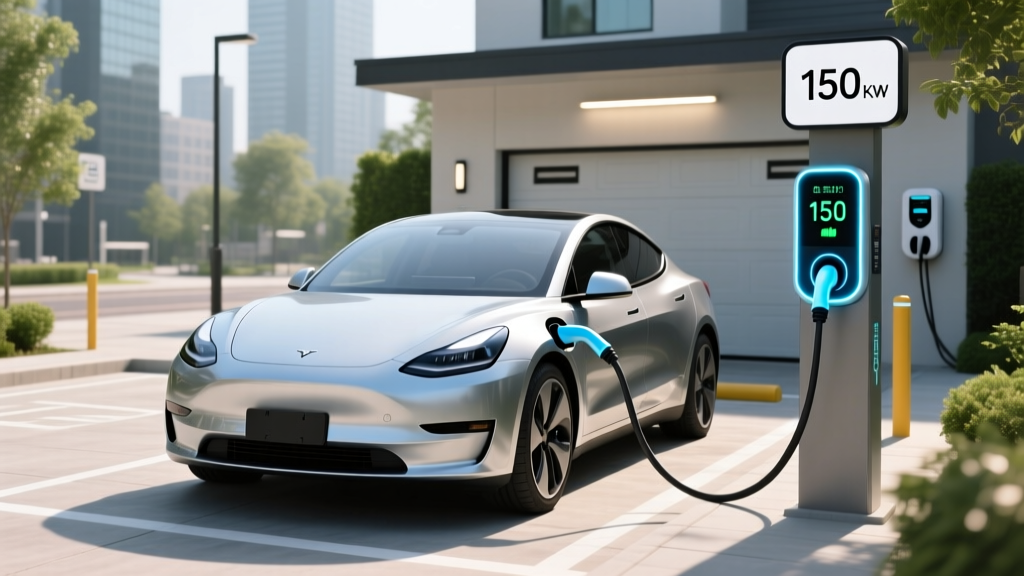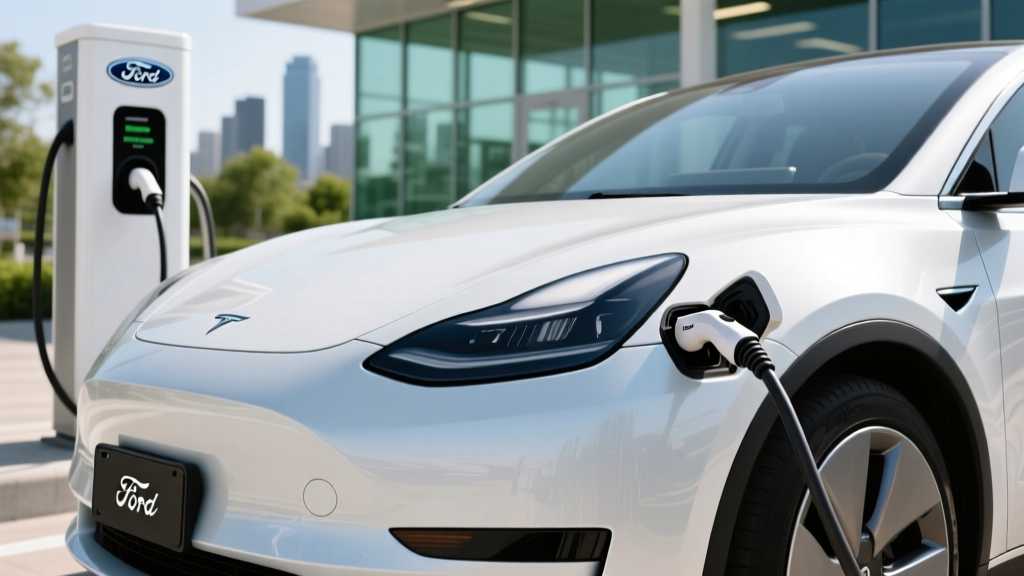
If you own a Ford Mustang Mach-E, F-150 Lightning, or the newer Ford Explorer EV, you've likely heard that the Supercharger network is now open to you — but only if you have the right hardware. The Ford Tesla adapter (officially a NACS-to-CCS1 adapter or a factory-installed NACS port, depending on your model year) is the physical bridge between Ford's electric vehicles and Tesla's 17,000+ North American Superchargers. This guide covers exactly what the adapter does, how fast you'll charge, what it costs, and how to set up your home charging to complement road-trip DC fast charging.
Why the Ford Tesla Adapter Matters in 2026
Starting in 2024, Ford became one of the first legacy automakers to adopt Tesla's North American Charging Standard (NACS) for its EVs. By the 2025 model year, vehicles like the refreshed Mustang Mach-E and F-150 Lightning began shipping with a native NACS charge port — eliminating the need for an adapter entirely. However, 2021–2024 model-year Ford EVs were built with CCS1 ports. For those vehicles, Ford provides a Ford-branded NACS adapter (sometimes called the "Ford Tesla adapter" colloquially) that plugs into the car's CCS1 inlet on one end and accepts a Tesla NACS connector on the other.
This adapter unlocks access to Tesla's V3 and V4 Supercharger stalls, which deliver up to 250 kW of DC fast charging power. Without it, older Ford EVs are restricted to Electrify America, EVgo, and other CCS1 networks — which, while improving, still trail Tesla in reliability and geographic coverage according to J.D. Power EV ownership studies.
Charging Levels Explained: Speeds in kW and Miles Per Hour
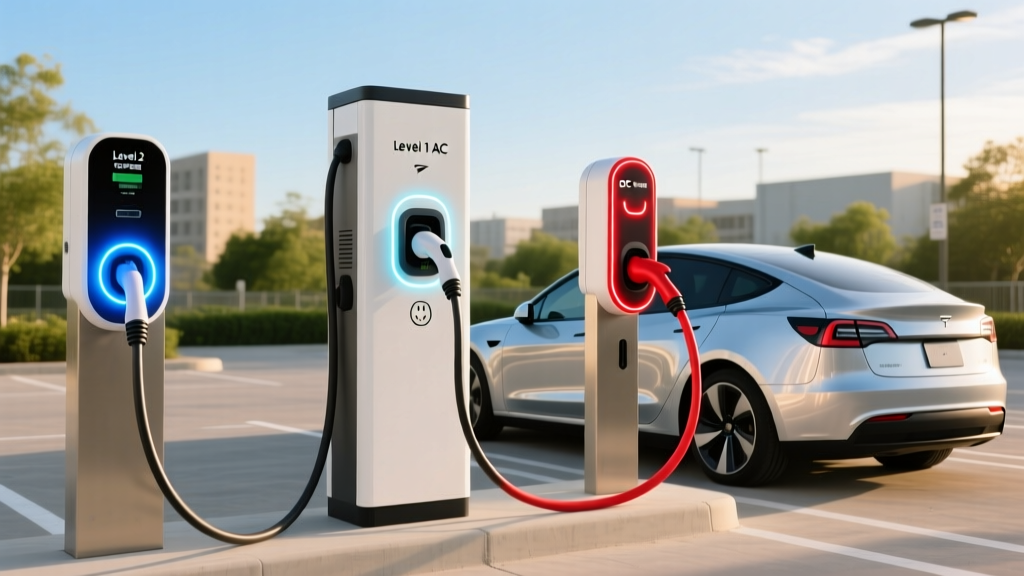
Before we get into adapter specifics, let's ground the discussion in the three charging levels every EV owner must understand. kW (kilowatts) measures power — the rate at which energy flows into your battery. kWh (kilowatt-hours) measures energy — the total capacity of your battery. Think of kW as the width of a hose and kWh as the size of the bucket.
| Level | Voltage / Amps | Power (kW) | Miles of Range Added Per Hour | Best For |
|---|---|---|---|---|
| Level 1 (120V AC) | 120V / 12A | ~1.4 kW | 3–5 mi/hr | Overnight top-offs, PHEVs, emergency |
| Level 2 (240V AC) | 240V / 32–48A | 7.7–11.5 kW | 25–40 mi/hr | Daily home charging, workplace |
| DC Fast Charging | 400–800V DC | 50–250 kW (peak) | 150–600+ mi/hr (at peak) | Road trips, rapid top-ups |
For context, a 2024 Ford F-150 Lightning with the extended-range 131 kWh battery gains roughly 3–4 miles per hour on Level 1, about 30 miles per hour on a 48A Level 2 home charger, and can add up to 120+ miles in 15 minutes at a 150 kW DC fast charger (peak rate before taper).
Connector Compatibility: NACS, CCS1, and Your Ford EV
The North American EV charging landscape underwent a massive consolidation beginning in 2023 when Tesla opened its connector design as the NACS standard. By 2026, virtually every major automaker — Ford, GM, Rivian, Volvo, Polestar, BMW, Hyundai, and others — has either adopted NACS natively or committed to doing so. Here's where Ford models stand:
| Ford Model | Model Years | Native Port | Needs Adapter for Superchargers? | Adapter Included by Ford? |
|---|---|---|---|---|
| Mustang Mach-E | 2021–2024 | CCS1 | Yes — NACS adapter required | Complimentary adapter program (check Ford) |
| Mustang Mach-E (refreshed) | 2025+ | NACS (native) | No | N/A |
| F-150 Lightning | 2022–2024 | CCS1 | Yes — NACS adapter required | Complimentary adapter program (check Ford) |
| F-150 Lightning (updated) | 2025+ | NACS (native) | No | N/A |
| E-Transit (commercial) | 2022+ | CCS1 | Yes — NACS adapter required | Varies by fleet program |
Critical note: The Ford-supplied adapter is rated for DC fast charging up to the vehicle's maximum acceptance rate. Third-party adapters exist on Amazon and eBay, but Ford explicitly warns against using uncertified adapters, which may lack proper thermal management or communication protocols with the vehicle's BMS (Battery Management System). Always source your adapter through a Ford dealer or the Ford accessories portal.
DC Fast Charging Speeds with the Ford Tesla Adapter
The adapter itself does not bottleneck charging speed. Your Ford EV's onboard charge controller determines how many kilowatts it can accept. Here's what real-world charging looks like at Tesla Superchargers using the adapter:
| Vehicle | Battery (kWh usable) | Peak DC Charge Rate (kW) | 10–80% Time (est.) | Supercharger Compatibility |
|---|---|---|---|---|
| 2024 Mach-E Extended Range | 91 kWh (NMC) | ~150 kW | ~38 min | V3 (250 kW stalls) — throttled by vehicle |
| 2024 F-150 Lightning Ext. Range | 131 kWh (NMC) | ~150 kW | ~41 min | V3 (250 kW stalls) — throttled by vehicle |
| 2025 Mach-E GT (NACS native) | 91 kWh (NMC) | ~170 kW | ~34 min | V3/V4 Superchargers |
| 2025 F-150 Lightning (NACS native) | 131 kWh (NMC) | ~155 kW | ~39 min | V3/V4 Superchargers |
Understanding the charge curve: Your Ford EV will not sustain its peak kW rate for the entire session. A Mach-E that peaks at ~150 kW between 10–30% State of Charge (SoC) will taper to ~90 kW by 50% SoC and ~45 kW by 70% SoC. This is normal lithium-ion behavior managed by the BMS to protect battery longevity. The 10–80% times above account for this taper. Plan road-trip stops around the 10–80% window — charging from 80–100% can take as long as the entire 10–80% session.
Per fueleconomy.gov, preconditioning your battery before a DC fast charge session (available via FordPass navigation to a charger) can improve peak charge rates by 15–25% in cold weather by warming the battery to its optimal charging temperature.
Home Charging Setup for Your Ford EV
Road-trip Supercharger access is valuable, but 80–90% of EV charging happens at home. Here's what you need to know about installing a Level 2 home charger for a Ford EV — whether you're using the CCS1 port directly or will also use your NACS adapter at home.
Electrical Requirements
A Level 2 home charger requires a 240-volt dedicated circuit, similar to what an electric dryer or oven uses. The most common configurations:
- 32A circuit (40A breaker): Delivers 7.7 kW — sufficient for overnight charging on most Ford EVs
- 40A circuit (50A breaker): Delivers 9.6 kW — recommended for the F-150 Lightning's larger battery
- 48A circuit (60A breaker): Delivers 11.5 kW — fastest Level 2 option; requires heavier-gauge wiring
The National Electrical Code (NEC) requires that continuous loads (like EV charging) not exceed 80% of a circuit's rated amperage. A 50A breaker therefore supports a 40A continuous charge. Your licensed electrician will confirm your panel's available capacity.
Do You Need a Panel Upgrade?
Many homes built before 2000 have 100A or 150A main electrical panels. Adding a 40–60A EV circuit to an already-loaded panel may require upgrading to a 200A service. Signs you'll likely need an upgrade:
- Your panel is at or near capacity (electrician will perform a load calculation per NEC Article 220)
- You have a 100A main breaker
- You already run multiple high-draw appliances simultaneously (electric heat, electric dryer, electric range, hot tub)
- Your panel is a legacy brand with known issues (Federal Pacific, Zinsco, certain Challenger models)
| Cost Component | Low Estimate | High Estimate | Notes |
|---|---|---|---|
| Level 2 Charger (hardware) | $350 | $750 | 32A–48A smart charger, 20–25 ft cable |
| Electrician labor | $400 | $1,500 | Depends on run length from panel to garage/driveway |
| Permit & inspection | $50 | $250 | Varies by municipality; some waive for EV installs |
| Panel upgrade (if needed) | $1,500 | $4,000 | 100A→200A service upgrade; not always required |
| TOTAL (no panel upgrade) | $800 | $2,500 | Typical scenario for modern 200A homes |
| TOTAL (with panel upgrade) | $2,300 | $6,500 | Older homes needing service upgrade |
Safety and Code Requirements
Your installation must comply with NEC Article 625 (Electric Vehicle Charging System Equipment). Key requirements:
- Dedicated circuit: Your EV charger must have its own breaker — no sharing with other outlets or appliances
- GFCI protection: Required for outdoor installations and recommended for garages (NEC 2020+ code requires GFCI on 240V EV circuits in many jurisdictions)
- NEMA 14-50 outlet vs. hardwired: A NEMA 14-50 receptacle offers portability (take the charger when you move), but hardwired installations are more reliable, avoid receptacle wear, and can support 48A+ (NEMA 14-50 is limited to 50A/40A continuous)
- Outdoor rating: If charging outside, the charger must carry a NEMA 4 or IP65+ weatherproof rating
- Wire gauge: 6 AWG copper for 40A circuits; 4 AWG for 50A; your electrician will spec this per NEC Table 310.16
Level 2 Charger Equipment Recommendations for Ford EVs
Not all Level 2 chargers are equal. Below are proven options that work with Ford EVs (via the CCS1 port or NACS port on 2025+ models). Note: If your Ford has a CCS1 port and you want to use a NACS-connector charger at home, you'd use the same Ford Tesla adapter — but most home setups simply use the CCS1 connector directly, which is simpler.
Best Overall: ChargePoint Home Flex
- Power: Up to 11.5 kW (48A) on a 60A circuit; configurable down to 16A
- Connector: CCS1 (J1772 + CCS combo) — works natively with 2021–2024 Ford EVs
- Cable length: 23 feet
- Smart features: Wi-Fi, app scheduling, energy tracking, Alexa integration
- Price: ~$599 (hardware only)
- Why it's good for Ford: Adjustable amperage lets you match your panel's capacity without overspending on electrical work
Best for NACS-Native Fords: Tesla Wall Connector
- Power: Up to 11.5 kW (48A) on a 60A circuit
- Connector: NACS (native for 2025+ Ford EVs)
- Cable length: 24 feet
- Smart features: Wi-Fi, power sharing (daisy-chain two units on one circuit), OTA updates
- Price: ~$475 (hardware only)
- Why it's good for Ford: If your 2025+ Ford has a NACS port, this is the most seamless home charging experience — same connector as Superchargers
Best Value: Emporia Level 2 EV Charger
- Power: Up to 11.5 kW (48A)
- Connector: CCS1 (J1772 combo)
- Cable length: 24 feet
- Smart features: Wi-Fi, app scheduling, solar integration, energy monitoring
- Price: ~$399 (hardware only)
- Why it's good for Ford: Lowest-cost 48A smart charger; excellent energy tracking to monitor charging costs
Best for F-150 Lightning: Ford Connected Charge Station
- Power: Up to 11.5 kW (48A)
- Connector: CCS1 (2022–2024 models) / NACS (2025+ models)
- Cable length: 25 feet
- Smart features: Deep FordPass integration, scheduled charging, battery preconditioning alerts
- Price: ~$700–$800 (hardware only; sometimes included with vehicle purchase)
- Why it's good for Ford: Tightest integration with Ford's ecosystem; automatic firmware updates via FordPass
Charging Cost: Per Mile vs. Gasoline
One of the strongest financial arguments for EV ownership is the lower per-mile fuel cost. Here's how charging a Ford Mach-E or F-150 Lightning compares to fueling a comparable gas vehicle, using 2026 energy prices:
| Scenario | Rate | Cost to "Fill" (Mach-E 91 kWh) | Cost Per Mile (Mach-E, ~3.2 mi/kWh) | Gas Equivalent (28 MPG avg @ $3.40/gal) |
|---|---|---|---|---|
| Home off-peak (utility TOU rate) | $0.09/kWh | $8.19 | $0.028/mi | $0.121/mi |
| Home standard rate | $0.16/kWh | $14.56 | $0.050/mi | $0.121/mi |
| Public Level 2 (ChargePoint, etc.) | $0.25–$0.39/kWh | $22.75–$35.49 | $0.078–$0.122/mi | $0.121/mi |
| Tesla Supercharger (V3, non-Tesla rate) | $0.28–$0.48/kWh | $25.48–$43.68 | $0.088–$0.151/mi | $0.121/mi |
| Electrify America (CCS1, no subscription) | $0.48–$0.56/kWh | $43.68–$50.96 | $0.151–$0.176/mi | $0.121/mi |
The takeaway: Home charging on an off-peak rate is roughly 4× cheaper per mile than gasoline. Even at Supercharger rates, the Mach-E is competitive with or cheaper than gas. However, public DC fast charging at the highest rates (Electrify America without a subscription) can actually exceed the per-mile cost of gasoline — which is why home charging is so critical to EV economics.
For the F-150 Lightning, which averages ~2.0–2.3 mi/kWh due to its larger mass and less aerodynamic profile, multiply the per-mile costs above by approximately 1.4×. Home charging still wins decisively over gas, which costs a comparable F-150 gas truck around $0.17/mi at 20 MPG combined.
Using the Ford Tesla Adapter at Superchargers: Practical Tips
Once you have the adapter in hand, here's what the actual Supercharger experience looks like:
- Download the Tesla app and create an account. Add a payment method. As of 2025–2026, Tesla also supports payment via the FordPass app at participating Superchargers, but the Tesla app remains the most reliable fallback.
- Locate Superchargers via the Tesla app or your Ford's built-in navigation (which now shows Supercharger locations for adapter-equipped vehicles after a 2024 OTA update).
- Plug in: Insert the Ford NACS adapter into your vehicle's CCS1 charge port first, then plug the Tesla Supercharger cable into the adapter's NACS end. The connection is secure and rated for the full power of V3 stalls (250 kW).
- Monitor: Charging status appears in both the Tesla app and FordPass. You'll see real-time kW draw, SoC percentage, and estimated time to completion.
- Unplug: Stop the session in the app, unplug the Tesla connector from the adapter, then remove the adapter from your vehicle. Store the adapter in your frunk or glovebox — it weighs roughly 1.5 lbs and is about the size of a large water bottle.
Frequently Asked Questions
How much does the Ford Tesla adapter cost?
Ford initially offered the NACS adapter at no cost to eligible Mach-E and F-150 Lightning owners as part of a complimentary program. As of 2026, availability and pricing vary — some owners still qualify for a free adapter through Ford's program, while others may need to purchase it through a dealer for approximately $200–$250. Check with your local Ford dealer or the FordPass app for your specific eligibility. Third-party CCS1-to-NACS adapters are available for $150–$300, but Ford recommends only its OEM-certified adapter.
Can I use the Ford Tesla adapter for Level 2 home charging?
Technically yes — the adapter bridges the physical connector difference for both DC fast charging and AC Level 2 charging. However, for home use, it's simpler and more practical to use a CCS1-connector Level 2 charger (like the ChargePoint Home Flex or Emporia) directly with your Ford's CCS1 port. Save the adapter for Supercharger road trips. If you have a 2025+ NACS-native Ford, a Tesla Wall Connector at home eliminates the need for any adapter.
Will using the adapter void my Ford battery warranty?
No. Ford's high-voltage battery warranty (8 years / 100,000 miles, with a capacity retention threshold of 70%) covers the battery regardless of which certified charging network you use. Using the Ford-supplied NACS adapter at Tesla Superchargers is an approved charging method. However, damage caused by uncertified third-party adapters or modified equipment may not be covered under warranty.
How fast will each charging level add range to my Ford EV?
Level 1 (120V): 3–5 miles per hour. Level 2 (240V, 48A): 25–40 miles per hour depending on vehicle efficiency. DC Fast Charging (150 kW peak): roughly 120–150 miles added in 15 minutes at peak rate, though the charge curve tapers significantly above 50–60% SoC. These figures apply to the Mach-E; the heavier F-150 Lightning adds approximately 25–30% fewer miles per hour at each level due to lower mi/kWh efficiency.
What electrical upgrades might I need for a home Level 2 charger?
If your home has a 200A electrical panel with available capacity, you'll likely only need a new dedicated circuit (breaker + wiring + outlet or hardwire). If your panel is 100A, already near capacity, or uses a legacy brand (Federal Pacific, Zinsco), you may need a full panel upgrade to 200A — costing $1,500–$4,000. A licensed electrician will perform a NEC Article 220 load calculation to determine this. Some utilities offer rebates of $250–$1,000 for panel upgrades done in conjunction with EV charger installation — check with your local provider.
Does the Ford Tesla adapter work at all Supercharger stalls?
The adapter works at Tesla V3 (250 kW) and V4 Supercharger stalls that have been opened to non-Tesla vehicles. Not every Supercharger location is open to non-Tesla EVs yet — Tesla has been progressively expanding access, and by 2026 the majority of U.S. Supercharger stations support non-Tesla vehicles. The Tesla app and your Ford's navigation system will indicate which stations are available. Older V2 (150 kW) stalls with the legacy Tesla connector are generally accessible with the adapter but offer slower charge speeds.
Is the IRS §30D tax credit available for home charger installation?
The federal Alternative Fuel Vehicle Refueling Property Credit (IRS Form 8911, not §30D — that's the vehicle credit) previously offered up to $1,000 for home EV charger installation. This credit expired for most taxpayers after 2021 but was partially reinstated under the Inflation Reduction Act for installations in qualified census tracts (low-income or non-urban areas) through 2032, capped at 30% of cost up to $1,000. Check IRS.gov guidance and consult a tax professional to determine your eligibility. Many states and utilities also offer separate charger installation rebates of $250–$1,500.
Bottom Line: Is the Ford Tesla Adapter Worth Getting?
If you own a 2021–2024 Ford Mach-E or F-150 Lightning with a CCS1 port, the Ford NACS adapter is effectively essential for road-trip charging in 2026. Tesla's Supercharger network offers superior reliability, geographic coverage, and often lower per-kWh pricing compared to CCS1-only networks. The adapter is a small, lightweight accessory that dramatically expands your charging options.
For home charging, invest in a quality Level 2 charger (48A if your panel supports it) on a dedicated 240V circuit, and use the CCS1 connector directly — no adapter needed at home. Budget $800–$2,500 for a standard installation, or $2,300–$6,500 if your panel needs upgrading. And always confirm your local utility's time-of-use rates to keep your per-mile charging cost well below gasoline.