Why Charging Setup Matters for the Ford Ranger PHEV
The Ford Ranger PHEV is arriving in the US market as one of the first midsize plug-in hybrid pickups, blending an estimated 30–40 miles of electric-only range with a turbocharged gas engine for longer hauls. But that electric range is only useful if you can actually replenish it efficiently. A PHEV with a depleted battery that you never plug in is just a heavier, less efficient hybrid.
This guide breaks down exactly how to charge a Ford Ranger PHEV in the USA — from the slow-but-free Level 1 cord that comes in the box, to a Level 2 home wall connector that refills the battery overnight, to DC fast-charging realities on road trips. We'll cover electrical requirements, real installation costs, connector compatibility, and the per-mile economics compared to gassing up a conventional Ranger.
Charging Levels Explained: Speeds in kW and Miles Per Hour
Before we get into equipment, let's clarify the single most important distinction in EV charging: kW (kilowatts) measures power — how fast energy flows into the battery. kWh (kilowatt-hours) measures energy — the total capacity of the battery itself. Think of kW as the width of a hose and kWh as the size of the bucket.
| Level | Voltage / Amps | Power (kW) | Miles of Range Added Per Hour | 0–100% Time (Est.) | Best Use Case |
|---|---|---|---|---|---|
| Level 1 (120V) | 120V / 12A | ~1.4 kW | ~4–5 mi/hr | ~12–14 hours | Overnight top-up if daily driving is under 30 miles |
| Level 2 (240V) | 240V / 32A | ~7.7 kW | ~22–26 mi/hr | ~2.5–3 hours | Daily home charging — fully refills overnight |
| Level 2 (240V, 48A) | 240V / 48A | ~11.5 kW | ~30+ mi/hr | ~1.5–2 hours | Faster home refill; limited by PHEV onboard charger max (~7.7 kW expected) |
| DC Fast Charge | 400V+ DC | 50+ kW (if equipped) | ~100+ mi/hr | ~20–30 min (10–80%) | Road trips — but PHEV DC fast-charge availability TBD for US spec |
Critical PHEV reality: Most plug-in hybrids have an onboard AC charger rated between 3.3 kW and 7.7 kW. Even if you plug into a 48-amp Level 2 wall connector capable of delivering 11.5 kW, the Ranger PHEV will only draw what its onboard charger allows — likely around 7.7 kW maximum. That means a ~7.7 kW Level 2 unit is the sweet spot; paying extra for a 48A charger won't speed up PHEV charging.
On DC fast charging: many PHEVs sold in the US do not include DC fast-charge capability, since the small battery doesn't justify the added cost and weight. Ford has not confirmed whether the US-spec Ranger PHEV will support CCS1 DC fast charging. If it does, expect a modest peak rate around 50 kW given the battery size — adequate for a 10–80% fill in roughly 20–30 minutes, but not comparable to the 150–350 kW rates of full BEVs.
Home Charger Installation: Electrical Requirements and Real Costs
Installing a Level 2 home charger for a PHEV is generally simpler and cheaper than for a full BEV, because the power requirements are lower. Here's what you need to know before calling an electrician.
Electrical Requirements
- Circuit: A dedicated 40-amp, 240V circuit is the standard recommendation for a 32A (7.7 kW) Level 2 charger. The National Electrical Code (NEC) requires the circuit to be rated at 125% of the continuous load, so a 32A charger needs a 40A breaker.
- Wire gauge: Typically 8 AWG copper (THHN/THWN) for runs up to ~50 feet; 6 AWG for longer runs to minimize voltage drop.
- Outlet vs. hardwired: A NEMA 14-50 outlet gives you flexibility to unplug and take the charger if you move. Hardwired installations are slightly cheaper (no outlet cost) and required for some higher-amperage units. For a PHEV at 32A, a NEMA 14-50 is ideal.
- Panel capacity: Your electrical panel must have enough spare capacity to add a 40A double-pole breaker. Most modern 200A panels have adequate headroom. Older homes with 100A service may need a panel upgrade — a significant added cost.
Installation Cost Breakdown
| Item | Low Estimate | High Estimate | Notes |
|---|---|---|---|
| Level 2 charger (hardware) | $300 | $700 | 32A–40A smart charger, NACS or J1772 |
| Electrician labor (2–6 hrs) | $500 | $2,000 | Depends on run length, wall type, conduit needs |
| Electrical permit | $50 | $200 | Varies by municipality |
| NEMA 14-50 outlet (if not hardwired) | $50 | $150 | Includes outlet, box, and cover |
| Panel upgrade (if needed) | $1,500 | $4,000 | 100A→200A upgrade; not needed for most homes |
| Total (no panel upgrade) | $900 | $3,050 | Typical install for most homeowners |
| Total (with panel upgrade) | $2,400 | $7,050 | Older homes with 100A service |
Pro tip for PHEV owners: Because the Ranger PHEV's onboard charger likely caps at ~7.7 kW, you don't need a 48A circuit. A 40A circuit with a 32A charger is perfectly matched, which means shorter wire runs, smaller wire gauge, and potentially lower electrician quotes compared to a full-BEV installation requiring 60A circuits.
Safety and Code Considerations
- GFCI protection: The 2020 NEC requires GFCI protection for 125V and 250V receptacles in garages. If you install a NEMA 14-50 outlet, your electrician will likely need a GFCI breaker (~$100–$150 additional). Hardwired chargers are exempt from this requirement in many jurisdictions.
- Outdoor rating: If your charger will be mounted outside (driveway, exterior wall), ensure the unit carries a NEMA 4 or IP55+ rating for weather resistance.
- Dedicated circuit: Never share the charger circuit with other loads (dryer, HVAC). The NEC mandates a dedicated circuit for continuous EV charging loads.
- Permit and inspection: Skipping the permit saves money upfront but can cause problems during a home sale or insurance claim. Always pull the permit and get the final inspection.
Connector Compatibility: NACS, CCS1, and the PHEV Question
The US charging connector landscape has shifted dramatically. Tesla opened its Supercharger network to non-Tesla vehicles using the North American Charging Standard (NACS), and most major automakers have committed to NACS for new vehicles starting in the 2025–2026 model years. But PHEVs are a special case.
| Connector | Type | Used By | Ranger PHEV Compatibility |
|---|---|---|---|
| J1772 | AC (Level 1 & 2) | All non-Tesla EVs/PHEVs (legacy standard) | Expected — standard for AC charging |
| NACS (Tesla) | AC + DC | Tesla; Ford, GM, Rivian, others (2025+) | Likely for AC; DC TBD — may need J1772-to-NACS adapter |
| CCS1 | DC Fast Charge | Most non-Tesla BEVs (legacy DC standard) | Uncertain — many PHEVs lack DC fast-charge entirely |
| CHAdeMO | DC Fast Charge | Nissan Leaf (legacy, being phased out) | Not applicable |
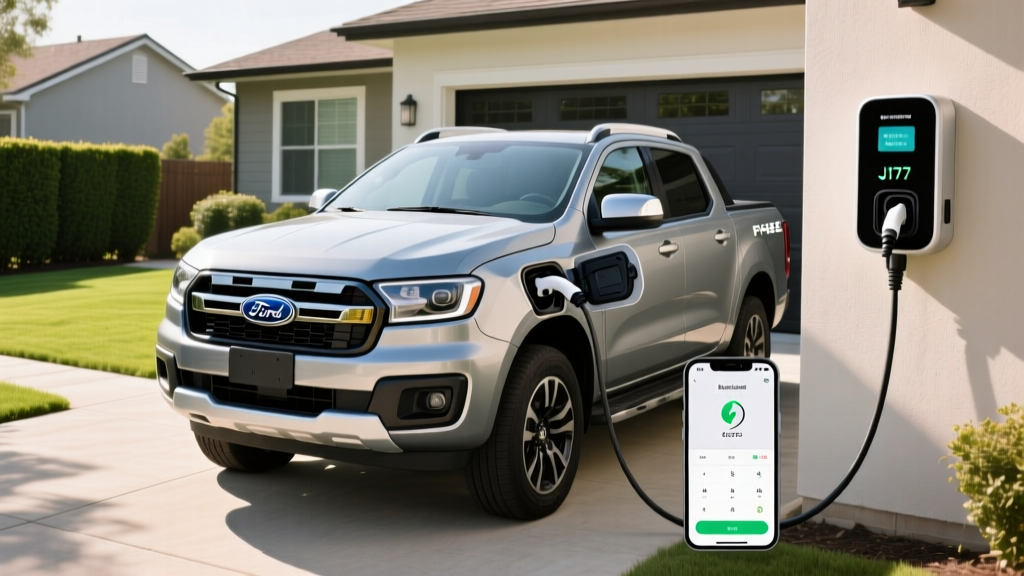
For AC home and public Level 2 charging: The Ranger PHEV will almost certainly use a J1772 inlet for Level 1 and Level 2 AC charging, consistent with Ford's current US PHEV lineup (Escape PHEV). If Ford equips the Ranger PHEV with a NACS port instead, a simple J1772-to-NACS adapter (~$50–$100) will let you use any J1772 public charger. Conversely, if the truck has J1772, a NACS-to-J1772 adapter unlocks Tesla Destination Chargers.
For DC fast charging: This is the big unknown. Many PHEVs — including the current Ford Escape PHEV — do not offer DC fast charging at all, relying exclusively on Level 1 and Level 2 AC. If the Ranger PHEV follows this pattern, you'll charge at home and at public Level 2 stations only. If Ford does include a CCS1 or NACS DC fast-charge port, expect a modest ~50 kW peak rate. We'll update this guide once Ford publishes final US specifications.
Cost to Charge: Per-Mile Economics vs. Gas
One of the strongest arguments for a PHEV is the ability to run daily commutes on electricity at a fraction of the cost of gasoline. Let's run the numbers for the Ranger PHEV against a conventional 2026 Ford Ranger with the 2.3L EcoBoost.
| Scenario | Energy/Fuel Cost | Efficiency | Cost Per Mile |
|---|---|---|---|
| Home charging (off-peak, $0.13/kWh) | $0.13/kWh | ~3.0 mi/kWh (est.) | $0.043/mi |
| Home charging (peak, $0.22/kWh) | $0.22/kWh | ~3.0 mi/kWh | $0.073/mi |
| Public Level 2 ($0.30/kWh avg) | $0.30/kWh | ~3.0 mi/kWh | $0.10/mi |
| DC Fast Charge ($0.48/kWh avg) | $0.48/kWh | ~3.0 mi/kWh | $0.16/mi |
| Gas Ranger (23 MPG combined, $3.40/gal) | $3.40/gal | 23 MPG | $0.148/mi |
The takeaway: Charging at home on off-peak electricity, the Ranger PHEV costs roughly 3.5× less per mile than fueling a gas Ranger. Even at public Level 2 rates, you're saving ~30% per mile. Only expensive DC fast charging approaches gasoline cost parity — and for a PHEV with a small battery, DC fast charging will be rare.
For a driver who covers 30 miles per day and charges at home at $0.13/kWh, annual electric fuel cost is roughly $525. The same 30 miles/day in a gas Ranger at 23 MPG and $3.40/gallon costs about $1,618 per year — a savings of over $1,000 annually just on the electric portion of your driving. Once the battery is depleted and the gas engine kicks in, the Ranger PHEV will operate as a conventional hybrid with an estimated combined fuel economy of 25–30 MPG (official EPA figures pending), which still beats the gas-only Ranger.
Charging Time Examples: What to Expect with the Ranger PHEV
With an estimated 18 kWh usable battery, the Ranger PHEV charges far faster than a full BEV. Here are realistic time estimates for common scenarios:
- Level 1 (120V, 1.4 kW): A full 0–100% charge takes approximately 12–14 hours. Plugging in when you get home at 6 PM gives you a full battery by 6–8 AM. If you drove only 15 miles (using ~5 kWh), a Level 1 top-up takes about 3.5 hours.
- Level 2 (240V, 32A, 7.7 kW): A full 0–100% charge takes approximately 2.5–3 hours. A typical daily top-up of 15–20 miles (~5–7 kWh) finishes in under an hour. This is the ideal home setup.
- Level 2 (240V, 48A, 11.5 kW): No benefit for the Ranger PHEV — the onboard charger caps at ~7.7 kW, so charge times are identical to the 32A scenario above.
- DC Fast Charge (if equipped, ~50 kW peak): 10–80% in approximately 20–30 minutes. Note that PHEV batteries are small, so the charge curve tapers quickly above 80%. In practice, a DC fast-charge session from 20% to full might take only 25–35 minutes total.
Equipment Recommendations: Best Level 2 Chargers for the Ranger PHEV
Since the Ranger PHEV's onboard charger is expected to max out around 7.7 kW (32A at 240V), you don't need a 48A or 80A charger. A well-built 32A–40A unit is the right match. Here are three proven options:
Emporia Vue Level 2 Smart Charger
- Power output: 40A / 9.6 kW max (PHEV will draw ~7.7 kW)
- Connector: J1772 (NACS version available)
- Cable length: 24 ft
- Smart features: Wi-Fi, app scheduling, energy monitoring, solar integration, load management
- Price: ~$399
- Best for: Budget-conscious buyers who want smart scheduling to charge during off-peak utility rates
ChargePoint Home Flex
- Power output: Configurable 16A–50A (set to 32A for PHEV on a 40A circuit)
- Connector: J1772 (NACS adapter included in newer kits)
- Cable length: 23 ft
- Smart features: Wi-Fi, app with scheduling, Alexa integration, flexible amperage settings
- Price: ~$549
- Best for: Flexibility — set amperage to match your circuit, upgrade to higher amps later if you add a BEV
Ford Connected Charge Station
- Power output: 48A / 11.5 kW max (PHEV will draw ~7.7 kW)
- Connector: J1772 (Ford's OEM unit; NACS compatibility TBD for Ranger PHEV)
- Cable length: 25 ft
- Smart features: FordPass app integration, scheduled charging, charge status in-vehicle
- Price: ~$595 (sometimes included or discounted with new Ford PHEV purchase)
- Best for: Seamless integration with Ford's app ecosystem; check for purchase incentives with the Ranger PHEV
Our pick for most Ranger PHEV buyers: The ChargePoint Home Flex. Its adjustable amperage means you can set it to 32A on a 40A circuit today and increase it to 48A later if you add a full BEV to your garage — all without replacing the unit. The included NACS adapter also future-proofs you as Ford transitions to the NACS connector.
Federal Tax Credits and Utility Rebates for Home Charging
While the federal §30C Alternative Fuel Vehicle Refueling Property Credit offers up to $1,000 (30% of equipment + installation costs, capped at $1,000) for home EV charger installation, eligibility depends on your census tract meeting specific low-income or non-urban criteria as defined by the IRS. This credit is separate from the §30D New Clean Vehicle Credit that applies to the vehicle purchase itself.
Additionally, many utility companies offer rebates of $200–$500 for installing a smart Level 2 charger, and some provide discounted time-of-use (TOU) rates that make overnight charging even cheaper. Check with your local utility before purchasing equipment — some utilities require pre-approval or specify eligible charger models.
Important: Tax credit eligibility rules, including income limits, MSRP caps, and battery sourcing requirements, change frequently. Consult irs.gov or a qualified tax professional for current-year guidance specific to your situation.
Public Charging Strategy for a PHEV Pickup
The Ranger PHEV's small battery changes the public charging calculus. Here's how to think about it:
- Level 2 public stations (ChargePoint, EVgo Level 2, Blink): Ideal for topping up while parked at work, a grocery store, or a trailhead. At 7.7 kW, you'll add roughly 20–25 miles of range per hour parked. For a PHEV, that's often enough to fully refill during a shopping trip or workday.
- DC fast chargers (Electrify America, EVgo, Tesla Superchargers with Magic Dock): Only relevant if the Ranger PHEV supports DC fast charging. If it does, a 20-minute stop adds enough range to cover most daily commutes. If it doesn't, skip DC stations entirely — you can't use them.
- Tesla Superchargers: With Ford's NACS adoption, future Ford EVs will access Tesla's Supercharger network. For the Ranger PHEV, access depends on whether Ford equips it with a NACS port. A J1772-to-NACS adapter (~$70–$100) may bridge the gap for Tesla Destination Chargers (Level 2), but Supercharger access requires native NACS hardware.
For most Ranger PHEV owners, home charging will cover 90%+ of electric driving. Public charging is a bonus, not a necessity — which is the entire point of a PHEV. The gas engine eliminates range anxiety on road trips, while home charging delivers EV-like economics for daily commuting.
Frequently Asked Questions
How much does it cost to install a home EV charger for the Ford Ranger PHEV?
For a typical installation with a 40A, 240V circuit and no panel upgrade, expect to spend $900–$3,050 total (charger hardware + electrician labor + permit). If your home has an older 100A electrical panel that needs upgrading to 200A, add $1,500–$4,000. Because the Ranger PHEV only needs a 32A charger, installation costs are on the lower end compared to full-BEV setups requiring 48A–80A circuits.
How fast will each charging level add range to the Ranger PHEV?
Level 1 (120V) adds roughly 4–5 miles of electric range per hour. Level 2 (240V, 32A) adds approximately 22–26 miles per hour. DC fast charging (if equipped) could add 100+ miles per hour, but the small PHEV battery means a full session is measured in minutes, not hours. A complete Level 2 refill from empty takes about 2.5–3 hours.
Which connector is compatible with the Ford Ranger PHEV?
For AC Level 1 and Level 2 charging, expect a J1772 inlet — the universal standard for non-Tesla PHEVs in the US. If Ford equips the Ranger PHEV with a NACS port, adapters are readily available (~$50–$100) to use J1772 stations. DC fast-charge connector compatibility (CCS1 or NACS) has not been confirmed for the US-spec model.
How much does charging cost per mile vs. gas in the Ranger PHEV?
At home on off-peak electricity ($0.13/kWh), the Ranger PHEV costs approximately $0.043 per mile in electric mode — about 3.5× cheaper than fueling a gas Ranger at $0.148 per mile (23 MPG, $3.40/gallon). Even at public Level 2 rates ($0.30/kWh), you save roughly 30% per mile. Annual savings for a 30-mile daily commute exceed $1,000 when charging at home.
What electrical upgrades might I need for a home Level 2 charger?
Most homes with a 200A electrical panel need no upgrades — just a new 40A double-pole breaker and a wire run to the garage or driveway. Homes with older 100A panels may need a full panel upgrade ($1,500–$4,000) to safely add a 40A EV circuit alongside existing loads. Your electrician will perform a load calculation per NEC Article 220 to determine if your panel has sufficient capacity. Some utilities offer load-management devices that let you add a charger without a panel upgrade by automatically reducing charger power when other large loads are running.
Is the Ford Ranger PHEV available in the USA yet?
As of early 2026, Ford has announced the Ranger PHEV for global markets (Australia, Europe), but US availability has not been officially confirmed with a firm on-sale date. US-spec details including battery capacity, electric range, onboard charger power, and connector type may differ from international versions. Monitor Ford's official Ranger page for updates. We'll update this guide with verified US specs as they're published.