Why the Ford Ranger Hybrid Changes Your Charging Strategy
The 2026 Ford Ranger Hybrid pairs a turbocharged engine with an electric motor and a modest battery pack — typically in the 1.5–2.0 kWh range for a conventional hybrid (HEV), or potentially larger if Ford introduces a plug-in variant. Unlike a full battery-electric vehicle (BEV) with a 75+ kWh pack, a hybrid's small battery means your charging needs look very different. But understanding charging infrastructure still matters: it affects how you maintain battery health, whether a future PHEV Ranger variant fits your garage, and how to evaluate public charging if you own multiple electrified vehicles.
This guide breaks down every charging level, what home installation actually costs, which connectors you'll encounter, and how charging economics compare to filling the Ranger's gas tank — all with exact numbers.
Charging Levels Explained: Speeds, kW, and Miles Per Hour
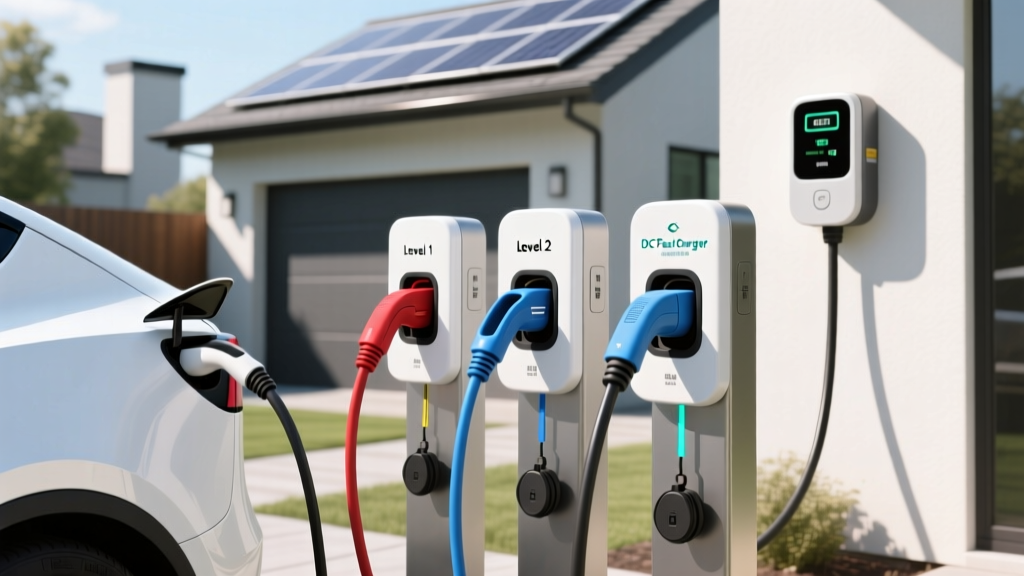
The three charging levels differ fundamentally in power delivery. Power is measured in kW (kilowatts) — the rate of energy flow — while battery capacity is measured in kWh (kilowatt-hours) — the total energy stored. Confusing these is the single most common EV mistake. Think of kW as how fast water flows from a hose, and kWh as the size of the bucket.
| Level | Voltage / Amps | Power (kW) | Miles of Range Added Per Hour | Best For |
|---|---|---|---|---|
| Level 1 | 120V / 12–16A | 1.4–1.9 kW | 3–5 mi/hr | Overnight trickle; PHEVs with small packs |
| Level 2 | 240V / 32–48A | 7.7–11.5 kW | 20–40 mi/hr | Daily home charging; most BEVs and PHEVs |
| DC Fast Charge | 400–800V DC | 50–350 kW | 150–1,000+ mi/hr (peak) | Road trips; rapid top-ups (BEVs only) |
For a PHEV with a ~15 kWh usable battery (similar to the Ford Escape PHEV), Level 1 charging from empty to full takes roughly 8–10 hours. Level 2 at 7.7 kW cuts that to about 2 hours. DC fast charging is generally not available on most PHEVs due to small battery size and cost engineering — Ford's current PHEV lineup uses Level 2 as its maximum charge rate.
Home Charger Installation: Electrical Requirements and Real Costs
Installing a Level 2 home charger is the single biggest infrastructure decision for any electrified-vehicle owner. The total cost depends on your electrical panel's capacity, the distance from panel to charger location, and local permit fees.
Electrical Requirements
A typical Level 2 charger requires a 240V dedicated circuit — the same voltage as your electric dryer or oven. Common configurations:
- 32A circuit (7.7 kW): Requires a 40A breaker (NEC code mandates 125% overrating for continuous loads). Uses 8 AWG copper wire.
- 40A circuit (9.6 kW): Requires a 50A breaker. Uses 6 AWG copper wire. Most versatile for future-proofing.
- 48A circuit (11.5 kW): Requires a 60A breaker. Uses 4 AWG copper wire. Needs a 200A+ main panel with spare capacity.
Panel Upgrade Reality
Homes built before 2000 often have 100A or 150A main panels. Adding a 40–50A EV circuit may push total load past 80% of panel capacity — the NEC safety threshold. If your panel is maxed out, an upgrade to 200A costs significantly more but is sometimes unavoidable.
| Component | Low Estimate | High Estimate | Notes |
|---|---|---|---|
| Level 2 charger (hardware) | $350 | $700 | Smart Wi-Fi models cost more |
| Electrician labor (standard install) | $500 | $1,500 | Depends on run length, wall type |
| Permit & inspection | $50 | $300 | Varies by municipality |
| Panel upgrade (if needed) | $1,500 | $4,000 | 100A → 200A; older homes only |
| Total (no panel upgrade) | $900 | $2,500 | Most homes with 200A panels |
| Total (with panel upgrade) | $2,400 | $6,500 | Homes with 100–150A panels |
Always get at least two quotes from licensed electricians and confirm they pull a permit. Unpermitted work can void homeowner's insurance and cause problems at resale. For detailed code requirements, consult the National Electrical Code (NEC) or your local building department.
Connector Compatibility: NACS, CCS, and What Ford Uses
The connector landscape shifted dramatically in 2024–2025 when Ford, along with most major automakers, adopted the North American Charging Standard (NACS) — the Tesla-designed connector — for its electric vehicles. Here's what that means for current and future Ford owners:
| Connector | Description | Ford Compatibility (2026) |
|---|---|---|
| NACS (Tesla) | Compact, lightweight; AC + DC in one plug | Native on new Ford EVs (F-150 Lightning, Mustang Mach-E 2025+); Supercharger access |
| CCS1 | Larger combo plug; legacy DC standard | Older Ford EVs (pre-2025); adapter available for Supercharger use |
| J1772 | Standard AC Level 1/2 connector | Universal for AC charging on all Fords; NACS vehicles use included adapter |
| CHAdeMO | Legacy Japanese DC standard | Not used on any Ford vehicle; being phased out nationally |
Key takeaway: If a Ranger PHEV or future Ranger EV arrives, expect it to ship with a NACS port. For home Level 2 charging, you'll use either a NACS-equipped wall connector or a J1772 charger with the NACS adapter Ford includes. At public DC fast chargers, NACS gives you access to both Tesla Superchargers (now open to Ford EVs) and Electrify America stations (via CCS adapter or native NACS stalls being deployed through 2026).
Charging Time Examples by Battery Size
Charge time depends on battery capacity (kWh) divided by charger power (kW), adjusted for charging inefficiency (~10–15% loss). Here's what to expect for common Ford battery sizes:
| Vehicle Type | Battery (kWh usable) | Level 1 (1.4 kW) | Level 2 (7.7 kW) | Level 2 (11.5 kW) | DC Fast (peak) |
|---|---|---|---|---|---|
| PHEV (e.g., Escape PHEV class) | ~14.4 kWh | ~10 hrs | ~2 hrs | ~1.4 hrs | N/A (no DC port) |
| BEV small (e.g., future compact) | ~65 kWh | ~46 hrs | ~8.5 hrs | ~5.7 hrs | 10–80% in ~30 min at 150 kW |
| BEV large (e.g., F-150 Lightning ext.) | ~131 kWh | ~94 hrs | ~17 hrs | ~11.5 hrs | 10–80% in ~42 min at 150 kW |
Charging curve reality: DC fast charging does not sustain peak kW for the entire session. A truck that peaks at 150 kW may only hold that rate from 10–40% state of charge (SoC), then taper to 100 kW through 60%, and drop to 50 kW or less above 80%. This is why manufacturers quote 10–80% times — the final 20% can take as long as the first 70%.
Cost to Charge: Per-Mile Economics vs. Gas
Electricity pricing varies enormously by location, time of day, and charger type. Here are real 2026 scenarios based on national averages from the U.S. Energy Information Administration:
| Scenario | Price per kWh | Vehicle Efficiency | Cost per Mile |
|---|---|---|---|
| Home off-peak (utility time-of-use rate) | $0.09/kWh | 3.0 mi/kWh (PHEV electric mode) | $0.03/mi |
| Home standard rate (national avg) | $0.17/kWh | 3.0 mi/kWh | $0.057/mi |
| Public Level 2 (ChargePoint, etc.) | $0.25–$0.49/kWh | 3.0 mi/kWh | $0.08–$0.16/mi |
| DC fast charge (Electrify America) | $0.48–$0.64/kWh | 2.5 mi/kWh (highway BEV) | $0.19–$0.26/mi |
| Gas comparison (Ranger Hybrid, 25 MPG combined) | $3.30/gal | 25 MPG | $0.132/mi |
The math is clear: home charging on off-peak rates delivers fuel cost at roughly one-quarter the price of gasoline. Public DC fast charging, however, can actually exceed the cost of gas per mile — making it a road-trip convenience, not a daily strategy. For a Ford Ranger Hybrid operating primarily on its gasoline engine at ~25 MPG combined, the hybrid system saves fuel through regenerative braking and electric assist at low speeds, but you're still paying gas prices for the majority of your miles.
Recommended Home Charging Equipment for Ford Owners
These chargers are selected for NACS/J1772 compatibility, reliability, and value for Ford's current and upcoming electrified lineup:
Tesla Wall Connector (Gen 4)
- Power: 11.5 kW (48A) max
- Connector: NACS native
- Cable: 24 ft
- Smart features: Wi-Fi, OTA updates, power sharing between units, load management
- Price: ~$475
- Best for: Ford NACS-equipped vehicles; cleanest Supercharger-compatible home setup
ChargePoint Home Flex
- Power: Up to 12 kW (50A) configurable
- Connector: J1772 (NACS adapter included with Ford EVs)
- Cable: 23 ft
- Smart features: Wi-Fi, app scheduling, Alexa, utility integration for off-peak rates
- Price: ~$550–$650
- Best for: Universal compatibility; flexible amperage for panel-constrained homes
Ford Connected Charge Station
- Power: 11.5 kW (48A)
- Connector: J1772 / NACS (model-year dependent)
- Cable: 25 ft
- Smart features: FordPass integration, scheduled charging, vehicle status sync
- Price: ~$600–$800 (often discounted at purchase)
- Best for: Seamless FordPass app experience; single-app ecosystem
Emporia Vue Level 2 Charger
- Power: Up to 11.5 kW (48A)
- Connector: J1772
- Cable: 24 ft
- Smart features: Energy monitoring, solar integration, real-time cost tracking
- Price: ~$350–$400
- Best for: Budget-conscious install; solar-panel homes wanting charge-from-sun tracking
Safety, Code, and Installation Best Practices
EV charging involves sustained high-current draw — often 8+ hours at full amperage. This is classified as a continuous load under the NEC, triggering specific safety requirements:
- Dedicated circuit: Your EV charger must have its own breaker — never share a circuit with other appliances. A 40A charger needs a 50A breaker with nothing else on it.
- GFCI protection: The 2023 NEC update (Article 625) requires GFCI protection for all EV supply equipment. Most modern hardwired chargers have built-in GFCI; plug-in units (NEMA 14-50 outlets) require a GFCI breaker, which adds $40–$80.
- Outdoor rating: If your charger is mounted outside or in an unsealed garage, confirm it carries a NEMA 4 or IP65 rating for weather resistance. All chargers listed above meet this standard.
- Wire gauge: Undersized wire causes heat buildup and fire risk. Your electrician must match wire gauge to breaker size and run length. For runs over 100 feet, wire gauge must increase to compensate for voltage drop.
- Hardwired vs. plug: Hardwired installations (no outlet) are generally safer and more reliable for 48A+ circuits. NEMA 14-50 outlets offer portability but introduce a connection point that can overheat if not installed with an industrial-grade receptacle (Hubbell or Bryant brand recommended over standard hardware-store outlets).
Frequently Asked Questions
Does the Ford Ranger Hybrid plug in to charge?
The 2026 Ford Ranger Hybrid is a conventional HEV — it does not have a plug-in port. Its small battery charges through regenerative braking and the gasoline engine. If Ford introduces a Ranger PHEV variant in the future, it would include a charge port compatible with Level 1 and Level 2 AC charging. This guide prepares you for that eventuality and applies to any other plug-in Ford you may own.
How much does it cost to install a home EV charger?
A standard Level 2 home installation (equipment + electrician + permit) costs between $900 and $2,500 if your electrical panel has sufficient capacity. Homes needing a panel upgrade from 100A to 200A should budget $2,400 to $6,500 total. Always get multiple quotes from licensed electricians and confirm permits are pulled.
How fast will each charging level add range?
Level 1 (120V) adds 3–5 miles per hour. Level 2 (240V) adds 20–40 miles per hour depending on amperage and vehicle efficiency. DC fast charging can add 150–1,000+ miles per hour at peak power, but sustained rates taper significantly above 60–80% state of charge. For a PHEV with ~35 miles of electric range, Level 2 fully recharges in about 2 hours.
Which connector is compatible with Ford vehicles?
New Ford EVs (2025+) use the NACS connector natively, providing direct access to Tesla Superchargers and growing NACS public networks. Older Ford EVs use CCS1 and can access Superchargers via a Ford-provided adapter. For home AC charging, all Ford EVs accept J1772 or NACS. The conventional Ranger Hybrid has no charge port.
How much does charging cost per mile compared to gas?
Home charging on off-peak rates costs roughly $0.03–$0.06 per mile, while the Ford Ranger Hybrid on gasoline at 25 MPG and $3.30/gallon costs $0.13 per mile. Public DC fast charging at $0.48–$0.64/kWh costs $0.19–$0.26 per mile — more expensive than gas. The economics strongly favor home charging.
What electrical upgrades might I need for a home charger?
The most common upgrade is a panel capacity increase from 100A or 150A to 200A, costing $1,500–$4,000. You may also need a new dedicated circuit with appropriately sized wire (6 or 8 AWG), a GFCI breaker ($40–$80), and a permit ($50–$300). Homes with existing 200A panels and spare breaker slots typically need no panel upgrade.
Is there a federal tax credit for home charger installation?
The federal Alternative Fuel Vehicle Refueling Property Credit (IRS §30C) covers 30% of home charging equipment and installation costs, up to $1,000. However, eligibility depends on whether your census tract qualifies as a low-income or non-urban area per IRS guidelines. Check your eligibility before purchasing. Some utilities also offer rebates of $200–$500 for Level 2 charger installations — contact your local provider.