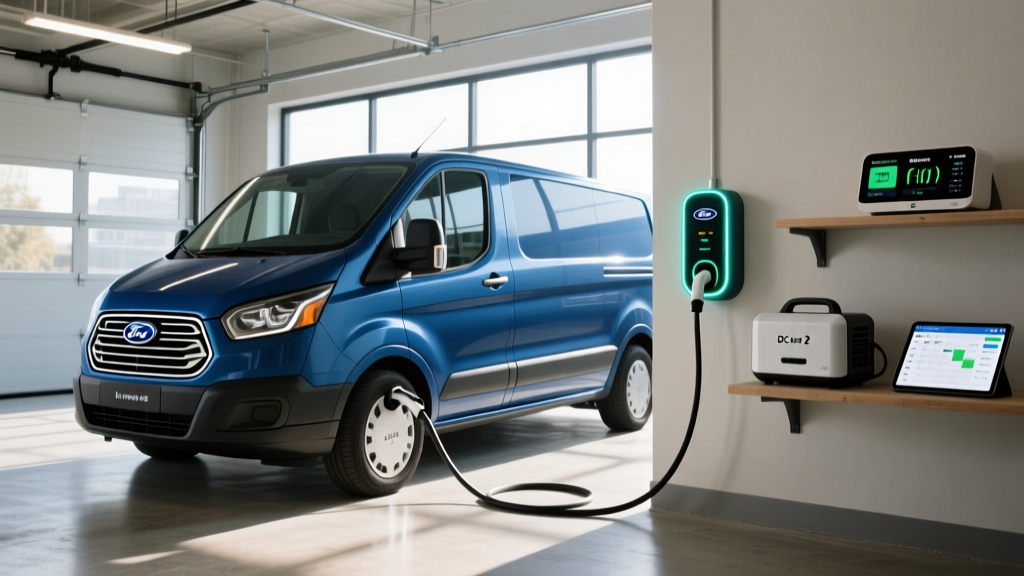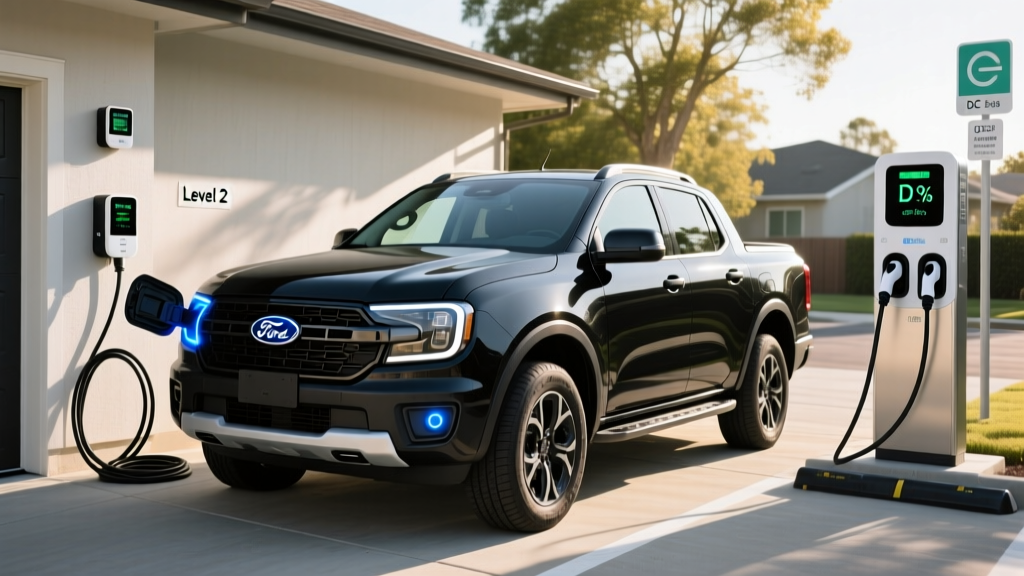
The upcoming Ford Ranger EV promises to bring midsize electric truck capability to a segment hungry for options. But before you put down a deposit, you need a charging plan. Whether you're eyeing the Ranger EV for daily commuting, job-site runs, or weekend towing, understanding how to charge it efficiently at home and on the road will define your ownership experience.
This guide breaks down every charging scenario you'll encounter with the Ford Ranger EV — from Level 1 trickle charging on a standard outlet to DC fast charging on a road trip — with exact numbers on speeds, costs, equipment, and electrical requirements.
Understanding EV Charging Levels: What the Ranger EV Supports
Before we get into specifics, let's clarify the critical distinction between kW (kilowatts — the rate of power delivery, like water pressure in a hose) and kWh (kilowatt-hours — the total energy stored in the battery, like the size of the tank). Charging speed is measured in kW; battery capacity is measured in kWh. Confusing these two is the single most common mistake new EV buyers make.
The Ford Ranger EV is expected to support all three standard charging levels. Here's how each one translates into real-world range recovery:
| Level | Voltage / Amperage | Power (kW) | Miles of Range Added Per Hour | Best Use Case |
|---|---|---|---|---|
| Level 1 (120V) | 120V / 12A | ~1.4 kW | 3–5 miles | Overnight top-up, emergencies |
| Level 2 (240V) | 240V / 32–48A | 7.7–11.5 kW | 22–35 miles | Daily home charging, workplace |
| DC Fast Charging | 400–800V DC | 50–150+ kW (peak) | 150–300+ miles (at peak rate) | Road trips, rapid top-ups |
How Much Does It Cost to Install a Home EV Charger for the Ranger EV?
Home Level 2 charging is the backbone of practical EV truck ownership. For a midsize truck like the Ranger EV — which will likely carry a battery in the 75–100 kWh range based on segment competitors — a Level 2 charger is essentially mandatory. Level 1 at 1.4 kW would take 50+ hours for a full charge, which isn't viable for daily use.
Here's a realistic cost breakdown for a 240V / 48A Level 2 home installation:
| Component | Low End | High End | Notes |
|---|---|---|---|
| Level 2 Charger (Hardware) | $350 | $750 | Smart Wi-Fi-enabled 40–48A unit |
| Electrician Labor | $500 | $1,500 | Varies by run length, wall type, conduit |
| Permit & Inspection | $50 | $250 | Required in most jurisdictions |
| Electrical Panel Upgrade (if needed) | $1,500 | $3,500 | 100A→200A service upgrade for older homes |
| Total (No Panel Upgrade) | $900 | $2,500 | Most homes with 200A service |
| Total (With Panel Upgrade) | $2,400 | $6,000 | Homes with 100A or maxed-out panels |
The Panel Upgrade Gotcha
This is where many first-time EV buyers get blindsided. A 48A Level 2 charger requires a dedicated 60A circuit (the National Electrical Code requires circuits to be rated at 125% of continuous load). If your home has a 100A electrical panel — common in homes built before the 1990s — you likely don't have enough spare capacity. An electrician will perform a load calculation to determine whether your panel can handle the additional draw alongside your HVAC, water heater, dryer, and other major appliances.
If an upgrade to 200A service is needed, budget $1,500–$3,500 for that work alone. Some utility companies offer rebates for panel upgrades tied to EV adoption — check with your local provider.
Electrical Requirements for the Ranger EV Home Charger
- Circuit: Dedicated 60A breaker (for a 48A continuous charger) or 50A breaker (for a 40A charger)
- Wiring: 6 AWG copper (60A) or 8 AWG copper (50A) THHN in conduit, or equivalent NM-B
- Outlet vs. Hardwired: A NEMA 14-50 outlet offers portability; hardwired units are often cheaper to install and eliminate GFCI breaker requirements in some jurisdictions
- GFCI Protection: NEC 2020+ requires GFCI protection for outdoor receptacles — a hardwired installation may bypass this requirement depending on local code
- Outdoor Rating: If mounting outside, ensure the charger carries a NEMA 4 (weatherproof) rating
Always hire a licensed electrician familiar with EV charger installations. The National Electrical Code (NEC) governs these requirements, and local amendments may apply.
Which Connector Does the Ford Ranger EV Use? NACS vs. CCS Compatibility
Ford made a pivotal decision in late 2023: all new Ford EVs will adopt the North American Charging Standard (NACS) connector — the Tesla-designed plug that has become the de facto industry standard. The Ranger EV, as a forthcoming Ford model, is expected to ship with a native NACS charge port.
This matters enormously for your charging flexibility:
| Connector | Native Support? | Where You'll Find It | Adapter Needed? |
|---|---|---|---|
| NACS (Tesla) | Yes (expected) | Tesla Superchargers, newer Electrify America, EVgo, and ChargePoint stations | No |
| CCS1 | No (native) | Legacy Electrify America, some ChargePoint and EVgo stations | NACS-to-CCS adapter (~$100–$200) |
| CHAdeMO | No | Largely deprecated; remaining Nissan Leaf infrastructure | Not practical |
| J1772 (Level 2 AC) | Via included adapter | Public Level 2 stations, older home chargers | NACS-to-J1772 adapter (usually included with vehicle) |
Level 2 Home Charger Recommendations for the Ranger EV
Not all Level 2 chargers are created equal. For a truck-class EV with a large battery, you want maximum amperage (48A if your panel supports it), a long cable, smart scheduling features, and robust build quality. Here are three chargers that fit the bill:
ChargePoint Home Flex (NACS)
- Power Output: Up to 11.5 kW (48A at 240V) — configurable down to 16A
- Connector: Native NACS (new 2025+ model)
- Cable Length: 23 feet
- Smart Features: Wi-Fi, app scheduling, energy tracking, Alexa integration
- Price: ~$550–$650
- Best For: Flexible amperage settings for homes with limited panel capacity
Tesla Wall Connector (NACS)
- Power Output: Up to 11.5 kW (48A at 240V)
- Connector: Native NACS
- Cable Length: 24 feet
- Smart Features: Wi-Fi, over-the-air updates, power sharing between two units, load management
- Price: ~$475–$500
- Best For: Best value at 48A; ideal if you also own a Tesla or want seamless NACS integration
Emporia Level 2 Smart Charger
- Power Output: Up to 11.5 kW (48A at 240V)
- Connector: NACS (2025+ revision) or J1772 with adapter
- Cable Length: 24 feet
- Smart Features: Wi-Fi, detailed energy monitoring, solar integration, time-of-use scheduling
- Price: ~$350–$400
- Best For: Budget-conscious buyers who want granular energy data and solar pairing
For the Ranger EV's likely large battery pack, I recommend a 48A charger if your electrical panel can support a 60A dedicated circuit. The difference between a 32A (7.7 kW) and 48A (11.5 kW) charger is meaningful: you'll recover roughly 50% more range per hour of charging. That's the difference between waking up with 180 miles vs. 270 miles after an 8-hour overnight session.
DC Fast Charging the Ranger EV: What to Expect on Road Trips
For the Ranger EV, DC fast charging will be your road-trip lifeline. While Ford hasn't published final peak charge rates for the production Ranger EV, we can make informed projections based on the F-150 Lightning's architecture and Ford's broader EV platform.
The F-150 Lightning with the extended-range battery peaks at approximately 150 kW on a DC fast charger, reaching 10–80% in roughly 41 minutes. The Ranger EV, being smaller with a likely smaller battery (estimated 75–85 kWh usable), could see similar or slightly faster relative charge times.
| Charger Rating | 10–80% Time (Estimated) | Miles Added in 20 Min | Notes |
|---|---|---|---|
| 350 kW charger | ~30–35 min | ~120–150 miles | Truck peaks well below 350 kW; charger is overbuilt |
| 150 kW charger | ~35–42 min | ~100–130 miles | Good match for expected peak rate |
| 50 kW charger | ~80–90 min | ~50–60 miles | Older CHAdeMO/CCS stations; plan longer stops |
Charging Cost Per Mile: Ranger EV vs. Gas-Powered Ranger
The economics of EV charging vs. gasoline are where the Ranger EV makes a compelling case — particularly for high-mileage drivers. Let's compare using concrete numbers.
Assumptions: The gas-powered Ford Ranger 4x4 achieves approximately 22 MPG combined (EPA). Gas at $3.40/gallon (2026 national average). The Ranger EV is projected at roughly 2.0–2.5 kWh/mile (or ~2.0–2.5 miles/kWh efficiency, expressed as approximately 90–100 MPGe combined).
| Charging / Fueling Scenario | Cost Per Unit | Cost Per Mile | Annual Cost (15,000 mi) |
|---|---|---|---|
| Home Level 2 (off-peak utility rate) | $0.10/kWh | $0.04–$0.05 | $600–$750 |
| Home Level 2 (national avg rate) | $0.16/kWh | $0.06–$0.08 | $960–$1,200 |
| Public Level 2 (ChargePoint, etc.) | $0.25–$0.35/kWh | $0.10–$0.14 | $1,500–$2,100 |
| DC Fast Charging (Tesla Supercharger avg) | $0.28–$0.36/kWh | $0.11–$0.14 | $1,650–$2,160 |
| Gas Ranger (22 MPG combined) | $3.40/gallon | $0.15 | $2,318 |
The takeaway is clear: home charging is where the savings live. At off-peak utility rates, the Ranger EV costs roughly one-quarter to one-third per mile compared to the gas Ranger. Even at public DC fast-charging rates, you're still slightly ahead of gasoline on a per-mile basis.
However, if you rely exclusively on public DC fast charging — say, you live in an apartment without home charging access — the cost advantage narrows considerably. Some public networks charge $0.40–$0.50/kWh in urban areas, which can push EV fueling costs above gasoline. Factor this into your decision honestly.
Safety, Code, and Practical Installation Considerations
EV charging involves sustained high-current draw — often 8+ hours at 40–48 amps. This is unlike any other appliance in your home. Safety and code compliance aren't optional.
Key Safety Requirements
- Dedicated Circuit: Your Level 2 charger must be on its own dedicated breaker — never shared with other appliances. A 48A charger requires a 60A breaker; a 40A charger requires a 50A breaker.
- GFCI Protection: NEC 2020 and later requires GFCI (Ground Fault Circuit Interrupter) protection for all outdoor receptacles. If you install a NEMA 14-50 outlet outdoors, your electrician will need a GFCI breaker (~$100–$150 additional). Hardwired installations in garages may not require GFCI depending on local interpretation.
- Outdoor-Rated Equipment: If mounting outdoors, the charger must carry at minimum a NEMA 4 rating (protection against splashing water and ice). Look for UL or ETL listing marks.
- Cable Management: A 24-foot cable is heavy and can be a trip hazard. Wall-mounted cable organizers or retractable reels keep the installation safe and tidy.
- Permit and Inspection: Most jurisdictions require an electrical permit for a new 240V circuit. The inspection ensures the work meets NEC standards — don't skip this step. Unpermitted work can void homeowner's insurance claims related to electrical fires.
Smart Charger Features Worth Paying For
A "smart" charger with Wi-Fi connectivity isn't just a luxury — it provides real utility:
- Time-of-Use Scheduling: Set charging to occur during off-peak hours when electricity rates are lowest (often 10 PM – 6 AM). This can cut your charging bill by 30–50%.
- Load Management: Some chargers (like the Tesla Wall Connector) support load sharing between two units on a single circuit — useful if you add a second EV.
- Energy Monitoring: Track exactly how many kWh you're consuming per session and per month, which is essential for accurate cost tracking and potential utility rebate programs.
Frequently Asked Questions: Ranger EV Charging
How fast will each charging level add range to the Ranger EV?
Level 1 (120V) adds approximately 3–5 miles per hour — enough for an overnight top-up of 30–40 miles if you have 10 hours. Level 2 (240V, 48A) adds roughly 25–35 miles per hour, meaning a full overnight session can add 200+ miles. DC fast charging at peak rates can add 150+ miles in 20 minutes, though the charge curve tapers significantly above 70% SoC.
How much does it cost to install a home EV charger?
Expect $900–$2,500 for a standard Level 2 installation in a home with a 200A electrical panel and a short wire run. If your home needs a panel upgrade from 100A to 200A, total costs can reach $2,400–$6,000. Always get a detailed quote from a licensed electrician that separates equipment, labor, and permit costs.
Which connector is compatible with the Ranger EV?
The Ranger EV is expected to use the NACS (North American Charging Standard) connector natively, giving it direct access to Tesla Superchargers and an expanding network of NACS-equipped public stations. For legacy CCS1 stations, you'll need a NACS-to-CCS adapter. Level 2 public stations using J1772 will require the NACS-to-J1772 adapter that Ford is expected to include with the vehicle.
How much does charging cost per mile compared to gas?
At home off-peak rates ($0.10/kWh), the Ranger EV should cost roughly $0.04–$0.05 per mile — about one-third the cost of a gas Ranger at $0.15/mile (22 MPG, $3.40/gallon). Even at public DC fast-charging rates ($0.28–$0.36/kWh), you're looking at $0.11–$0.14/mile, still slightly below gasoline. The savings are largest when you can charge at home consistently.
What electrical upgrades might I need for a home charger?
The most common upgrade is a panel capacity increase. A 48A Level 2 charger draws 11.5 kW continuously — equivalent to running two electric dryers simultaneously. If your home has a 100A panel or your existing loads are near capacity, an upgrade to 200A service ($1,500–$3,500) may be required. Your electrician will perform a NEC Article 220 load calculation to determine this. Other potential upgrades include adding a sub-panel in the garage or trenching conduit for a detached-garage installation.
Can I use a portable Level 2 charger instead of installing a wall unit?
Yes. Ford is expected to offer a portable Level 2 charging cord that plugs into a NEMA 14-50 outlet. This gives you flexibility to take the charger when you move or use it at RV parks. However, portable units are limited to 32A (7.7 kW) on most 14-50 outlets due to the 40A breaker rating, which is slower than a hardwired 48A wall unit. For daily use with a large truck battery, a dedicated wall charger is the better long-term solution.
Does the Ranger EV qualify for the federal EV tax credit?
Federal tax credit eligibility under IRS §30D depends on several factors: the vehicle's MSRP must not exceed $80,000 (for trucks), the buyer's adjusted gross income must fall below $150,000 (single) or $300,000 (joint), and the battery must meet critical-mineral and component-sourcing requirements that tighten annually. The credit can be transferred to the dealer at point of sale for an immediate price reduction. Verify current eligibility on the IRS website before purchasing, as sourcing rules change year to year.