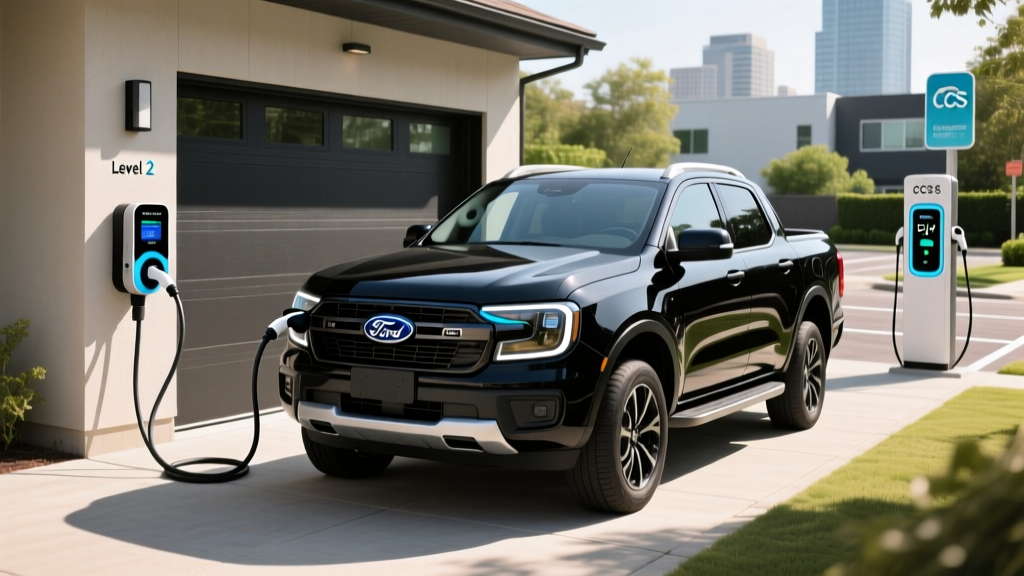
The Ford Ranger electric vehicle — announced as part of Ford's expanding global EV truck lineup — represents the brand's push into the midsize electric pickup segment. Whether you're eyeing a future reservation or planning ahead for when deliveries begin, understanding the charging ecosystem now saves time, money, and frustration later. This guide covers every charging scenario for the electric Ranger: home installation requirements, public network compatibility, real-world charging times for its estimated battery pack, and what you'll actually pay per mile compared to a gas truck.
kW (kilowatts) = power, or how fast energy flows into your truck (like water pressure from a hose). kWh (kilowatt-hours) = energy, or how much the battery stores (like the size of the tank). A 180 kW DC fast charger delivers energy quickly; a 75 kWh battery stores enough energy for roughly 230–270 miles of driving depending on conditions.
Charging Levels Explained: What Speeds to Expect
Every EV owner uses three tiers of charging. Here's how each level applies to the Ford Ranger electric vehicle, based on its expected ~75–85 kWh usable battery capacity and midsize truck efficiency profile.
| Level | Voltage / Amps | Power (kW) | Miles of Range Added per Hour | Best For |
|---|---|---|---|---|
| Level 1 (120V household) | 120V / 12A | ~1.4 kW | 3–5 mi/hr | Overnight top-ups, emergencies |
| Level 2 (240V home/public) | 240V / 32–48A | 7.7–11.5 kW | 22–38 mi/hr | Daily home charging, workplace |
| DC Fast Charging | 400–800V DC | Up to 150–180 kW (peak) | 180–250+ mi/hr (peak) | Road trips, rapid top-ups |
- Level 1 (1.4 kW): 0–100% in ~57 hours — only practical for maintaining charge or adding ~40 miles overnight.
- Level 2 at 11.5 kW (48A): 0–100% in ~7 hours; 10–80% in roughly 5 hours. Ideal for overnight replenishment.
- Level 2 at 7.7 kW (32A): 0–100% in ~10.5 hours; 10–80% in ~7.5 hours.
- DC Fast at 150 kW peak: 10–80% in approximately 30–35 minutes. Note: peak rate only holds between ~10–50% SoC; charging tapers significantly above 80% to protect battery health. Expect 80–100% to take an additional 25–30 minutes.
The EPA's fueleconomy.gov database will list official MPGe and range figures once the Ranger EV receives certification. For a midsize electric truck with an ~80 kWh pack and truck aerodynamics, expect an EPA-estimated range in the 230–270 mile window, with real-world highway driving yielding roughly 15–20% less, especially at sustained 70+ mph speeds or in cold weather below 40°F.
Home Charger Installation: Requirements, Costs & Gotchas
Installing a Level 2 home charger is the single most impactful upgrade for daily EV ownership. For the Ford Ranger electric vehicle, a 48-amp (11.5 kW) Level 2 unit on a dedicated 60-amp circuit is the sweet spot — it fully replenishes the battery overnight while leaving headroom for future vehicles or larger packs.
Electrical Requirements
- Circuit: Dedicated 60-amp breaker for a 48A charger (NEC requires circuits rated at 125% of continuous load, so 48A × 1.25 = 60A minimum).
- Voltage: 240V, single-phase — the same as your electric dryer or oven.
- Wire gauge: 6 AWG copper (THHN in conduit) or 4 AWG aluminum for runs up to ~50 feet; longer runs may need thicker wire to minimize voltage drop.
- GFCI protection: Required for outdoor receptacles under NEC 2020/2023. Hardwired units may bypass this requirement in some jurisdictions — check with your local inspector.
- Outdoor rating: If mounting outside, the charger must carry a NEMA 4 or NEMA 4X rating for weather resistance.
Do You Need a Panel Upgrade?
This is the cost wildcard that catches many homeowners off guard. A Level 2 charger draws 32–48 amps continuously. If your home has a 100-amp main panel (common in homes built before the 1990s), you likely lack the spare capacity for a 60-amp dedicated circuit — especially if you already run electric heat, a dryer, and an oven simultaneously.
The load calculation test: A licensed electrician will perform a NEC Article 220 load calculation to determine whether your existing panel can handle the additional draw. If your calculated load exceeds 80% of your panel's rating, a panel upgrade to 200 amps is required.
| Component | Low Estimate | High Estimate | Notes |
|---|---|---|---|
| Level 2 Charger (Equipment) | $350 | $750 | 32A–48A smart charger, 25 ft cable |
| Electrician Labor (no panel upgrade) | $300 | $1,200 | Depends on run length, conduit, drywall repair |
| Electrical Permit | $50 | $200 | Varies by municipality |
| Panel Upgrade (if needed: 100A → 200A) | $1,500 | $3,500 | Major cost adder for older homes |
| TOTAL (no panel upgrade) | $700 | $2,150 | Most homes built after 2000 |
| TOTAL (with panel upgrade) | $2,200 | $5,650 | Pre-1990s homes or 100A panels |
Pro tip: Get at least three quotes from licensed electricians. Ask specifically whether the quote includes the permit, load calculation, and any drywall/conduit work. Some utilities offer rebates or time-of-use rate plans that offset installation costs.
Connector Compatibility: NACS, CCS1 & Adapter Reality
Ford has committed to adopting the North American Charging Standard (NACS) — the Tesla-designed connector — across its EV lineup. The Ford Ranger electric vehicle is expected to ship with a native NACS charge port, giving it direct access to Tesla's Supercharger network (the largest and most reliable DC fast-charging network in North America) without an adapter.
| Connector | Used By | Ranger EV Compatibility | Adapter Needed? |
|---|---|---|---|
| NACS (Tesla) | Tesla, Ford (2025+), GM, Rivian, Volvo, others | ✅ Native port (expected) | None for Superchargers; NACS-to-J1772 adapter for older Level 2 stations |
| CCS1 | Legacy standard: VW, Hyundai, BMW, older Ford EVs | ⚠️ Via NACS-to-CCS adapter | Yes — ~$200–$250 for a certified adapter (e.g., Lectron, A2Z) |
| CHAdeMO | Nissan Leaf (legacy, phasing out) | ❌ Not practical | No reliable adapter exists; network is shrinking |
| J1772 (Level 2 AC) | Universal AC standard in North America | ✅ Via NACS-to-J1772 adapter | Yes — included with most Ford EVs or ~$100–$150 aftermarket |
What this means practically: With a native NACS port, you plug directly into any Tesla Supercharger (V3 at 150 kW or V4 at up to 250+ kW). For Electrify America, EVgo, or ChargePoint DC fast stations that still use CCS1 cables, you'll carry a NACS-to-CCS adapter in your truck. Ford has previously included a Mobile Power Cord with J1772 adapter capability in its EV offerings — expect similar for the Ranger EV.
Cost to Charge: Per-Mile Economics vs. Gas
The Ford Ranger electric vehicle's biggest ownership advantage over its gas counterpart emerges at the fuel pump — or rather, the charger. Here's a breakdown of real charging costs across scenarios, assuming an efficiency of ~3.0 miles per kWh (a reasonable estimate for a midsize electric truck).
| Scenario | Cost per kWh | Cost per Mile | Cost for 300 Miles |
|---|---|---|---|
| Home (off-peak utility rate) | $0.12/kWh | $0.04/mi | $12.00 |
| Home (national average rate) | $0.17/kWh | $0.057/mi | $17.00 |
| Public Level 2 (ChargePoint, etc.) | $0.25–$0.35/kWh | $0.08–$0.12/mi | $25–$35 |
| DC Fast Charging (Tesla Supercharger) | $0.28–$0.38/kWh | $0.09–$0.13/mi | $28–$38 |
| DC Fast (Electrify America, peak) | $0.43–$0.56/kWh | $0.14–$0.19/mi | $43–$56 |
| Gas Ranger (22 MPG combined, $3.50/gal) | $3.50/gallon | $0.16/mi | $47.70 |
The takeaway: Charging at home on an off-peak rate is roughly 75% cheaper per mile than fueling a gas Ranger. Even at public DC fast chargers, you'll typically break even or save modestly. The savings compound over 15,000 annual miles — home charging can save $1,500–$2,000 per year versus gasoline.
To maximize savings, enroll in your utility's time-of-use (TOU) plan and schedule charging between 10 PM and 6 AM when rates drop to $0.08–$0.12/kWh in many regions. Most smart chargers and the FordPass app allow scheduled charging to automate this.
Recommended Level 2 Home Chargers for the Ranger EV
Based on the expected NACS port, power acceptance, and real-world reliability data from the EV owner community, here are the top Level 2 units to pair with the Ford Ranger electric vehicle.
🏆 Top Pick: Tesla Wall Connector
- Power: Up to 11.5 kW (48A)
- Connector: Native NACS — no adapter needed
- Cable length: 24 feet
- Smart features: Wi-Fi, OTA updates, power sharing (load balance two units on one circuit), Tesla app monitoring
- Price: ~$475
- Best for: NACS-native vehicles like the Ranger EV; cleanest install with no adapter clutter
🔧 Most Versatile: ChargePoint Home Flex
- Power: Up to 12 kW (50A), adjustable down to 16A for smaller circuits
- Connector: J1772 (NACS adapter required) — or NACS version now available
- Cable length: 23 feet
- Smart features: Wi-Fi, ChargePoint app, Alexa integration, flexible amperage dial
- Price: ~$550–$700
- Best for: Households with mixed EVs (NACS + J1772); adjustable amps fit older panels
💰 Budget Pick: Emporia Vue Level 2
- Power: Up to 11.5 kW (48A)
- Connector: J1772 (NACS adapter needed) or NACS version
- Cable length: 24 feet
- Smart features: Wi-Fi, Emporia app, energy monitoring, solar integration, scheduled charging
- Price: ~$350–$400
- Best for: Budget-conscious buyers who want smart features and solar-panel coordination
⚡ High-Power Pick: Grizzl-E Smart
- Power: Up to 10 kW (40A)
- Connector: J1772 or NACS options
- Cable length: 24 feet
- Smart features: OCPP compatibility, adjustable amperage, extreme cold rated (-40°F)
- Price: ~$450–$550
- Best for: Cold-climate owners; rugged outdoor builds; Canadian-made with 3-year warranty
What to avoid: Cheap, no-name 32A chargers from marketplace sellers lacking UL/ETL certification. A charger is a high-amperage appliance running 8+ hours continuously — safety certification is non-negotiable. Verify UL listing on any unit you purchase.
Safety, Code & Installation Best Practices
EV charging involves sustained high-current draw that stresses electrical systems differently than intermittent loads like a microwave. Here are the safety and code essentials for your Ford Ranger electric vehicle installation:
- Dedicated circuit: Your Level 2 charger must have its own dedicated breaker — never share a circuit with other appliances. This prevents overloads and nuisance tripping.
- Hardwired vs. plug-in: Hardwired installations (no receptacle) are generally preferred for 48A+ chargers — they eliminate the failure point of a 14-50 receptacle and may not require GFCI breakers (which can nuisance-trip on EV loads and add $100–$150 to the install). If you want portability, a NEMA 14-50 receptacle on a 50A breaker supports up to 40A continuous draw.
- GFCI requirements: NEC 2020 and 2023 require GFCI protection for outdoor receptacles. Some jurisdictions extend this to indoor garage outlets. Hardwired units sidestep this requirement in many areas — confirm with your local AHJ (Authority Having Jurisdiction).
- Outdoor installation: Use a charger rated NEMA 4 (weatherproof) and ensure conduit and junction boxes are rated for wet locations. Mount the unit at least 18 inches above grade in flood-prone areas.
- Permit and inspection: Always pull an electrical permit. The inspection ensures wire gauge, breaker sizing, grounding, and bonding meet code — this protects your home and is required for insurance claims if an electrical fire occurs.
- WiFi connectivity: Smart chargers with scheduled charging, energy monitoring, and utility demand-response integration help you optimize costs and avoid peak-rate penalties.
Ford Ranger EV Tax Credit & Incentive Considerations
Under the current IRS §30D Clean Vehicle Credit, a qualifying new electric truck may be eligible for up to $7,500 in federal tax credits, with the option to transfer the credit to the dealer as a point-of-sale discount. However, eligibility hinges on several criteria that change frequently:
- MSRP cap: Trucks/vans/SUVs must be under $80,000 MSRP
- Buyer income cap: AGI ≤ $300,000 (joint) / $225,000 (head of household) / $150,000 (single)
- Battery sourcing: Required percentages of critical minerals and battery components must be sourced from the US or FTA partners (thresholds increase annually)
- Final assembly: Vehicle must be assembled in North America
- Point-of-sale transfer: You can transfer the credit to the dealer for an upfront price reduction, even if you owe less than $7,500 in taxes
Rules are subject to legislative and regulatory changes. Consult a tax professional and verify current eligibility at irs.gov before purchasing.
If the Ranger EV qualifies, the effective price drops significantly. Additionally, many states and utilities offer separate rebates for EV purchases and home charger installation — check the Department of Energy's charging infrastructure resources and your local utility for current programs.
Frequently Asked Questions
How much does it cost to install a home EV charger for the Ford Ranger electric vehicle?
A typical Level 2 home installation with a 48A charger runs $700–$2,150 if your electrical panel has sufficient capacity. If your home needs a panel upgrade from 100A to 200A, add $1,500–$3,500, bringing the total to $2,200–$5,650. Always get multiple quotes from licensed electricians and verify the quote includes permits.
How fast will each charging level add range to the Ranger EV?
Level 1 (120V) adds roughly 3–5 miles per hour — adequate only for overnight maintenance. Level 2 (240V, 48A) adds 25–38 miles per hour, fully replenishing the battery overnight. DC fast charging at peak rate can add 180–250+ miles per hour, achieving a 10–80% charge in approximately 30–35 minutes before tapering.
Which connector does the Ford Ranger electric vehicle use?
The Ranger EV is expected to use the NACS (Tesla) connector natively, providing direct access to Tesla Superchargers. For CCS1-equipped public stations, you'll need a NACS-to-CCS adapter (~$200–$250). For Level 2 stations with J1772 cables, a NACS-to-J1772 adapter (often included or ~$100–$150) is needed.
How much does charging cost per mile vs. a gas Ranger?
Home charging at off-peak rates costs approximately $0.04 per mile, compared to $0.16 per mile for a gas Ranger getting 22 MPG at $3.50/gallon. That's a 75% savings — roughly $1,500–$2,000 per year for a driver covering 15,000 miles annually. Public DC fast charging narrows the gap but typically still beats gasoline.
What electrical upgrades might I need for a home charger?
The most common and costly upgrade is a panel upgrade from 100A to 200A ($1,500–$3,500), necessary in older homes with limited spare capacity. Other potential needs include: running new conduit for long wire runs (50+ feet from panel to garage), upgrading service entrance wiring, or adding a sub-panel. A licensed electrician's load calculation will determine exactly what's required.
Can I use a standard 120V outlet to charge the Ranger EV?
Yes, but it's slow — Level 1 at ~1.4 kW adds only 3–5 miles of range per hour. A full charge from empty would take roughly 57 hours. Level 1 is practical only as a backup or for topping up if your daily driving is under 30 miles. For daily use, a Level 2 installation is strongly recommended.
Does DC fast charging degrade the battery faster?
Occasional DC fast charging has minimal impact on battery health. Modern thermal management systems actively cool the pack during fast charging to mitigate stress. However, exclusive reliance on DC fast charging (daily use, always to 100%) can accelerate degradation slightly over years. Best practice: use Level 2 at home for daily charging, reserve DC fast charging for road trips, and set your charge limit to 80–90% for routine use.
The Ford Ranger electric vehicle details in this guide are based on Ford's announced EV truck platform specifications and industry estimates. Final EPA range, charging speeds, and pricing will be confirmed upon official release. Always verify specs with Ford's official channels and fueleconomy.gov before making purchase decisions.