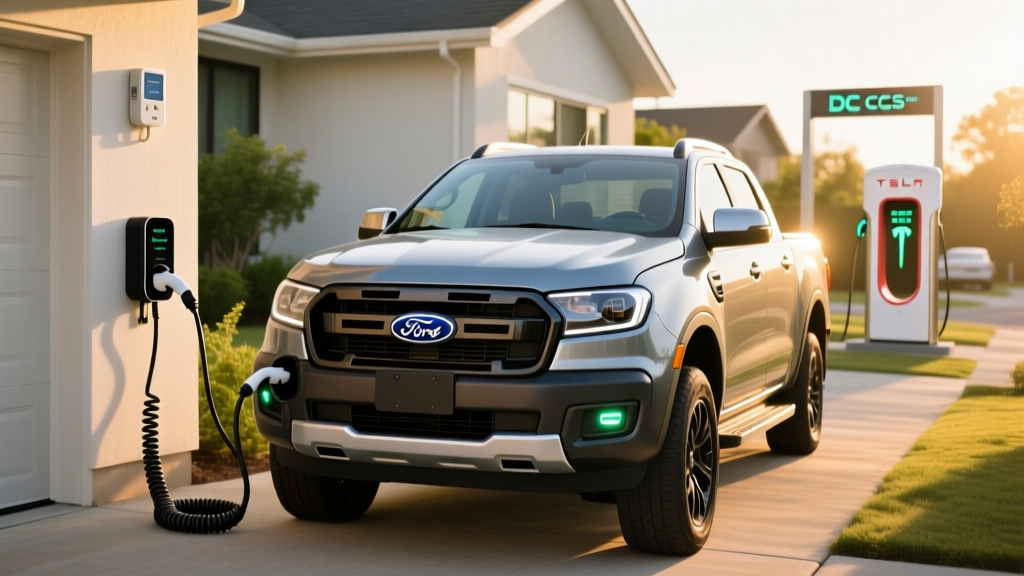
The upcoming Ford Ranger electric truck promises midsize pickup capability with zero tailpipe emissions — but owning an EV pickup means rethinking how, where, and how much you pay to refuel. Whether you are prepping your garage for a 240-volt Level 2 wallbox before delivery day or mapping out DC fast-charging stops for a highway haul, this guide covers the exact numbers you need.
Important context: As of early 2026, Ford has announced plans to produce a next-generation Ranger EV, but final battery capacity, range, and pricing remain preliminary. This guide uses estimated specifications based on Ford's current EV platform data, the F-150 Lightning architecture, and industry reporting. We will update this page when official specs are released. The charging principles, equipment recommendations, and cost frameworks below apply to any midsize electric truck in this class.
Charging Levels Explained: How Fast Will the Ranger EV Gain Range?
The single most common EV confusion is between kW (kilowatts — the rate of power delivery, like water pressure) and kWh (kilowatt-hours — the total energy stored in the battery, like gallons in a tank). A charger rated at 11.5 kW delivers energy at that rate; a 90 kWh battery stores 90 kWh total. Keep this distinction in mind throughout this guide.
| Level | Voltage / Amperage | Power (kW) | Miles of Range Added per Hour | Best For |
|---|---|---|---|---|
| Level 1 (Standard Outlet) | 120V / 12A | ~1.4 kW | ~3–5 mi/hr | Emergency top-ups, overnight trickle |
| Level 2 (Home / Workplace) | 240V / 40–48A | 9.6–11.5 kW | ~25–32 mi/hr | Daily home charging, full overnight refill |
| DC Fast Charging (Public) | 400–800V DC | 50–150+ kW (peak) | ~150–250+ mi in 20 min | Road trips, rapid top-ups away from home |
Home Charger Installation: Electrical Requirements and Costs
Most Ranger EV owners will want a Level 2 home charger. This requires a dedicated 240-volt circuit — the same type of outlet your electric dryer uses — and typically a licensed electrician to install.
Electrical Panel and Circuit Requirements
- Circuit: A dedicated 50-amp breaker (for a 40A continuous charger) or 60-amp breaker (for a 48A charger). National Electrical Code requires the continuous load to be 80% of the breaker rating.
- Wire: 6 AWG copper for 50A circuits; 4 AWG for 60A. Longer wire runs may require thicker gauge to prevent voltage drop.
- Panel capacity: Your main service panel must have enough spare amperage. A 200-amp panel is standard for modern homes; older homes with 100-amp panels will likely need a panel upgrade ($1,500–$3,000+) before adding a 50A EV circuit.
- Permit: Most jurisdictions require an electrical permit ($50–$200) and a post-installation inspection.
Installation Cost Breakdown
| Item | Cost Range | Notes |
|---|---|---|
| Level 2 Charger (Equipment) | $400–$750 | Hardwired or NEMA 14-50 plug; 40A–48A |
| Electrician Labor | $500–$1,500 | Depends on wire run length, wall type, conduit |
| Materials (Wire, Conduit, Breaker) | $100–$400 | Longer runs and outdoor installs cost more |
| Electrical Permit | $50–$200 | Varies by municipality |
| Panel Upgrade (If Needed) | $1,500–$3,500 | Required for older 100A panels or no spare slots |
| Total (No Panel Upgrade) | $1,050–$2,850 | Typical for modern homes with 200A service |
| Total (With Panel Upgrade) | $2,550–$6,350 | Older homes or high-load panels |
Connector Compatibility: NACS, CCS, and the Adapter Question
Ford has committed to adopting the North American Charging Standard (NACS) — the Tesla-designed connector — across its EV lineup. For the Ranger electric truck, this matters significantly for charging access.
| Connector | Type | Used By | Notes for Ranger EV Owner |
|---|---|---|---|
| NACS (J3400) | AC + DC combo | Tesla, Ford (2025+), GM, Rivian, others | Native on Ranger EV; access to Tesla Supercharger network directly |
| CCS1 | AC + DC combo | Legacy Ford, VW, Hyundai, BMW | May need NACS-to-CCS adapter for older Electrify America / EVgo stations |
| CHAdeMO | DC only | Nissan Leaf (legacy) | Phasing out; unlikely to affect Ranger EV owners |
| J1772 | AC only (Level 1/2) | All non-Tesla EVs (legacy) | Home Level 2 chargers with J1772 plugs need a J1772-to-NACS adapter (usually included) |
What this means practically: If the Ranger EV ships with a native NACS port, you can plug directly into any Tesla Supercharger (V3 at 150 kW, V4 at up to 350 kW) without an adapter. For public CCS-based networks like Electrify America, you may need a NACS-to-CCS adapter (~$150–$250) until those networks retrofit their cables. Most home Level 2 chargers currently ship with a J1772 connector, so a J1772-to-NACS adapter (often included with the vehicle) handles home charging.
Recommended Home Level 2 Chargers for the Ranger EV
For a midsize electric truck with an estimated 85–95 kWh battery, you want a Level 2 charger that can fully replenish the pack overnight — roughly 8–10 hours from near-empty. Here are three proven options:
ChargePoint Home Flex
- Power Output: Up to 12 kW (50A) / configurable down to 16A
- Connector: J1772 (NACS adapter needed or included with truck)
- Cable Length: 23 feet
- Smart Features: Wi-Fi, app scheduling, utility integration, Alexa
- Price: ~$550–$650
- Best For: Flexibility — adjustable amperage matches your panel capacity
Emporia Level 2 EV Charger
- Power Output: Up to 11.5 kW (48A)
- Connector: J1772 (NACS adapter needed)
- Cable Length: 24 feet
- Smart Features: Wi-Fi, app control, solar integration, energy monitoring
- Price: ~$400–$450
- Best For: Budget-conscious buyers who want smart features and energy tracking
Tesla Wall Connector (NACS Native)
- Power Output: Up to 11.5 kW (48A)
- Connector: NACS (native — no adapter needed for Ranger EV)
- Cable Length: 24 feet
- Smart Features: Wi-Fi, OTA updates, power sharing between units
- Price: ~$425–$475
- Best For: NACS-native vehicles; cleanest plug-and-charge experience
All three units are UL-listed, rated for indoor or outdoor installation (NEMA 4 outdoor rating), and compatible with hardwired or NEMA 14-50 plug installation. Hardwired is preferred for 48A units, as NEMA 14-50 outlets are typically rated for 40A continuous use.
Charging Cost: Electricity vs Gasoline per Mile
One of the strongest arguments for the Ranger EV over a gasoline Ranger is fuel cost. Here is how the math works using national averages as of early 2026.
| Scenario | Rate | Cost per Mile (Ranger EV est. 2.5 mi/kWh) | Cost per Mile (Gas Ranger est. 22 MPG combined) |
|---|---|---|---|
| Home Off-Peak Charging | $0.09/kWh | $0.036 | — |
| Home Average Rate | $0.16/kWh (US avg) | $0.064 | — |
| Public Level 2 | $0.30/kWh | $0.12 | — |
| DC Fast Charging | $0.45/kWh | $0.18 | — |
| Gasoline (Regular) | $3.40/gallon | — | $0.155 |
| Gasoline (Premium) | $3.90/gallon | — | $0.177 |
The takeaway: Home-charging the Ranger EV at average residential rates costs roughly $0.06/mile — about 60% less than the gasoline Ranger at $0.155/mile. Over 15,000 miles/year, that is approximately $1,425 in annual savings. Even DC fast charging at $0.45/kWh is only slightly more expensive than gas per mile, and you would rarely rely solely on DC fast charging.
Safety, Code, and Installation Best Practices
EV charging draws sustained high current for hours — unlike a dryer that cycles on and off. This makes proper installation non-negotiable.
- Dedicated circuit: Your Level 2 charger must be on its own dedicated breaker. Sharing the circuit with other appliances is a code violation and a fire hazard.
- GFCI protection: NEC 2023 and later editions require GFCI (Ground Fault Circuit Interrupter) protection for EV charging outlets in garages. Hardwired chargers may not require a GFCI breaker depending on local code — your electrician will confirm.
- Outdoor rating: If your charger is installed outside (carport, driveway wall), ensure the unit carries a NEMA 4 or NEMA 4X rating for weather resistance. All three chargers recommended above meet this standard.
- Cable management: A 23–24 foot cable draped across a garage floor is a tripping hazard. Consider a cable organizer or retractable reel, especially if you park in a shared space.
- Surge protection: A whole-panel surge protective device (SPD, ~$150–$300 installed) protects your charger and vehicle from lightning-induced voltage spikes. Highly recommended in storm-prone regions.
- Utility incentives: Many utilities offer rebates of $250–$500 for installing a qualified Level 2 charger, and some provide free or discounted TOU rate enrollment. Check with your local utility before purchasing equipment.
Charging the Ranger EV on Road Trips: Public Network Strategy
For towing or long-distance travel, DC fast charging is your lifeline. Here is how to plan around the Ranger EV's estimated charging capabilities:
- Estimated peak DC charge rate: 150 kW (based on Ford's current 400V architecture; future 800V platforms could push this higher)
- 10–80% session time (estimated): 35–45 minutes on a 150 kW charger
- Network access: Native NACS means direct access to 20,000+ Tesla Superchargers. For Electrify America, EVgo, and ChargePoint DC stations, a NACS-to-CCS adapter may be needed until cable retrofits are complete.
- Towing range reduction: Expect 30–50% range loss when towing near max capacity. A Ranger EV with an estimated 250–300 miles of EPA range may deliver only 150–200 miles while towing a 4,000-lb trailer. Plan charging stops accordingly — every 100–120 miles under heavy tow.
- Preconditioning: Use your truck's navigation to route to a DC fast charger. Most EV platforms automatically warm the battery when a charger is set as the destination, enabling faster charge rates upon arrival. In cold weather, this can cut 10–80% time by 10–15 minutes.
For trip planning, apps like A Better Routeplanner (ABRP) and PlugShare let you input your vehicle model, cargo load, and weather conditions to generate realistic charging-stop itineraries.
Frequently Asked Questions
How much does it cost to install a home EV charger for the Ford Ranger electric truck?
Expect $1,050–$2,850 for a typical installation in a modern home with a 200-amp panel and short wire runs. This includes the charger ($400–$750), electrician labor ($500–$1,500), materials ($100–$400), and permit ($50–$200). Homes needing a panel upgrade should budget $2,550–$6,350 total.
How fast will each charging level add range to the Ranger EV?
Level 1 (120V) adds roughly 3–5 miles per hour — essentially a trickle. Level 2 (240V, 48A) adds approximately 25–32 miles per hour, fully recharging a ~90 kWh battery in 8–10 hours. DC fast charging at 150 kW can add 150–200 miles in a 20–30 minute session, tapering above 80% SoC.
Which connector does the Ford Ranger electric truck use?
Ford has adopted NACS (J3400) for its EV lineup. The Ranger EV is expected to ship with a native NACS charge port, giving it direct access to Tesla Superchargers. For CCS-equipped public chargers, a NACS-to-CCS adapter (~$150–$250) may be needed. Most home Level 2 chargers ship with J1772 connectors; a J1772-to-NACS adapter (often included with the vehicle) handles this.
How much does charging the Ranger EV cost per mile compared to gas?
At the US average residential electricity rate of $0.16/kWh, the Ranger EV costs approximately $0.064 per mile. A gasoline Ranger at 22 MPG combined and $3.40/gallon costs about $0.155 per mile. Home charging saves roughly $1,425 per year at 15,000 miles driven annually.
What electrical upgrades might I need before installing a Level 2 charger?
The most common upgrade is a panel upgrade from 100-amp to 200-amp service ($1,500–$3,500) if your panel lacks spare capacity. You will also need a dedicated 50A or 60A breaker with two adjacent open slots. Older homes may need new wiring from the panel to the garage. A licensed electrician can perform a load calculation to determine your exact requirements.
Can I use a standard household outlet to charge the Ranger EV?
Yes, but only for emergencies or very low daily mileage. A standard 120V outlet (Level 1) delivers about 1.4 kW, adding 3–5 miles of range per hour. Recharging a ~90 kWh battery from 10% to full would take over 60 hours. Level 1 is practical only if you drive fewer than 30–40 miles per day and can leave the truck plugged in for 10+ hours.
Sources: EPA Fuel Economy, IRS Clean Vehicle Credits, Alternative Fuels Data Center