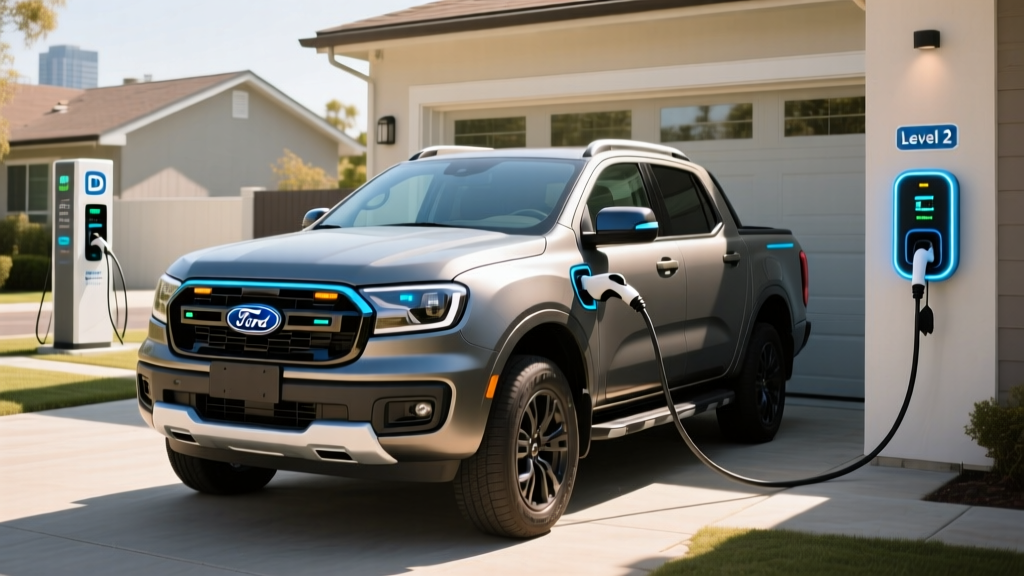
The upcoming Ford Ranger Electric pickup promises midsize-truck utility with zero tailpipe emissions — but owning one hinges on a solid charging plan. Whether you're wiring a Level 2 station in your garage or mapping DC fast-charger stops on a road trip, understanding the power requirements, connector standards, and real costs will save you time, money, and frustration once the Ranger Electric reaches dealers.
Below, we break down every layer of charging for a midsize electric pickup with an estimated 75–90 kWh usable battery (based on Ford's current BEV platform architecture), including exact install requirements, hardware picks, and the math behind cost-per-mile versus a gas Ranger.
Charging Levels Explained: How Fast Will the Ford Ranger Electric Gain Range?
Electric vehicle charging operates at three tiers, each defined by its power delivery in kW (kilowatts — the rate of energy flow). The battery itself stores energy in kWh (kilowatt-hours). Think of kW as the speed of the hose and kWh as the size of the bucket. Here's what each level delivers for a midsize electric truck:
| Level | Voltage / Amps | Power (kW) | Miles of Range Added Per Hour | Best Use Case |
|---|---|---|---|---|
| Level 1 | 120V / 12A | ~1.4 kW | ~3–5 mi/hr | Emergency top-ups, overnight trickle |
| Level 2 (Home) | 240V / 32–48A | 7.7–11.5 kW | ~22–35 mi/hr | Daily overnight charging |
| DC Fast Charge | 400–800V DC | 150–200+ kW (peak) | ~180–280 mi/hr (10–80%) | Road trips, quick stops |
Real-world context: A Level 1 outlet adds roughly 4 miles of range per hour — that's about 48 miles over a 12-hour night, which may cover a short commute but won't replenish a depleted truck battery in any practical timeframe. For a midsize electric pickup, Level 2 home charging is the minimum viable daily setup.
On a DC fast charger, expect the peak rate (e.g., 180 kW) to hold roughly from 10–50% State of Charge, then taper progressively. A 10–80% session on a 180 kW-capable truck should take approximately 28–35 minutes at a properly maintained station. Above 80%, charging slows dramatically to protect battery chemistry — plan your stops around the 80% mark for optimal time efficiency.
Home Charger Installation: Electrical Requirements, Costs & Panel Considerations
Installing a Level 2 home charger for the Ford Ranger Electric is the single most impactful ownership decision you'll make. Most daily charging will happen here, and a properly sized unit means waking up to a full battery every morning.
Electrical Requirements
A Level 2 charger requires a dedicated 240-volt circuit, similar to what powers an electric dryer or oven. For optimal charging speed on a midsize truck battery, target a 48-amp circuit (delivering up to 11.5 kW continuous), which requires a 60-amp breaker per National Electrical Code (NEC) continuous-load derating rules (125% of the rated draw).
- Minimum viable: 240V / 32A circuit (40A breaker) → 7.7 kW → ~23 mi/hr
- Recommended: 240V / 48A circuit (60A breaker) → 11.5 kW → ~33 mi/hr
- Connector: Hardwired (preferred for 48A+) or NEMA 14-50 outlet (max 40A / 9.6 kW)
Do You Need a Panel Upgrade?
Homes built before 2000 often have 100-amp or 150-amp main electrical panels. Adding a 60-amp EV circuit may push your total calculated load beyond the panel's capacity, especially if you already run electric heat, a dryer, and an oven. A licensed electrician will perform a load calculation (NEC Article 220) to determine if your panel has headroom.
If you need a panel upgrade from 100A to 200A, budget $1,500–$3,500 for that work alone, on top of the charger circuit installation. Homes with 200A panels and gas appliances usually have ample capacity for a 48A EV circuit without an upgrade.
Installation Cost Breakdown
| Component | Cost Range | Notes |
|---|---|---|
| Level 2 Charger (Equipment) | $400–$750 | 40A–48A smart charger, NACS or J1772 |
| Electrical Permit | $50–$250 | Varies by municipality |
| Electrician Labor (standard install) | $500–$1,500 | Panel to garage, <30 ft run, conduit |
| Panel Upgrade (if needed) | $1,500–$3,500 | 100A → 200A service upgrade |
| NEMA 14-50 Outlet (alternative) | $200–$600 | Outlet only; charger not included |
| Total (no panel upgrade) | $950–$2,500 | Most homes with 200A service |
| Total (with panel upgrade) | $2,450–$6,000 | Older homes with 100A service |
Pro tip: The federal Alternative Fuel Vehicle Refueling Property Credit (IRS Form 8911) may cover up to 30% of home charger equipment and installation costs (capped at $1,000) if you live in an eligible census tract. Check the current-year IRS guidance, as qualifying-tract maps update periodically.
Connector Compatibility: NACS, CCS, and the Ford Charging Network
Ford has transitioned its North American EV lineup to the NACS (North American Charging Standard) connector, originally developed by Tesla. The Ranger Electric is expected to ship with a native NACS charge port, giving it direct access to the Tesla Supercharger network — the largest and most reliable DC fast-charging network in the U.S.
| Connector | Standard | DC Fast Charge? | Ford Ranger Electric | Notes |
|---|---|---|---|---|
| NACS | Tesla / SAE J3400 | Yes (up to 350 kW) | ✅ Native (expected) | Direct Supercharger access |
| CCS1 | SAE J1772 Combo | Yes (up to 350 kW) | ⚠️ Adapter required | For Electrify America, EVgo, etc. |
| CHAdeMO | Legacy Japanese | Yes (up to 100 kW) | ❌ Not compatible | Being phased out in North America |
| J1772 | Level 2 AC | No (AC only) | ⚠️ Adapter required | For non-Tesla Level 2 stations |
What this means practically: With a native NACS port, the Ranger Electric can pull up to any of the 25,000+ Tesla Superchargers in North America without an adapter. For Electrify America, EVgo, or ChargePoint DC fast stations (which use CCS1), Ford provides or sells a NACS-to-CCS adapter. Keep one in the truck at all times for non-Tesla network access.
For Level 2 public charging at destinations (malls, workplaces, hotels), many stations still use the J1772 connector. A compact NACS-to-J1772 adapter (approximately $100–$180) ensures you can top up anywhere.
Charging Cost: Per-Mile Math vs. the Gas Ranger
The financial case for the Ford Ranger Electric depends heavily on where and when you charge. Electricity prices vary enormously by region and time of use, but home charging almost always beats gasoline on a per-mile basis.
| Scenario | $/kWh | Cost for Full Charge (est.) | Cost Per Mile |
|---|---|---|---|
| Home (off-peak / time-of-use rate) | $0.09–$0.14 | $7.65–$11.90 | $0.03–$0.04 |
| Home (standard residential avg.) | $0.16–$0.20 | $13.60–$17.00 | $0.05–$0.06 |
| Public Level 2 (workplace / destination) | $0.20–$0.35 | $17.00–$29.75 | $0.06–$0.11 |
| DC Fast Charge (Supercharger avg.) | $0.28–$0.42 | $23.80–$35.70 | $0.09–$0.13 |
| DC Fast Charge (peak urban / EA) | $0.48–$0.64 | $40.80–$54.40 | $0.15–$0.20 |
Gas comparison: A 2025 gas Ford Ranger 4x4 averages roughly 22 MPG combined per fueleconomy.gov. At $3.40/gallon, that's approximately $0.15 per mile. Even at standard residential electricity rates, home-charging the Ranger Electric costs roughly one-third what you'd spend on gas. The savings widen with off-peak utility rates and solar.
However, if you rely primarily on DC fast charging at peak-rate urban stations, your per-mile cost can approach or even exceed gasoline. This is why home charging access remains the linchpin of EV truck economics.
Recommended Home Chargers for the Ford Ranger Electric
We evaluated Level 2 chargers based on power output, cable length, smart features, connector type, build quality, and price. Here are our top picks for a midsize electric truck with a large battery:
Best Overall: Tesla Wall Connector (NACS)
- Power: Up to 11.5 kW (48A / 240V)
- Connector: Native NACS — no adapter needed
- Cable: 24 ft
- Smart features: Wi-Fi, OTA updates, load sharing, power scheduling
- Price: ~$475
- Why: Native NACS means plug-and-go with the Ranger Electric. Load-sharing lets you daisy-chain two units on one circuit.
Best Universal: ChargePoint Home Flex
- Power: Up to 12 kW (50A / 240V, configurable)
- Connector: J1772 (NACS adapter needed) or NACS version
- Cable: 23 ft
- Smart features: App scheduling, energy tracking, Alexa, load management
- Price: ~$550–$700
- Why: Flexible amperage settings let you match your circuit exactly. Strong app and utility-integration support.
Best Budget: Emporia Vue 2 Level 2
- Power: Up to 11.5 kW (48A / 240V)
- Connector: J1772 (NACS adapter needed)
- Cable: 24 ft
- Smart features: App control, scheduling, energy monitoring
- Price: ~$399
- Why: Solid 48A output at a sub-$400 price. Great for budget-conscious installs.
Best for Cold Climates: Grizzl-E Smart
- Power: Up to 10 kW (40A / 240V)
- Connector: J1772 or NACS (select at purchase)
- Cable: 24 ft (cold-rated flexible)
- Smart features: OCPP, app, scheduling
- Price: ~$449–$549
- Why: Built and tested in Canada for -40°F operation. Cable stays pliable in freezing weather.
Safety, Code & Installation Best Practices
EV charging involves sustained high-current draw over many hours — more like running a kiln than plugging in a lamp. Cutting corners on installation risks fire, equipment damage, or insurance claim denial.
- Dedicated circuit: Your Level 2 charger must have its own dedicated breaker — never share a circuit with other appliances.
- GFCI protection: NEC 2020+ requires GFCI (Ground Fault Circuit Interrupter) protection for all EV charging outlets. Hardwired chargers with built-in ground-fault detection may exempt you from a GFCI breaker (which can nuisance-trip on EV loads). Consult your electrician.
- Outdoor rating: If your charger mounts outside, it must carry a NEMA 4 (weatherproof) rating. All the chargers above meet this standard.
- Permit & inspection: Most jurisdictions require an electrical permit for new 240V circuits. The inspection ensures the wire gauge, breaker size, conduit, and grounding meet code. Skipping the permit can void your homeowner's insurance coverage for electrical fires.
- Wire gauge: A 60A breaker / 48A continuous load typically requires 6 AWG copper (THHN in conduit) or 4 AWG aluminum (SER cable). Your electrician will size this based on run length and local code.
Public Charging & Road-Trip Strategy for the Ranger Electric
With a native NACS port, the Ford Ranger Electric gains direct access to Tesla Superchargers — over 25,000 stalls across North America, many now upgraded to V4 architecture capable of 250+ kW. For a midsize truck battery, expect 10–80% sessions in roughly 28–35 minutes at V3/V4 Superchargers.
For non-Tesla DC networks like Electrify America or EVgo, you'll need the NACS-to-CCS adapter. These networks have improved reliability significantly since 2024, but Tesla's uptime record still leads. When planning road trips:
- Precondition the battery: Navigate to a charger using the truck's built-in routing, which warms the battery pack for optimal charge acceptance. Skipping preconditioning in cold weather can cut your peak charge rate by 30–50%.
- Target 80%, not 100%: The charge curve tapers sharply above 80%. That last 20% can take as long as the first 70%. Plan stops around the 10–80% window for fastest travel.
- Use PlugShare or A Better Routeplanner: Cross-reference real-time charger status before committing to a stop. Dead stalls still happen on non-Tesla networks.
Frequently Asked Questions
How much does it cost to install a home EV charger for the Ford Ranger Electric?
Expect $950–$2,500 for a standard installation (equipment, permit, and electrician labor) if your home has a 200-amp panel with available capacity. Older homes needing a panel upgrade should budget $2,450–$6,000 total. Always get at least two quotes from licensed electricians and verify they have EV charger installation experience.
How fast will each charging level add range to the Ranger Electric?
Level 1 (120V) adds roughly 3–5 miles per hour — impractical for daily truck use. Level 2 (240V, 48A) adds approximately 30–35 miles per hour, fully replenishing a depleted battery overnight. DC fast charging at 150–200 kW can add 180+ miles in a 30-minute session (10–80%).
Which connector does the Ford Ranger Electric use?
The Ranger Electric is expected to use a native NACS (Tesla-style) charge port. This gives direct access to Tesla Superchargers. For CCS-based networks (Electrify America, EVgo), a NACS-to-CCS adapter is required. For J1772 Level 2 public stations, a NACS-to-J1772 adapter is needed.
How much does charging the Ranger Electric cost per mile vs. a gas Ranger?
Home charging at average residential rates ($0.16/kWh) costs approximately $0.05–$0.06 per mile. A gas Ranger at 22 MPG and $3.40/gallon costs about $0.15 per mile. Home charging saves roughly 60–65% per mile. Public DC fast charging at peak rates ($0.48+/kWh) narrows or eliminates that advantage.
What electrical upgrades might I need for a home charger?
If your home has a 200-amp panel with gas appliances, you likely need no upgrade — just a new 60-amp breaker and dedicated circuit. Homes with 100-amp panels, all-electric appliances, or long wire runs from the panel to the garage may need a panel upgrade ($1,500–$3,500), a sub-panel, or heavier-gauge wiring. A licensed electrician's load calculation is the definitive answer.
Sources: fueleconomy.gov (EPA efficiency data), IRS.gov (refueling property credit), Ford Motor Company press releases (Ranger Electric announcement).