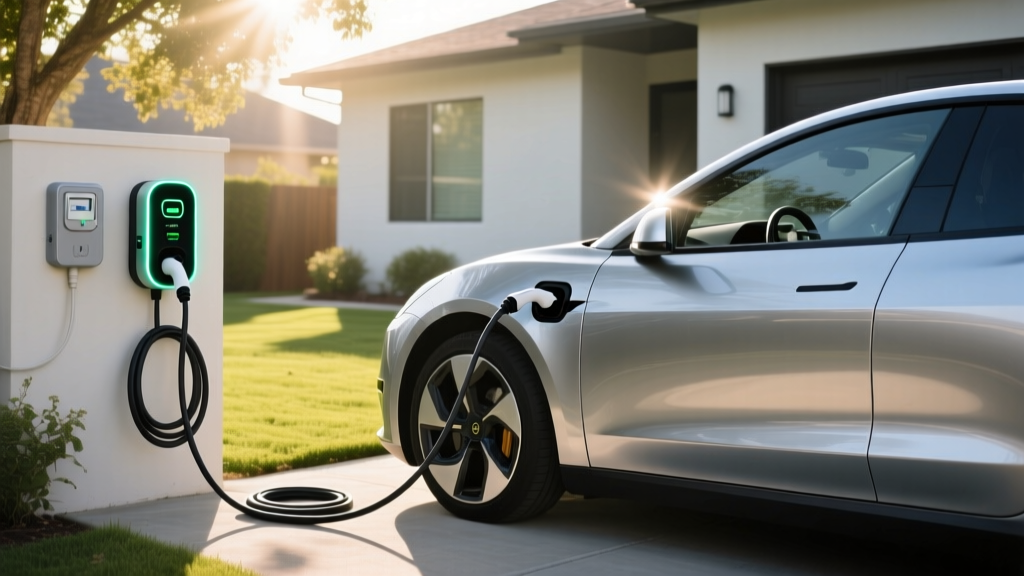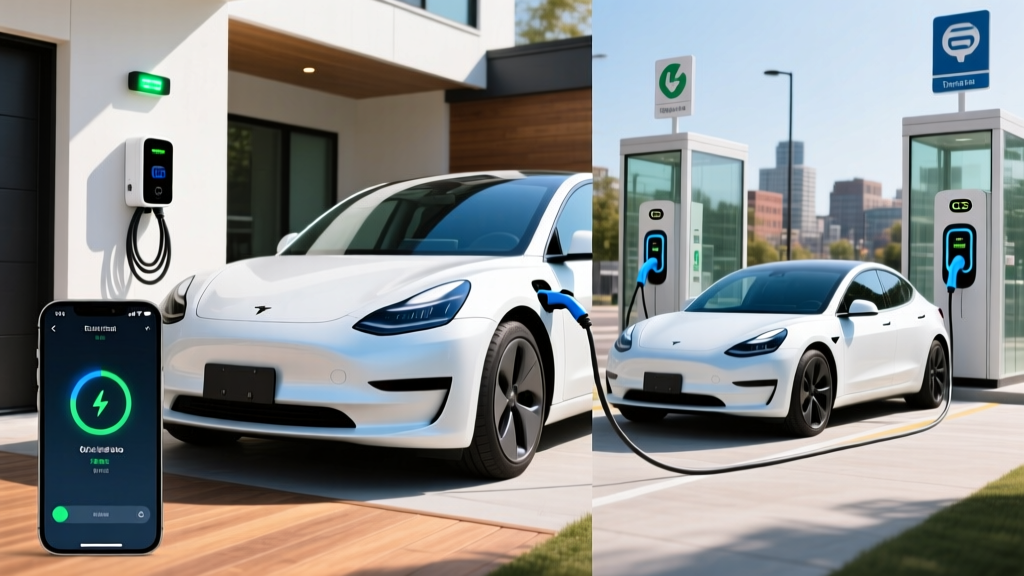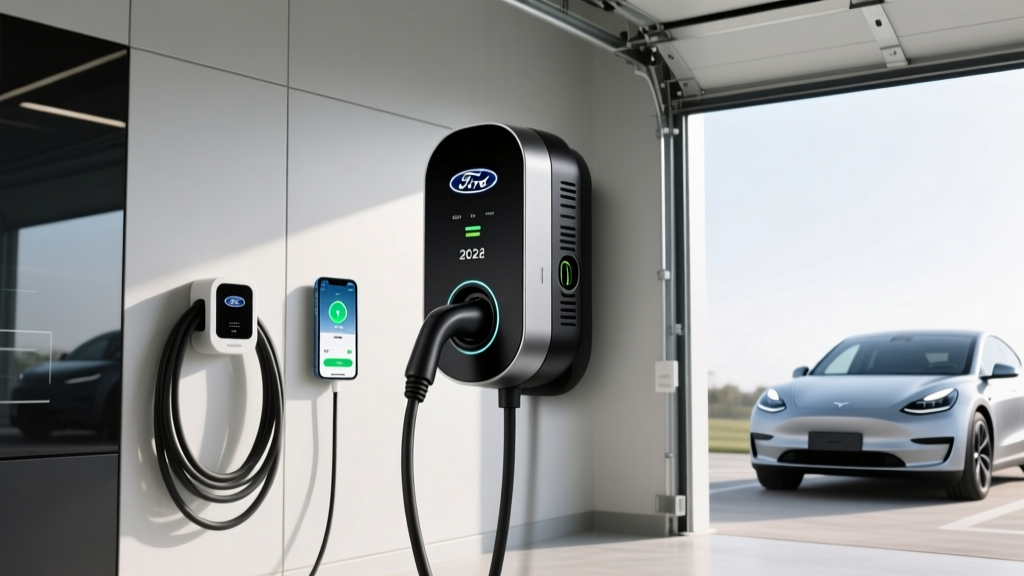
If you own a Ford F-150 Lightning, Mustang Mach-E, or E-Transit — or plan to by 2026 — the Ford Pro Charger (officially the Ford Connected Charge Station or Ford Power-Up Charger lineup) is the OEM-branded Level 2 wall unit designed to maximize home charging speed on Ford's electric platform. But is it the right charger for your garage, your electrical panel, and your budget? This guide breaks down the Ford Pro Charger's real-world output, installation requirements, connector compatibility, and how it stacks up against third-party alternatives like ChargePoint, Emporia, and Wallbox.
What Is the Ford Pro Charger? Platform Overview
Ford offers two primary home charging units under its "Pro" and consumer branding:
- Ford Connected Charge Station (80A circuit / 48A continuous output): The flagship hardwired wallbox bundled with early F-150 Lightning reservations and available through Ford dealers. Delivers up to 11.5 kW on a 240V/48A continuous draw.
- Ford Mobile Power Cord (30A / 24A continuous): A portable dual-voltage cord (120V Level 1 or 240V NEMA 14-50 plug) included with most Ford EVs. Outputs up to ~5.8 kW on a 240V outlet.
For commercial fleet operators, the Ford Pro Charging ecosystem adds networked depot chargers (up to 180 kW DC) and telematics-integrated AC units managed through the Ford Pro software platform. This article focuses on the residential and light-commercial AC units most buyers will encounter.
| Specification | Ford Connected Charge Station | Ford Mobile Power Cord |
|---|---|---|
| Max Circuit Rating | 80A dedicated | 30A (NEMA 14-50) / 15A (120V) |
| Continuous Output | 48A (11.5 kW) | 24A (5.8 kW) / 12A (1.4 kW) |
| Voltage | 240V hardwired | 240V or 120V (plug-in) |
| Connector | NACS (Tesla-style, 2025+ models) / J1772 (pre-2025) | J1772 with NACS adapter available |
| Cable Length | 25 ft | 20 ft |
| Smart Features | Wi-Fi, FordPass scheduling, OTA updates | Basic indicator lights |
| Approx. Price | $599–$799 (often bundled) | Included with vehicle; $399 replacement |
| Warranty | 3 years | 3 years |
Charging Levels Explained: Speeds in kW and Miles Per Hour
Before evaluating the Ford Pro Charger specifically, it's critical to understand the three EV charging tiers and what they mean for your daily routine. Power is measured in kW (kilowatts) — the rate of energy flow — while battery capacity is measured in kWh (kilowatt-hours) — the total energy stored. Confusing these two is the single most common mistake new EV owners make.
| Level | Voltage | Power (kW) | Miles of Range Added Per Hour | Typical Use |
|---|---|---|---|---|
| Level 1 | 120V AC | 1.2–1.4 kW | 3–5 mi/hr | Overnight trickle; PHEV top-ups |
| Level 2 (Portable) | 240V AC | 5.8–7.7 kW | 18–28 mi/hr | Garage outlet; moderate daily use |
| Level 2 (Hardwired) | 240V AC | 9.6–19.2 kW | 30–60+ mi/hr | Dedicated home/depot charging |
| DC Fast Charge | 400–800V DC | 50–350 kW | 150–1,000+ mi/hr | Road trips; 10–80% in 15–40 min |
At 48A continuous (11.5 kW), the Ford Connected Charge Station sits at the top of residential Level 2. Here's what that means in practice for popular Ford EVs:
- F-150 Lightning Extended Range (131 kWh usable battery): 0–100% in roughly 11–12 hours. A typical 20–80% daily charge takes ~7 hours.
- F-150 Lightning Standard Range (98 kWh): 0–100% in ~8.5 hours. 20–80% in ~5.5 hours.
- Mustang Mach-E Extended Range (91 kWh usable): 0–100% in ~8 hours. 20–80% in ~5 hours.
- Mustang Mach-E Standard Range (70 kWh): 0–100% in ~6 hours. 20–80% in ~4 hours.
These times assume the vehicle's onboard charger can accept the full 48A. The F-150 Lightning's onboard charger is rated for up to 19.2 kW (80A circuit), so it can fully utilize the 48A station. The Mach-E's onboard charger tops out at 10.5 kW (48A on some model years), meaning it also pairs well.
Home Installation: Electrical Requirements and Costs
The Ford Connected Charge Station requires a dedicated 80-amp, 240-volt circuit, hardwired by a licensed electrician. This is not a plug-in unit — it must be permanently connected to your electrical panel with appropriately sized wiring (typically 2 AWG copper or 1/0 AWG aluminum).
Electrical Panel Capacity
An 80A circuit is a significant load. Per the National Electrical Code (NEC), a circuit can draw up to 80% of its breaker rating continuously — that's why a 48A charger needs an 80A breaker. Your home's electrical panel must have enough spare capacity to support this. Here's the reality:
- 200A panel (modern homes): Usually sufficient if you don't already have heavy loads (electric range, dryer, HVAC, pool equipment). Most electricians can add an 80A breaker without issue.
- 100A panel (older homes): Almost certainly requires a panel upgrade to 200A before installation. This is a major cost driver.
- 150A panel: Borderline — depends on existing loads. An electrician will perform a load calculation per NEC Article 220.
Permitting and Inspection
Most jurisdictions require an electrical permit for a new dedicated circuit, especially at 80A. Permit fees typically range from $50–$250 depending on your municipality. The work must pass inspection before the circuit is energized. Skipping the permit risks voiding your homeowner's insurance if a fire occurs.
Installation Cost Breakdown
| Item | Simple Install (Panel Adjacent) | Moderate Install (50–80 ft Run) | Complex Install (Panel Upgrade + Long Run) |
|---|---|---|---|
| Ford Connected Charge Station (equipment) | $599–$799 | $599–$799 | $599–$799 |
| Electrician labor (2–8 hrs @ $85–$150/hr) | $300–$500 | $600–$1,200 | $1,500–$3,000 |
| Wiring and conduit materials | $100–$200 | $300–$600 | $500–$1,000 |
| Electrical permit | $50–$150 | $50–$200 | $100–$250 |
| Panel upgrade (if needed) | $0 | $0 | $2,000–$4,500 |
| Total estimated range | $1,049–$1,649 | $1,549–$2,799 | $4,699–$9,549 |
If a panel upgrade is needed, budget an additional $2,000–$4,500 for a 200A service upgrade. Some utilities offer rebates for panel upgrades tied to EV adoption — check with your local provider. The IRS §30C alternative fuel vehicle refueling property credit may also cover up to 30% of home charging equipment and installation costs (capped at $1,000) for eligible taxpayers in qualifying census tracts.
Connector Compatibility: NACS, CCS, and the 2026 Landscape
Ford made a pivotal decision in 2023: starting with 2025 model-year vehicles, Ford EVs ship with the NACS (North American Charging Standard) connector — the same plug used by Tesla's Supercharger network. This means:
- 2025–2026 F-150 Lightning, Mustang Mach-E, and E-Transit: Native NACS port. Direct compatibility with Tesla Superchargers (V3 and V4) and Ford Pro Charger units equipped with NACS cables.
- 2021–2024 Ford EVs: Built with CCS1 (Combined Charging System) ports. Require a Ford-approved NACS-to-CCS adapter (provided by Ford to eligible owners) to use Tesla Superchargers or NACS-equipped home chargers.
| Connector Type | 2021–2024 Ford EVs | 2025–2026 Ford EVs | Adapter Needed? |
|---|---|---|---|
| NACS (Tesla-style) | No (requires adapter) | Yes (native) | Ford NACS adapter for 2021–2024 models |
| CCS1 | Yes (native) | No (requires adapter) | Third-party CCS adapter for 2025+ models |
| CHAdeMO | No | No | N/A — largely discontinued in US |
| J1772 (Level 2 AC) | Yes (via J1772-to-NACS adapter or native) | Yes (native J1772 inlet for AC on some; NACS for AC on others) | Check vehicle port — Ford includes adapter |
Key detail for home charging: AC Level 2 charging uses the same physical port as DC fast charging on NACS vehicles. The Ford Connected Charge Station with a NACS cable plugs directly into 2025+ Ford EVs with no adapter needed. For 2021–2024 models with CCS ports, Ford's NACS adapter works for both AC and DC connections.
Cost to Charge: Home vs. Public vs. Gas
One of the strongest arguments for home Level 2 charging — whether with the Ford Pro Charger or any equivalent unit — is the dramatic per-mile cost advantage over gasoline and public DC fast charging.
| Scenario | Rate ($/kWh) | Cost Per Mile | Full 0–100% Charge (131 kWh) |
|---|---|---|---|
| Home off-peak (utility TOU rate) | $0.08–$0.12 | $0.17–$0.25 | $10.48–$15.72 |
| Home standard rate | $0.14–$0.18 | $0.29–$0.38 | $18.34–$23.58 |
| Public Level 2 (ChargePoint, etc.) | $0.25–$0.49 | $0.53–$1.03 | $32.75–$64.19 |
| DC Fast Charge (Electrify America, Tesla) | $0.35–$0.55 | $0.74–$1.16 | $45.85–$72.05 |
| Gas equivalent (F-150 gas, 20 MPG, $3.40/gal) | — | $0.17/mi (hybrid) to $0.34/mi (gas) | $78+ (equivalent energy) |
At off-peak residential rates, charging an F-150 Lightning at home costs roughly $0.17–$0.25 per mile — comparable to or cheaper than a 20 MPG gas F-150 at $3.40/gallon. The savings compound: a driver covering 12,000 miles/year saves $600–$1,800 annually versus gas, depending on local electricity and fuel prices. Source: fueleconomy.gov.
For fleet operators using Ford Pro Charging's managed depot system, commercial electricity rates (typically $0.08–$0.15/kWh) combined with scheduled off-peak charging can push per-mile costs below $0.20 even for E-Transit vans.
Ford Pro Charger vs. Competitors: Equipment Comparison
The Ford Connected Charge Station isn't the only 48A home charger on the market. Here's how it compares to leading alternatives for a buyer outfitting a garage in 2026:
| Feature | Ford Connected Charge Station | ChargePoint Home Flex | Emporia Vue 2 | Wallbox Pulsar Plus |
|---|---|---|---|---|
| Max Output | 48A / 11.5 kW | Up to 50A / 12 kW (configurable) | 48A / 11.5 kW | 48A / 11.5 kW |
| Circuit Required | 80A dedicated | Up to 80A (adjustable down) | 60A or 80A | 60A or 80A |
| Connector | NACS (2025+) or J1772 | NACS or J1772 (configurable) | J1772 (NACS via adapter) | J1772 or NACS |
| Cable Length | 25 ft | 18 ft or 23 ft | 24 ft | 25 ft |
| Smart Features | Wi-Fi, FordPass app, OTA | Wi-Fi, ChargePoint app, Alexa | Wi-Fi, Emporia app, energy monitoring | Wi-Fi, Bluetooth, Wallbox app |
| Load Sharing | No | Yes (with 2nd unit) | Yes (with Emporia panel integration) | Yes (Power Sharing) |
| Approx. Price | $599–$799 | $599–$699 | $499–$599 | $549–$649 |
| Indoor/Outdoor | Both (NEMA 4 rated) | Both (NEMA 4) | Both (NEMA 4) | Both (NEMA 4) |
When the Ford Pro Charger makes the most sense: If you own a Ford EV and want seamless FordPass integration — including scheduled charging that syncs with your vehicle's preconditioning and departure times — the OEM unit offers the tightest software experience. Ford also bundles the unit with some vehicle purchases, effectively making it free.
When a competitor may be better: If you own multiple EV brands, the ChargePoint Home Flex's adjustable amperage (set it to 40A, 32A, or 24A depending on your panel) offers more flexibility without requiring an 80A circuit. The Emporia Vue 2 integrates with whole-home energy monitoring, useful for solar-equipped households managing panel capacity.
Safety, Code, and Best Practices
Any 80A hardwired installation must comply with NEC Article 625 (Electric Vehicle Charging System Equipment) and local amendments. Key requirements and recommendations:
- Dedicated circuit: The charger must be on its own breaker — no sharing with other appliances.
- GFCI protection: NEC 2020 and later require ground-fault circuit interrupter protection for all EV charging outlets and hardwired units in garages. Most modern EVSEs (Electric Vehicle Supply Equipment) include built-in GFCI, but your electrician will verify code compliance.
- Outdoor rating: If mounting outdoors or in an unenclosed carport, the unit must be rated NEMA 4 (weatherproof). The Ford Connected Charge Station carries this rating.
- Wire sizing: 80A circuits require 2 AWG copper or larger. Undersized wiring creates fire risk and will fail inspection.
- Cable management: Use a cord organizer or retractable reel to prevent tripping hazards and cable damage. A 25-foot cable draped across a garage floor is a wear-and-tear liability.
- Ventilation: While Level 2 EVSEs produce minimal heat, enclosed garages should have adequate airflow, especially in hot climates where ambient temperatures can affect charging efficiency.
Never use an extension cord with any EV charger. Never plug a Level 2 charger into a circuit shared with high-draw appliances (dryer, oven, HVAC compressor). And always have the installation inspected — unpermitted work can void insurance coverage and create resale complications.
Frequently Asked Questions
How much does it cost to install a Ford Pro Charger at home?
Total installed cost ranges from roughly $1,050 for a simple install near a 200A panel to $9,500+ if a panel upgrade and long wire run are required. The charger unit itself costs $599–$799, but the 80A dedicated circuit, wiring, permit, and electrician labor make up the bulk of the expense. Get three quotes from licensed electricians and ask specifically about panel load calculations before committing.
How fast will the Ford Connected Charge Station add range?
At 48A continuous (11.5 kW), expect approximately 30–35 miles of range per hour of charging for an F-150 Lightning and 35–40 miles per hour for a Mustang Mach-E. A full overnight charge (10 hours) can replenish 300+ miles — more than enough for virtually any daily driving pattern. This assumes the vehicle's onboard charger can accept the full 11.5 kW.
Is the Ford Pro Charger compatible with non-Ford EVs?
Physically, yes — a NACS-equipped Ford Connected Charge Station will plug into any vehicle with a NACS port (Tesla, Rivian, GM, and others adopting the standard). However, the FordPass smart features (scheduled charging, vehicle status sync) only function with Ford vehicles. If you own mixed-brand EVs, a universal smart charger like the ChargePoint Home Flex may offer better cross-brand app integration.
Do I need a panel upgrade for an 80A charger circuit?
It depends on your existing panel capacity and current electrical loads. Homes with 100A panels almost always need an upgrade to 200A ($2,000–$4,500). Homes with 200A panels usually have enough headroom unless you already run heavy electric loads (dual HVAC, electric range, dryer, pool heater, hot tub). A licensed electrician will perform a NEC Article 220 load calculation to determine if your panel can handle the additional 80A breaker.
Can I use a lower-amperage charger on an 80A circuit?
Yes — and this is often smart if you want future flexibility. You can install an 80A circuit and wire it to a charger configured for 40A or 48A draw. This leaves headroom for a second charger or an upgrade later without re-running wire. Conversely, the ChargePoint Home Flex allows you to set the amperage via DIP switches, so the same unit works on 40A, 50A, or 60A circuits.
How does the Ford Pro Charger handle power outages and Wi-Fi loss?
The charger defaults to immediate charging when plugged in if Wi-Fi is unavailable — you won't be stranded because your router rebooted. Scheduled charging and FordPass features require connectivity, but basic charging is always available. After a power outage, the unit resumes its last-configured state automatically.
Is there a federal tax credit for installing a home EV charger?
Yes. The IRS §30C Alternative Fuel Vehicle Refueling Property Credit covers 30% of the cost of home charging equipment and installation, up to a maximum credit of $1,000. However, eligibility depends on your property being located in a qualifying census tract (generally non-urban or low-income areas). Consult a tax professional and verify current-year rules on irs.gov before assuming eligibility.
The Ford Pro Charger (Connected Charge Station) is a well-built, high-output Level 2 unit that makes particular sense for Ford EV owners who value OEM software integration and can accommodate an 80A circuit. For buyers with panel constraints or multi-brand garages, third-party 48A chargers offer comparable speed with more installation flexibility. Either way, the math strongly favors home Level 2 charging: at off-peak utility rates, you'll fuel your F-150 Lightning or Mach-E for roughly $0.17–$0.25 per mile — a fraction of what gas costs, and dramatically cheaper than relying on public DC fast charging networks.