Ford's Power Promise program has reshaped how new EV buyers think about home charging by bundling a complimentary Level 2 charge station with eligible vehicle purchases. But "free charger" doesn't mean "free installation." Whether you're plugging in a 2025 F-150 Lightning, Mustang Mach-E, or E-Transit, getting that Ford Power Promise home charger mounted on your garage wall requires understanding electrical capacity, circuit requirements, and real installation costs that can range from a simple $400 outlet job to a $3,000+ panel upgrade.
This guide breaks down exactly what the Ford Power Promise includes, the electrical infrastructure your home needs to support Level 2 charging, connector compatibility across the Ford EV lineup, and what you'll actually pay per mile compared to gas. We'll also cover the third-party chargers worth considering if you want to go beyond the included hardware.
What the Ford Power Promise Actually Includes
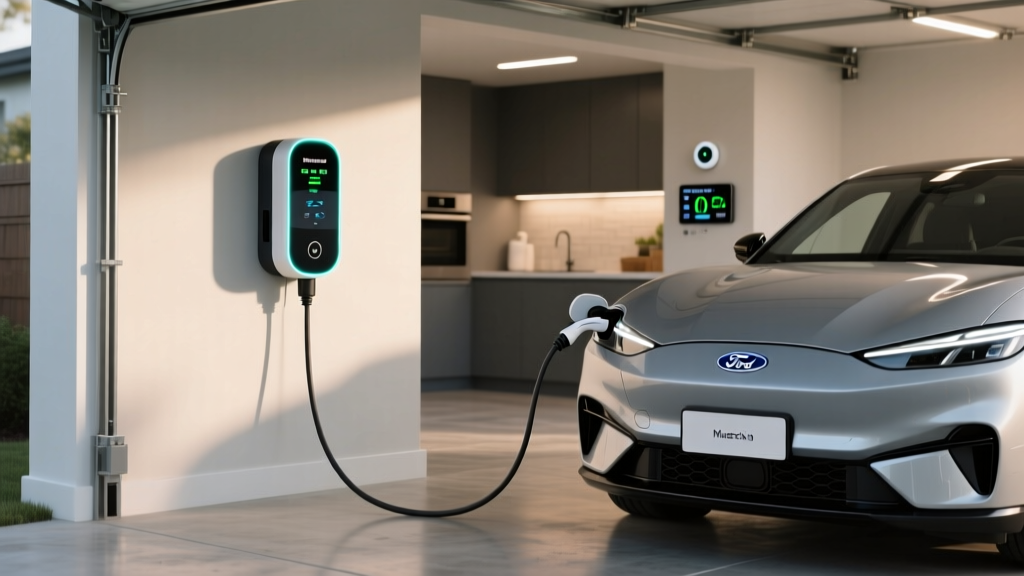
Ford's Power Promise, introduced alongside the expanded F-150 Lightning and Mach-E lineup, provides eligible buyers with a Ford Charge Station Pro (an 80-amp hardwired Level 2 unit capable of up to 19.2 kW output on a 100-amp circuit) or the Ford Mobile Power Cord (a dual-voltage portable unit delivering up to 32 amps / 7.7 kW on a 240V NEMA 14-50 outlet). The specific hardware depends on the vehicle trim, model year, and current promotional terms.
The critical distinction: Ford supplies the equipment. The installation — electrical work, permits, potential panel upgrades — falls to the owner. Ford partners with licensed installer networks (including Sunrun for solar-integrated setups) to streamline quotes, but you're ultimately paying a licensed electrician for the labor and materials beyond the charger itself.
Charging Levels Explained: Speeds in kW and Miles Per Hour
Understanding the difference between kW (kilowatts — power, the rate of energy delivery) and kWh (kilowatt-hours — energy, the battery's total capacity) is essential. Think of kW as the width of a hose and kWh as the size of the bucket. A wider hose (higher kW) fills the bucket (kWh battery) faster.
| Level | Voltage / Amps | Max Power (kW) | Miles of Range Per Hour | Best For |
|---|---|---|---|---|
| Level 1 | 120V / 12A | 1.4 kW | 3-5 mi/hr | Overnight top-ups, PHEVs, low-mileage drivers |
| Level 2 (standard) | 240V / 32-48A | 7.7-11.5 kW | 20-35 mi/hr | Daily home charging, most EVs |
| Level 2 (high-power) | 240V / 80A | 19.2 kW | 30-45 mi/hr | Large batteries (Lightning, E-Transit) |
| DC Fast | 400-800V DC | 50-350 kW | 150-500+ mi/hr (burst) | Road trips, quick top-ups (not for daily use) |
For context, a 2025 F-150 Lightning Extended Range with its 131 kWh usable battery needs roughly 105 kWh to go from 20% to 100%. On a 19.2 kW Ford Charge Station Pro, that takes about 5.5 hours (accounting for taper above 85%). On a 7.7 kW Mobile Power Cord, the same session stretches to nearly 14 hours — which is why the hardwired Charge Station Pro is the preferred Power Promise hardware for truck owners.
Home Installation: Electrical Requirements and Costs
The Ford Charge Station Pro requires a dedicated 100-amp, 240-volt circuit with hardwired connection — not a plug-in outlet. This is a substantial electrical load. Most modern homes with 200-amp service panels can accommodate this, but older homes with 100-amp or 150-amp main panels will likely need a panel upgrade, which is the single largest variable in your total cost.
The Ford Mobile Power Cord, by contrast, plugs into a NEMA 14-50 (240V, 50-amp) outlet, which requires a dedicated 50-amp circuit — far more manageable for most homes. However, the 14-50 outlet must be installed by a licensed electrician on a dedicated breaker; sharing the circuit with a dryer or oven is a code violation and a fire hazard.
Installation Cost Breakdown
| Component | Charge Station Pro (80A Hardwired) | Mobile Power Cord (14-50 Outlet) |
|---|---|---|
| Equipment (charger itself) | Included via Power Promise ($0) | Included via Power Promise ($0) |
| Electrician labor (basic run, <50 ft) | $800–$1,500 | $300–$700 |
| Conduit, wiring, breaker | $200–$500 | $100–$250 |
| Permit & inspection | $100–$300 | $50–$150 |
| Panel upgrade (if needed) | $1,500–$3,500 | $1,500–$3,500 |
| Total (no panel upgrade) | $1,100–$2,300 | $450–$1,100 |
| Total (with panel upgrade) | $2,600–$5,800 | $1,950–$4,600 |
These ranges reflect national averages as of early 2026. Urban areas with higher labor rates (California, Northeast) skew toward the upper end; rural and Southeast markets trend lower. Always get at least three quotes from licensed electricians, and confirm they pull permits — unpermitted work can void homeowner's insurance claims and create resale complications.
What Electrical Upgrades Might You Need?
Before scheduling an electrician, check your main service panel. If your home has 200-amp service and available breaker slots, you're likely clear for either charger. If you have 100-amp or 150-amp service, a panel upgrade to 200A (or even 400A for homes adding solar, battery storage, and EV charging) is probable. Signs you'll need an upgrade include: frequent breaker trips, a panel already near capacity with existing large appliances, or a home built before 1990 with original wiring.
Some utilities offer rebates for panel upgrades tied to EV adoption — check your local provider. The federal Residential Clean Energy Credit (IRS Form 5695) covers 30% of qualified EV supply equipment installation costs up to $1,000, though this credit phases down and has specific eligibility requirements. Consult a tax professional to confirm your situation.
Connector Compatibility: NACS, CCS, and Ford's Transition
Ford made a pivotal decision in 2023 to adopt the North American Charging Standard (NACS) — Tesla's connector design — for its EVs starting with the 2025 model year. This means your connector situation depends on your vehicle's model year:
| Vehicle / Model Year | Built-In Connector | Home Charger Needed | Adapter Required? |
|---|---|---|---|
| 2025+ F-150 Lightning, Mach-E | NACS (native) | NACS-equipped charger | CCS-to-NACS adapter for older public stations |
| 2021-2024 F-150 Lightning, Mach-E | CCS1 | J1772/CCS charger | NACS-to-CCS adapter for Tesla Superchargers |
| All Ford PHEVs (Escape, etc.) | J1772 (Level 2 only) | J1772 charger | None for home; NACS adapter for Tesla destination |
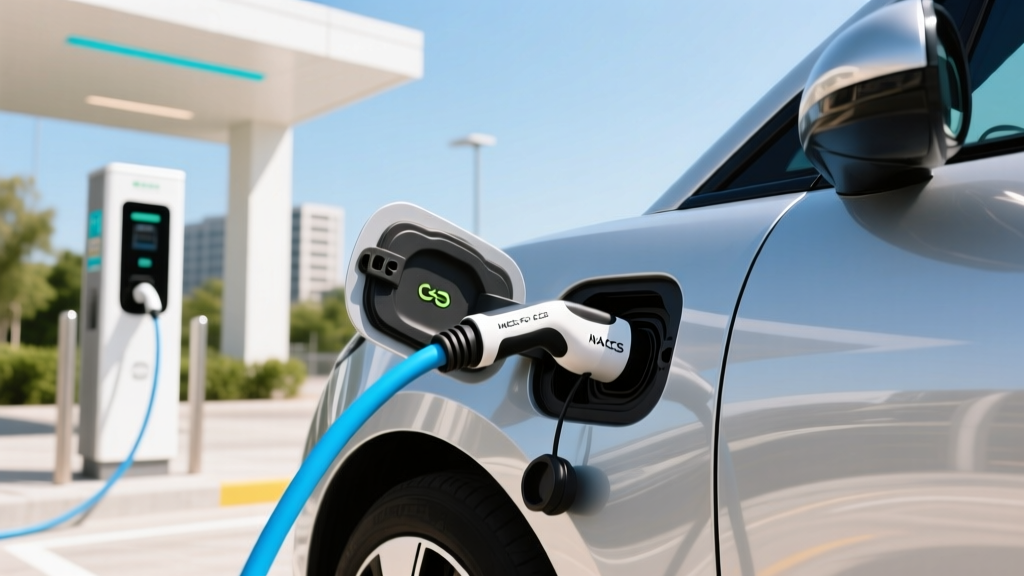
The Ford Charge Station Pro ships with a NACS connector for 2025+ vehicles. If you own a 2021-2024 CCS-equipped Ford, confirm with your dealer that you received the correct CCS-compatible version of the Charge Station Pro, or plan to use an adapter. Ford has provided NACS-to-CCS adapters to earlier-model owners for Supercharger access, but for home charging, matching the charger's native connector to your vehicle avoids daily adapter hassle and potential connection losses.
Cost to Charge: Per-Mile Economics vs. Gas
The financial case for home charging hinges on your local electricity rate and driving pattern. Here's the math using a 2025 F-150 Lightning Extended Range (EPA-rated 2.0 kWh/mile, or roughly 50 MPGe combined per fueleconomy.gov):
| Charging Scenario | Rate ($/kWh) | Cost Per Mile (Lightning) | Annual Cost (12,000 mi) |
|---|---|---|---|
| Home off-peak (utility time-of-use) | $0.09 | $0.036 | $432 |
| Home standard rate | $0.15 | $0.060 | $720 |
| Public Level 2 (ChargePoint, etc.) | $0.25 | $0.100 | $1,200 |
| DC Fast (Electrify America, peak) | $0.48 | $0.192 | $2,304 |
| Gas equivalent (F-150 4x4, 20 MPG, $3.40/gal) | — | $0.170 | $2,040 |
Home charging at off-peak rates delivers a 4.7x cost advantage over gas. Even at standard residential rates, you save roughly 65% per mile. The math breaks down only if you rely exclusively on DC fast charging — at $0.48/kWh, the Lightning costs more per mile than the gas F-150. This is why the Ford Power Promise home charger exists: to anchor your charging at the cheapest possible rate.
Charging Times: How Long for 10-80%?
Charging speed isn't linear. Lithium-ion batteries accept peak power between roughly 10-50% SoC, then taper progressively. The "10-80% time" is the industry-standard benchmark because charging above 80% slows dramatically to protect battery longevity (the charge curve taper).
Here are realistic 10-80% times for common Ford EV battery sizes on the Ford Charge Station Pro (19.2 kW) and Mobile Power Cord (7.7 kW):
- F-150 Lightning Extended Range (131 kWh usable): 10-80% in ~4.5 hours (Charge Station Pro) or ~11.3 hours (Mobile Power Cord)
- F-150 Lightning Standard Range (98 kWh usable): 10-80% in ~3.4 hours (Charge Station Pro) or ~8.5 hours (Mobile Power Cord)
- Mustang Mach-E Extended Range (91 kWh usable): 10-80% in ~3.2 hours (Charge Station Pro) or ~7.9 hours (Mobile Power Cord)
- Mustang Mach-E Standard Range (70 kWh usable): 10-80% in ~2.4 hours (Charge Station Pro) or ~6.1 hours (Mobile Power Cord)
For DC fast charging on the road, the F-150 Lightning Extended Range peaks at approximately 150 kW on compatible CCS/NACS stations, achieving a 10-80% charge in roughly 41 minutes per Ford's published data. The Mach-E GT peaks around 150 kW as well, with a 10-80% time of approximately 37 minutes. Note that these are peak rates — sustained average is lower due to taper, especially in cold weather when the battery management system limits charge rate until the pack warms.
Equipment Recommendations: Beyond the Included Charger
The Ford Charge Station Pro is solid hardware, but depending on your electrical setup, vehicle, or smart-home preferences, these third-party alternatives deserve consideration:
Emporia Vue Level 2 Charger
- Power: 48A / 11.5 kW (hardwired) or 40A / 9.6 kW (14-50 plug)
- Connector: J1772 (NACS adapter available)
- Cable: 24 ft
- Smart features: Wi-Fi, energy monitoring, solar integration, scheduling via app
- Price: ~$399
- Best for: Budget-conscious buyers wanting energy tracking and solar pairing
Tesla Universal Wall Connector
- Power: 48A / 11.5 kW (NACS native, J1772 adapter included)
- Connector: NACS with integrated J1772 Magic Dock
- Cable: 24 ft
- Smart features: Wi-Fi, OTA updates, Power Sharing (link multiple units), load management
- Price: ~$599
- Best for: Multi-EV households, future-proofing for NACS standardization
Grizzl-E Smart Level 2
- Power: 40A / 9.6 kW (adjustable down to 16A for panel-limited homes)
- Connector: J1772 or NACS (specify at order)
- Cable: 24 ft
- Smart features: OCPP-compatible, adjustable amperage, extreme cold rating (-40°F)
- Price: ~$449
- Best for: Cold-climate owners, homes with limited panel capacity
Each of these units requires a dedicated 60-amp breaker (for 48A models) or 50-amp breaker (for 40A models) on a 240V circuit. The adjustable-amperage feature on the Grizzl-E is particularly valuable for older homes where a full 48A circuit isn't feasible — you can dial it down to 32A or 24A without replacing hardware.
Safety, Code, and Installation Best Practices
EV charging draws sustained high current for hours — far longer than a dryer or oven cycle. This makes proper installation non-negotiable:
- Dedicated circuit: Your EV charger must have its own breaker — never share with another appliance. A 48A charger requires a 60A breaker (NEC 80% continuous-load rule); an 80A charger like the Charge Station Pro requires a 100A breaker.
- GFCI protection: The 2023 NEC revision (Article 625) requires GFCI protection for all EV receptacles. Hardwired units like the Charge Station Pro have integrated ground-fault protection. If installing a 14-50 outlet, your electrician must use a GFCI breaker.
- Outdoor rating: If mounting outdoors, ensure the unit carries a NEMA 4 or IP65 rating. The Ford Charge Station Pro is rated for outdoor installation; the Mobile Power Cord is rated for indoor use only when used as a permanent charging solution.
- Wire gauge: A 60A circuit requires 6 AWG copper wire; a 100A circuit requires 3 AWG copper or 1 AWG aluminum. Undersized wiring is a fire risk and will fail inspection.
- Permit and inspection: Most jurisdictions require an electrical permit for EV charger installation. The inspection verifies wire gauge, breaker sizing, grounding, and GFCI compliance. Skipping the permit risks insurance denial in the event of an electrical fire.
Frequently Asked Questions
How much does it cost to install a Ford Power Promise home charger?
With the charger equipment included through Ford's program, expect to pay $450–$1,100 for a basic Mobile Power Cord (14-50 outlet) installation or $1,100–$2,300 for the Charge Station Pro (hardwired 100A circuit) in a home with adequate panel capacity. If your home needs a panel upgrade from 100A to 200A service, add $1,500–$3,500, bringing totals to $1,950–$5,800 depending on scope.
How fast will each charging level add range to my Ford EV?
Level 1 (120V) adds 3-5 miles per hour — adequate only for PHEVs or very low daily mileage. Level 2 at 7.7 kW adds roughly 20-25 miles per hour; at 11.5 kW, about 30-35 miles per hour; and at 19.2 kW (Charge Station Pro), up to 30-45 miles per hour depending on the vehicle's efficiency. DC fast charging delivers 150-500+ miles per hour in short bursts, but is intended for road trips, not daily use.
Which connector and charger is compatible with my Ford EV?
2025 and newer Ford EVs use the NACS connector natively. 2021-2024 models use CCS1. Ford PHEVs use J1772 for Level 2 charging. The Ford Charge Station Pro ships in NACS or CCS versions to match your vehicle. If you own an older CCS Ford and want NACS Supercharger access, Ford has provided adapters — check with your dealer for availability.
How much does charging cost per mile compared to gas?
At home off-peak rates (~$0.09/kWh), an F-150 Lightning costs approximately $0.036/mile — about 4.7x cheaper than a gas F-150 at $3.40/gallon and 20 MPG ($0.17/mile). At standard home rates ($0.15/kWh), the Lightning costs $0.06/mile. DC fast charging at $0.48/kWh costs $0.19/mile, which actually exceeds the gas truck. Home charging is where the economics work.
What electrical upgrades might my home need for an EV charger?
The most common upgrade is a panel capacity increase from 100A or 150A to 200A service, required when your existing panel lacks headroom for a 60A or 100A dedicated EV circuit. Other potential upgrades include: replacing a Federal Pacific or Zinsco panel (known fire hazards that insurers may require you to replace), adding a sub-panel if your main panel is full, or upgrading the service drop from the utility if your home's supply wire is undersized. A licensed electrician's load calculation will determine your exact needs.
Can I charge my Ford EV on a standard 120V outlet?
Yes, but it's slow. Level 1 charging at 1.4 kW adds only 3-5 miles per hour, meaning a full charge on a 131 kWh Lightning Extended Range would take over 90 hours. Level 1 is practical for PHEVs (which have 20-40 miles of electric range) or as an emergency backup. For daily BEV use, Level 2 is strongly recommended.
Is the Ford Charge Station Pro worth the 100-amp circuit requirement?
For F-150 Lightning owners with the Extended Range battery, yes — the 19.2 kW output cuts overnight charging to roughly 5.5 hours for a 10-80% session, ensuring a full battery by morning even after heavy driving days. For Mach-E owners with smaller batteries, a 48A / 11.5 kW charger provides sufficient speed at lower installation cost and panel demand. Match the charger to your battery size and panel capacity.
Sources: EPA fuel economy data from fueleconomy.gov; Ford Power Promise and Charge Station Pro specifications from Ford Motor Company; IRS Residential Clean Energy Credit guidelines from irs.gov. Installation cost ranges based on 2026 national electrician surveys. All pricing and specifications are subject to change; verify current terms with your Ford dealer and a licensed electrician.