What Is the Ford Performance Supercharger Network?
Ford's entry into high-power DC fast charging arrived through its partnership with Tesla's Supercharger network and the subsequent rollout of Ford-branded charging solutions. By 2026, Ford Performance vehicles — including the Mustang Mach-E GT, F-150 Lightning, and the upcoming next-gen EV platforms — access Tesla Supercharger stalls via the native NACS (North American Charging Standard) port, while Ford's own branded charging hardware focuses on home and destination Level 2 solutions.
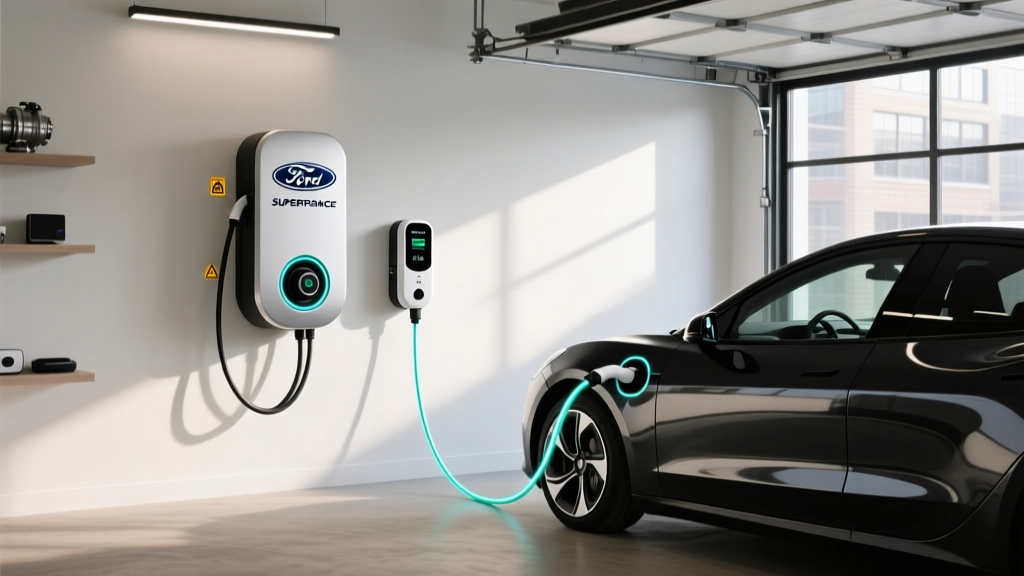
The term "Ford Performance Supercharger" in common usage refers to two things: (1) the DC fast-charging capability of Ford's performance EV models on the Supercharger network, and (2) Ford's own high-output home charging equipment like the Ford Charge Station Pro (80A / 19.2 kW Level 2) and the Ford Connected Charge Station (48A / 11.5 kW). This guide covers both — public fast charging and the home setup that makes daily EV ownership practical.
Charging Levels Explained: Speeds in kW and Miles Per Hour
Understanding the three charging tiers is the foundation of any EV ownership plan. Here's how each level performs with typical Ford EV battery sizes (91 kWh usable for the F-150 Lightning Extended Range, 91 kWh for the Mach-E GT):
| Level | Voltage / Amps | Power (kW) | Miles of Range Added Per Hour | Typical Use Case |
|---|---|---|---|---|
| Level 1 | 120V / 12A | 1.4 kW | 3–5 mi/hr | Overnight trickle; emergency top-up |
| Level 2 | 240V / 32–80A | 7.7–19.2 kW | 25–65 mi/hr | Daily home charging; workplace; destination |
| DC Fast Charge | 400–800V DC | 50–250+ kW | 180–800+ mi/hr (peak) | Road trips; rapid top-ups on Supercharger/EA networks |
Real-world charging time examples for a Ford F-150 Lightning Extended Range (131 kWh usable battery):
- Level 1 (1.4 kW): 0–100% in roughly 93 hours — impractical for full charges, but adds ~40 miles overnight.
- Level 2 at 48A (11.5 kW) — Ford Connected Charge Station: 0–100% in ~11.5 hours. A full overnight charge is realistic.
- Level 2 at 80A (19.2 kW) — Ford Charge Station Pro: 0–100% in ~7 hours. Ford's fastest home option; requires a 100A dedicated circuit.
- DC Fast Charge at 150 kW peak (Supercharger V3): 10–80% in approximately 38–44 minutes. Peak rate tapers significantly above 80% SoC to protect battery health.
For the Mustang Mach-E GT (91 kWh usable), those Level 2 times drop proportionally: ~8 hours at 11.5 kW, ~5 hours at 19.2 kW, and DC fast 10–80% in roughly 30–35 minutes at a 150 kW stall.
Connector Compatibility: NACS, CCS1, and Adapter Requirements
As of the 2025 model year, Ford transitioned all new EVs to the NACS (Tesla-style) charging port, replacing the CCS1 port used on 2021–2024 models. This means your connector needs depend heavily on your model year:
| Connector | Ford Models (2025+) | Ford Models (2021–2024) | Adapter Needed? |
|---|---|---|---|
| NACS (Tesla) | Native port — direct plug at Superchargers and NACS stations | Requires CCS-to-NACS adapter (Ford provides one for eligible owners) | 2021–2024: Yes (adapter) |
| CCS1 | Requires NACS-to-CCS adapter for Electrify America, EVgo, etc. | Native port — direct plug at CCS stations | 2025+: Yes (adapter) |
| CHAdeMO | Not supported (legacy standard, largely retired) | Not supported | N/A |
| J1772 (Level 2) | NACS port includes J1772 adapter in-box | Native J1772 inlet for Level 2 | 2025+: Use included adapter |
Practical tip: If you own a 2025+ Ford EV with NACS, you can charge at any Tesla Supercharger stall natively. For Electrify America or ChargePoint DC fast chargers (still predominantly CCS1 in many locations), carry a NACS-to-CCS adapter. Ford's official EV accessories page lists approved adapters.
Home Charger Installation: Electrical Requirements and Costs
Installing a Level 2 home charger is the single biggest ownership upgrade for daily EV convenience. Here's what's involved electrically and financially:
Electrical Requirements by Charger
- Ford Connected Charge Station (48A / 11.5 kW): Requires a 240V / 60A dedicated circuit. Uses a NEMA 14-50 outlet or hardwired connection.
- Ford Charge Station Pro (80A / 19.2 kW): Requires a 240V / 100A dedicated circuit. Must be hardwired — no plug-in option at this amperage. This is the same unit that enables Ford Intelligent Backup Power (V2H) on the F-150 Lightning.
- Third-party 40A chargers (e.g., ChargePoint Home Flex): Require a 240V / 50A dedicated circuit.
Panel Upgrade Reality
Many homes built before 2010 have 100A or 150A main service panels. Adding a 60A or 100A dedicated circuit may exceed available capacity, requiring a panel upgrade to 200A — a significant added cost. Even some 200A panels lack physical breaker spaces. Have a licensed electrician perform a load calculation before committing to a charger.
| Cost Component | Simple Install (panel nearby, no upgrade) | Complex Install (long run, panel upgrade) |
|---|---|---|
| Charger equipment | $500–$800 | $500–$1,300 |
| Electrician labor (2–8 hrs @ $85–$150/hr) | $250–$600 | $800–$2,500 |
| Permit & inspection | $50–$200 | $100–$350 |
| Panel upgrade (if needed) | $0 | $1,500–$4,000 |
| Conduit, wiring, misc. materials | $100–$300 | $400–$1,200 |
| Total estimated cost | $900–$1,900 | $3,300–$9,350 |
Check with your utility — many offer rebates of $250–$1,000 for Level 2 installation, and some provide free or discounted equipment. The federal Alternative Fuel Vehicle Refueling Property Credit (IRC §30C) covers up to 30% of home charging equipment and installation costs, capped at $1,000, subject to census-tract eligibility requirements. Consult a tax professional for your specific situation.
Cost to Charge: Home vs. Public vs. Gas per Mile
Electricity pricing varies enormously by location, time of day, and charging tier. Here's a realistic comparison using the F-150 Lightning Extended Range (2.0 kWh/mile efficiency, or roughly 48 MPGe combined per fueleconomy.gov):
| Charging Scenario | Typical $/kWh | Cost per Mile (F-150 Lightning) | Annual Cost (12,000 mi) |
|---|---|---|---|
| Home off-peak (utility time-of-use rate) | $0.08–$0.14 | $0.016–$0.028 | $192–$336 |
| Home standard rate (no TOU plan) | $0.15–$0.22 | $0.030–$0.044 | $360–$528 |
| Public Level 2 (ChargePoint, workplace) | $0.20–$0.40 | $0.040–$0.080 | $480–$960 |
| DC Fast — Supercharger / Electrify America | $0.30–$0.55 | $0.060–$0.110 | $720–$1,320 |
| Gasoline equivalent (25 MPG truck @ $3.40/gal) | $3.40/gal | $0.136 | $1,632 |
The takeaway: Home off-peak charging delivers fuel costs roughly 80–88% lower than gasoline. Even exclusive DC fast charging on road trips still undercuts gas per mile in most scenarios. The economics favor home charging heavily — which is why Level 2 installation is the highest-ROI upgrade for any EV owner.
Equipment Recommendations: Ford and Third-Party Chargers Compared
Below are the top Level 2 home chargers compatible with Ford's EV lineup, with exact specs that matter:
Ford Charge Station Pro
- Power output: 19.2 kW (80A @ 240V)
- Connector: NACS native (2025+ models); J1772 adapter included
- Cable length: 25 ft
- Smart features: FordPass app integration, scheduled charging, Intelligent Backup Power (V2H) on F-150 Lightning
- Installation: Hardwired, 100A dedicated circuit required
- Price: ~$1,300 (equipment only)
- Best for: F-150 Lightning owners wanting fastest home charge + backup power
Ford Connected Charge Station
- Power output: 11.5 kW (48A @ 240V)
- Connector: NACS native (2025+ models)
- Cable length: 25 ft
- Smart features: FordPass scheduling, charge status alerts, energy usage tracking
- Installation: NEMA 14-50 plug or hardwired, 60A circuit
- Price: ~$750 (equipment only)
- Best for: Mach-E owners; garages with standard 60A capacity
ChargePoint Home Flex
- Power output: Up to 12 kW (50A @ 240V, adjustable down)
- Connector: J1772 standard; NACS adapter available
- Cable length: 23 ft
- Smart features: ChargePoint app, Alexa integration, flexible amperage settings, energy reports
- Installation: NEMA 14-50 or hardwired, up to 60A circuit
- Price: ~$550–$700
- Best for: Multi-EV households; adjustable amperage for older panels
Tesla Wall Connector
- Power output: Up to 11.5 kW (48A @ 240V)
- Connector: NACS native — direct plug for 2025+ Ford EVs
- Cable length: 24 ft
- Smart features: Wi-Fi updates, power sharing between multiple units, access control
- Installation: Hardwired, 60A circuit
- Price: ~$450–$500
- Best for: Budget-conscious NACS-native Ford owners; excellent build quality at low price
Safety, Code Compliance, and Outdoor Installation
EV charger installation is governed by the National Electrical Code (NEC Article 625) and local amendments. Non-negotiable requirements include:
- Dedicated circuit: Your EV charger must have its own breaker — no shared circuits with dryers, ranges, or HVAC.
- GFCI protection: NEC 2020 and later requires GFCI protection for all EVSE on circuits 60A and below. Hardwired units above 60A may have different requirements depending on jurisdiction.
- Outdoor rating: If mounting outside, the unit must carry a NEMA 4 (or IP65+) rating for weather resistance. All chargers listed above meet outdoor standards, but verify the specific model's rating.
- Cable management: NEC requires the charging cable not to cross pedestrian walkways. Wall-mounted retractors or cable organizers keep setups code-compliant and safe.
- Permit and inspection: Most jurisdictions require an electrical permit for new 240V circuits. Skipping inspection can void homeowner insurance coverage for electrical fires. Budget $50–$350 for permit fees.
- Wire gauge: 60A circuits typically require 6 AWG copper wire; 100A circuits require 3 AWG copper or 1 AWG aluminum. Your electrician will size appropriately based on run length and local code.
Using the Ford Performance Supercharger Network on Road Trips
For 2025+ Ford EVs with native NACS ports, accessing Tesla Supercharger stalls is seamless — plug in and the FordPass or Tesla app initiates billing via Ford's BlueOval Charge network integration. Key performance figures for DC fast charging on Ford performance models:
- Mustang Mach-E GT (2025+): Peaks at ~150 kW on V3 Superchargers; 10–80% in approximately 30–35 minutes. Sustained rate averages ~110 kW across the curve due to thermal management taper above 60% SoC.
- F-150 Lightning Extended Range: Peaks at ~155 kW; 10–80% in roughly 38–44 minutes. The larger 131 kWh battery means longer absolute charge times even at similar peak rates.
- Preconditioning: Navigate to a Supercharger in the vehicle's nav system to activate battery preconditioning — warming the pack to optimal temperature for faster charge acceptance. In cold weather (below 40°F), preconditioning can reduce 10–80% time by 10–15 minutes.
Charging curve reality: No EV sustains its peak kW rate for the full session. A "150 kW" charge session averages closer to 100–120 kW across the 10–80% window. Above 80% SoC, charging slows dramatically to protect battery longevity — expect 80–100% to take nearly as long as 10–80%. For road trips, charge to 80% and drive on; the time penalty of charging past 80% rarely justifies the added range.
Frequently Asked Questions
How much does it cost to install a home EV charger?
A straightforward Level 2 installation with an adequate electrical panel typically runs $900–$1,900 including equipment, electrician labor, and permit. If your home needs a panel upgrade to 200A service, expect $3,300–$9,350 total. Utility rebates and the federal §30C tax credit (up to $1,000) can offset some costs.
How fast will each charging level add range?
Level 1 (120V) adds 3–5 miles per hour. Level 2 (240V) adds 25–65 miles per hour depending on amperage. DC fast charging adds 180–800+ miles per hour at peak rate, but sessions are measured in minutes (typically 30–45 minutes for 10–80%) because the rate tapers as the battery fills.
Which connector/charger is compatible with my Ford EV?
2025 and newer Ford EVs use the NACS connector natively, plugging directly into Tesla Superchargers and NACS-equipped stations. 2021–2024 Ford EVs use CCS1 and may require a Ford-provided adapter for Supercharger access. For Level 2 home charging, 2025+ models need a NACS-equipped charger or a J1772-to-NACS adapter (typically included with the vehicle).
How much does charging cost per mile vs. gas?
Home off-peak charging costs roughly $0.02–$0.03 per mile in an F-150 Lightning — about 80% less than a comparable gas truck at $0.14/mile. Even public DC fast charging at $0.35–$0.55/kWh typically costs $0.07–$0.11/mile, still below gasoline. Your savings depend on local electricity rates and how much you charge at home vs. publicly.
What electrical upgrades might I need?
The most common upgrade is a panel upgrade from 100A to 200A service if your existing panel lacks capacity for a new 60A or 100A dedicated circuit. Other potential needs include: adding breaker spaces via a sub-panel, upgrading service entrance wiring, or replacing an outdated fuse box with a modern breaker panel. A licensed electrician's load calculation will determine exactly what's required before you purchase equipment.
Does the Ford Charge Station Pro enable home backup power?
Yes — the Ford Charge Station Pro (80A hardwired) paired with the F-150 Lightning's available Intelligent Backup Power system enables vehicle-to-home (V2H) energy transfer. During a grid outage, the truck's 131 kWh battery can power an average home for up to 3 days (at ~30 kWh/day usage). This requires Ford's Home Integration System (an additional ~$3,900 installed) and is exclusive to the F-150 Lightning platform.