If you own or are shopping for a Ford Mustang Mach-E, understanding how to charge it efficiently is the single biggest factor in preserving its EPA-rated range and minimizing your cost per mile. The 2025–2026 Mach-E lineup offers usable battery capacities from approximately 75.7 kWh (Standard Range) to 91 kWh (Extended Range), with the GT variant pushing performance at the cost of some efficiency. But those batteries are only as useful as the charging infrastructure you pair them with.
This guide breaks down exactly how to charge a Mustang Mach-E at home and on the road — with precise kW speeds, installation costs, equipment recommendations, and the real math on what you'll pay per mile versus gasoline.
The 2025 Mach-E Select RWD with the Standard Range battery carries an EPA-estimated 250 miles, while the Extended Range RWD achieves EPA 320 miles (fueleconomy.gov). In real-world highway driving at 70–75 mph, expect roughly 10–15% less — so around 215–280 miles depending on battery pack. Cold weather (below 32°F) can reduce range an additional 15–30% due to cabin heating demands and reduced battery chemistry efficiency. Plan trips around usable range, not the sticker number.
Charging Levels Explained: kW, Speeds, and Range Added Per Hour
The most critical distinction in EV charging is between kW (kilowatts), which measures power — the rate at which energy flows into your battery — and kWh (kilowatt-hours), which measures energy capacity — the total amount of electricity stored. Think of kW as the width of a pipe and kWh as the size of the tank. A wider pipe fills the tank faster.
Here is how each charging level translates into real speed for a Ford Mustang Mach-E:
| Charging Level | Power (kW) | Voltage / Amperage | Miles of Range Added Per Hour | Typical Use Case |
|---|---|---|---|---|
| Level 1 (Standard 120V outlet) | 1.4–1.9 kW | 120V / 12–16A | 3–5 miles/hr | Overnight trickle, PHEVs, emergencies |
| Level 2 (Home or public AC) | 7.7–11.5 kW | 240V / 32–48A | 22–37 miles/hr | Daily home charging, workplace, shopping centers |
| DC Fast Charging (Public) | 115–150 kW peak | 400–500V DC direct | ~160–220 miles/hr (at peak) | Road trips, highway corridors |
The Mustang Mach-E's onboard charger accepts up to 10.5 kW on Level 2 AC (single-phase, 48A). On DC fast charging, the Extended Range battery can peak at approximately 150 kW, while the Standard Range peaks around 115 kW. Ford advertises a 10–80% DC fast charge in roughly 45 minutes for the Extended Range pack under ideal conditions — though real-world sessions often stretch to 50–55 minutes due to charge-curve tapering above 80% State of Charge (SoC).
Which Connector Does the Mustang Mach-E Use?
Ford made a pivotal decision in 2024: new Mach-E models shipped with the NACS (North American Charging Standard) charge port — the Tesla-designed connector — replacing the previous CCS1 port. This gives 2025–2026 Mach-E owners native access to the Tesla Supercharger network (over 25,000 stalls in North America) without an adapter.
| Connector Type | Mach-E Model Years | Network Access | Adapter Needed? |
|---|---|---|---|
| NACS (Tesla) | 2025–2026 (factory-equipped) | Tesla Superchargers, plus growing NACS public networks | No — native port |
| CCS1 | 2021–2024 models | Electrify America, EVgo, ChargePoint DC, most non-Tesla networks | No — native port |
| CHAdeMO | N/A — never equipped on Mach-E | Largely legacy/deprecated in North America | N/A |
If you own a 2021–2024 Mach-E with CCS1: Ford offers a NACS adapter that enables Supercharger access. It typically retails around $200–$250 and is rated for up to 150 kW DC. Conversely, if you have a 2025+ NACS-equipped Mach-E and need to use a CCS1 station, Ford and third-party vendors now sell NACS-to-CCS adapters — though availability and pricing vary. Always verify adapter ratings match your vehicle's peak charge rate.
Home Charger Installation: Electrical Requirements, Costs, and Panel Upgrades
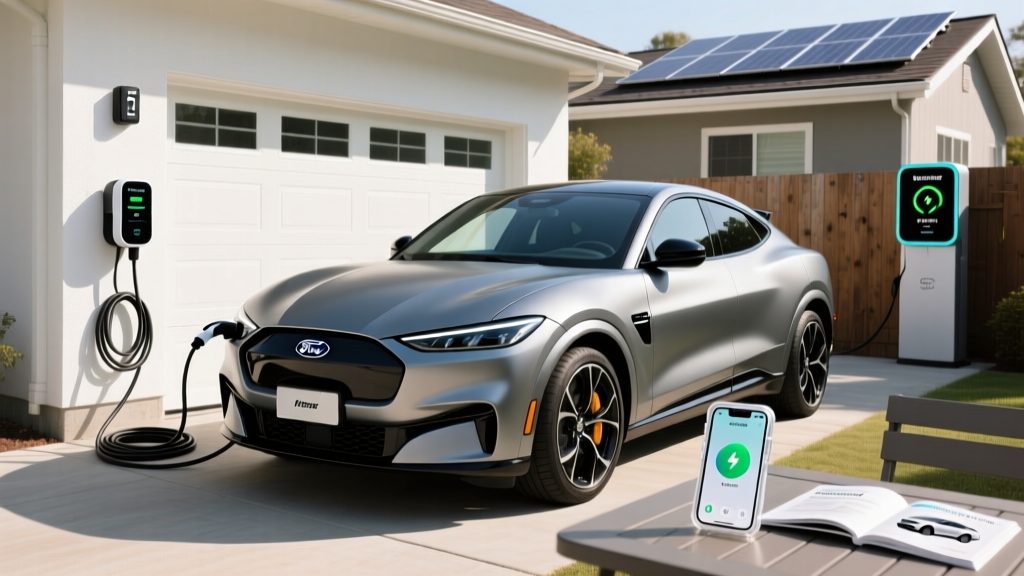
Installing a Level 2 home charger is the single best investment a Mach-E owner can make. You'll wake up every morning with a full battery and pay the lowest per-kWh rate available. But installation costs vary widely based on your home's electrical panel, distance from the panel to the garage, and local code requirements.
Electrical Requirements for a Mach-E Home Charger
To deliver the Mach-E's maximum 10.5 kW Level 2 rate, you need a 240-volt, 48-amp dedicated circuit (a 60-amp breaker, since the National Electrical Code requires circuits to be rated 125% above continuous load). A 40-amp circuit (32A continuous) delivers 7.7 kW — still adequate for overnight charging in most cases, adding roughly 22 miles per hour.
Installation Cost Breakdown
| Component | Typical Cost Range | Notes |
|---|---|---|
| Level 2 charger (hardware) | $350 – $700 | Smart Wi-Fi chargers with 24–25 ft cable |
| Electrician labor (standard install) | $500 – $1,500 | Assumes panel within 30–50 ft of install location |
| Electrical permit | $50 – $200 | Varies by municipality; some jurisdictions bundle with inspection |
| Panel upgrade (if needed) | $1,500 – $4,000+ | Required if your panel is 100A or less and near capacity; 200A service recommended |
| Conduit/wiring (long runs) | $200 – $800 | Added cost if charger is far from the panel or requires underground conduit |
| Total (no panel upgrade) | $900 – $2,400 | Most homes with a modern 200A panel |
| Total (with panel upgrade) | $2,500 – $5,500+ | Older homes with 100A or 150A service |
The panel upgrade gotcha: If your home was built before 1990, there's a meaningful chance you have a 100-amp electrical panel that may already be near capacity with existing appliances (electric dryer, oven, HVAC). Adding a 48A EV circuit could push you over. A licensed electrician will perform a load calculation per NEC Article 220 to determine if an upgrade is required. Don't skip this — undersized panels are a fire hazard, and your insurance may deny claims from unpermitted work.
Safety and Code Considerations
- Dedicated circuit: Your Level 2 charger must be on its own dedicated breaker — never shared with other appliances.
- GFCI protection: NEC 2020 and later require GFCI (Ground Fault Circuit Interrupter) protection for EV charging outlets in garages. Most hardwired chargers have built-in GFCI; plug-in units using a NEMA 14-50 outlet require a GFCI breaker (adds $50–$100).
- Outdoor rating: If installing outside, ensure the charger carries a NEMA 4 or IP65 rating for weather resistance. All recommended units below meet this standard.
- Permit and inspection: Most jurisdictions require a permit for new 240V circuits. Inspections typically cost nothing beyond the permit fee and protect you from liability.
Recommended Home Chargers for the Mustang Mach-E
Based on compatibility, reliability, smart features, and value, here are three chargers well-suited to the Mach-E's 10.5 kW onboard charger limit:
ChargePoint Home Flex
- Power output: Up to 12 kW (50A) — configurable down to 16A for lower-capacity panels
- Connector: NACS (2025+ models) or J1772 (with NACS adapter for older Mach-E)
- Cable length: 23 feet
- Smart features: Wi-Fi, Alexa integration, scheduled charging, utility demand-response, detailed session tracking via app
- Price: ~$549–$649 (hardware only)
- Best for: Most Mach-E owners wanting a flexible, future-proof smart charger
Grizzl-E Smart
- Power output: Up to 11.5 kW (48A)
- Connector: NACS or J1772 variants available
- Cable length: 24 feet
- Smart features: Wi-Fi, OCPP protocol support, energy monitoring, adjustable amperage
- Price: ~$499–$599
- Best for: Budget-conscious buyers wanting a rugged, Canadian-built unit rated to -40°F
Ford Connected Charge Station
- Power output: Up to 10.4 kW (48A)
- Connector: NACS (for 2025+ Mach-E); J1772 on older versions
- Cable length: 25 feet
- Smart features: Deep FordPass app integration, scheduled charging, preconditioning coordination, OTA updates
- Price: ~$599–$799 (sometimes discounted or bundled with vehicle purchase)
- Best for: Owners wanting seamless FordPass integration and OEM warranty support
For most Mach-E owners, the ChargePoint Home Flex earns our top recommendation for its amperage flexibility (critical if your panel can't support a full 48A circuit) and robust app ecosystem. If you prioritize FordPass integration for scheduled departure preconditioning — which warms the battery before a DC fast-charge session and can shave 5–10 minutes off your charging time — the Ford Connected Charge Station is worth the premium.
Cost to Charge: Home vs. Public vs. Gas — The Per-Mile Math
One of the strongest arguments for the Mach-E is fuel cost. Let's run the numbers using real electricity and gasoline rates.
The 2025 Mach-E Extended Range RWD achieves an EPA-rated 101 MPGe combined (source), consuming approximately 33 kWh per 100 miles. Here's what that costs across different charging scenarios:
| Charging Scenario | Avg. Cost per kWh | Cost per 100 Miles | Cost per Mile |
|---|---|---|---|
| Home (national avg. residential rate) | $0.16/kWh | $5.28 | $0.053 |
| Home (off-peak utility rate, e.g. TOU plan) | $0.09/kWh | $2.97 | $0.030 |
| Public Level 2 (ChargePoint, EVgo) | $0.25–$0.35/kWh | $8.25–$11.55 | $0.083–$0.116 |
| DC Fast Charging (Electrify America, Tesla Supercharger) | $0.30–$0.48/kWh | $9.90–$15.84 | $0.099–$0.158 |
| Gas equivalent (25 MPG avg. at $3.40/gal) | — | $13.60 | $0.136 |
Charging at home on a standard residential rate saves roughly 60% per mile versus gasoline. Even exclusive DC fast charging — the most expensive scenario — can match or beat gas prices depending on your local electricity and fuel costs. The break-even point where DC fast charging exceeds gas cost is around $0.41/kWh, which some premium urban chargers do exceed.
Pro tip: Many utilities offer Time-of-Use (TOU) plans that drop rates to $0.06–$0.10/kWh between 11 PM and 6 AM. Scheduling your Mach-E to charge during these hours via the FordPass app or your charger's built-in scheduling can cut your home charging cost below $3 per 100 miles — a fraction of what a comparable gas SUV costs.
Public Charging Strategy for Road Trips
The Mach-E's real-world DC fast-charging experience depends heavily on network reliability and charge-curve behavior. Here's what to expect:
- Tesla Superchargers (NACS-equipped 2025+ Mach-E): V3 Superchargers deliver up to 250 kW, but the Mach-E's peak acceptance is ~150 kW. Expect 10–80% in approximately 40–50 minutes depending on battery temperature and state of health. Supercharger reliability consistently leads the industry, with Ford's own data showing 95%+ uptime.
- Electrify America: 350 kW stalls available, but the Mach-E will cap at its own 150 kW peak. Session reliability has improved but still trails Tesla. Expect 10–80% in roughly 45–55 minutes. Use the EA app to check real-time stall availability before routing.
- EVgo and ChargePoint DC: Typically 50–125 kW stalls. Slower sessions — 10–80% may take 60–75 minutes on a 50 kW unit. Good for topping up, not ideal as a primary road-trip strategy.
Preconditioning matters: If you navigate to a DC fast charger using the Mach-E's built-in navigation, the vehicle will precondition the battery — warming it to optimal temperature before arrival. This can improve peak charge rates by 15–25 kW in cold weather and reduce overall session time by 5–10 minutes. Always route through the car's nav system when possible.
Frequently Asked Questions
How much does it cost to install a home EV charger for my Mustang Mach-E?
A typical Level 2 home charger installation runs $900 to $2,400 if your electrical panel has sufficient capacity (a modern 200A service). If a panel upgrade is needed — common in pre-1990 homes — total costs can reach $2,500 to $5,500+. Always get at least two quotes from licensed electricians and confirm the work includes a permit and inspection.
How fast will each charging level add range to the Mach-E?
Level 1 (120V) adds roughly 3–5 miles per hour — essentially unusable for daily driving beyond short commutes. Level 2 (240V, 48A) adds 22–37 miles per hour, easily refilling a full battery overnight. DC fast charging adds approximately 160–220 miles per hour at peak rate, though the charge curve tapers significantly above 80% SoC, making 10–80% the practical fast-charge window.
Which connector is compatible with my Mach-E?
2025–2026 Mach-E models come with a native NACS charge port, giving direct access to Tesla Superchargers. 2021–2024 models have CCS1 ports and access Electrify America, EVgo, and other CCS networks natively. Ford sells a NACS adapter for CCS1-equipped models to enable Supercharger access. CHAdeMO is not supported on any Mach-E.
How much does charging a Mach-E cost per mile versus a gas car?
At the national average residential electricity rate ($0.16/kWh), home charging costs approximately $0.053 per mile. A comparable gas SUV at 25 MPG and $3.40/gallon costs $0.136 per mile. That's a savings of roughly $830 per year at 10,000 miles driven. Off-peak home charging can push EV cost below $0.03/mile.
What electrical upgrades might I need before installing a home charger?
The most common upgrade is a panel capacity increase from 100A or 150A to 200A, required if your existing panel lacks headroom for a 48A continuous EV circuit. Other potential needs include running new conduit for long distances from panel to garage, upgrading from aluminum to copper wiring, or adding a GFCI breaker for code compliance on NEMA 14-50 outlets. A licensed electrician's load calculation will determine exactly what's required.
Does the Mustang Mach-E qualify for the federal EV tax credit?
Under current IRS §30D rules, the Mach-E may qualify for up to $7,500 in federal tax credits, but eligibility depends on MSRP caps (under $80,000 for SUVs), buyer income limits ($300K joint / $150K single AGI), and battery critical-mineral and component sourcing requirements that change annually. As of 2025–2026, select Mach-E trims with US-sourced battery components may qualify for the full or partial credit — but verify current-year eligibility on the IRS website or with a tax professional before purchasing. The credit can be transferred to the dealer at point of sale as an instant rebate.
Bottom Line: Charge Smart, Preserve Your Range
The Ford Mustang Mach-E's range is genuinely competitive — 250 to 320 EPA miles depending on battery and drivetrain — but your real-world experience depends on how you charge. A properly installed Level 2 home charger on an off-peak utility plan delivers the lowest cost per mile in all of personal transportation. For road trips, the growing NACS/Supercharger network gives 2025+ Mach-E owners a meaningful reliability advantage over CCS-dependent competitors. Budget $1,500–$2,500 for a quality home setup, choose a smart charger with amperage flexibility, and let the Mach-E's preconditioning and scheduling features do the optimization work for you.