Ford Mustang Mach-E Charging at a Glance: 2026 Specs
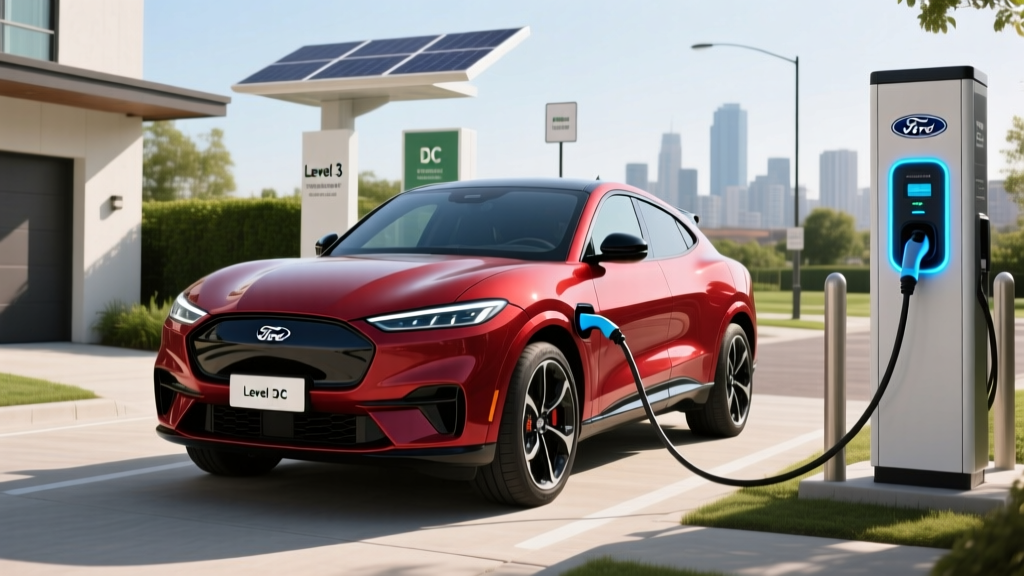
If you own or are shopping for a 2026 Ford Mustang Mach-E, charging speed is likely your top practical concern. Ford equips the 2026 Mach-E with two battery options — a 75.7 kWh usable Standard Range (LFP chemistry) and a 91.0 kWh usable Extended Range (NMC chemistry) — and the charging hardware to match. The headline number is a peak DC fast-charging rate of 150 kW on Extended Range models and 115 kW on Standard Range trims. On Level 2 AC power, every 2026 Mach-E accepts up to 10.5 kW from its onboard charger.
Those are the spec-sheet numbers. Real-world charging involves charge-curve tapering, connector logistics, and home electrical capacity. This guide breaks down exactly what 2026 Mach-E owners can expect at every charging level, what home installation actually costs, and how charging expenses compare to gasoline on a per-mile basis.
| Spec | Standard Range (LFP) | Extended Range (NMC) |
|---|---|---|
| Usable Battery Capacity | 75.7 kWh | 91.0 kWh |
| EPA Range | 250 mi (Select RWD) | 320 mi (Premium RWD) |
| Peak DC Fast Charge Rate | 115 kW | 150 kW |
| 10–80% DC Fast Charge Time | ~38 min | ~33 min |
| Level 2 AC Onboard Charger | 10.5 kW (48A at 240V) | 10.5 kW (48A at 240V) |
| Level 2 Full Charge (10–100%) | ~8.5 hours | ~10 hours |
| Level 1 (120V) Charge Rate | ~1.4 kW | ~1.4 kW |
| Native Charge Port | CCS1 (NACS via adapter) | CCS1 (NACS via adapter) |
Source: Ford Motor Company 2026 Mach-E Specifications
Charging Levels Explained: How Fast Each Adds Range
The 2026 Mach-E supports three charging levels. Understanding the difference between them — and how many miles of range each adds per hour — is essential for planning both daily routines and road trips.
| Level | Voltage | Max Power (kW) | Miles of Range Added/Hour | Typical Use Case |
|---|---|---|---|---|
| Level 1 | 120V AC | 1.4 kW | ~3–4 mi/hr | Overnight top-up, emergencies, low-mileage drivers |
| Level 2 | 240V AC | 10.5 kW (vehicle limit) | ~28–32 mi/hr | Home daily charging, workplace, shopping centers |
| DC Fast | 400V+ DC | 150 kW peak (ER) / 115 kW (SR) | ~150–230 mi in 30 min | Road trips, highway corridor stops |
Level 1 uses a standard 120V household outlet and the mobile cord that ships with the Mach-E. At roughly 3–4 miles of range per hour, a full overnight session (10 hours) adds only 30–40 miles. This works for drivers with short commutes under 25 miles round-trip but is impractical as a primary strategy for Extended Range owners who want to use the full 320-mile EPA range.
Level 2 is where most Mach-E owners do their daily charging. At 10.5 kW, the Extended Range pack gains roughly 30 miles of range per hour. A depleted-to-full charge takes about 10 hours — ideal for overnight sessions. The Mach-E's 10.5 kW onboard charger is a competitive advantage: many rivals cap at 7.2 kW or 9.6 kW, meaning the Mach-E fills faster on the same 48-amp home circuit.
DC Fast Charging bypasses the onboard charger entirely, sending DC current straight to the battery. Here's where the charge curve matters: the Mach-E will peak at 150 kW (Extended Range) only between roughly 10% and 35% state of charge. Above 50% SoC, the rate tapers to ~100 kW, and above 80% it drops sharply to protect battery health. This is why manufacturers quote 10–80% times — the final 20% can take as long as the first 70%.
Home Level 2 Installation: Electrical Requirements and Costs
Installing a dedicated Level 2 home charger is the single most impactful upgrade a Mach-E owner can make. Here's what the electrical work actually involves and what it costs.
Electrical Requirements for the Mach-E
To unlock the Mach-E's full 10.5 kW Level 2 capability, you need a 240V / 60-amp dedicated circuit feeding a hardwired EVSE (Electric Vehicle Supply Equipment) rated for 48 amps continuous draw. The National Electrical Code (NEC) requires that continuous loads not exceed 80% of a circuit breaker's rating — so a 48A charger requires a 60A breaker.
If you opt for a 40-amp charger (32A continuous, 7.7 kW), a 50A circuit suffices and may be adequate if your electrical panel has limited capacity. You'll sacrifice roughly 8 miles/hour of charge speed, but for overnight charging, the difference is often negligible.
Installation Cost Breakdown
| Component | Budget Scenario | Typical Scenario | Complex Scenario |
|---|---|---|---|
| EVSE Hardware (40A–48A smart charger) | $400–$550 | $550–$750 | $700–$900 |
| Electrician Labor (2–6 hours) | $300–$600 | $600–$1,200 | $1,200–$2,500 |
| Electrical Permit | $50–$100 | $100–$200 | $150–$300 |
| Panel Upgrade (if needed: 100A → 200A) | N/A | $1,500–$2,500 | $2,500–$4,000 |
| Conduit/Wiring (long runs >50 ft) | $100–$200 | $200–$500 | $500–$1,200 |
| Total Estimated Cost | $850–$1,450 | $1,450–$3,150 | $4,550–$8,900 |
The "budget scenario" applies when your electrical panel is near the garage, has spare capacity (two open breaker slots and adequate amperage headroom), and the wiring run is short. The "complex scenario" covers older homes with 100-amp service that need a full panel upgrade, long conduit runs through finished walls, or trenching for detached garages.
Panel upgrade reality check: Homes built before 1990 frequently have 100-amp or even 60-amp electrical service. Adding a 60A EV circuit to an already-loaded 100A panel may require upgrading to 200A service. This is the single largest variable in installation cost and can push the total above $5,000. Always get a load calculation from a licensed electrician before committing to hardware.
Safety and Code Considerations
- Dedicated circuit: The EVSE must have its own breaker — not shared with other appliances.
- GFCI protection: NEC 2020 and later require GFCI protection for all EV outlets. Hardwired units typically have GFCI built in; receptacle-plugged units need a GFCI breaker.
- Outdoor rating: If your charger mounts outside, ensure the EVSE carries a NEMA 4 or NEMA 4X rating for weather resistance.
- Hardwired vs. plug: Hardwired installations at 48A avoid the need for a NEMA 14-50 receptacle and eliminate one potential failure point. Ford recommends hardwired for 48A+ setups.
- Permit and inspection: Most jurisdictions require an electrical permit and post-installation inspection. Skipping this can void homeowner's insurance coverage for electrical fires.
Connector Compatibility: CCS1, NACS, and the Tesla Adapter
The 2026 Mustang Mach-E ships with a CCS1 (Combined Charging System) charge port. This is the standard used by Electrify America, EVgo, and most non-Tesla public DC fast-charging networks. However, the charging landscape has shifted dramatically: Tesla's North American Charging Standard (NACS) has been adopted by Ford, and Mach-E owners now have access to Tesla Supercharger stations using an adapter.
| Connector / Network | Native or Adapter? | Notes |
|---|---|---|
| CCS1 (Electrify America, EVgo, ChargePoint) | Native — no adapter needed | Direct plug-in at all CCS-equipped stations |
| NACS (Tesla Supercharger) | Ford-provided NACS adapter required | Access to 25,000+ Supercharger stalls; adapter included with new 2026 Mach-E purchase or available from Ford for ~$200 |
| CHAdeMO | Not compatible | CHAdeMO is effectively discontinued in North America; no adapter exists for Mach-E |
| J1772 (public Level 2) | CCS1 port accepts J1772 natively | The upper portion of the CCS1 connector is J1772; no adapter needed for Level 2 public stations |
Supercharger access practicalities: When using a NACS adapter at a Tesla Supercharger, the Mach-E charges at the station's maximum output up to the vehicle's 150 kW ceiling. V3 Superchargers (250 kW) will be capped by the Mach-E's hardware; V4 stalls perform similarly. Ford's in-dash navigation and the FordPass app route you to compatible Supercharger stalls and CCS stations seamlessly.
Source: Ford EV Charging Network
Charging Cost per Mile: Mach-E vs. Gasoline Equivalent
One of the strongest ownership arguments for the Mach-E is fuel cost savings. Let's quantify them with real 2026 electricity and gasoline prices.
| Charging/Fueling Scenario | Cost per kWh / Gallon | Cost per Mile (Mach-E ER) | Cost per Mile (Gas SUV, 25 MPG combined) |
|---|---|---|---|
| Home Level 2 (off-peak utility rate) | $0.09–$0.13/kWh | $0.030–$0.043 | $0.136 (at $3.40/gal) |
| Home Level 2 (standard residential rate) | $0.14–$0.18/kWh | $0.047–$0.060 | $0.136 |
| Public Level 2 (ChargePoint, etc.) | $0.25–$0.39/kWh | $0.083–$0.130 | $0.136 |
| DC Fast Charging (Electrify America) | $0.38–$0.56/kWh | $0.127–$0.187 | $0.136 |
| Tesla Supercharger (NACS adapter) | $0.28–$0.42/kWh | $0.093–$0.140 | $0.136 |
Annual savings calculation: Driving 12,000 miles per year and charging primarily at home on an off-peak rate ($0.11/kWh), a Mach-E Extended Range owner spends roughly $430/year on electricity. A comparable 25 MPG gas SUV burning $3.40/gallon gasoline costs $1,632/year. That's an annual savings of approximately $1,200, or $6,000 over five years.
The math shifts if you rely heavily on DC fast charging. At $0.48/kWh (common on Electrify America's pay-as-you-go tier), the Mach-E's fuel cost per mile actually exceeds that of a fuel-efficient gas SUV. The economic case for EV ownership is strongest when you can charge at home.
The 2026 Mach-E Extended Range achieves an EPA-rated 101 MPGe combined (33 kWh/100 mi). The Standard Range is rated at approximately 100 MPGe combined. These figures from fueleconomy.gov let you compare efficiency directly against gas vehicles.
Recommended Home Chargers for the Mustang Mach-E
The Mach-E's 10.5 kW onboard charger means you need a 48-amp EVSE to unlock its full Level 2 potential. Here are three proven units that match the Mach-E's capabilities, with specific specs for each.
Emporia Level 2 Smart Charger
- Power Output: 48A / 11.5 kW (hardwired) or 40A / 9.6 kW (NEMA 14-50 plug)
- Connector: J1772 (CCS1 compatible for AC)
- Cable Length: 24 ft
- Smart Features: Wi-Fi, energy monitoring, solar integration, scheduling via app
- Price: ~$400 (hardwired version)
- Best For: Budget-conscious owners who want energy monitoring and solar pairing
ChargePoint Home Flex
- Power Output: Up to 50A / 12 kW (hardwired, adjustable from 16A–50A)
- Connector: J1772 (CCS1 AC compatible)
- Cable Length: 23 ft
- Smart Features: Wi-Fi, Alexa integration, charge scheduling, detailed session history
- Price: ~$550–$650
- Best For: Most Mach-E owners — flexible amperage adjusts to your panel capacity
Grizzl-E Smart
- Power Output: 40A / 9.6 kW (NEMA 14-50) or 48A / 11.5 kW (hardwired)
- Connector: J1772 (CCS1 AC compatible)
- Cable Length: 24 ft
- Smart Features: Wi-Fi, OCPP protocol, energy tracking, adjustable amperage
- Price: ~$500–$600
- Best For: Cold-climate owners — built in Canada, rated to -40°F, rugged aluminum case
Editor's pick for Mach-E: The ChargePoint Home Flex at 48A hardwired delivers the full 10.5 kW the Mach-E can accept. Its adjustable amperage (16A–50A) is valuable if your electrician determines your panel can't support a full 60A circuit — you can dial it down to 32A or 40A without replacing hardware.
Frequently Asked Questions
How much does it cost to install a home EV charger for the Mach-E?
A typical Level 2 home installation for a 2026 Mach-E runs $1,450–$3,150 including a 48A smart charger ($550–$750), electrician labor ($600–$1,200), a permit ($100–$200), and wiring materials ($200–$500). Costs rise to $4,500–$8,900 if your home needs a 200A panel upgrade or has long conduit runs through finished walls. Always get a load calculation from a licensed electrician before purchasing equipment.
How fast will each charging level add range to my Mach-E?
Level 1 (120V) adds about 3–4 miles per hour. Level 2 (240V, 48A) adds about 28–32 miles per hour, fully replenishing the Extended Range battery overnight in ~10 hours. DC fast charging at 150 kW peak adds up to ~59 miles in 10 minutes during the optimal 10–35% SoC window, with a 10–80% session taking approximately 33 minutes for the Extended Range pack.
Which connector is compatible with my 2026 Mach-E?
The 2026 Mach-E has a native CCS1 port. This directly connects to Electrify America, EVgo, and all CCS-equipped public chargers, as well as J1772 Level 2 stations. For Tesla Supercharger access, you need Ford's NACS adapter (included with new 2026 Mach-E purchases or available separately for ~$200). CHAdeMO is not compatible and has no adapter option.
How much does charging the Mach-E cost per mile compared to gas?
Charging at home on off-peak electricity ($0.11/kWh), the Mach-E Extended Range costs approximately $0.036 per mile. A comparable 25 MPG gas SUV at $3.40/gallon costs $0.136 per mile — nearly four times more. However, DC fast charging at $0.48/kWh pushes the Mach-E to $0.159 per mile, which exceeds the gas vehicle. Home charging access is the key economic variable.
What electrical upgrades might I need for a Level 2 charger?
You need a dedicated 240V circuit with a 60A breaker (for 48A continuous charging) or a 50A breaker (for 40A charging). If your home has a 100A electrical panel that is already heavily loaded — common in homes built before 1990 — you may need a panel upgrade to 200A service, which costs $1,500–$4,000. Your electrician will perform a load calculation (NEC Article 220) to determine if your existing panel has sufficient headroom. Some utilities offer rebates of $250–$1,000 for panel upgrades when paired with EV charger installation.
Does the Mach-E's LFP Standard Range battery charge differently?
Yes. The Standard Range Mach-E uses an LFP (lithium iron phosphate) battery, which Ford recommends charging to 100% regularly — unlike the NMC Extended Range pack, which benefits from staying between 20–80% for daily use. LFP also has a slightly lower peak DC fast-charge rate (115 kW vs. 150 kW), so 10–80% takes about 38 minutes. The trade-off: LFP offers longer cycle life, greater thermal stability, and lower cost, though with less energy density and therefore shorter range (250 mi EPA vs. 320 mi).
For the latest IRS rules on the §30D federal EV tax credit and whether the 2026 Mach-E qualifies (subject to MSRP caps, buyer income limits, and battery-sourcing requirements), consult irs.gov or a tax professional. Credit eligibility changes frequently and varies by buyer.