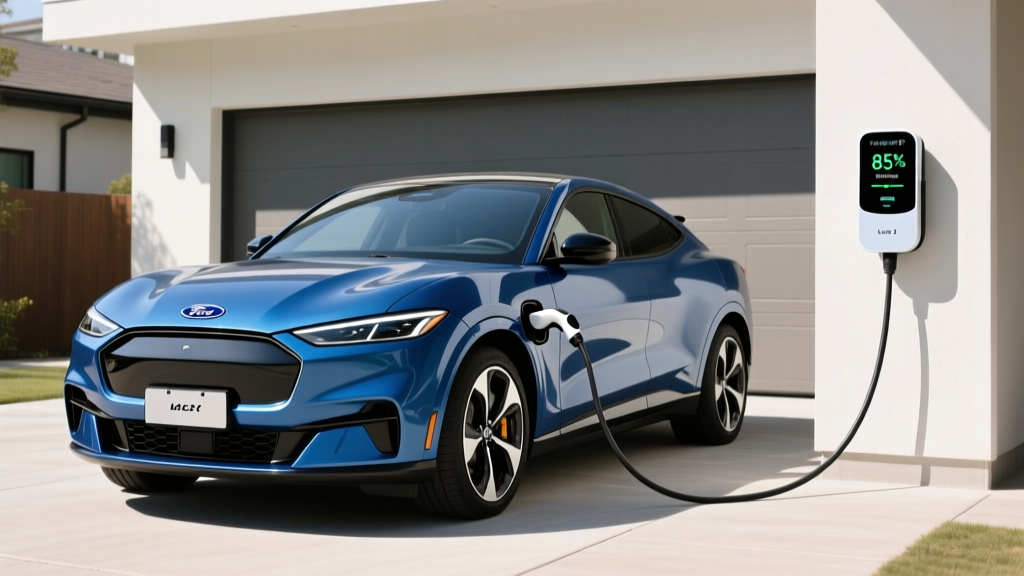
Owning a Ford Mustang Mach-E means making one critical infrastructure decision before or shortly after delivery: which charger to install at home and how to navigate public networks. The Mach-E's 91 kWh usable battery pack (Standard Range trims use a smaller 70 kWh pack) demands a thoughtful charging strategy. This guide walks through every charging scenario a Mach-E owner will face — from overnight Level 2 top-ups to cross-country DC fast charging — with exact numbers, real costs, and equipment recommendations that work in 2026.
Ford Mustang Mach-E Charging Specs at a Glance
Before choosing equipment, here are the Mach-E's hard charging numbers. These apply to current Extended Range and GT models with the 91 kWh usable (NMC chemistry) battery. Standard Range models with the 70 kWh pack charge proportionally faster due to smaller capacity.
| Specification | Value |
|---|---|
| Battery Capacity (usable) | 91 kWh (NMC) |
| EPA Range | 290–320 mi depending on trim |
| Max DC Fast Charge Rate | 150 kW peak |
| DC Fast Charge 10–80% | ~45 minutes (at 150 kW+ station) |
| Onboard Charger (Level 2) | 10.5 kW (48A at 240V) |
| Level 2 Charge Time (0–100%) | ~10.5 hours |
| Level 1 Charge Rate (120V) | ~1.4 kW (12A) |
| Charging Port | CCS1 (2021–2024); NACS (2025+ models) |
Charging Levels Explained: How Fast Each Adds Range
Understanding the difference between kW (power — how fast energy flows into the battery) and kWh (energy — the battery's total capacity) is essential. Think of kW as the width of the hose and kWh as the size of the bucket. A wider hose (higher kW) fills the bucket faster.
| Level | Voltage | Power (kW) | Miles of Range per Hour | Best Use Case |
|---|---|---|---|---|
| Level 1 | 120V AC | ~1.4 kW | ~3–4 mi/hr | Emergency / overnight trickle for low-mileage drivers |
| Level 2 | 240V AC | Up to 10.5 kW (Mach-E onboard limit) | ~25–30 mi/hr | Daily home charging — the standard for EV owners |
| DC Fast Charge | 400V+ DC | Up to 150 kW peak | ~150–200 mi in 20 min (tapers above 80%) | Road trips and quick top-ups away from home |
The Mach-E's 10.5 kW onboard charger is the bottleneck for Level 2 charging. Even if you install a 48-amp (11.5 kW) or 80-amp wall connector, the car will only accept 10.5 kW. This is important for equipment selection — you don't need to overspend on a charger that exceeds what the car can accept, though a higher-capacity unit gives you flexibility for a future EV.
Home Charger Installation: Electrical Requirements and Costs
A proper Level 2 home installation for the Mustang Mach-E requires a dedicated 240V circuit. Here's what your electrician will assess:
- Circuit amperage: A 60-amp breaker is ideal for a 48-amp continuous charge (the National Electrical Code requires breakers rated at 125% of continuous load). A 50-amp circuit (40A continuous / 9.6 kW) also works and is cheaper to install.
- Wire gauge: 6 AWG copper for a 60-amp circuit; 8 AWG for 50-amp.
- Electrical panel capacity: Most modern 200-amp service panels can handle a 60-amp EV circuit. Homes with 100-amp service or panels already near capacity may need a panel upgrade ($1,500–$3,500) or a smart load-management device like the Emporia Smart Load Center.
- Permit: Nearly all jurisdictions require an electrical permit for a new 240V circuit. This typically costs $50–$250 and ensures the work is inspected for code compliance.
How Much Does It Cost to Install a Home EV Charger?
Installation costs vary widely depending on your home's electrical setup and the distance from the panel to the charging location. Here's a realistic breakdown based on 2026 market rates:
| Component | Simple Install (panel near garage) | Complex Install (panel far / upgrade needed) |
|---|---|---|
| Level 2 Charger (hardware) | $400–$700 | $400–$700 |
| Electrician labor | $500–$1,200 | $1,500–$3,000 |
| Materials (wire, conduit, breaker) | $100–$300 | $300–$800 |
| Permit | $50–$150 | $100–$250 |
| Panel upgrade (if needed) | $0 | $1,500–$3,500 |
| Total | $1,050–$2,350 | $3,800–$8,250 |
The single biggest variable is whether your electrical panel needs an upgrade. Homes built after 2000 with 200-amp service and garage-adjacent panels typically fall in the simple-install range. Older homes, those with panels on the opposite side of the house from the garage, or those with 100-amp service will trend toward the higher end. Always get at least two quotes from licensed electricians — some may suggest load-management solutions that avoid a full panel upgrade.
Connector Compatibility: NACS vs CCS1 for the Mach-E
The Mustang Mach-E's charging connector depends on model year, and this directly affects which public chargers you can use without adapters.
| Model Year | Built-In Port | DC Fast Networks (native) | Tesla Supercharger Access |
|---|---|---|---|
| 2021–2024 | CCS1 | Electrify America, EVgo, ChargePoint, Ionity | Requires Ford-provided NACS adapter (free for owners; ~$200 replacement) |
| 2025+ | NACS | Tesla Supercharger network (15,000+ stalls in US) | Native — no adapter needed |
For 2021–2024 CCS1 Mach-E owners: Ford began shipping complimentary NACS adapters to registered owners in 2024. If you didn't receive one, contact your dealer or check the FordPass app. This adapter unlocks Tesla Supercharger stalls — critical since Tesla's network is the most reliable DC fast-charging infrastructure in the US. You can still use CCS1-native stations (Electrify America, EVgo) without the adapter.
For 2025+ NACS Mach-E owners: You plug directly into Tesla Superchargers. For CCS1 stations like Electrify America, you'll need a NACS-to-CCS adapter (available from Ford and third parties like Lectron for ~$150–$250). Carry one in your frunk for road trips outside Supercharger coverage.
For Level 2 home charging, all Mach-E model years use the standard J1772 connector (or NACS, which is J1772-compatible for AC charging via the same pins). Any Level 2 home charger with a J1772 plug or NACS connector will work.
Best Ford Mustang Mach-E Chargers for Home: Equipment Picks
Since the Mach-E accepts a maximum of 10.5 kW on Level 2, you need a charger that delivers at least 48 amps to maximize charge speed. Here are proven units that pair well with the Mach-E:
Ford Connected Charge Station
Power: 48A / 11.5 kW (Mach-E will draw 10.5 kW)
Connector: J1772 (CCS1 models) or NACS (2025+ models)
Cable Length: 25 ft
Smart Features: FordPass integration, scheduled charging, energy monitoring
Price: ~$599 (often included or discounted with new Mach-E purchase)
Best For: Seamless FordPass app integration and warranty simplicity
ChargePoint Home Flex
Power: Configurable up to 50A / 12 kW
Connector: J1772 (NACS adapter available)
Cable Length: 23 ft
Smart Features: Wi-Fi, app scheduling, Alexa integration, amperage adjustable via DIP switch
Price: ~$549
Best For: Flexibility across multiple EV brands and adjustable amperage for panel-limited homes
Tesla Wall Connector
Power: Up to 48A / 11.5 kW
Connector: NACS (J1772 adapter included in box)
Cable Length: 24 ft
Smart Features: Wi-Fi, over-the-air updates, power sharing between two units, load management
Price: ~$420
Best For: Best value in a premium charger; ideal for NACS-equipped 2025+ Mach-E or households with a Tesla + Ford
Emporia Vue Level 2 Charger
Power: Up to 48A / 11.5 kW
Connector: J1772
Cable Length: 24 ft
Smart Features: Whole-home energy monitoring via Emporia Vue panel, solar integration, scheduling
Price: ~$399
Best For: Budget-conscious buyers who want energy monitoring; pairs excellently with solar panels
Any of these chargers will fully charge a Mach-E Extended Range overnight (approximately 10–11 hours from near-empty). In practice, most owners arrive home with 40–60% battery remaining and wake up to 100% — or 80% if you set a charge limit to preserve long-term battery health.
Charging Cost: Home vs Public vs Gas
One of the strongest ownership arguments for the Mach-E is fuel cost. Here's how the numbers break down across charging scenarios, using the Extended Range model's 300-mile EPA range and 91 kWh battery as the baseline.
| Scenario | Rate | Cost for Full Charge (91 kWh) | Cost per Mile (300 mi range) |
|---|---|---|---|
| Home — off-peak utility rate | $0.08–$0.12/kWh | $7.28–$10.92 | $0.024–$0.036/mi |
| Home — standard residential rate | $0.14–$0.18/kWh | $12.74–$16.38 | $0.042–$0.055/mi |
| Public Level 2 (ChargePoint, etc.) | $0.25–$0.49/kWh | $22.75–$44.59 | $0.076–$0.149/mi |
| DC Fast Charge (Electrify America, EVgo) | $0.35–$0.55/kWh | $31.85–$50.05 | $0.106–$0.167/mi |
| Tesla Supercharger (varies by location) | $0.25–$0.40/kWh | $22.75–$36.40 | $0.076–$0.121/mi |
| Gas equivalent (25 MPG combined, $3.40/gal) | $3.40/gal | $40.80 (12 gal equivalent) | $0.136/mi |
The bottom line: Home charging at off-peak rates costs roughly 3 cents per mile — about one-quarter the cost of gasoline. Even expensive public DC fast charging generally matches or undercuts gas on a per-mile basis. The savings compound: a driver covering 12,000 miles annually saves $1,200–$1,500 per year charging at home versus fueling a comparable gas vehicle. Over five years, that's $6,000–$7,500 in fuel savings, according to fueleconomy.gov comparisons.
Pro tip: Many utilities offer time-of-use (TOU) plans with deeply discounted overnight rates (10 PM – 6 AM). Setting your Mach-E or charger to schedule charging during off-peak hours can cut your electricity cost nearly in half compared to standard rates.
Public DC Fast Charging: What to Expect on Road Trips
The Mach-E's 150 kW peak DC fast-charge rate is competitive but not class-leading (the Hyundai Ioniq 5 peaks at 240 kW on 800V architecture). Here's what real-world DC fast charging looks like:
- 10–80% charge time: Approximately 45 minutes at a 150 kW+ station. The charge curve tapers significantly above 80% to protect battery longevity — going from 80–100% can take an additional 25–35 minutes.
- Preconditioning: The Mach-E will precondition its battery when you navigate to a DC fast charger via the built-in navigation or FordPass app. This warms the pack to optimal charging temperature and can shave 5–10 minutes off your session, especially in cold weather. Always navigate to the charger rather than just driving there.
- Station reliability: As of 2026, Tesla Superchargers (now accessible to Mach-E via adapter or native NACS) maintain the highest uptime at approximately 98%. Electrify America and EVgo have improved but still experience occasional stall outages — always have a backup station in your route plan.
- Charging curve reality: The Mach-E peaks at 150 kW only between roughly 10–30% state of charge. It then steps down to ~100 kW through 60%, and further to ~50 kW above 80%. The advertised "10–80% in 45 minutes" assumes a station that can sustain the peak rate.
Safety and Code Considerations for Home Installation
Your Level 2 charger installation must comply with the National Electrical Code (NEC) and local amendments. Key requirements your electrician will address:
- Dedicated circuit: The EV charger must be on its own dedicated breaker — it cannot share a circuit with other appliances.
- GFCI protection: The 2020 NEC and later require GFCI (Ground Fault Circuit Interrupter) protection for all 240V EV charging outlets in garages and outdoor locations. Hardwired chargers may have built-in GFCI; if using a NEMA 14-50 receptacle, a GFCI breaker is required.
- Outdoor rating: If your charger is installed outdoors (carport, driveway), the unit must carry an NEMA 4 or IP65 weather rating. All units recommended above meet outdoor standards.
- Cable management: The NEC prohibits charging cables from running across walkways or creating trip hazards. Plan your charger location to keep the cable within your parking footprint.
- Wi-Fi connectivity: Not a code requirement, but a practical one — smart chargers with Wi-Fi enable scheduled charging, energy monitoring, and firmware updates that improve reliability over time.
Frequently Asked Questions
Can I charge my Mustang Mach-E with a regular 120V outlet?
Yes, but slowly. A standard 120V household outlet delivers approximately 1.4 kW, adding about 3–4 miles of range per hour. A full charge from empty would take roughly 65 hours. Level 1 is viable only if you drive less than 30 miles per day and can leave the car plugged in overnight. For any real-world usage pattern, a Level 2 installation is strongly recommended.
Does the Mustang Mach-E qualify for the federal EV tax credit?
As of 2026, the IRS §30D clean vehicle credit provides up to $7,500 for qualifying new EVs, but eligibility depends on battery component and critical mineral sourcing, buyer income caps ($300K joint / $150K single), and MSRP limits ($55,000 for sedans, $80,000 for SUVs/trucks). The Mach-E qualifies as an SUV for the $80,000 MSRP cap. However, battery sourcing requirements have tightened significantly — check the latest eligibility list on fueleconomy.gov before purchasing, as qualifying trims can change quarterly. The credit can now be transferred to the dealer at point of sale, reducing your purchase price directly.
How long does the Mach-E battery last before needing replacement?
Ford warranties the high-voltage battery for 8 years / 100,000 miles, guaranteeing it will retain at least 70% of original capacity. Real-world data from high-mileage Mach-E owners and similar NMC packs suggests 10–15% degradation over 100,000 miles is typical. A full battery replacement outside warranty currently costs approximately $15,000–$20,000, though prices are declining as battery manufacturing scales. Setting your daily charge limit to 80% (via FordPass) and avoiding frequent DC fast charging in extreme heat will maximize long-term battery health.
Should I get a hardwired charger or a plug-in (NEMA 14-50) unit?
Hardwired installations are slightly cheaper (no receptacle cost), can support higher amperage without GFCI breaker requirements, and eliminate the risk of a loose plug connection. Plug-in (NEMA 14-50) installations offer portability — you can take the charger when you move and unplug it for troubleshooting. Most EV owners choose hardwired for a permanent garage installation. If you rent or plan to move within a few years, a plug-in unit makes more sense.
Is it worth installing a 48-amp charger if the Mach-E only accepts 10.5 kW?
A 48-amp charger delivers up to 11.5 kW, and the Mach-E will use 10.5 kW of that — you're only leaving 1 kW on the table. Installing a 48-amp (60-amp circuit) charger is worthwhile because it future-proofs your garage for a next EV with a larger onboard charger, costs only marginally more than a 40-amp installation, and ensures you're always getting the Mach-E's maximum Level 2 speed.