Why Understanding Charging Is the Key to Maximizing Ford Mach-E Range
The Ford Mustang Mach-E delivers between 230 and 320 miles of EPA-estimated range depending on battery pack and drivetrain. But that sticker number is only the starting point. Real-world Ford Mach-E range depends heavily on how you charge, where you charge, and how well you understand the relationship between your battery's usable capacity (measured in kilowatt-hours, or kWh) and the speed at which energy flows into it (measured in kilowatts, or kW).
Confusing kW with kWh is the single most common EV literacy gap. Think of it this way: kWh is the size of your fuel tank (energy stored), while kW is how fast the pump fills it (power delivered). A 91 kWh battery charged at 10.5 kW takes roughly 8.7 hours from empty. That same battery on a 150 kW DC fast charger can recover 80% in about 45 minutes. The difference transforms how you plan road trips, size your home charger, and budget for electricity.
This guide covers every charging scenario a Mach-E owner will face — from overnight Level 2 top-ups at home to DC fast charging on the highway — with exact numbers, equipment picks, and installation realities.
Ford Mach-E Battery and Range Specifications (2025–2026 Models)
Before we discuss charging, let's establish what you're charging. The current Mach-E lineup uses two battery sizes and offers rear-wheel drive (RWD) and all-wheel drive (eAWD) configurations. Ford uses NMC (nickel manganese cobalt) chemistry in both packs, prioritizing energy density for longer range.
| Configuration | Battery (Usable kWh) | EPA Range | Real-World Range Estimate* | Peak DC Charge Rate | 10–80% DC Time |
|---|---|---|---|---|---|
| Standard Range RWD | 70 kWh (LFP)** | 250 mi | 210–230 mi | 115 kW | ~38 min |
| Extended Range RWD | 91 kWh (NMC) | 320 mi | 270–295 mi | 150 kW | ~45 min |
| Extended Range eAWD | 91 kWh (NMC) | 290 mi | 245–270 mi | 150 kW | ~45 min |
| GT (AWD) | 91 kWh (NMC) | 280 mi | 235–260 mi | 150 kW | ~45 min |
*Real-world estimates account for highway driving at 70+ mph, moderate climate use, and temperatures between 40–85°F. Cold weather (below 30°F) can reduce range by 15–30% due to battery heating demands and cabin climate load.
**The 2025 Standard Range model transitioned to LFP (lithium iron phosphate) chemistry, which supports routine 100% charging without degradation concerns — a significant advantage for daily commuters.
Charging Levels Explained: Speeds, Times, and Range Recovery
Every Mach-E owner will use some combination of three charging levels. Here's what each delivers in concrete terms.
| Level | Voltage / Amperage | Max Power (kW) | Miles of Range per Hour | Best Use Case |
|---|---|---|---|---|
| Level 1 (120V) | 120V / 12A | 1.4 kW | 3–5 mi/hr | Emergency top-up, PHEVs, low-mileage drivers |
| Level 2 (240V) | 240V / 32–48A | 7.7–11.5 kW | 20–37 mi/hr | Daily home charging, overnight full charge |
| DC Fast Charge | 400V+ DC | 115–150 kW (Mach-E) | 150–300+ mi/hr (peak) | Road trips, rapid top-ups away from home |
Level 1: The Emergency Backup
Every Mach-E ships with a mobile charge cord that plugs into a standard 120V household outlet. At 1.4 kW, you'll recover roughly 3–5 miles of range per hour — about 35–50 miles overnight. This is adequate for plug-in hybrids but impractical as a primary strategy for a 70–91 kWh battery. A full charge from empty on Level 1 takes 50–65 hours.
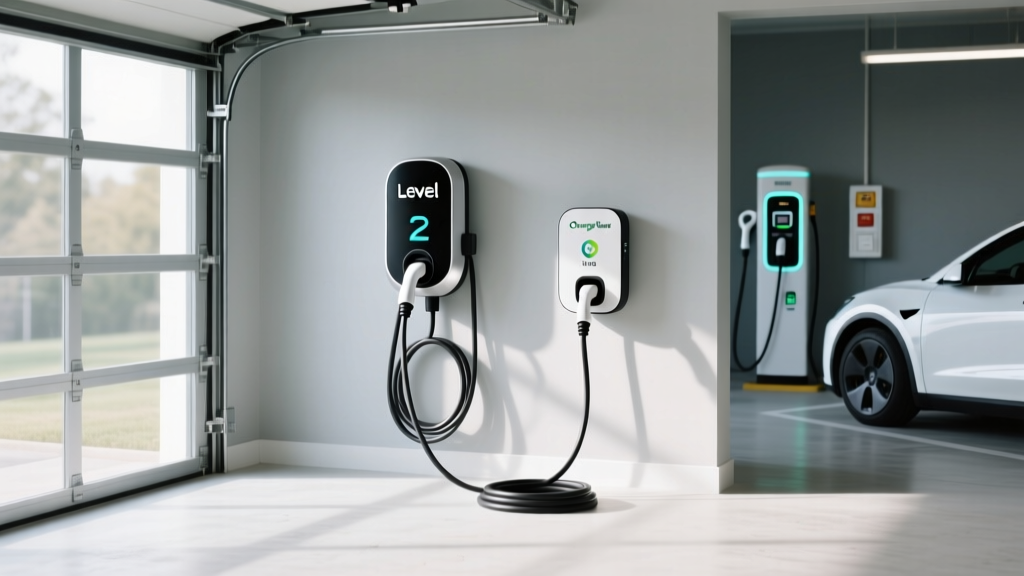
Level 2: The Home Charging Sweet Spot
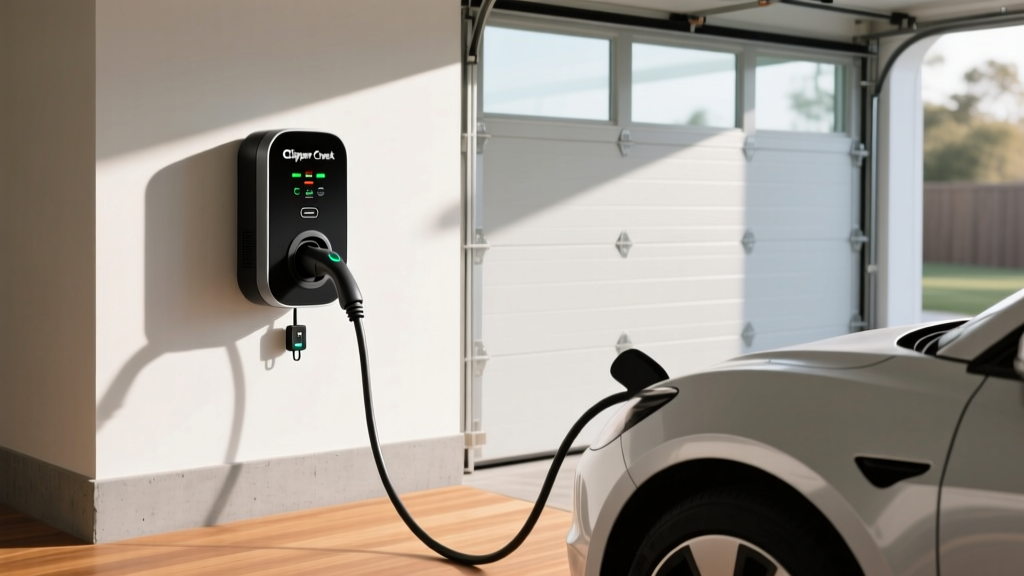
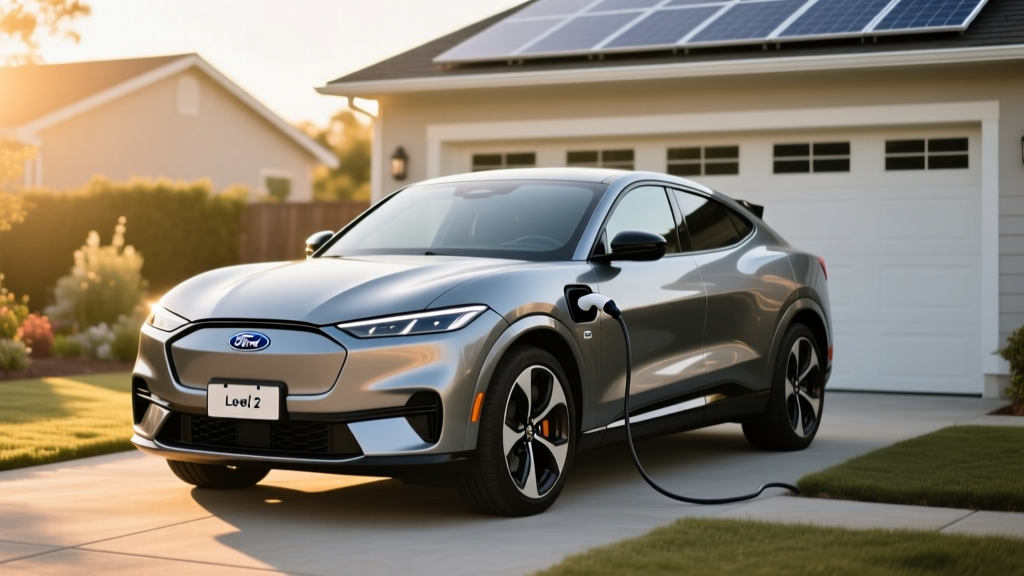
A 240V Level 2 charger is the backbone of practical EV ownership. The Mach-E's onboard charger accepts up to 10.5 kW (at 48 amps) on Extended Range models and 10.5 kW on Standard Range models. At this rate, you'll add roughly 30–37 miles of range per hour, fully replenishing a depleted Extended Range battery in about 9 hours — perfect for overnight charging.
The included Ford Mobile Power Cord delivers up to 30 amps (7.2 kW) on a 240V NEMA 14-50 outlet, adding about 22 miles per hour. For the full 10.5 kW experience, you'll need a dedicated 48-amp wall-mounted charger on a 60-amp circuit.
DC Fast Charging: Road Trip Essential
DC fast charging bypasses the onboard charger entirely, sending high-power direct current straight to the battery. The Mach-E Extended Range peaks at 150 kW on compatible CCS or NACS chargers, though peak rate is only sustained at lower states of charge (typically 10–40% SoC). Above 80%, the charge curve tapers significantly — a 150 kW peak may drop to 40–50 kW above 80% SoC to protect battery longevity.
For road trip planning, budget 45 minutes for a 10–80% session on a 150 kW charger. If you only need a quick 20–60% top-up, expect about 20–25 minutes.
Home Charger Installation: Requirements, Costs, and Gotchas
Installing a dedicated Level 2 home charger is the single biggest upgrade you can make for daily Mach-E ownership. Here's what's involved and what it actually costs.
Electrical Requirements
To achieve the Mach-E's maximum 10.5 kW Level 2 rate, you need a 48-amp charger hardwired to a dedicated 60-amp, 240V circuit. If you opt for a plug-in charger using a NEMA 14-50 outlet, you're limited to 40 amps continuous (9.6 kW) on a 50-amp circuit — still excellent for overnight charging.
Your electrical panel must have sufficient capacity. Most modern homes with 200-amp service can accommodate a 60-amp EV circuit without a panel upgrade. Older homes with 100-amp service often require an upgrade to 200 amps, which adds $1,500–$3,000 to the project.
Installation Cost Breakdown
| Component | Budget Scenario | Typical Scenario | Complex Scenario |
|---|---|---|---|
| Level 2 Charger (40–48A) | $350–$500 | $500–$700 | $600–$800 |
| Electrician Labor | $200–$400 | $400–$800 | $800–$1,500 |
| Electrical Permit | $50–$100 | $100–$200 | $100–$250 |
| Panel Upgrade (if needed) | N/A | $1,500–$2,500 | $2,500–$4,000 |
| Total | $600–$1,000 | $1,000–$1,700 | $2,000–$4,550 |
The "budget" scenario assumes your panel has open slots, the charger location is near the panel (short wire run under 20 feet), and no conduit or trenching is needed. The "complex" scenario includes long wire runs through finished walls, conduit requirements, or a panel upgrade. Always get 2–3 quotes from licensed electricians and confirm they pull a permit — unpermitted work can void your homeowner's insurance and cause issues at sale time.
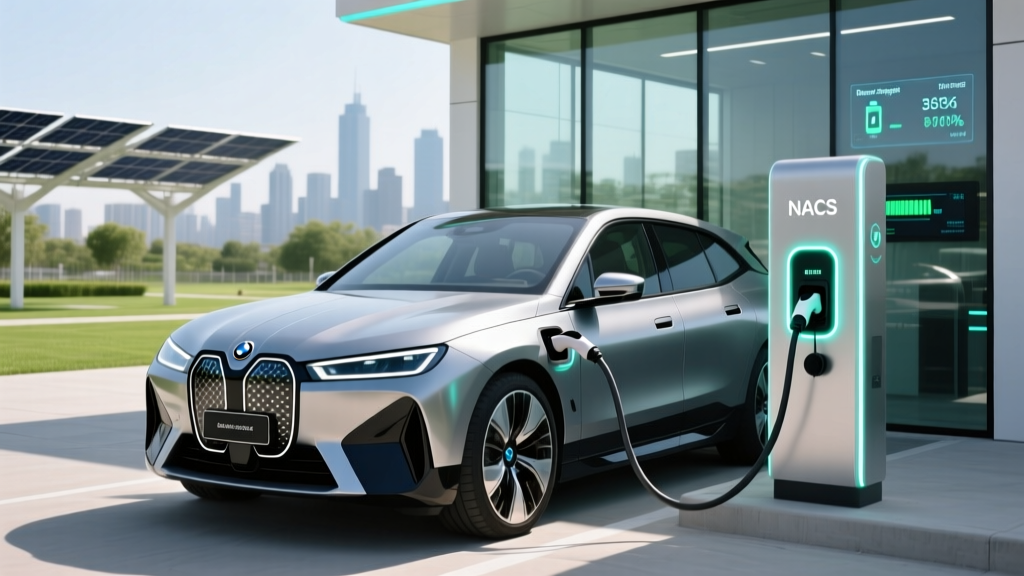
Connector Compatibility: NACS, CCS, and the Adapter Question
The Mach-E's charging port compatibility has evolved significantly. Here's where things stand for current and recent model-year vehicles.
| Model Year | Built-In Port | Tesla Supercharger Access | CCS Public Chargers | Adapter Needed? |
|---|---|---|---|---|
| 2021–2024 | CCS1 | Yes (with Ford-provided NACS adapter) | Native — no adapter | NACS adapter for Superchargers |
| 2025–2026 | NACS (Tesla-style) | Native — no adapter | Yes (with CCS adapter) | CCS adapter for non-Tesla DC chargers |
What this means practically: If you're buying a 2025–2026 Mach-E, your native port is NACS. You can plug directly into any Tesla Supercharger — and the Ford Supercharger network access includes over 20,000 stalls nationwide. For Electrify America, EVgo, and other CCS-equipped networks, you'll need a NACS-to-CCS adapter (typically $150–$250 from Ford or third-party suppliers like Lectron).
If you own a 2021–2024 Mach-E with a CCS port, Ford has made a NACS adapter available (often at no cost through a Ford program) that unlocks the Supercharger network. Verify adapter availability through your FordPass account or local dealer.
Home charging note: Level 2 home chargers use the J1772 connector standard for non-Tesla chargers, and all Mach-E models accept J1772 natively for Level 2 AC charging. Tesla Wall Connectors can be configured with a J1772 adapter or purchased in a NACS configuration for 2025+ models.
Cost to Charge Your Mach-E: Home vs. Public vs. Gas Comparison
One of the strongest arguments for the Mach-E is fuel cost savings, but the actual savings depend heavily on where and when you charge. Let's run the numbers using the Extended Range RWD model (91 kWh battery, 320 EPA miles, ~280 real-world miles per full charge).
| Scenario | Rate | Cost for Full Charge (91 kWh) | Cost per Mile | Annual Fuel Cost* |
|---|---|---|---|---|
| Home (off-peak utility rate) | $0.10/kWh | $9.10 | $0.033 | $495 |
| Home (national avg. residential) | $0.17/kWh | $15.47 | $0.055 | $825 |
| Public Level 2 (ChargePoint, etc.) | $0.30/kWh | $27.30 | $0.098 | $1,470 |
| DC Fast Charge (Electrify America) | $0.48/kWh | $43.68 | $0.156 | $2,340 |
| Gas Vehicle (27 MPG, $3.40/gal) | — | $35.26 per 280 mi | $0.126 | $1,890 |
*Based on 15,000 miles driven annually. Real costs vary by local electricity rates, driving habits, and charging mix.
The takeaway is clear: home charging on an off-peak rate delivers fuel costs roughly 75% lower than a comparable gas vehicle. Even at the national average residential rate, you're saving about $1,000 per year. However, if you rely exclusively on DC fast charging, your "fuel" costs can actually exceed gasoline — a critical consideration for apartment dwellers without home charging access.
Many utilities offer time-of-use (TOU) plans that drop rates to $0.06–$0.12/kWh during overnight hours (typically 11 PM–6 AM). Check with your utility about EV-specific rate plans — some offer $0.05/kWh or lower during super-off-peak windows. According to the U.S. Department of Energy's EV fuel cost calculator, the national average e-gallon equivalent is roughly $1.20–$1.50 when charging at home.
Recommended Home Chargers for the Ford Mach-E
Here are three proven Level 2 chargers that pair well with the Mach-E's 10.5 kW onboard charger capability, selected for reliability, smart features, and value.
Emporia Level 2 Smart Charger — Best Value
- Power Output: 48A / 11.5 kW (hardwired) or 40A / 9.6 kW (NEMA 14-50 plug)
- Connector: J1772 (compatible with all Mach-E model years for Level 2)
- Cable Length: 24 feet
- Smart Features: Wi-Fi connected, energy monitoring, scheduling via app, solar integration
- Price: ~$399 (hardwired) / ~$449 (plug-in)
- Why it works: Full 48A output maximizes the Mach-E's onboard charger. Energy monitoring helps track charging costs. One of the best price-to-performance chargers available.
ChargePoint Home Flex — Best Smart Features
- Power Output: Up to 50A / 12 kW (adjustable, hardwired) or up to 40A (NEMA 14-50)
- Connector: J1772
- Cable Length: 23 feet
- Smart Features: Wi-Fi, Alexa integration, detailed app analytics, flexible amperage settings (16–50A)
- Price: ~$649
- Why it works: Adjustable amperage lets you match your circuit capacity precisely — ideal if your panel is tight on headroom. Excellent app and scheduling features for TOU rate optimization.
Tesla Wall Connector (J1772 version) — Best Build Quality
- Power Output: 48A / 11.5 kW (hardwired on 60A circuit)
- Connector: J1772 (Magic Dock version also available with NACS)
- Cable Length: 24 feet
- Smart Features: Wi-Fi, over-the-air updates, power sharing between two units, load management
- Price: ~$450 (J1772 version)
- Why it works: Sleek design, robust build, and power-sharing capability if you plan to add a second EV. The J1772 version works with all Mach-E model years.
Important: All three chargers require a dedicated 240V circuit installed by a licensed electrician. The 48A models need a 60-amp breaker. Never share a circuit with other high-draw appliances (dryers, ranges, HVAC). Per the National Electrical Code (NEC), continuous loads like EV chargers must be rated at no more than 80% of the circuit breaker rating — so a 48A charger requires a 60A breaker, and a 40A charger requires a 50A breaker.
Safety and Code Considerations
EV charger installation is not a DIY project. Improper wiring can cause fires, void insurance, and fail inspection. Here's what a proper installation includes:
- Dedicated circuit: Your charger must have its own breaker — no sharing with other outlets or appliances.
- GFCI protection: The NEC (2023 and 2026 editions) requires GFCI protection for all EV charging outlets. Hardwired chargers with built-in ground-fault protection satisfy this requirement.
- Outdoor rating: If your charger is installed outside or in an unenclosed carport, it must carry a NEMA 4 (weatherproof) rating. All three recommended chargers above are outdoor-rated.
- Wire gauge: A 60-amp circuit requires 6 AWG copper wire (or 4 AWG aluminum). Your electrician will size this correctly based on run length and local code.
- Permit and inspection: Most jurisdictions require an electrical permit for EV charger installation ($50–$250). The work must pass a final inspection. Do not skip this step — it protects you legally and ensures safety.
For a detailed overview of federal and state EV infrastructure incentives, consult the Alternative Fuels Data Center, which maintains a current database of charger rebates and tax incentives by state.
Charging Times for the Mach-E: Real Scenarios
Here's how long charging actually takes in common scenarios, accounting for real-world charge curve behavior:
| Scenario | Charger Type | SoC Range | Time (Extended Range, 91 kWh) | Range Added |
|---|---|---|---|---|
| Overnight home charge | 48A Level 2 (10.5 kW) | 10–100% | ~8.5 hours | ~288 mi |
| Quick home top-up | 32A Level 2 (7.7 kW) | 30–80% | ~6 hours | ~160 mi |
| Road trip DC fast | 150 kW DCFC | 10–80% | ~45 minutes | ~224 mi |
| Highway pit stop | 150 kW DCFC | 20–60% | ~20 minutes | ~112 mi |
| Emergency Level 1 | 12A / 120V (1.4 kW) | 20–50% | ~19 hours | ~84 mi |
Charge curve reality check: The 150 kW peak rate only applies at low states of charge (roughly 10–35% SoC) with a preconditioned battery. As the battery fills, the rate tapers — from 150 kW down to roughly 80 kW at 60% SoC, and further to 40–50 kW above 80%. This is why 10–80% takes 45 minutes, not 33 minutes (which a flat 150 kW rate would suggest). Always plan road trip stops around 10–80% sessions rather than trying to charge to 100% on DC — the last 20% takes nearly as long as the first 70%.
Frequently Asked Questions
How much does it cost to install a home EV charger for my Mach-E?
A typical Level 2 home charger installation costs $1,000–$1,700 including the charger ($350–$700), electrician labor ($400–$800), and permit ($100–$200). If your home needs a 200-amp panel upgrade, add $1,500–$3,000. Homes with existing 200-amp service and a short wire run to the garage are at the low end; older homes with 100-amp panels and long conduit runs are at the high end.
How fast will each charging level add range to my Mach-E?
Level 1 (120V) adds 3–5 miles per hour. Level 2 (240V, 48A) adds 30–37 miles per hour — enough to fully replenish overnight. DC fast charging at 150 kW adds up to 150–300 miles per hour at peak rate (low SoC), though average rate over a 10–80% session is closer to 75–90 kW.
Which connector is compatible with my Mach-E?
Model years 2021–2024 have a CCS1 port and need a NACS adapter for Tesla Superchargers. Model years 2025–2026 have a native NACS port and need a CCS adapter for Electrify America and other CCS networks. All model years accept J1772 for Level 2 home and public AC charging.
How much does charging a Mach-E cost per mile compared to gas?
At home on the national average electricity rate ($0.17/kWh), the Mach-E Extended Range costs about $0.055 per mile. A comparable gas SUV at 27 MPG and $3.40/gallon costs about $0.126 per mile. Home charging saves roughly $0.07 per mile, or about $1,050 per year at 15,000 miles. Off-peak home rates can drop this to $0.033/mile.
What electrical upgrades might I need for a home charger?
The most common upgrade is a panel capacity increase from 100 amps to 200 amps ($1,500–$3,000) if your existing panel lacks headroom for a 60-amp EV circuit. Other potential upgrades include adding a sub-panel ($500–$1,200) if the main panel is full, running conduit for long wire runs ($5–$15 per foot), or installing a smart load-management device ($500–$800) to avoid a panel upgrade by dynamically sharing capacity between the charger and other appliances.
Should I charge my Mach-E to 100% every night?
For Extended Range models with NMC batteries, Ford recommends setting the charge limit to 80–90% for daily use to maximize long-term battery health. Use 100% only when you need maximum range for a trip. For 2025 Standard Range models with LFP batteries, routine 100% charging is fine and actually recommended periodically for accurate state-of-charge calibration. The Mach-E's battery management system includes a buffer that protects against true overcharge regardless of chemistry.