The Ford Lightning Charging Landscape at a Glance
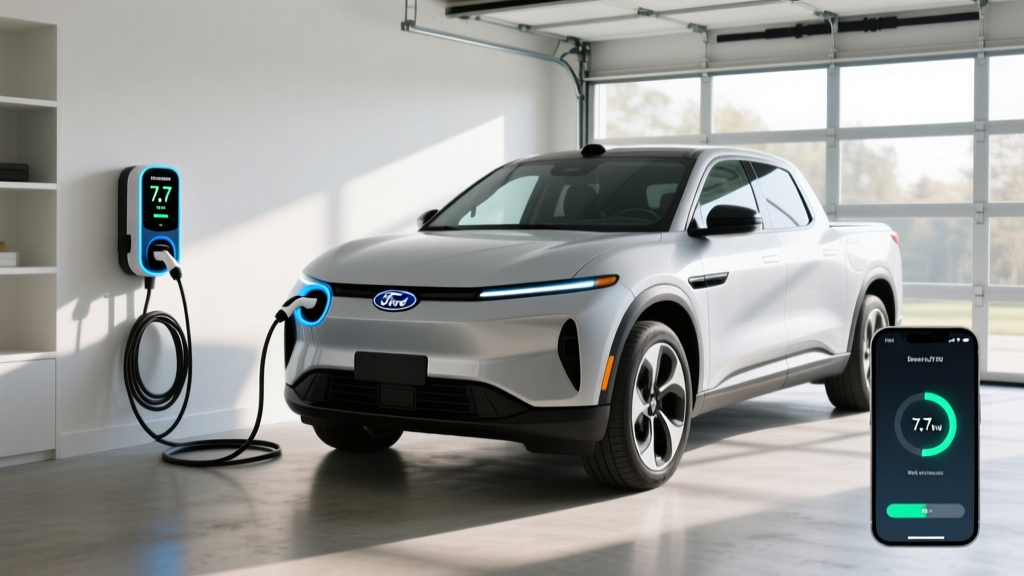
The Ford F-150 Lightning packs either a 98 kWh usable (Standard Range) or 131 kWh usable (Extended Range) lithium-ion NMC battery. That's a lot of energy to replenish — and how you choose to refill it determines whether you're waiting 80 hours on a wall outlet or 41 minutes at a DC fast charger. Getting the right Ford Lightning charger setup at home is the single biggest ownership upgrade you can make after taking delivery.
This guide walks through every charging tier, the exact electrical requirements for home Level 2 installation, real-world cost math, and the best charger hardware available for the Lightning in 2026. Whether you own the Pro, XLT, Lariat, or Platinum trim, the physics are the same — only your battery size changes the clock.
- Standard Range: 98 kWh usable | EPA 240 mi | Real-world highway ~200–215 mi
- Extended Range: 131 kWh usable | EPA 320 mi | Real-world highway ~260–280 mi
Source: fueleconomy.gov. Cold weather (below 32°F) can reduce range 15–30%.
Charging Levels Explained: kW, Miles Per Hour, and 10–80% Times
Before picking hardware, you need to understand the three charging tiers and what they actually deliver to a Lightning. Remember: kW (kilowatts) measures power — how fast energy flows into the battery. kWh (kilowatt-hours) measures energy — the battery's total capacity. Think of kW as the width of a hose and kWh as the size of the bucket.
| Level | Voltage | Power (kW) | Miles of Range Added/Hour | 10–80% Time (Std Range 98 kWh) | 10–80% Time (Ext Range 131 kWh) |
|---|---|---|---|---|---|
| Level 1 (120V outlet) | 120V / 12A | ~1.4 kW | ~2–3 mi/hr | ~58 hours | ~78 hours |
| Level 2 (240V home/public) | 240V / 32–80A | 7.7–19.2 kW | ~13–30 mi/hr | 6–11 hours | 8–15 hours |
| DC Fast Charging | 400V+ DC | Up to 150 kW (Std) / 150 kW (Ext) | ~150–220 mi in 30 min | ~41 min | ~41 min |
A few critical nuances:
- The Lightning's onboard charger caps at 10.5 kW on single-phase AC (Standard Range) and 19.2 kW when equipped with the optional 80A Charge Station Pro and the dual onboard charger package (Extended Range trims). Even if you plug into a 19.2 kW wall unit, a Standard Range Lightning will only pull ~10.5 kW.
- DC fast charging peaks early, then tapers. Ford quotes 15–80% in roughly 41 minutes at a 150 kW station. Expect peak rates of 120–150 kW from 15–50% SoC, tapering to ~60 kW above 70%, and ~30 kW above 85%. This charge-curve taper is normal battery-protection behavior.
- Level 1 is emergency-only for a Lightning. Adding 3 miles per hour means a depleted Extended Range battery takes over three days to fill. It's fine for topping off a PHEV, but not a full-size electric truck.
Home Level 2 Installation: Electrical Requirements, Panel Upgrades, and Real Costs
Most Lightning owners install a 240V Level 2 home charger — the sweet spot for overnight replenishment. Here's what that actually requires from your home's electrical system.
Baseline Electrical Requirements
- Circuit: Dedicated 240V circuit, sized at 125% of the charger's continuous draw (NEC Article 625). A 40A charger needs a 50A breaker; a 48A charger needs a 60A breaker; an 80A charger needs a 100A breaker.
- Wire gauge: Typically 6 AWG copper for 50A circuits, 4 AWG for 60A, and 3 AWG or 2 AWG for 80–100A circuits. Long runs may require upsizing.
- Outlet vs. hardwired: A NEMA 14-50 outlet (50A) offers portability — you can take the charger when you move. Hardwired units support higher amperage (60A, 80A) and avoid GFCI breaker nuisance-tripping issues common with 14-50 receptacles on some panels.
- GFCI protection: NEC 2020+ requires GFCI on receptacle-based EV circuits in garages. Some EV chargers have built-in ground-fault protection, making hardwired installs simpler.
The Panel-Upgrade Reality
This is the cost item most online guides gloss over. The average US home has a 100A or 200A main service panel. Adding a 50A or 60A EV circuit to an already-loaded 100A panel may exceed capacity, especially if you run electric HVAC, an electric dryer, and an electric oven simultaneously.
You'll likely need a panel upgrade if:
- Your home has a 100A main breaker and you already have multiple 240V appliances.
- Your panel has no open slots for a double-pole breaker.
- Your panel is a legacy brand (Federal Pacific, Zinsco) that an electrician flags as unsafe.
A panel upgrade from 100A to 200A typically costs $1,500–$3,500 depending on utility coordination, conduit runs, and local permitting. For a 200A-to-400A upgrade (needed for 80A charger circuits on heavily loaded homes), expect $3,000–$5,000+.
Installation Cost Breakdown
| Component | Simple Install (Near Panel, 240V/50A) | Moderate Install (50–80 ft run) | Complex Install (Panel Upgrade + Long Run) |
|---|---|---|---|
| EV Charger Equipment | $400–$700 | $400–$700 | $500–$1,200 |
| Electrician Labor | $300–$600 | $600–$1,200 | $1,500–$3,500 |
| Permit & Inspection | $50–$150 | $50–$200 | $100–$300 |
| Panel Upgrade (if needed) | $0 | $0 | $1,500–$5,000 |
| Total Estimated Cost | $750–$1,450 | $1,050–$2,100 | $3,600–$10,000 |
Always get 2–3 quotes from licensed electricians who list EV charger installation as a specialty. Ask whether the quote includes the permit, the breaker, the conduit, and any trenching if the run goes outdoors. According to NHTSA safety guidance, all EV charging equipment should be UL-listed or ETL-certified.
Connector Compatibility: NACS, CCS1, and Adapter Options for the Lightning
The Ford F-150 Lightning's charge-port connector depends on when it was built and which network you're using:
| Connector Standard | Lightning Compatibility | Notes |
|---|---|---|
| CCS1 (Combined Charging System) | Native on 2022–2024 Lightnings | Standard on Electrify America, EVgo, most non-Tesla DC networks |
| NACS (North American Charging Standard / Tesla) | Native on 2025+ Lightnings; adapter available for 2022–2024 models | Ford began shipping NACS-equipped Lightnings in late 2024; Ford-provided adapter unlocks Tesla Supercharger access for CCS1-port trucks |
| CHAdeMO | Not compatible | Largely obsolete in the US; no adapter recommended |
| J1772 (Level 2 AC) | Native on all Lightnings (AC portion of CCS1/NACS port) | Universal for Level 2 public and home charging |
Key takeaway for 2026 buyers: If you're purchasing a new 2025 or 2026 F-150 Lightning, it ships with a NACS port and has native access to Tesla Superchargers (17,000+ stalls in North America). If you own a 2022–2024 Lightning with a CCS1 port, request the Ford-approved NACS adapter (often provided free or at low cost through Ford dealers) to unlock Supercharger access. For home Level 2 charging, any J1772 or NACS-equipped wall charger works — the AC charging protocol is identical.
Cost to Charge: Lightning Per-Mile Cost vs. a Gas F-150
Charging economics are where the Lightning earns its keep — but costs vary dramatically by where and when you plug in. Here's the real math for a Lightning Extended Range (131 kWh battery, EPA 320 mi, real-world ~270 mi highway).
The Lightning Extended Range averages roughly 2.0–2.2 kWh per mile in mixed driving (EPA combined efficiency ~48–50 MPGe). Let's use 2.1 kWh/mi for calculations.
| Charging Scenario | Rate ($/kWh) | Cost for Full 131 kWh Fill | Cost Per Mile (~270 real-world mi) |
|---|---|---|---|
| Home off-peak (utility TOU rate) | $0.08–$0.12 | $10.50–$15.70 | $0.04–$0.06 |
| Home standard rate (national avg) | $0.16 | $20.96 | $0.08 |
| Public Level 2 (workplace, mall) | $0.20–$0.35 | $26.20–$45.85 | $0.10–$0.17 |
| DC Fast Charging (Electrify America, EVgo) | $0.35–$0.55 | $45.85–$72.05 | $0.17–$0.27 |
| Tesla Supercharger (NACS-equipped) | $0.25–$0.40 | $32.75–$52.40 | $0.12–$0.19 |
Gas F-150 comparison: A 2026 F-150 3.5L EcoBoost 4x4 averages ~20 MPG combined. At $3.40/gallon (2026 national average), that's $0.17 per mile. The Lightning charged at home off-peak costs roughly one-third as much per mile. Even DC fast charging at $0.45/kWh is only marginally more expensive than gas — and most Lightning owners do 80%+ of charging at home.
For the Standard Range Lightning (98 kWh, ~2.0 kWh/mi, EPA 240 mi), multiply the full-fill costs above by 0.75. Home off-peak fills cost roughly $8–$12.
Best Home Chargers for the Ford Lightning: Equipment Picks
Choosing a charger means matching the Lightning's onboard charger limit, your home's electrical capacity, and your budget. Here are top picks across three tiers:
Budget Pick: Emporia Vue Level 2 Charger
- Power Output: 48A / 11.5 kW (240V, hardwired on 60A breaker)
- Connector: J1772 (universal Level 2)
- Cable Length: 24 ft
- Smart Features: Wi-Fi, app scheduling, energy monitoring, solar integration
- Price: ~$400
- Best For: Standard Range Lightning owners who need reliable overnight charging without premium pricing
Best Overall: ChargePoint Home Flex
- Power Output: Up to 50A / 12 kW (NEMA 14-50) or up to 80A / 19.2 kW (hardwired, 100A breaker)
- Connector: J1772 (NACS adapter available separately)
- Cable Length: 23 ft
- Smart Features: Wi-Fi, Alexa integration, flexible amperage via DIP switches, scheduled charging, detailed session logs
- Price: ~$550–$700
- Best For: Extended Range Lightning owners who want to maximize the 19.2 kW onboard charger capability with a hardwired 80A install
Premium Pick: Ford Charge Station Pro
- Power Output: 80A / 19.2 kW (hardwired, 100A breaker)
- Connector: NACS (native on 2025+ Lightnings) / CCS1-compatible via Ford ecosystem
- Cable Length: 25 ft
- Smart Features: FordPass integration, Intelligent Backup Power (V2H — powers your home during outages when paired with the Home Integration System), OTA updates
- Price: ~$1,300 (charger) + ~$3,000–$5,000 for Home Integration System + install
- Best For: Lightning owners who want bidirectional power (vehicle-to-home) and the deepest FordPass integration
A note on amperage matching: The Standard Range Lightning's onboard charger maxes out at ~10.5 kW (44A at 240V). Installing an 80A/19.2 kW ChargePoint or Ford Charge Station Pro will work perfectly — the truck simply draws only what it can accept. If you plan to own future EVs with higher AC acceptance rates, oversizing the circuit now avoids re-running wire later.
Safety, Code, and Smart Installation Practices
EV chargers draw sustained high current for hours — this is not the same load profile as a dryer or oven that cycles on and off. Proper installation protects your home and your warranty.
- Dedicated circuit only: Never share the EV charger circuit with other appliances. NEC Article 625 mandates a dedicated branch circuit.
- Permit and inspection: Most jurisdictions require an electrical permit for new 240V circuits. The inspection verifies wire gauge, breaker sizing, grounding, and GFCI compliance. Skipping the permit can void your homeowner's insurance in the event of a fire.
- Outdoor-rated equipment: If your charger mounts outdoors (carport, driveway), ensure it carries a NEMA 4 or IP65 weather rating. All three picks above meet outdoor installation standards.
- UL/ETL certification: Only install chargers that carry a UL or ETL mark. Uncertified imports sold on marketplace sites may lack proper ground-fault and overcurrent protection. Check the listing mark on the unit itself, not just the product page.
- Surge protection: Consider a whole-home surge protector at the panel, especially in lightning-prone regions. A $200 SPD can protect a $1,300 charger and the truck's onboard charger from voltage spikes.
Frequently Asked Questions
How much does it cost to install a home EV charger for the Ford Lightning?
A straightforward Level 2 install (50A circuit, charger within 20 feet of the panel, no panel upgrade) typically costs $750–$1,450 including equipment, electrician labor, and permit. If your panel needs upgrading from 100A to 200A, add $1,500–$3,500. Complex installs with long conduit runs or trenching can reach $3,000–$5,000 without a panel upgrade. Always get itemized quotes.
How fast will each charging level add range to the Lightning?
Level 1 (120V) adds roughly 2–3 miles per hour — essentially unusable for daily driving. Level 2 (240V) at 48A adds about 18–22 miles per hour, enough to fully replenish a Standard Range Lightning overnight in 10–11 hours. DC fast charging at 150 kW can add 100+ miles in approximately 15 minutes during the peak portion of the charge curve (15–50% SoC).
Which connector and charger is compatible with my Ford Lightning?
All Lightnings accept J1772 for Level 2 AC charging. For DC fast charging, 2022–2024 models use CCS1 natively (with a Ford-supplied NACS adapter for Supercharger access), while 2025+ models ship with a native NACS port. Any UL-listed Level 2 charger with a J1772 or NACS connector will work. For DC fast charging, use stations matching your truck's native connector or carry the appropriate adapter.
How much does charging the Lightning cost per mile vs. a gas F-150?
At a typical home electricity rate of $0.16/kWh, the Lightning Extended Range costs roughly $0.08 per mile. With off-peak utility rates ($0.08–$0.12/kWh), that drops to $0.04–$0.06 per mile. A comparable gas F-150 EcoBoost at 20 MPG and $3.40/gallon costs $0.17 per mile. Home-charged Lightning owners save $900–$1,300 annually over 12,000 miles of driving. Public DC fast charging at $0.45/kWh costs roughly $0.19 per mile — still competitive with gas.
What electrical upgrades might I need before installing a Lightning charger?
The most common upgrade is a panel capacity increase from 100A to 200A ($1,500–$3,500) if your existing panel can't support a new 50A–100A circuit alongside existing loads. You may also need new conduit runs if the charger location is far from the panel, a sub-panel addition for detached garages, or utility service lateral upgrades for 400A service. A licensed electrician performs a load calculation (NEC Article 220) to determine your exact requirements before any work begins.
Can I use a Tesla Supercharger with my Ford Lightning?
Yes. 2025 and 2026 F-150 Lightnings have a native NACS port and can use Tesla Superchargers directly. For 2022–2024 Lightnings with a CCS1 port, Ford provides a NACS adapter that enables Supercharger access — contact your Ford dealer to request one. The Lightning is also integrated into Ford's navigation system for Supercharger routing and preconditioning.