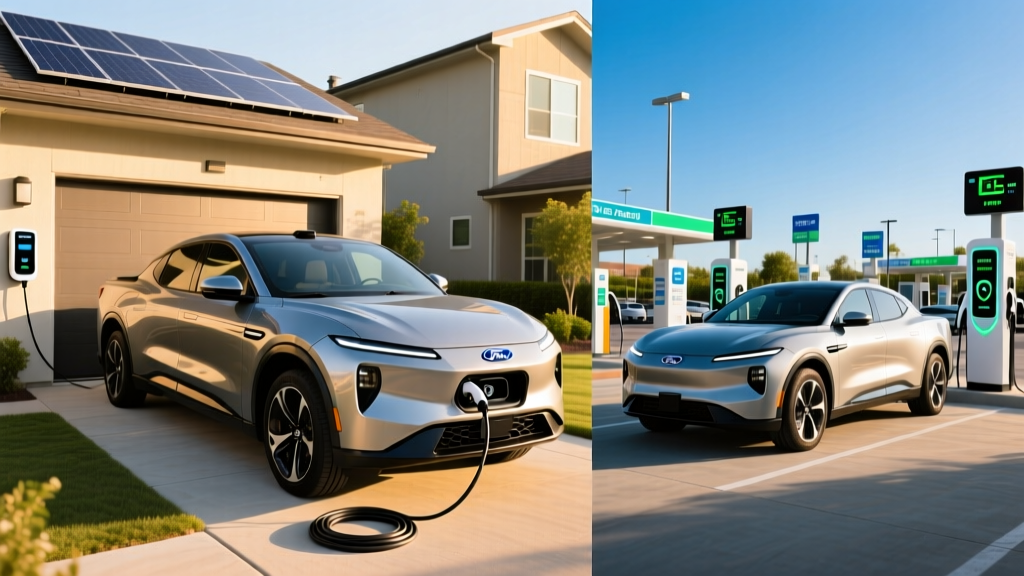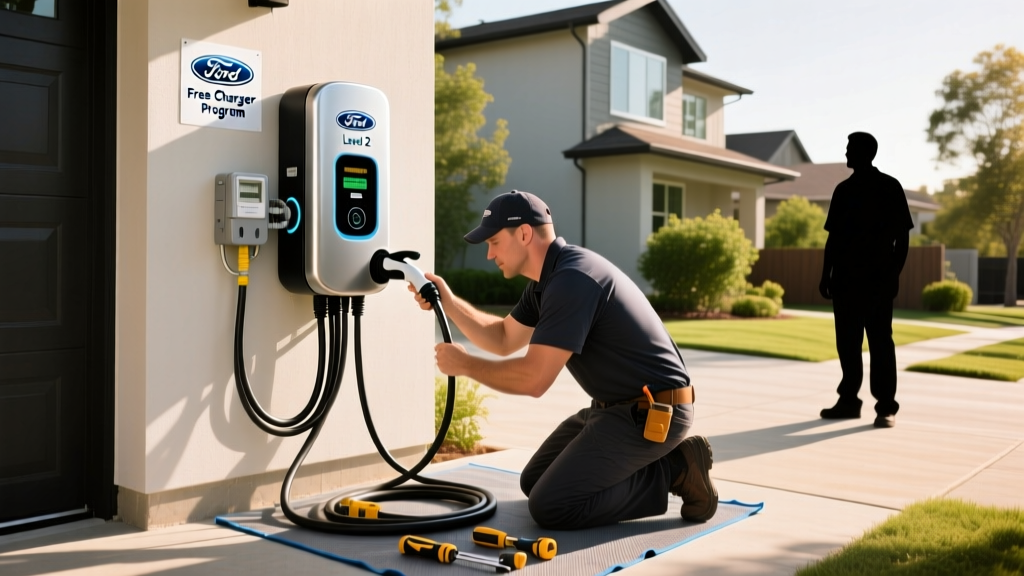
If you've purchased or leased a new Ford EV or plug-in hybrid recently, you've likely encountered the Ford free charger offer — a program that provides eligible buyers with a complimentary home charging unit. But "free" hardware is only part of the equation. The real cost question is what it takes to get that charger wired into your home's electrical system, how fast it actually charges, and whether it's the best option compared to third-party alternatives.
This guide breaks down the Ford charger program specifics, home installation requirements and realistic costs, charging speeds across all levels, connector compatibility as Ford transitions to NACS, and the per-mile economics of home charging versus gas. All figures reflect 2026 model-year vehicles and current electrical code requirements.
What the Ford Free Charger Program Actually Includes
Ford has offered complimentary home charging equipment with the purchase or lease of several electrified models, including the F-150 Lightning, Mustang Mach-E, and Escape PHEV. The specific hardware has varied by model year and promotion period:
- Ford Mobile Power Cord (2024–early 2025 models): A dual-voltage cord with both 120V (Level 1) and 240V (Level 2) plugs. At 240V/32A, it delivers up to ~7.7 kW — adequate for overnight charging but not the fastest wall-mounted option.
- Ford Connected Charge Station (select promotions): A hardwired 48A wall unit delivering up to 11.5 kW on a 60A circuit. This is the higher-value piece of hardware when included.
- 2026 update: As Ford transitions its North American lineup to the NACS (Tesla-style) connector, newer bundled chargers now ship with the NACS plug natively. Buyers of 2025.5+ Mach-E and 2026 F-150 Lightning models should confirm whether the included unit is CCS1 or NACS before scheduling an electrician.
The critical distinction: the charger itself may be free, but professional installation is not included. You'll need a licensed electrician to run a dedicated 240V circuit — and that's where most of the real cost lives.
Charging Levels Explained: Speeds in kW and Miles Per Hour
Before budgeting for an install, understand what each charging level actually delivers. The most common EV confusion is between kW (kilowatts) — the rate of power flow, like water pressure — and kWh (kilowatt-hours) — the total energy stored in your battery, like the size of the tank.
| Level | Voltage | Power (kW) | Miles of Range Added/Hour | Typical Use |
|---|---|---|---|---|
| Level 1 | 120V (standard outlet) | 1.0–1.9 kW | 3–5 miles | Overnight trickle; PHEVs or low daily mileage |
| Level 2 (32A) | 240V | 7.7 kW | 20–28 miles | Ford Mobile Power Cord on 240V outlet |
| Level 2 (48A) | 240V | 11.5 kW | 30–40 miles | Ford Connected Charge Station; most wall units |
| Level 2 (80A) | 240V | 19.2 kW | 50–65 miles | F-150 Lightning with dual onboard chargers |
| DC Fast (CCS/NACS) | 400–800V DC | 50–350 kW | 150–1,000+ miles (peak) | Public fast charging; road trips |
- F-150 Lightning Extended Range (131 kWh usable battery, NMC): Level 2 at 11.5 kW adds roughly 30 miles/hour. A full 10–80% charge at home takes ~8.5 hours. DC fast charging at a 150 kW station: 10–80% in approximately 40–45 minutes (charge curve tapers significantly above 80%).
- Mustang Mach-E Extended Range (91 kWh usable, NMC): Level 2 at 11.5 kW: 10–80% in roughly 5.5 hours. DC fast at 150 kW peak: 10–80% in approximately 30–38 minutes.
- Escape PHEV (14.4 kWh battery): Level 2 at 7.7 kW: 0–100% in about 2 hours. Level 1 at 120V: roughly 5–6 hours.
How Much Does It Cost to Install a Home EV Charger?
The Ford free charger saves you $500–$700 on hardware, but professional installation is a separate and often larger expense. Costs vary dramatically based on your home's electrical panel capacity and the distance from panel to garage or parking spot.
| Component | Simple Install (panel nearby, 200A service) | Complex Install (long run or panel upgrade needed) |
|---|---|---|
| Charger unit (Ford-supplied) | $0 (included) | $0 (included) |
| Electrical permit | $50–$150 | $50–$200 |
| Electrician labor (2–4 hrs simple / 6–12 hrs complex) | $300–$700 | $800–$1,800 |
| Wiring, conduit, breaker (50A or 60A) | $100–$300 | $300–$800 |
| Panel upgrade (100A → 200A, if needed) | N/A | $1,500–$3,500 |
| Total estimated cost | $450–$1,150 | $2,650–$6,300 |
Electrical Requirements for the Ford Connected Charge Station
The 48A Ford Connected Charge Station requires a dedicated 60-amp, 240-volt circuit (NEC code requires circuits to be rated at 125% of continuous load — so a 48A charger needs a 60A breaker). The Ford Mobile Power Cord at 32A requires a dedicated 40A circuit.
Panel capacity check: Most modern homes have 200-amp main service panels. Adding a 60A EV circuit is usually feasible if your panel isn't already near capacity. Homes built before 1990 often have 100A or 150A service — adding a large EV charger may require a panel upgrade to 200A, which is the single biggest cost variable in any install.
Code requirements (2026 NEC):
- Dedicated circuit — the EV charger cannot share a breaker with other appliances
- GFCI protection required for outdoor receptacles (240V outlets in garages may require GFCI depending on local code interpretation)
- Outdoor-rated (NEMA 4 or 4X) enclosure and connectors if installed outside
- Hardwired units must use proper gauge wire: 6 AWG copper for 60A circuits, 4 AWG for runs over 50 feet to manage voltage drop
Connector Compatibility: NACS, CCS1, and Adapters
Ford's 2025–2026 transition to the NACS (North American Charging Standard, i.e., Tesla-style) connector has created a split in the fleet. Your charger's plug must match your vehicle's inlet.
| Model | 2024 and Earlier | 2025 (mid-year transition) | 2026 Model Year |
|---|---|---|---|
| F-150 Lightning | CCS1 | CCS1 (early) / NACS (late) | NACS (native) |
| Mustang Mach-E | CCS1 | CCS1 (early) / NACS (late) | NACS (native) |
| Escape PHEV | J1772 (Level 2 only) | J1772 | J1772 |
| E-Transit (commercial) | CCS1 | CCS1 | NACS (expected) |
Adapter situations:
- If you have a 2024 CCS1 Mach-E and receive a NACS Ford charger, you'll need a NACS-to-CCS1 adapter (~$200–$250 from Ford or third-party suppliers like Lectron or A2Z). Verify the adapter is UL-listed.
- For public DC fast charging, Ford provides a CCS1-to-NACS adapter with some 2026 models to access legacy Electrify America and EVgo stations still equipped with CCS1 cables.
- Tesla Supercharger access: 2026 Ford EVs with native NACS can use Tesla Superchargers directly. Older CCS1 Ford EVs require Ford's approved adapter for Supercharger access.
Cost to Charge: Home vs. Public vs. Gas Per Mile
Home charging with your Ford-supplied Level 2 unit is almost always the cheapest way to fuel an EV. Here's how the economics compare across scenarios, using national average electricity and gas prices as of early 2026.
| Scenario | Average Cost | Cost Per Mile (Mach-E, 3.0 mi/kWh) | Cost Per Mile (F-150 Lightning, 2.2 mi/kWh) |
|---|---|---|---|
| Home (national avg residential, 16¢/kWh) | $0.16/kWh | $0.053 | $0.073 |
| Home off-peak TOU rate (utility time-of-use) | $0.08–$0.12/kWh | $0.027–$0.040 | $0.036–$0.055 |
| Public Level 2 (ChargePoint, EVgo L2) | $0.25–$0.45/kWh | $0.083–$0.150 | $0.114–$0.205 |
| DC Fast Charging (Electrify America, Tesla) | $0.35–$0.55/kWh | $0.117–$0.183 | $0.159–$0.250 |
| Gasoline equivalent (25 MPG avg, $3.30/gal) | — | $0.132 | $0.165 (at 20 MPG) |
The bottom line: Home charging at off-peak rates costs roughly 3–5 cents per mile in a Mach-E — about 75% less than gasoline. Even at full residential rates, home EV charging saves 50–60% per mile versus gas. DC fast charging on road trips narrows the gap but still typically undercuts gas for the Mach-E. The F-150 Lightning, with its lower efficiency, is closer to gas parity when relying exclusively on public DC fast charging.
According to fueleconomy.gov, the 2026 Mustang Mach-E Extended Range achieves approximately 99 MPGe combined, while the F-150 Lightning Extended Range rates at roughly 70 MPGe combined — useful benchmarks for comparing against ICE vehicles.
Equipment Recommendations: Should You Use the Ford Charger or Buy Third-Party?
The Ford free charger is a solid baseline, but depending on your needs — cable length, smart scheduling, amperage, or connector — a third-party unit may serve you better.
Ford Connected Charge Station
- Power: 11.5 kW (48A, hardwired, 60A circuit)
- Connector: CCS1 (2024) or NACS (2026)
- Cable length: 25 ft
- Smart features: FordPass app scheduling, off-peak optimization
- Price: Included (free) with eligible vehicle purchase; ~$699 retail if buying separately
- Best for: Ford-only households wanting tight FordPass integration
ChargePoint Home Flex
- Power: Up to 12.0 kW (50A, NEMA 14-50 plug or hardwired)
- Connector: J1772 (NACS adapter available separately)
- Cable length: 23 ft
- Smart features: ChargePoint app, Alexa, adjustable amperage (16A–50A)
- Price: ~$649
- Best for: Multi-EV households; adjustable amperage for older panels
Tesla Wall Connector (Universal)
- Power: 11.5 kW (48A, hardwired, 60A circuit)
- Connector: NACS native with integrated J1772 adapter (Magic Dock style)
- Cable length: 24 ft
- Smart features: Wi-Fi updates, Tesla app, load sharing between multiple units
- Price: ~$599
- Best for: 2026 NACS Ford EVs; households with both Tesla and Ford vehicles
Emporia Vue Level 2
- Power: Up to 11.5 kW (48A, hardwired or plug)
- Connector: J1772 (NACS version available)
- Cable length: 24 ft
- Smart features: Energy monitoring, solar integration, V2H-ready
- Price: ~$399–$499
- Best for: Budget-conscious installs; solar-home integration
Safety, Code, and Panel-Upgrade Gotchas
Level 2 EV charging is a continuous load under the National Electrical Code (NEC Article 625), meaning the circuit must be rated at 125% of the charger's maximum draw. A 48A charger requires a 60A breaker and 6 AWG copper wire minimum. Cutting corners here creates fire risk and will fail inspection.
Common panel-upgrade scenarios:
- 100A service (pre-1990 homes): Almost certainly requires upgrading to 200A before adding a 60A EV circuit. Budget $1,500–$3,500 for the panel swap plus utility coordination. This can add 2–4 weeks to your timeline.
- 150A service: May accommodate a 40A EV circuit (for the 32A Mobile Power Cord) without an upgrade, but a 60A circuit for the 48A Charge Station may push the panel over its calculated load. Your electrician will perform a NEC Article 220 load calculation.
- 200A service with existing heavy loads (electric range, dryer, HVAC, pool heater): Even a 200A panel can be maxed out. An electrician's load calc will determine if there's headroom. Some utilities now offer managed charging programs that allow a smaller panel to support an EV charger by throttling the charger when other loads peak.
Permitting: Nearly all US jurisdictions require an electrical permit for a new 240V circuit. The permit fee is typically $50–$200, and the work must pass inspection. Skipping the permit risks insurance claim denials if an electrical fire occurs and can complicate home sales.
For detailed guidance on electrical work, consult a licensed electrician familiar with NEC Article 625 (EV charging system requirements). Final specifications should always come from a qualified professional evaluating your specific home.
Frequently Asked Questions
Is the Ford free charger really free, or are there hidden costs?
The charger hardware is included at no additional cost with eligible new vehicle purchases or leases during promotional periods. However, professional installation — electrical permit, wiring, breaker, and electrician labor — typically costs $450–$1,150 for a straightforward install, or $2,650–$6,300 if a panel upgrade is required. Ford does not cover installation costs.
Can I use the Ford charger with a non-Ford EV?
The Ford Connected Charge Station will charge any EV with a matching connector (CCS1 for older units, NACS for 2026 units, or J1772 for PHEVs). However, the FordPass scheduling features are optimized for Ford vehicles. If you own a mixed-brand garage, a third-party charger like the ChargePoint Home Flex or Tesla Universal Wall Connector may offer better cross-brand compatibility.
How fast will each charging level add range to my Ford EV?
Level 1 (120V): approximately 3–5 miles of range per hour — adequate for PHEVs like the Escape (37 miles of electric range) but impractical for a 320-mile Mach-E. Level 2 at 32A (7.7 kW): ~20–28 miles/hour. Level 2 at 48A (11.5 kW): ~30–40 miles/hour. DC fast charging at 150 kW: can add 150+ miles in 20 minutes at peak rate, though the charge curve tapers significantly above 80% State of Charge.
What electrical upgrades might I need for a Level 2 charger?
At minimum, you need a dedicated 240V circuit (40A for 32A chargers, 60A for 48A chargers) installed by a licensed electrician. If your home has 100A service, a panel upgrade to 200A is likely required ($1,500–$3,500). Homes with 150A or 200A service may accommodate the charger without an upgrade, depending on existing loads — your electrician will perform a load calculation per NEC Article 220.
How much does charging cost per mile compared to gas?
Home charging at the national average residential rate (16¢/kWh) costs approximately 5 cents per mile in a Mustang Mach-E and 7 cents per mile in an F-150 Lightning. With off-peak time-of-use rates (8–12¢/kWh), that drops to 3–4 cents per mile. A comparable gas vehicle at 25 MPG and $3.30/gallon costs about 13 cents per mile. According to EPA data on fueleconomy.gov, home charging typically saves EV owners $500–$1,200 annually versus gasoline depending on mileage and local rates.
Should I get a NACS or CCS1 home charger in 2026?
If you own a 2026 Ford EV with a native NACS port, install a NACS charger. If you own a 2024 or early-2025 CCS1 Ford EV and plan to keep it for several years, a CCS1 charger (or a J1772 charger with adapter) makes sense. For households planning to add a Tesla or newer NACS vehicle, the Tesla Universal Wall Connector offers the most future-proof option.