If you're researching the Ford Focus 2017 electric range and charging logistics, you're likely evaluating this compact EV as a used commuter car or daily driver. The 2017 Focus Electric was a significant upgrade over its predecessor, jumping from a 23 kWh to a 33.5 kWh usable battery and pushing the EPA-estimated range to 107 miles. That made it a credible rival to the Nissan Leaf and Chevrolet Bolt of its era.
But owning an EV is only half the equation — the other half is understanding how to charge it efficiently, what it costs, and what electrical work your home might need. This guide covers the Focus Electric's real-world range, charging behavior at every level, connector compatibility, home installation costs, and how its per-mile cost compares to a gas equivalent in 2026.
2017 Ford Focus Electric: Range, Battery & Key Specs
The 2017 model year was the last for the Focus Electric, and Ford gave it a meaningful battery bump. Here's the full spec snapshot:
| Specification | 2017 Ford Focus Electric |
|---|---|
| EPA Range | 107 miles |
| Battery (usable) | 33.5 kWh, liquid-cooled lithium-ion (LG Chem) |
| Efficiency | 107 MPGe combined (31 kWh/100 mi) |
| Motor Output | 143 hp / 184 lb-ft torque |
| 0–60 mph | ~9.3 seconds |
| Onboard Charger (AC) | 6.6 kW (Level 2) |
| DC Fast Charge (CCS1) | Up to 50 kW peak |
| Connector | J1772 (AC) / CCS1 (DC) |
| EPA Fuel Economy | 107 MPGe (city 118 / hwy 96) |
Charging Levels Explained: How Fast Can You Add Miles?
Before we get into costs and equipment, let's clarify the single most important distinction in EV charging: kW (kilowatts) measures power — the rate at which energy flows into your car. kWh (kilowatt-hours) measures energy — the total capacity stored in your battery. Think of kW as the width of a hose and kWh as the size of the bucket. A wider hose fills the bucket faster.
The 2017 Focus Electric's 33.5 kWh battery is a relatively small bucket by today's standards, which actually works in your favor for home charging — you don't need a massive electrical upgrade to fill it overnight.
| Charging Level | Voltage / Amps | Power (kW) | Miles Added Per Hour | 0–100% Time (33.5 kWh) |
|---|---|---|---|---|
| Level 1 (standard outlet) | 120V / 12A | ~1.4 kW | ~4–5 miles/hr | ~24 hours |
| Level 2 (home/public AC) | 240V / 32A | 6.6 kW (car-limited) | ~22–24 miles/hr | ~5 hours |
| DC Fast Charge (CCS1) | 400V+ DC | Up to 50 kW peak | ~150–170 miles/hr (peak) | 10–80% in ~30 min |
A few practical notes on these numbers:
- Level 1 is viable only if you drive fewer than 40 miles per day and can plug in for 10+ hours overnight. At ~4 miles per hour of charging, a full recharge takes a full day.
- Level 2 is the standard for daily home charging. Even though many 2026-era home chargers deliver 9.6–11.5 kW, the Focus Electric's onboard charger caps at 6.6 kW. Buying a 48-amp charger won't speed up this car — a 32-amp unit is the sweet spot.
- DC Fast Charging at 50 kW is modest by 2026 standards (modern EVs hit 150–350 kW), but it's adequate for a 33.5 kWh pack. Expect the charge rate to taper significantly above 80% State of Charge (SoC) to protect battery health. A 10–80% session takes roughly 30 minutes; 80–100% can take another 20+ minutes.
Home EV Charger Installation: Costs, Electrical Requirements & Panel Upgrades
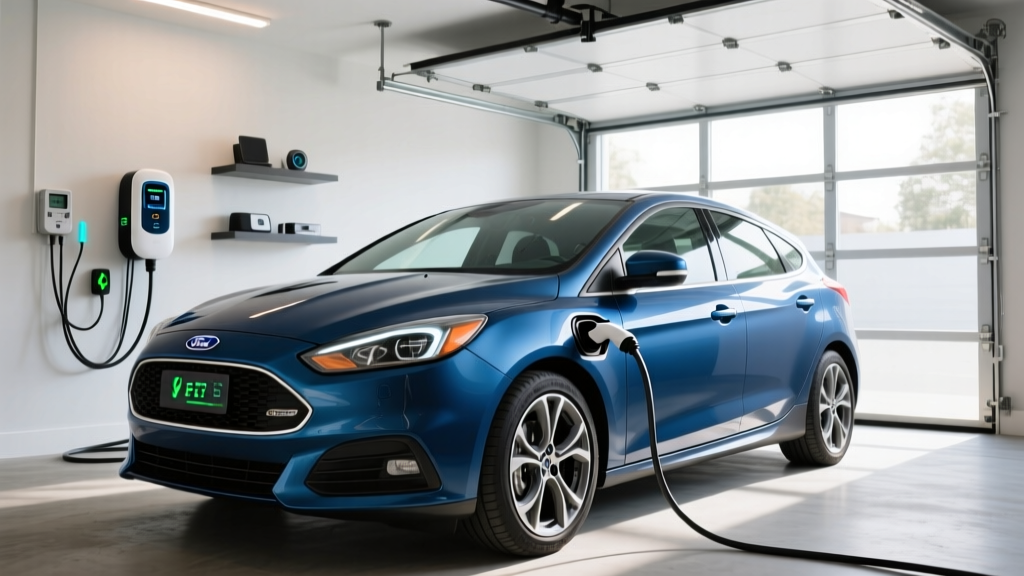
Installing a Level 2 home charger is the single best upgrade any EV owner can make. For a Focus Electric with a 33.5 kWh battery, a properly installed 240V circuit means waking up to a full charge every morning — no public charging required for daily driving.
Electrical Requirements for the Focus Electric
Because the car's onboard charger maxes out at 6.6 kW (drawing ~32 amps at 240V), you need a dedicated 40-amp circuit (NEC code requires circuits to be rated at 125% of continuous load, so 32A × 1.25 = 40A). This requires:
- A 240V double-pole breaker in your electrical panel
- 6 AWG copper wire (or 4 AWG aluminum) run from panel to charger location
- A NEMA 14-50 receptacle (if using a plug-in charger) or hardwired connection
- GFCI protection if the outlet is outdoors or in a garage, per 2020 NEC and later
Will You Need a Panel Upgrade?
This is the wildcard that catches many homeowners off guard. A licensed electrician will perform a load calculation on your existing panel. If you have a 100-amp panel already running central AC, an electric dryer, and an electric range, adding a 40-amp EV circuit may push you over the limit. Upgrading to a 200-amp panel typically costs $1,500–$3,500 depending on your utility and local labor rates. Homes with 200-amp panels usually have sufficient headroom.
| Cost Component | Typical Range | Notes |
|---|---|---|
| Level 2 Charger (hardware) | $250–$650 | 32A–40A, J1772 connector |
| Electrician labor | $500–$1,500 | Depends on wire run length, wall/ceiling penetration |
| Permit & inspection | $50–$250 | Required in most jurisdictions; varies by municipality |
| Panel upgrade (if needed) | $1,500–$3,500 | 100A → 200A service upgrade |
| Total (no panel upgrade) | $800–$2,400 | Most common scenario for 200A-panel homes |
| Total (with panel upgrade) | $2,300–$5,900 | Older homes with 100A or 60A service |
Always hire a licensed electrician and pull a permit. Unpermitted EV charger installations can void homeowner's insurance claims and create fire risk. The National Electrical Contractors Association maintains a directory of qualified installers.
Connector Compatibility: J1772, CCS1, and Adapter Options
The 2017 Ford Focus Electric uses two connector standards:
- J1772 for Level 1 and Level 2 AC charging — this is the universal North American AC connector used by every non-Tesla EV.
- CCS1 (Combined Charging System) for DC fast charging — the J1772 plug with two additional DC pins below it.
| Connector | Used For | Focus Electric Compatible? | Adapter Needed? |
|---|---|---|---|
| J1772 | Level 1 & Level 2 AC | Yes (native) | No |
| CCS1 | DC Fast Charge | Yes (native) | No |
| NACS (Tesla) | Tesla Supercharger DC | Not natively | CCS1-to-NACS adapter (~$200–$300) |
| CHAdeMO | DC Fast (Nissan, older) | No | No adapter available |
As of 2026, Tesla has opened its Supercharger network to non-Tesla EVs via built-in Magic Dock CCS1 adapters at select stations, or you can purchase a third-party CCS1-to-NACS adapter from brands like Lectron or A2Z. For a Focus Electric owner, this unlocks a meaningful portion of Tesla's 25,000+ North American Supercharger stalls — though the car's 50 kW DC peak rate means you won't take full advantage of V3 Supercharger speeds (250 kW).
Charging Cost Per Mile: Focus Electric vs. Gas Equivalent
One of the strongest arguments for the Focus Electric is its low cost per mile. Let's compare it against a gas-powered 2017 Ford Focus (2.0L, ~30 MPG combined) using 2026 energy and fuel prices.
| Scenario | Cost per kWh / Gallon | Cost per Mile | Annual Cost (12,000 mi) |
|---|---|---|---|
| Home charging (off-peak, national avg.) | $0.13/kWh | $0.040 | $484 |
| Home charging (California TOU peak) | $0.30/kWh | $0.093 | $1,116 |
| Public Level 2 (ChargePoint, avg.) | $0.25/kWh | $0.078 | $930 |
| DC Fast Charge (Electrify America) | $0.48/kWh | $0.149 | $1,786 |
| Gas Focus (30 MPG, $3.40/gal) | $3.40/gallon | $0.113 | $1,360 |
At the national average residential electricity rate of ~$0.13/kWh (U.S. EIA), the Focus Electric costs roughly 4 cents per mile to drive on home charging — about one-third the cost of its gas counterpart. Even at public DC fast-charging rates, the EV is competitive with gas on a per-mile basis, though the savings narrow considerably.
The Focus Electric consumes approximately 31 kWh per 100 miles (per EPA). Multiply that by your local electricity rate to calculate your personal cost per mile.
Recommended Home Chargers for the 2017 Focus Electric
Since the Focus Electric caps at 6.6 kW AC charging, you don't need the most powerful charger on the market. A quality 32-amp or 40-amp Level 2 unit with a J1772 connector is ideal. Here are three proven options:
Emporia Vue Level 2 Charger
- Power: 48A max (11.5 kW) — car will draw only 32A
- Connector: J1772
- Cable length: 24 ft
- Smart features: Wi-Fi, app scheduling, energy monitoring, utility TOU integration
- Price: ~$399
- Best for: Budget-conscious buyers who want smart scheduling for off-peak rates
ChargePoint Home Flex
- Power: Configurable 16A–50A (up to 12 kW)
- Connector: J1772
- Cable length: 23 ft
- Smart features: Wi-Fi, Alexa integration, detailed session logs, amperage adjustment via app
- Price: ~$549
- Best for: Flexibility — set amperage to match your circuit; future-proof if you upgrade EVs
Grizzl-E Smart
- Power: 40A max (9.6 kW)
- Connector: J1772
- Cable length: 24 ft
- Smart features: OCPP-compatible, app control, works with utility demand-response programs
- Price: ~$449
- Best for: Cold-climate durability (rated to -40°F), built in Canada
Any of these units will fully charge the Focus Electric's 33.5 kWh battery in approximately 5–5.5 hours on a 40-amp circuit. If you plan to upgrade to a larger-battery EV in the future (e.g., a Ford Mustang Mach-E or Hyundai Ioniq 5), the ChargePoint Home Flex's adjustable amperage and 50A capability make it the most future-proof pick.
Safety, Code & Best Practices for Home Charging
EV charging draws sustained high current for hours — more like running an electric furnace than plugging in a phone charger. Follow these safety guidelines:
- Dedicated circuit: Your Level 2 charger must have its own dedicated breaker. Never share the circuit with other high-draw appliances.
- GFCI protection: Required for outdoor installations and recommended (often mandated) for garages under NEC 2020 and later. Some EV chargers have built-in GFCI; if not, your breaker must provide it.
- Outdoor rating: If mounting outside, choose a charger rated NEMA 4 (weatherproof). All three recommendations above carry outdoor ratings.
- Cable management: Use a wall-mounted holster or retractable reel to prevent tripping hazards and cable damage.
- Don't use extension cords: Never run an EV charger through an extension cord. If the cable doesn't reach, have an electrician relocate the outlet or charger.
- Annual inspection: Check the plug, cable, and receptacle annually for signs of heat damage, discoloration, or loose connections. Thermal imaging by an electrician can catch hotspots before they become hazards.
Frequently Asked Questions
What is the real-world range of the 2017 Ford Focus Electric?
The EPA rates it at 107 miles, but real-world range depends heavily on conditions. Expect roughly 95–105 miles in mixed city/highway driving at moderate temperatures. Highway-only driving at 70+ mph drops this to 85–100 miles. In freezing weather with heat on, plan for 70–85 miles. The liquid-cooled battery performs better in temperature extremes than passively cooled competitors.
How long does it take to charge the Focus Electric at home?
On a Level 2 (240V, 32A) home charger, a full 0–100% charge takes approximately 5 hours. Most owners plug in at night and wake up to a full battery. On a standard 120V Level 1 outlet, a full charge takes roughly 24 hours — practical only for topping up after short commutes.
Can I use a Tesla Supercharger with the 2017 Focus Electric?
Not natively. The Focus Electric uses CCS1 for DC fast charging, while Tesla Superchargers use the NACS connector. However, as of 2026, Tesla has opened portions of its Supercharger network to non-Tesla EVs. You can either use Tesla stations equipped with the built-in Magic Dock adapter or purchase a CCS1-to-NACS adapter (~$200–$300) from third-party manufacturers. Charging speed will be limited to the Focus Electric's 50 kW DC peak.
How much does it cost to install a home EV charger?
For most homes with a 200-amp electrical panel, expect to pay $800–$2,400 total (charger hardware + electrician labor + permit). If your home has an older 100-amp panel and needs a service upgrade, total costs can reach $2,300–$5,900. Always get at least two quotes from licensed electricians and ensure a permit is pulled.
Is the 2017 Focus Electric still a good buy in 2026?
It depends on your commute. If you drive fewer than 70 miles round-trip daily and can charge at home, the Focus Electric offers very low running costs (~4¢/mile on home electricity) and a comfortable, car-like driving experience. The 107-mile EPA range is limiting for road trips, and DC fast charging at 50 kW is slow by current standards. But as a used commuter EV — typically available for $8,000–$13,000 — it represents strong value with minimal maintenance needs. Check the battery's State of Health (SoH) via an OBD-II reader or dealer diagnostic before purchasing.