The Real Question: Supercharged V8 or Electric Lightning?
If you're researching a Ford F-150 Supercharged — whether that's the 5.0L V8 with a dealer-installed supercharger kit or the high-output 3.5L PowerBoost hybrid — you're likely also weighing Ford's F-150 Lightning EV. Both deliver serious torque and towing capability, but their refueling economics and infrastructure needs diverge dramatically.
This guide breaks down exactly what it takes to charge an F-150 Lightning at home and on the road, how those costs compare to fueling a supercharged F-150, and what electrical work your garage might need. We'll use real numbers: kilowatts (kW) for charging power, kilowatt-hours (kWh) for battery energy capacity, and dollars per mile for operating cost.
F-150 Lightning Battery Specs and Charging Architecture
The 2026 F-150 Lightning offers two battery packs. Understanding their capacity in kWh is essential before sizing a home charger or planning road-trip stops.
| Specification | Standard Range | Extended Range |
|---|---|---|
| Usable Battery Capacity | 98 kWh (LFP) | 131 kWh (NMC) |
| EPA Range | 240 miles | 320 miles |
| Real-World Highway Range* | ~190–210 miles | ~260–285 miles |
| Max DC Fast Charge Rate | 150 kW peak | 150 kW peak |
| 10–80% DC Fast Time | ~44 minutes | ~49 minutes |
| Level 2 AC Charge Rate | 11.3 kW (single) / 19.2 kW (dual) | 19.2 kW (dual onboard) |
| MPGe (Combined) | 68 MPGe | 70 MPGe |
*Real-world range reflects highway driving at 70 mph in moderate temperatures. Cold weather (below 30°F) can reduce range by 15–25%. Towing cuts range by 40–55% depending on trailer weight and aerodynamics.
Note the chemistry split: the Standard Range pack uses LFP (lithium iron phosphate), which tolerates daily 100% charging and shows slower long-term degradation. The Extended Range uses NMC (nickel manganese cobalt), which delivers higher energy density but benefits from staying between 20–80% for daily use.
Charging Levels Explained: kW and Miles Per Hour
EV charging speed is measured in kilowatts (kW) — the rate of power delivery. Battery capacity is measured in kilowatt-hours (kWh) — the total energy stored. Confusing these is the single most common EV mistake. Think of kW as the flow rate of a hose and kWh as the size of the tank.
| Charging Level | Power Source | Max Power (kW) | Miles of Range Added Per Hour | Best Use Case |
|---|---|---|---|---|
| Level 1 | 120V household outlet | 1.4 kW | ~3–4 miles/hour | Emergency top-ups, overnight trickle |
| Level 2 (single) | 240V, 48A circuit | 11.3 kW | ~28–32 miles/hour | Daily home charging (Standard Range) |
| Level 2 (dual) | 240V, 80A circuit | 19.2 kW | ~48–52 miles/hour | Daily home charging (Extended Range) |
| DC Fast Charging | 400V public station | 150 kW peak | ~150–180 miles in 30 min | Road trips, rapid top-ups |
Reality check on Level 1: Plugging a 131 kWh Extended Range Lightning into a standard 120V outlet will add roughly 3 miles of range per hour. A full 10–80% charge at Level 1 would take over 5 days. Level 1 is viable only for PHEVs with small batteries or as an emergency measure — not for daily Lightning ownership.
Home Charger Installation: Electrical Requirements and Cost
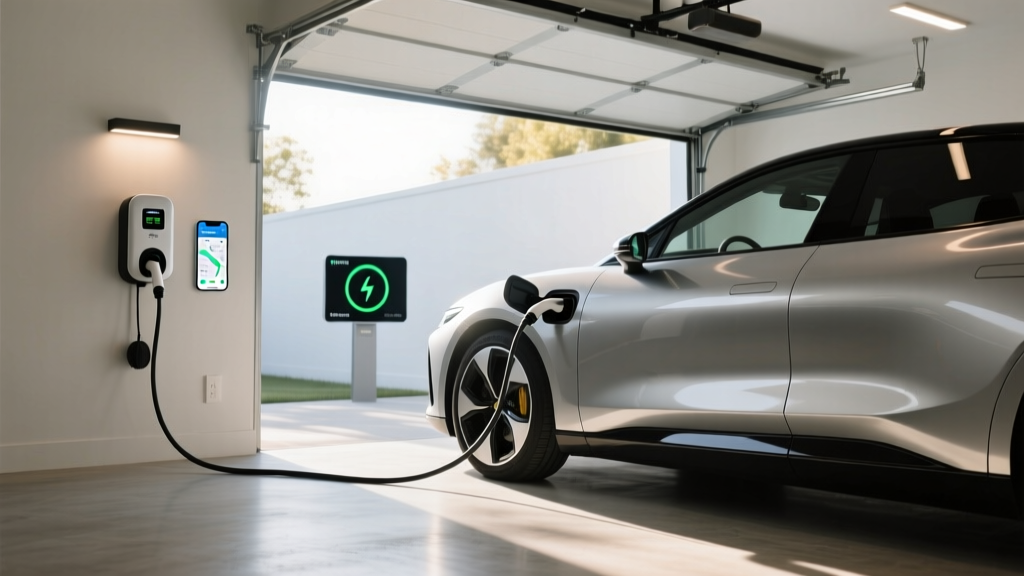
The F-150 Lightning's dual onboard chargers can accept up to 19.2 kW on Level 2 AC power — but only if your home's electrical system supports an 80-amp dedicated circuit. Here's what that entails.
Electrical Panel Requirements
- For 11.3 kW (48A) charging: You need a 60-amp dedicated breaker on a 240V circuit. Most modern homes with 200-amp service panels have sufficient capacity.
- For 19.2 kW (80A) charging: You need a 100-amp dedicated breaker. This often requires a 200-amp or larger main panel with available breaker slots and load capacity.
- Panel upgrade scenario: Older homes with 100-amp main service almost always require an upgrade to 200-amp service before adding a 60A or 100A EV circuit. This is the single largest variable in installation cost.
Installation Cost Breakdown
| Component | Simple Install (panel nearby, no upgrade) | Complex Install (panel upgrade or long run) |
|---|---|---|
| Level 2 Charger Hardware | $400–$700 | $400–$700 |
| Electrician Labor (2–6 hours) | $400–$800 | $1,200–$2,500 |
| Electrical Permit | $50–$200 | $50–$200 |
| Panel Upgrade (if needed) | $0 | $1,500–$3,500 |
| Conduit/Wiring (long runs) | $100–$300 | $500–$1,500 |
| Total Estimated Cost | $950–$2,000 | $3,650–$8,400 |
Always hire a licensed electrician and pull a permit. Unpermitted EV charger installs can void home insurance claims and fail inspection at resale. The National Electrical Code (NEC) requires GFCI protection for outdoor receptacles and continuous-load derating (the circuit must be rated 125% of the charger's max draw — so a 48A charger needs a 60A breaker).
Charging Cost Per Mile: Lightning vs Supercharged F-150 Gas
This is where the Ford F-150 Supercharged gas truck and the Lightning diverge most sharply. A supercharged 5.0L V8 F-150 typically achieves 14–16 MPG combined. Let's compare fueling costs directly.
| Scenario | F-150 Lightning Extended Range | F-150 Supercharged 5.0L V8 (15 MPG) |
|---|---|---|
| Home Charging (off-peak, $0.12/kWh) | $0.036/mile | — |
| Home Charging (peak, $0.22/kWh) | $0.066/mile | — |
| Public Level 2 ($0.35/kWh) | $0.105/mile | — |
| DC Fast Charging ($0.48/kWh) | $0.144/mile | — |
| Gasoline ($3.40/gallon) | — | $0.227/mile |
| Annual Cost (12,000 miles, mostly home) | $432–$792 | $2,720 |
The Lightning's efficiency is approximately 2.0–2.2 kWh/mile (per fueleconomy.gov). Even at expensive DC fast-charging rates, the Lightning costs less per mile than the supercharged V8. Home charging during off-peak hours delivers the most dramatic savings — roughly $2,300 less per year over 12,000 miles.
The IRS §30D federal tax credit may apply to the Lightning (subject to MSRP caps, buyer income limits, and battery-sourcing requirements), potentially reducing the purchase price by up to $7,500 at the point of sale. The supercharged F-150 gas truck qualifies for no such credit. Consult a tax professional for your specific eligibility.
Connector Compatibility and the NACS Transition
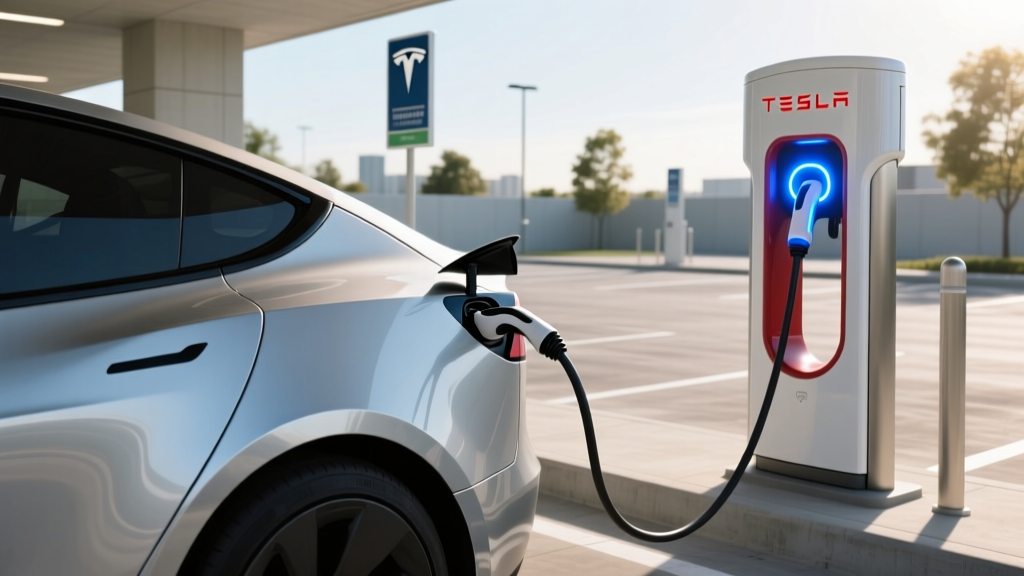
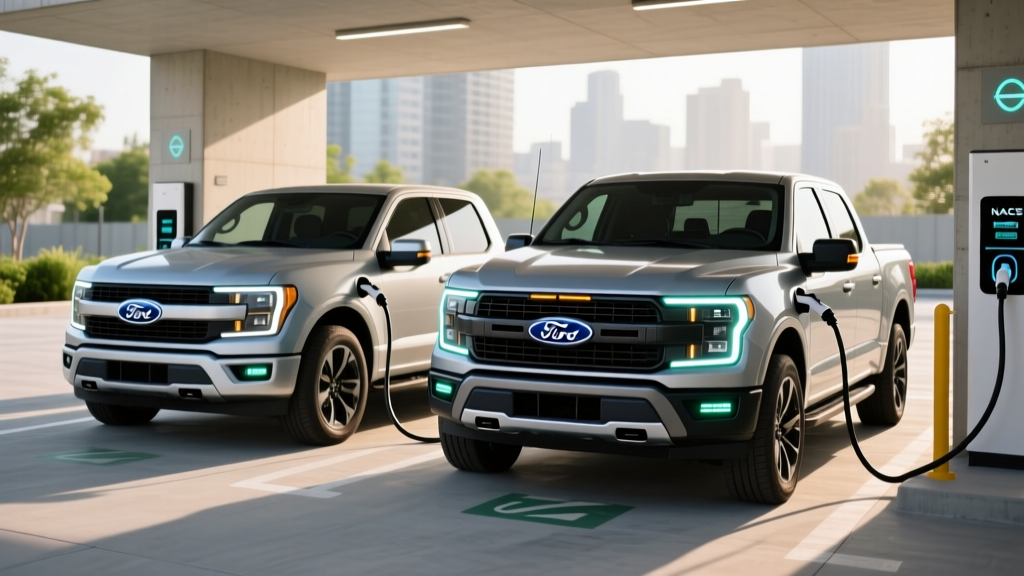
The 2026 F-150 Lightning ships with the NACS (North American Charging Standard) port — the Tesla-designed connector now adopted by Ford and most major automakers. This means native access to the Tesla Supercharger network without an adapter.
| Connector Type | Native or Adapter? | Network Access |
|---|---|---|
| NACS (Tesla-style) | Native port | Tesla Supercharger, Electrify America (new stalls), EVgo, many others |
| CCS1 (legacy) | NACS-to-CCS adapter (included) | Older Electrify America, ChargePoint, and non-Tesla DC fast stations |
| CHAdeMO | No adapter available | Not compatible — CHAdeMO is effectively obsolete in North America |
| J1772 (Level 2 AC) | NACS-to-J1772 adapter (included) | Public Level 2 stations, older destination chargers |
For home Level 2 charging, Ford includes the Mobile Power Cord with the Lightning, which supports both 120V (Level 1) and 240V (Level 2, up to 30A with a NEMA 14-50 outlet) out of the box. For the full 48A or 80A Level 2 experience, you'll need a dedicated wall-mounted charger (see recommendations below).
Recommended Home Chargers for the F-150 Lightning
These Level 2 chargers pair well with the Lightning's onboard charging capability. All use the NACS connector natively or via included adapter.
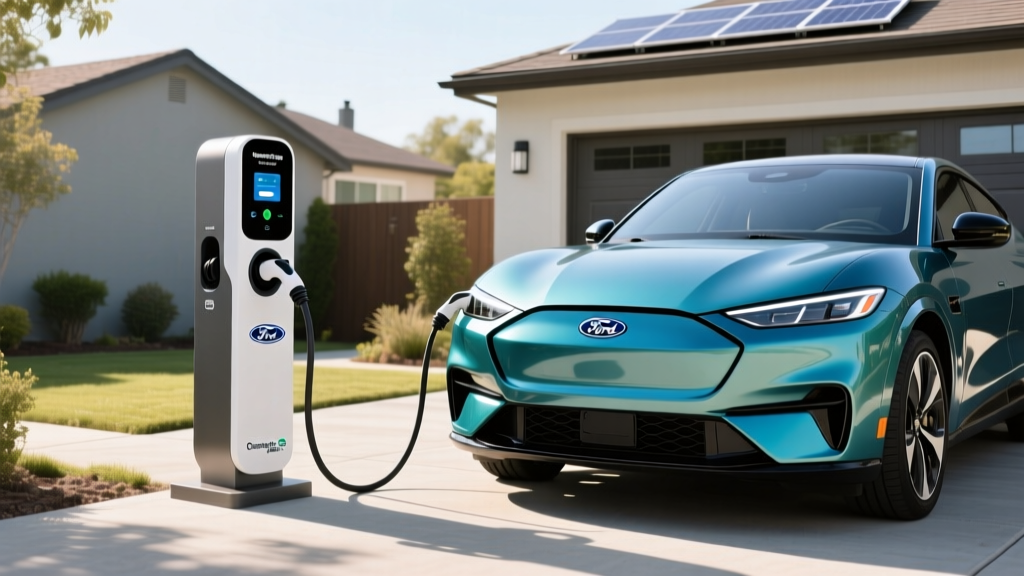
Ford Charge Station Pro
- Power Output: 19.2 kW (80A) — maximizes Lightning's dual onboard chargers
- Connector: NACS native
- Cable Length: 25 feet
- Smart Features: Wi-Fi connected, FordPass app scheduling, off-peak optimization, V2H (vehicle-to-home) backup power capable
- Price: ~$1,300 (hardware only)
- Best For: Extended Range owners who want fastest possible home charging and backup power integration
Emporia Level 2 EV Charger
- Power Output: 11.5 kW (48A) — sufficient for Standard Range daily charging
- Connector: J1772 (NACS adapter included with Lightning)
- Cable Length: 24 feet
- Smart Features: Wi-Fi, real-time energy monitoring, solar integration, load management
- Price: ~$400
- Best For: Budget-conscious installs, solar homeowners, Standard Range daily use
ChargePoint Home Flex
- Power Output: Up to 12 kW (50A) — configurable amperage to match your circuit
- Connector: J1772 or NACS (select at purchase)
- Cable Length: 23 feet
- Smart Features: Wi-Fi, Alexa integration, ChargePoint app scheduling, flexible amperage settings
- Price: ~$550
- Best For: Flexible installs where circuit capacity may be limited; good mid-range option
Public Charging: Networks, Speeds, and Road-Trip Realities
The Lightning's 150 kW peak DC fast-charging rate is adequate but not class-leading. Here's what to expect on the road:
- 10–80% charge time: Approximately 44–49 minutes depending on battery pack. The charge curve tapers significantly above 80% — a 10–90% charge may take 65+ minutes.
- Peak vs sustained rate: The Lightning hits 150 kW only briefly at low state-of-charge. Expect an average rate of ~90–110 kW across a 10–80% session.
- Preconditioning: Navigate to a charging station using the Lightning's built-in navigation to trigger battery preconditioning — this warms the pack to optimal temperature and can shave 5–10 minutes off your charge time, especially in cold weather.
- Towing and charging: If you're towing, expect to charge more frequently (every 120–170 miles with a loaded trailer) and accept that each stop will take longer due to the depleted battery's higher acceptance rate at low SoC but the need to charge more total kWh.
The NHTSA and IIHS safety ratings for the Lightning are strong (Top Safety Pick), but no safety agency currently rates charging equipment specifically — rely on UL-listed chargers and licensed electricians for safety assurance.
Safety, Electrical Code, and Permit Essentials
- Dedicated circuit required: EV chargers are classified as continuous loads under NEC Article 625. The breaker must be rated 125% of the charger's maximum amperage draw.
- GFCI protection: Required for all outdoor receptacles and increasingly required indoors for EV charging circuits in the 2023/2026 NEC updates.
- Outdoor rating: If your charger is mounted outside or in an unsealed garage, ensure it carries a NEMA 4 or IP65 weather resistance rating.
- Permit and inspection: Nearly all jurisdictions require an electrical permit for a new 240V circuit. The inspection verifies wire gauge, breaker sizing, grounding, and GFCI compliance. Skipping this risks insurance denial in the event of an electrical fire.
- Load calculation: Your electrician should perform a whole-home load calculation before adding a 60A or 100A EV circuit. If your panel is near capacity (common with electric ranges, dryers, and HVAC), you may need a panel upgrade or a smart load-management device like the Emporia Smart Load Management system.
Frequently Asked Questions
How much does it cost to install a home EV charger for an F-150 Lightning?
A straightforward install with an existing 200-amp panel and short wire run costs $950–$2,000 including the charger hardware, electrician labor, and permit. If you need a panel upgrade (common in pre-2000 homes with 100-amp service), total costs can reach $3,650–$8,400.
How fast will each charging level add range to the Lightning?
Level 1 (120V) adds about 3–4 miles per hour — impractical for daily use. Level 2 at 11.3 kW adds roughly 30 miles per hour. Level 2 at 19.2 kW (dual charger, Extended Range) adds roughly 50 miles per hour. DC fast charging at 150 kW peak can add 150+ miles in 30 minutes, but the rate tapers above 80% SoC.
Which connector does the 2026 F-150 Lightning use?
The 2026 Lightning uses the NACS connector natively, giving it direct access to the Tesla Supercharger network. Ford includes adapters for legacy CCS1 and J1772 stations. CHAdeMO is not supported.
How much does charging the Lightning cost per mile compared to gas?
Home charging at off-peak rates ($0.12/kWh) costs approximately $0.036 per mile. A supercharged F-150 V8 at 15 MPG with gas at $3.40/gallon costs about $0.227 per mile — roughly 6x more expensive. Even at public DC fast-charging rates ($0.48/kWh), the Lightning costs $0.144/mile, still 37% less than gasoline.
What electrical upgrades might I need for a home Lightning charger?
For 19.2 kW (80A) charging, you need a 100-amp breaker on a panel with at least 200-amp total service and sufficient spare capacity. Homes with 100-amp main service, older wiring, or panels near capacity will likely need a panel upgrade ($1,500–$3,500) or a smart load-management system to avoid overloading the service.
Can I use the Lightning for home backup power?
Yes, with the Ford Charge Station Pro and the Home Integration System, the F-150 Lightning Extended Range can provide up to 9.6 kW of vehicle-to-home (V2H) backup power — enough to run essential circuits in a typical home for up to three days during an outage. This requires additional hardware (~$3,500–$5,000 installed) and transfer switch integration by a licensed electrician.