If you've been cross-shopping body-on-frame trucks and noticed searches for a 2025 Ford F-150 single cab supercharged configuration, you're not alone — regular-cab, short-bed, supercharged V8 F-150s have a cult following among fleet buyers and old-school truck enthusiasts. But here's the reality check: Ford does not currently offer a 2025 F-150 single cab with a factory supercharged engine. The supercharged 5.2L Predator V8 is reserved for the F-150 Raptor R, which comes exclusively in SuperCrew configuration. Regular-cab F-150s are available primarily through the XL trim with the 3.3L V6, 2.7L EcoBoost, or 5.0L V8 — no factory supercharger.
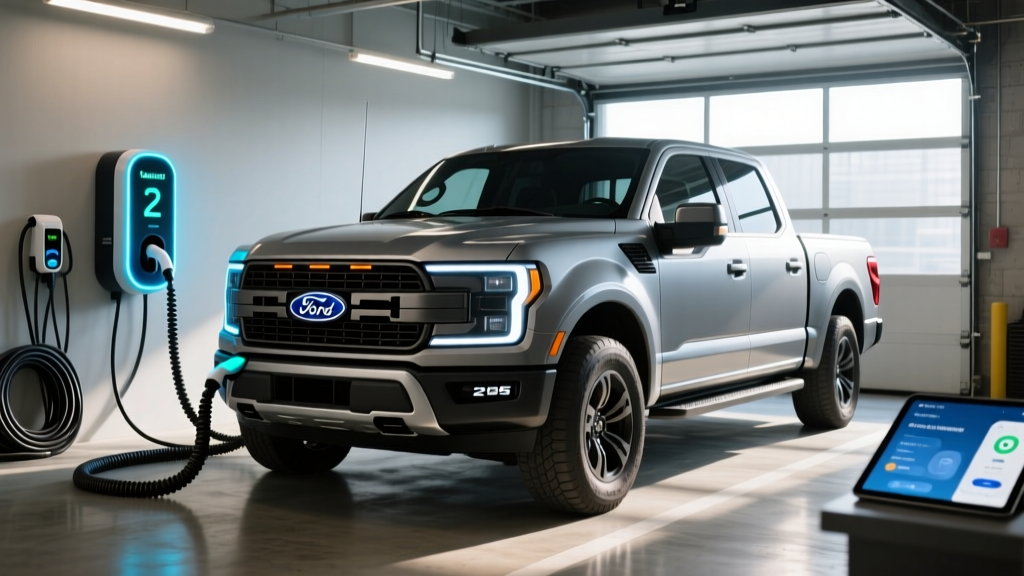
Meanwhile, the electrified F-150 Lightning — which Ford continues to produce for 2025 — offers a fundamentally different ownership proposition, one where home charging infrastructure matters more than horsepower. Whether you're weighing a Lightning against a traditional gas F-150 or simply need a definitive guide to setting up EV charging for a large-battery electric truck, this guide covers the exact numbers: kW speeds, install costs, connector standards, and what you'll actually pay per mile.
Charging Levels Explained: kW Speeds and Miles Per Hour
The single most important distinction in EV charging is kW (kilowatts) versus kWh (kilowatt-hours). kW measures power — how fast energy flows into your battery, like water pressure from a hose. kWh measures energy — the total capacity of your battery, like the size of the tank. Confusing these two is the most common EV literacy mistake. A 80 kW charger doesn't put 80 kWh into your truck; it delivers energy at a rate of 80 kW.
Here's how the three charging levels translate to real-world range recovery, using the F-150 Lightning's ~230 MPGe combined efficiency (~2.0 miles per kWh) as a baseline:
| Level | Voltage / Amps | Max Power (kW) | Miles of Range Per Hour | Best For |
|---|---|---|---|---|
| Level 1 | 120V / 12A | 1.4 kW | ~2-3 mi/hr | Emergency / overnight trickle |
| Level 2 (Home) | 240V / 32-48A | 7.7 - 11.5 kW | ~15-23 mi/hr | Daily home charging |
| Level 2 (Max) | 240V / 80A | 19.2 kW | ~30-38 mi/hr | Lightning w/ dual onboard chargers |
| DC Fast (Peak) | 400V+ DC | 150+ kW | ~150-250 mi/hr (burst) | Road trips, rapid top-ups |
Home Charger Installation: Electrical Requirements and Cost Breakdown
Installing a dedicated Level 2 home charger for an electric truck isn't plug-and-play. The F-150 Lightning's large battery makes a robust home charging setup essential — Level 1 (120V) would take over 3 days for a full charge, which is impractical for daily use.
What Your Electrical Panel Needs
A standard 48-amp Level 2 charger requires a dedicated 60-amp, 240-volt circuit (EV chargers are continuous loads, so the circuit must be rated 125% above the charger's max draw per NEC Article 625). Here's where it gets real for many homeowners:
- 100-amp main panel: Likely insufficient. Adding a 60A circuit may exceed your panel's capacity, especially if you already have electric range, dryer, and HVAC. A panel upgrade to 200A typically costs $1,500-$3,000.
- 200-amp main panel: Usually sufficient for a 60A EV circuit, assuming you have spare breaker slots and your load calculation allows it.
- Wire run distance: If your panel is far from the garage or parking spot, copper wire costs add up fast — roughly $8-$15 per foot for 6 AWG THHN in conduit.
| Component | Typical Range | Notes |
|---|---|---|
| Level 2 Charger (Equipment) | $400 - $750 | 40A-48A smart charger, hardwired or NEMA 14-50 |
| Electrical Permit | $50 - $250 | Varies by municipality; required in most jurisdictions |
| Electrician Labor (standard install) | $600 - $1,500 | Short wire run, existing 200A panel, garage mount |
| Wire & Conduit Materials | $150 - $500 | Depends on run distance; 6 AWG copper for 60A circuit |
| Panel Upgrade (if needed) | $1,500 - $3,500 | 100A → 200A service upgrade; not always required |
| Total (no panel upgrade) | $1,200 - $3,000 | Most common scenario for modern homes |
| Total (with panel upgrade) | $2,700 - $6,500 | Older homes with 100A service |
Always hire a licensed electrician and pull a permit. Unpermitted EV charger installs can void home insurance claims and create fire risk — a 60A continuous load on undersized wire is a serious hazard.
Connector Compatibility: NACS, CCS1, and What Fits Your Truck
The connector landscape has shifted dramatically. As of 2025, the North American Charging Standard (NACS) — originally Tesla's proprietary connector — has been adopted by Ford, GM, Rivian, Volvo, and most major automakers. Here's what that means for current and near-future EV truck owners:
| Connector | Brands Using It (Native) | DC Fast Charge Availability | Adapter Needed? |
|---|---|---|---|
| NACS (Tesla-style) | Tesla, Ford (2025+), GM (2025+), Rivian (2025+) | Tesla Superchargers, growing third-party networks | CCS→NACS adapter for older CCS vehicles (~$200-$250) |
| CCS1 | Hyundai, Kia, VW, BMW, most pre-2025 EVs | Electrify America, EVgo, ChargePoint | NACS→CCS adapter available from Ford for Supercharger access |
| CHAdeMO | Nissan Leaf (legacy), Mitsubishi | Limited and declining | No reliable adapter to CCS/NACS; avoid for new purchases |
For F-150 Lightning owners (2022-2024 models with CCS1): Ford provides a complimentary NACS adapter enabling access to Tesla Supercharger stations (V3 and V4). The 2025+ Lightning models ship with a native NACS port. Per Ford's F-150 Lightning page, this adapter unlocks over 15,000 additional DC fast-charging locations nationwide.
Cost Per Mile: EV Charging vs. Gas for a Full-Size Truck
This is where electric trucks make their strongest economic argument against supercharged or large-displacement V8 gas trucks. A gas F-150 with a 5.0L V8 (or an aftermarket supercharged setup) typically returns 15-18 MPG combined. The F-150 Lightning achieves approximately 2.0 miles per kWh (equivalent to ~66-70 MPGe combined, per fueleconomy.gov).
| Scenario | Cost per kWh / Gallon | Cost Per Mile (F-150 Lightning) | Cost Per Mile (Gas F-150 5.0L V8, 17 MPG) |
|---|---|---|---|
| Home charging (off-peak) | $0.12/kWh | $0.06/mi | $0.21/mi (at $3.50/gal) |
| Home charging (peak) | $0.22/kWh | $0.11/mi | $0.21/mi |
| Public Level 2 | $0.30/kWh | $0.15/mi | $0.21/mi |
| DC Fast Charging | $0.45/kWh | $0.23/mi | $0.21/mi |
Charging Time Examples: What to Expect With the Lightning's Big Battery
The F-150 Lightning's battery is among the largest in any consumer EV. The Standard Range pack holds ~98 kWh usable (LFP chemistry on some 2023+ models), while the Extended Range pack holds ~131 kWh usable (NMC chemistry). Here's what charging looks like in practice:
- 10-80% on DC Fast Charge (150 kW peak): ~41 minutes (Extended Range). Expect peak rates only between 15-55% SoC; the curve tapers to ~50 kW above 80%.
- 10-80% on 48A Level 2 (11.5 kW): ~8.5 hours (Extended Range). Ideal for overnight charging — plug in at 10 PM, full by 6:30 AM.
- 10-80% on 80A Level 2 (19.2 kW, dual onboard chargers): ~5 hours. Requires the Lightning's optional 80A Charge Station Pro and a 100A dedicated circuit.
- Overnight on Level 1 (1.4 kW): Adds roughly 14-18 miles of range in 8 hours. Not viable as a primary charging strategy for trucks with 230+ miles of range.
Equipment Recommendations: Best Home Chargers for Electric Trucks
For a large-battery EV like the F-150 Lightning, you want a charger that can deliver sustained high power, has a long cable for truck-length reach, and offers smart scheduling for off-peak utility rates.
Ford Charge Station Pro (80A)
Power: 19.2 kW (80A, 240V)
Connector: NACS (2025+), CCS (pre-2025)
Cable Length: 25 feet
Smart Features: FordPass integration, scheduled charging, off-peak optimization
Price: ~$1,100-$1,300 (equipment only)
Best For: Lightning owners wanting max Level 2 speed; requires 100A dedicated circuit and dual onboard charger option
Wall Connector (Tesla, NACS)
Power: 11.5 kW (48A, 240V)
Connector: NACS (native), J1772 adapter included
Cable Length: 24 feet
Smart Features: Wi-Fi, OTA updates, load sharing with Powerwall, access control
Price: ~$475
Best For: 2025+ Lightning with NACS port; excellent value and reliability
ChargePoint Home Flex
Power: Up to 12 kW (50A, 240V; adjustable down to 16A)
Connector: J1772 (CCS-compatible), NACS adapter available
Cable Length: 23 feet
Smart Features: App scheduling, Alexa integration, adjustable amperage for panel-limited homes
Price: ~$550-$650
Best For: Flexibility — adjustable amperage lets you match your panel capacity without a full upgrade
Safety, Code, and the Panel-Upgrade Reality
National Electrical Code (NEC) Article 625 governs EV charging installations. Key requirements that affect your install:
- Dedicated circuit: Your EV charger must have its own dedicated breaker — no sharing with other outlets or appliances.
- GFCI protection: Required for all outdoor receptacles used for EV charging (NEC 2020+). Hardwired installations may have different requirements depending on your local jurisdiction's adopted code cycle.
- Outdoor rating: If your charger is mounted outdoors or in an open carport, it must carry a NEMA 4 or IP65 weather-resistance rating. All three chargers recommended above meet this standard.
- Load calculation: Your electrician must perform an NEC Article 220 load calculation to verify your panel can handle the additional 60A (or 100A for 80A chargers) continuous draw. If the calculation fails, a panel upgrade is mandatory — not optional.
Frequently Asked Questions
How much does it cost to install a home EV charger?
A typical Level 2 home charger installation costs $1,200 to $3,000 when your electrical panel has sufficient capacity (200A service, spare breaker slots). This includes the charger ($400-$750), electrician labor ($600-$1,500), materials ($150-$500), and a permit ($50-$250). If your home needs a panel upgrade from 100A to 200A, add $1,500-$3,500, bringing the total to $2,700-$6,500. Always get at least two quotes from licensed electricians.
How fast will each charging level add range to an F-150 Lightning?
Level 1 (120V) adds roughly 2-3 miles of range per hour — essentially useless for a 230-mile truck. Level 2 at 48A (11.5 kW) adds about 20-23 miles per hour, recovering a full battery overnight. Level 2 at 80A (19.2 kW, with dual onboard chargers) adds 30-38 miles per hour. DC fast charging at 150 kW peak can add 150+ miles in 15-20 minutes, though the charge curve tapers significantly above 80% SoC.
Which connector and charger is compatible with my EV?
For 2025+ Ford F-150 Lightning models, the native connector is NACS (Tesla-style). For 2022-2024 Lightnings, the native connector is CCS1, and Ford provides a complimentary NACS adapter for Supercharger access. When choosing a home charger, match the connector to your vehicle's port — or use the appropriate adapter. CHAdeMO is effectively obsolete and should be avoided for new EV purchases.
How much does charging cost per mile versus gas?
Charging at home on off-peak electricity ($0.12/kWh), the F-150 Lightning costs roughly $0.06 per mile. A gas F-150 with a 5.0L V8 at 17 MPG and $3.50/gallon fuel costs $0.21 per mile. That's a 71% reduction in fuel cost. However, DC fast charging at $0.45/kWh pushes the Lightning to $0.23/mile — slightly more than gas. Your savings depend heavily on home charging access and local utility rates.
What electrical upgrades might I need for a home EV charger?
The most common upgrade is a panel capacity increase from 100A to 200A, costing $1,500-$3,500. You may also need additional breaker slots (a sub-panel can solve this for $400-$800), a longer wire run if your parking spot is far from the panel ($8-$15 per foot for 6 AWG copper), or a utility service drop upgrade if your incoming supply line is undersized. Your electrician's NEC Article 220 load calculation will determine exactly what's required. Some jurisdictions also require a whole-house surge protector when adding EV circuits — budget $200-$400 for this.