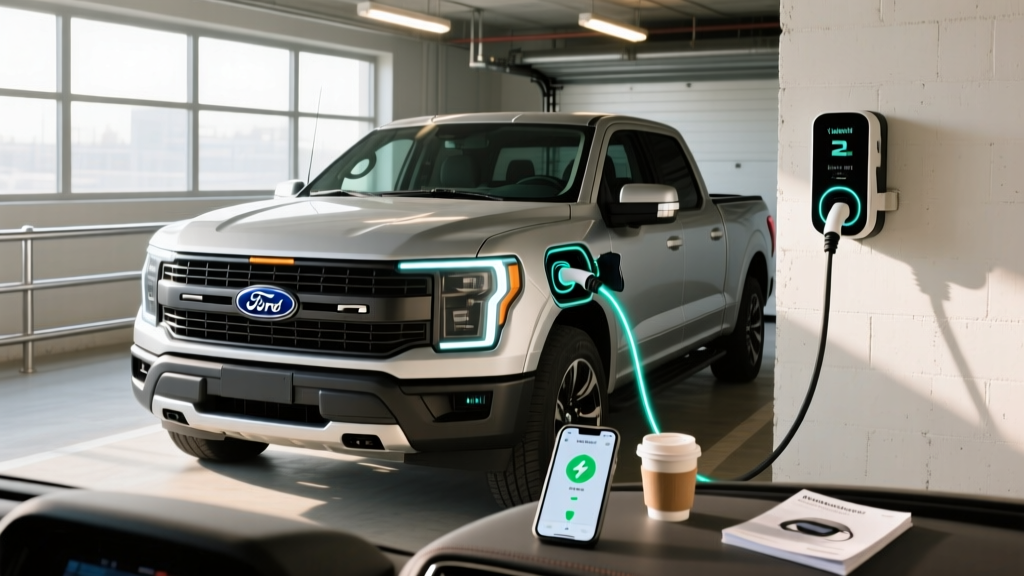
If you own or are considering a Ford F-150 Lightning, understanding the relationship between its battery size, real-world range, and charging setup is the single most important factor in daily satisfaction. The Lightning comes with two battery options, and how you charge at home determines whether you wake up to a full "tank" every morning or spend your evenings tethered to a wall outlet. This guide breaks down the exact range figures, charging speeds at every level, home installation costs, and the per-mile economics compared to a gas F-150.
Ford F-150 Lightning Range: EPA vs. Real World
The F-150 Lightning is offered with two battery packs for the 2025–2026 model years:
- Standard Range: ~98 kWh usable, lithium-ion NMC chemistry — EPA-estimated 240 miles
- Extended Range: ~131 kWh usable, lithium-ion NMC chemistry — EPA-estimated 320 miles
| Spec | Standard Range | Extended Range |
|---|---|---|
| EPA Range | 240 mi | 320 mi |
| Usable Battery | ~98 kWh | ~131 kWh |
| Chemistry | NMC | NMC |
| Peak DC Fast Charge | ~150 kW | ~150 kW |
| 10–80% DCFC Time | ~44 min | ~41 min |
| Onboard Charger (L2) | 11.3 kW (single) / 19.2 kW (dual) | 19.2 kW (dual) |
| Horsepower | 452 hp | 580 hp |
| 0–60 mph | ~4.5 sec | ~3.8 sec |
| Base MSRP | ~$55,000 | ~$70,000 |
| Battery Warranty | 8 years / 100,000 miles (≥70% capacity retention) | |
Source: fueleconomy.gov and Ford Motor Company specification sheets.
Charging Levels Explained: kW, Speeds, and Range Added Per Hour
Before comparing chargers, it's essential to understand the difference between kW (kilowatts) and kWh (kilowatt-hours). kW measures power — the rate at which electricity flows into your battery, like water pressure from a hose. kWh measures energy — the total capacity of your battery, like the size of the tank. A charger rated at 11.5 kW delivers 11.5 kWh of energy per hour of charging.
| Level | Voltage / Amperage | Power (kW) | Miles of Range Added Per Hour | Full Charge Time (Extended Range, 0–100%) |
|---|---|---|---|---|
| Level 1 (120V outlet) | 120V / 12A | ~1.4 kW | ~3–4 mi/hr | ~90+ hours |
| Level 2 (240V, basic) | 240V / 32A | 7.7 kW | ~20–23 mi/hr | ~17 hours |
| Level 2 (240V, recommended) | 240V / 48A | 11.5 kW | ~30–34 mi/hr | ~11.5 hours |
| Level 2 (240V/80A — Lightning dual charger) | 240V / 80A | 19.2 kW | ~50–55 mi/hr | ~7 hours |
| DC Fast Charge | 400V+ DC | Up to 150 kW peak | ~200+ mi in 30 min (tapered) | 10–80% in ~41 min |
Key insight: Level 1 charging is essentially useless for the Lightning's massive battery. At 3–4 miles per hour, you'd need to plug in for over 3 full days to fill the Extended Range pack. A Level 2 home charger is not optional — it's mandatory for practical ownership.
The F-150 Lightning Extended Range comes equipped with a dual onboard charger capable of accepting up to 19.2 kW on Level 2. This is one of the fastest AC charging capabilities in any production EV. However, to take advantage of it, you need an 80-amp dedicated circuit and a hardwired Level 2 charger rated for 19.2 kW (such as Ford's own Charge Station Pro). Most homes will need a panel upgrade to support this.
Home Charger Installation: Electrical Requirements, Costs, and Panel Upgrades
Installing a Level 2 home charger involves more than mounting a box on your garage wall. The electrical requirements scale with the power output you want, and older homes often need service panel upgrades.
Electrical Requirements by Charger Power
- 32A / 7.7 kW charger: Requires a 40A dedicated breaker (NEC rule: continuous loads can only use 80% of breaker capacity). 240V circuit with 8 AWA copper wire.
- 48A / 11.5 kW charger: Requires a 60A dedicated breaker. 240V circuit with 6 AWG copper wire. This is the most common "sweet spot" for EV owners.
- 80A / 19.2 kW charger (Lightning dual charger): Requires a 100A dedicated breaker. Hardwired only (no plug). 3 AWG copper wire. This demands a 200A or larger service panel with spare capacity.
How Much Does It Cost to Install a Home EV Charger?
| Component | 48A / 11.5 kW Setup | 80A / 19.2 kW Setup |
|---|---|---|
| Charger Equipment | $400–$700 | $800–$1,300 |
| Electrician Labor (run circuit, mount charger) | $500–$1,500 | $1,000–$2,500 |
| Electrical Permit | $50–$200 | $100–$300 |
| Panel Upgrade (if needed: 100A → 200A service) | $0 (usually not needed) | $1,500–$4,000 |
| TOTAL (no panel upgrade) | $950–$2,400 | $1,900–$4,100 |
| TOTAL (with panel upgrade) | $2,450–$6,400 | $3,400–$8,100 |
What electrical upgrades might I need? If your home has a 100-amp service panel (common in homes built before 1990), you'll almost certainly need an upgrade to 200A to support a 19.2 kW charger alongside your existing loads (HVAC, electric range, dryer). Even a 48A charger on a 100A panel may require a load calculation by a licensed electrician. Some utilities offer rebates for panel upgrades — check with your local provider.
The IRS Residential Clean Energy Credit (IRC §25C) covers up to 30% of home EV charger equipment and installation costs, capped at $1,000 per year. Consult a tax professional for eligibility.
Connector Compatibility: NACS, CCS1, and Adapters
The F-150 Lightning's charge port connector depends on model year and Ford's ongoing transition to the Tesla NACS standard:
- 2022–2024 Lightnings: Shipped with CCS1 (Combined Charging System) ports. These use the J1772 connector for Level 2 AC charging and the CCS1 combo connector for DC fast charging.
- 2025+ Lightnings: Ford began transitioning to the NACS (North American Charging Standard, i.e., Tesla's connector) for new production. Verify your specific vehicle's port before purchasing a charger.
| Connector | AC Level 2 | DC Fast Charge | Adapter Needed? |
|---|---|---|---|
| CCS1 (2022–2024 models) | ✅ Native (J1772) | ✅ Native | NACS adapter needed for Tesla Superchargers |
| NACS (2025+ models) | ✅ Native | ✅ Native (Tesla Supercharger) | CCS adapter needed for Electrify America, EVgo, etc. |
| CHAdeMO | ❌ Not compatible | ❌ No adapter available | N/A — legacy standard, largely retired |
Practical advice: If you have a CCS1-equipped Lightning, Ford offers a NACS adapter (approximately $230) that unlocks access to Tesla's Supercharger network — the most reliable DC fast-charging network in the US. If you have a NACS-equipped 2025+ model, you'll want a CCS adapter for non-Tesla DC fast chargers. For home Level 2 charging, most universal chargers ship with a J1772/NACS connector or offer both options.
Recommended Level 2 Home Chargers for the F-150 Lightning
Given the Lightning's large battery and available dual onboard charger, here are three chargers matched to different budgets and electrical scenarios:
Best Overall: ChargePoint Home Flex
- Power Output: Up to 12 kW (50A) on a 60A circuit; configurable down to 16A
- Connector: J1772 (NACS version available)
- Cable Length: 23 feet
- Smart Features: Wi-Fi, app scheduling, Alexa integration, energy tracking
- Price: ~$550–$650
- Best for: Standard Range Lightning owners, homes with 60A spare capacity
Best for Extended Range: Ford Charge Station Pro
- Power Output: 19.2 kW (80A), hardwired, requires 100A breaker
- Connector: Matches your Lightning's port (CCS1 or NACS depending on year)
- Cable Length: 25 feet
- Smart Features: FordPass integration, Intelligent Backup Power (with Home Integration System for V2H), OTA updates
- Price: ~$1,000–$1,300 (plus installation)
- Best for: Extended Range owners wanting maximum L2 speed and home backup capability
Best Value: Emporia Level 2 Smart Charger
- Power Output: Up to 11.5 kW (48A) on a 60A circuit
- Connector: J1772 (NACS adapter included)
- Cable Length: 24 feet
- Smart Features: Wi-Fi, app with real-time energy monitoring, solar integration, load management
- Price: ~$350–$400
- Best for: Budget-conscious owners, solar-panel homes, panel-constrained installations
Cost to Charge: Per-Mile Economics vs. Gas F-150
How much does charging cost per mile vs gas? The answer depends on where and when you charge. Here's a breakdown using the F-150 Lightning Extended Range (efficiency approximately 2.0 kWh/mile or 66 MPGe combined per fueleconomy.gov):
| Scenario | Rate / Price | Cost Per Mile | Cost for 320 Miles |
|---|---|---|---|
| Home charging (off-peak utility rate) | $0.10/kWh | $0.20 | $64.00 |
| Home charging (national avg residential) | $0.16/kWh | $0.32 | $102.40 |
| Public Level 2 (ChargePoint, etc.) | $0.25–$0.40/kWh | $0.50–$0.80 | $160–$256 |
| DC Fast Charging (Electrify America, EVgo) | $0.35–$0.55/kWh | $0.70–$1.10 | $224–$352 |
| Gas F-150 (4x4, 20 MPG combined) | $3.40/gallon | $0.17 per mile (gas only) | $54.40 (but wait — see below) |
Safety, Code, and Installation Best Practices
EV charging installations must comply with the National Electrical Code (NEC) and local building codes. Here are the non-negotiable safety requirements:
- Dedicated circuit: Your EV charger must be on its own dedicated breaker — it cannot share a circuit with other appliances. Continuous loads (defined as running 3+ hours, which EV charging always qualifies as) can only use 80% of the breaker rating. A 48A charger requires a 60A breaker.
- GFCI protection: NEC 2020 and later requires GFCI (Ground Fault Circuit Interrupter) protection for all 240V receptacles in garages. Hardwired chargers may be exempt in some jurisdictions — your electrician will confirm local code.
- Outdoor rating: If your charger is installed outdoors or in an open carport, it must carry a NEMA 4 or NEMA 4X rating for weather resistance. All chargers recommended above meet this standard.
- Wire gauge: Undersized wire causes heat buildup and fire risk. 60A circuits require minimum 6 AWG copper; 100A circuits require 3 AWG copper. Your electrician will pull the correct gauge — don't cut corners here.
- Permit and inspection: Most jurisdictions require an electrical permit ($50–$300) and a post-installation inspection. This protects you and is required for any insurance claim related to electrical fires. Never skip this step.
Frequently Asked Questions
Can I charge my F-150 Lightning on a regular 120V household outlet?
Technically yes, but practically no. Level 1 charging at 120V adds only 3–4 miles of range per hour. Charging the Extended Range battery from empty would take over 90 hours. Level 1 is only useful as a trickle-charge top-off if you drive fewer than 30 miles per day and have no other option. Budget for a Level 2 installation before taking delivery.
How fast will DC fast charging add range on a road trip?
The Lightning peaks at approximately 150 kW on DC fast chargers, but only between roughly 10–40% state of charge. Above 50%, the charge curve tapers significantly. Expect 10–80% in about 41 minutes. In practical terms, you'll add roughly 130–150 miles in a 20-minute stop at a 150 kW charger, then the rate drops. Plan road-trip stops accordingly — don't expect to charge from 80–100% at a fast charger, as the taper makes it painfully slow above 80%.
Do I need a 200-amp electrical panel for the F-150 Lightning?
Not always, but often. A 48A charger on a 60A breaker typically works with a 150A or 200A panel that has spare capacity. The 19.2 kW Ford Charge Station Pro (80A charger on a 100A breaker) almost always requires a 200A panel. If your home has a 100A service, a panel upgrade to 200A will cost $1,500–$4,000. A licensed electrician should perform a load calculation to determine what your panel can support.
Is the F-150 Lightning eligible for the $7,500 federal tax credit?
Eligibility for the IRS §30D Clean Vehicle Credit depends on multiple factors that change frequently: your adjusted gross income (caps at $150K single / $300K joint), the vehicle's MSRP (must be under $80,000 for trucks), battery component and critical mineral sourcing requirements, and whether you take delivery as a new purchase. Some Lightning trims qualify for the full $7,500, others for $3,750, and some not at all depending on the model year and production batch. The credit can now be transferred to the dealer at point of sale as an upfront discount. Check the latest rules at IRS.gov qualified vehicle list and consult a tax professional before purchasing.
What's the real-world range when towing with the Lightning?
Towing is the Lightning's Achilles' heel for range. With a 5,000-lb trailer, expect range to drop to approximately 120–160 miles (Extended Range) depending on speed, terrain, and wind. A 7,000-lb load can push range below 100 miles. If you tow frequently on long trips, plan charging stops every 90–100 miles and accept that DC fast charging a 131 kWh battery takes real time. The Lightning is an excellent tow vehicle for short hauls and local work, but long-distance towing remains a significant limitation of current EV technology.
Can I use a Tesla Supercharger with my CCS-equipped Lightning?
Yes, with Ford's official NACS adapter (approximately $230). Ford began providing adapters to CCS-equipped Lightning owners in 2024, and they are available for purchase through Ford dealers. Once equipped with the adapter, you can use the FordPass app to initiate charging at Tesla Superchargers. Access requires an active FordPass account linked to your vehicle.
Sources: fueleconomy.gov, Ford Motor Company, IRS.gov, National Electrical Code (NEC 2023). Specifications reflect 2025 model year data. Always verify current pricing, tax credit eligibility, and local electrical codes with qualified professionals before purchasing or installing equipment.