Owning a Ford F-150 Lightning means rethinking how you "fill up." With the Standard Range pack at 98 kWh usable and the Extended Range at 131 kWh, this truck demands a serious charging strategy — whether you're topping off overnight in the garage or pulling into a DC fast charger on a highway run. This guide covers every facet of 2025 Ford F-150 Lightning charging: what each level delivers, what your home electrical panel can handle, which connectors work, and exactly what it costs per mile compared to a gas F-150.
EPA estimates: 240 miles (Standard Range, 98 kWh) | 320 miles (Extended Range, 131 kWh).
Real-world expectation: Highway driving at 70+ mph reduces range by roughly 15–20%. Cold weather (below 30°F) can cut range an additional 20–30%. Plan for ~180–200 miles highway in winter with the Standard Range pack, and ~250–270 miles with the Extended Range. Source: fueleconomy.gov.
Charging Levels Explained: How Fast Can the Lightning Actually Charge?
Before buying equipment or calling an electrician, understand what each charging level means in practical terms. The single most important distinction in EV charging: kW (kilowatts) measures power — the rate of energy delivery, like water pressure from a hose. kWh (kilowatt-hours) measures energy — the total amount stored, like the size of the water tank. A 131 kWh battery charged at 19.2 kW takes far longer than at 150 kW.
| Level | Voltage / Amperage | Max Power (kW) | Miles of Range Added per Hour | Best Use Case |
|---|---|---|---|---|
| Level 1 (120V) | 120V / 12A | ~1.4 kW | ~2–3 mi/hr | Emergency/trickle only |
| Level 2 (240V Mobile) | 240V / 32A | ~7.7 kW | ~13–16 mi/hr | Basic overnight charging |
| Level 2 (240V Wall Unit) | 240V / 80A | 19.2 kW (Extended Range onboard) | ~30–33 mi/hr | Optimal daily home charging |
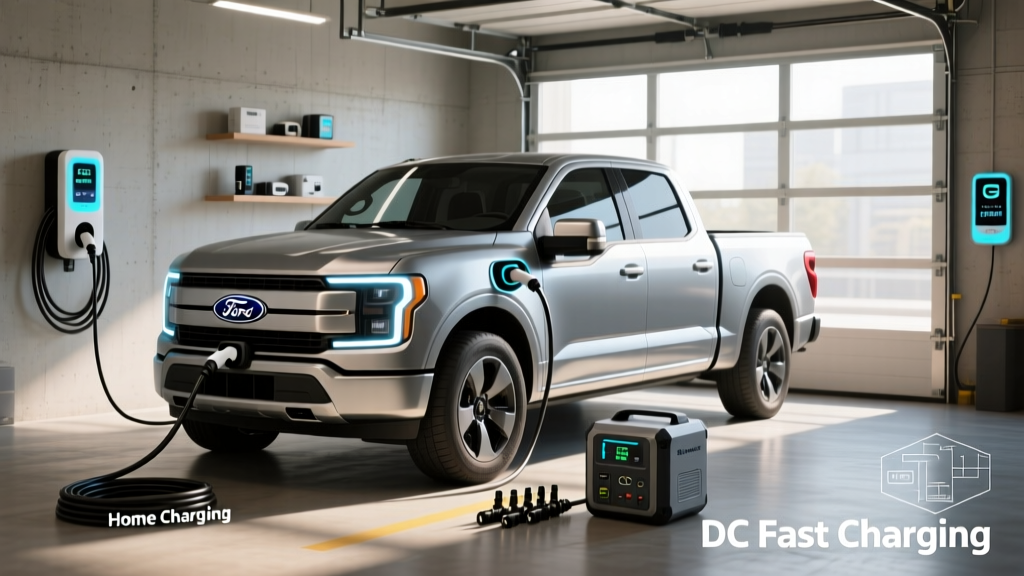
| DC Fast Charge | 400V+ DC | Up to ~150 kW peak | ~150–230 mi/hr (at peak) | Road trips, quick top-ups |
The Extended Range Lightning features a dual onboard charger system capable of accepting up to 19.2 kW on Level 2 — one of the highest AC charge rates available on any production EV. However, this requires a hardwired 80-amp Level 2 station and a 100-amp dedicated circuit. The Standard Range model is limited to 11.5 kW on Level 2 (48A), which still delivers roughly 19–21 miles of range per hour.
On DC fast charging, the Extended Range pack peaks around 150 kW and can charge from 15% to 80% in approximately 41 minutes, according to Ford. The Standard Range pack peaks around 120 kW and reaches 15–80% in roughly 44 minutes. Both follow a typical charge curve: power tapers significantly above 80% State of Charge (SoC) to protect battery health, meaning that last 20% can take as long as the first 60%.
Home Charger Installation: Electrical Requirements, Costs & Panel Upgrades
Charging an F-150 Lightning at home is the most convenient and cost-effective approach — but it requires proper electrical infrastructure. Here's what's involved.
Electrical Requirements by Charger Type
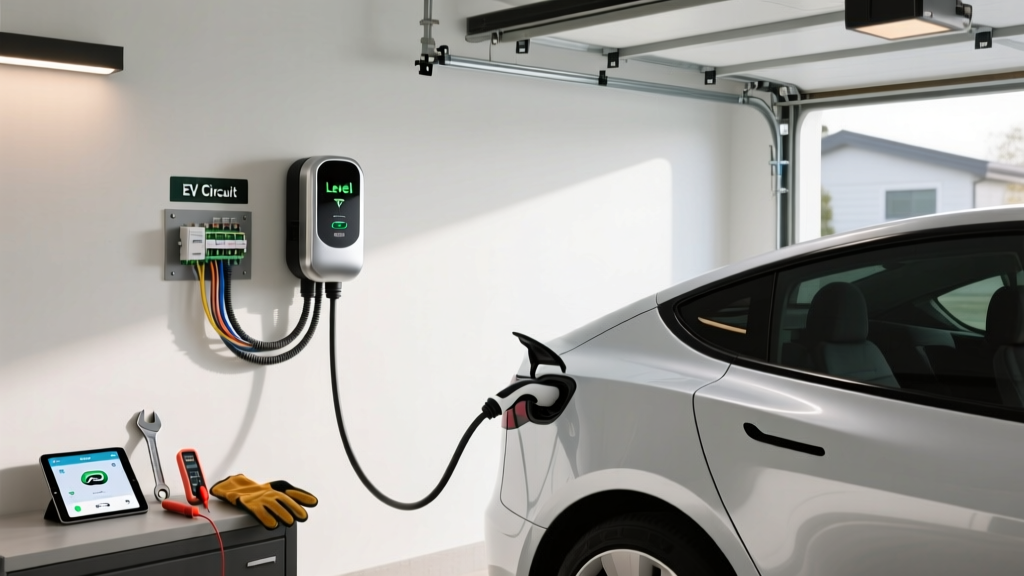
For the full 19.2 kW Level 2 experience (Extended Range trucks), you need:
- Hardwired connection — no plug; directly wired to your panel
- 100-amp dedicated circuit breaker (EVSE rated at 80A continuous draw, which requires a breaker rated at 125% of continuous load per NEC Article 625)
- 240V service with sufficient panel capacity
- 2-gauge or larger copper wire depending on run length
For a more moderate 48A / 11.5 kW setup (sufficient for Standard Range, and still fast for Extended Range overnight), a 60-amp breaker with a NEMA 14-50 outlet or hardwired connection works. This is the most common residential installation.
Panel Upgrade Reality
Many homes built before 2000 have 100-amp or 150-amp main service panels. Adding a 60A or 100A dedicated EV circuit may push total load beyond the panel's capacity, especially if you already run electric dryers, ovens, and HVAC. A licensed electrician will perform a load calculation per NEC Article 220. If an upgrade is needed, expect a panel swap to 200A service.
| Item | Low End | High End | Notes |
|---|---|---|---|
| Level 2 EVSE Equipment (48A–80A) | $400 | $1,200 | Varies by brand, smart features, cable length |
| Electrician Labor (basic install) | $500 | $1,500 | Depends on panel proximity, wall type, conduit run |
| Electrical Permit | $50 | $300 | Required in most jurisdictions; varies by municipality |
| Panel Upgrade (if needed) | $1,500 | $4,500 | 100A → 200A service; older homes most affected |
| Total (no panel upgrade) | $950 | $3,000 | Most homeowners fall in $1,200–$2,000 range |
| Total (with panel upgrade) | $2,450 | $7,500 | Get multiple quotes; some utilities offer rebates |
Safety & Code Considerations
- Dedicated circuit: The EV charger must have its own breaker — never share with other appliances.
- GFCI protection: NEC 2020 and later require GFCI protection for outdoor receptacles used for EV charging. Hardwired units often have built-in ground-fault protection.
- Outdoor rating: If mounting outside, ensure the EVSE is NEMA 4-rated (weatherproof). The Ford Mobile Power Cord is rated for outdoor use but should be protected from direct ground contact and standing water.
- Permit and inspection: Always pull a permit. Unpermitted work can void home insurance claims and cause issues at resale.
Connector Compatibility: NACS, CCS & What the Lightning Uses
The 2025 Ford F-150 Lightning ships with a CCS1 (Combined Charging System) port for DC fast charging and a J1772 inlet for Level 1/Level 2 AC charging. However, Ford has begun the transition to the NACS (North American Charging Standard) — the Tesla-designed connector now adopted industry-wide.
| Charging Network | Connector Type | Compatible with Lightning? | Adapter Needed? |
|---|---|---|---|
| Tesla Supercharger (V3/V4) | NACS | Yes (with adapter) | Ford-provided NACS adapter included for 2025 models |
| Electrify America | CCS1 | Yes — native | None |
| EVgo | CCS1 / NACS | Yes | None for CCS stalls; adapter for NACS stalls |
| ChargePoint (DC) | CCS1 | Yes — native | None |
| Home Level 2 (J1772) | J1772 | Yes — native | None |
| CHAdeMO stations | CHAdeMO | No | No reliable adapter available |
The Tesla Supercharger network access is a significant advantage for Lightning owners. Ford includes a NACS adapter with 2025 models, enabling access to over 20,000 Supercharger stalls. In the FordPass app, you can plan routes that include Supercharger stops and activate sessions directly. Note that some older V2 Supercharger stalls (150 kW max) may not deliver the Lightning's peak rate, while V3 stalls (250 kW) and V4 stalls exceed the truck's acceptance rate — so you'll charge at the Lightning's ~150 kW ceiling regardless.
Charging Cost: Per Mile vs. a Gas F-150
One of the strongest ownership arguments for the Lightning is fuel cost savings — but the numbers vary dramatically depending on where and when you charge.
| Scenario | Rate | Cost per Mile (Lightning) | Cost per Mile (Gas F-150 4x4, 20 MPG) |
|---|---|---|---|
| Home charging (national avg residential) | $0.16/kWh | $0.048 | $0.175 (at $3.50/gal) |
| Home off-peak (time-of-use rate) | $0.09/kWh | $0.027 | $0.175 |
| Public Level 2 (network avg) | $0.30/kWh | $0.090 | $0.175 |
| DC Fast Charging (avg network) | $0.42/kWh | $0.126 | $0.175 |
| DC Fast ( Electrify America Pass+) | $0.36/kWh | $0.108 | $0.175 |
Calculation basis: The F-150 Lightning Extended Range consumes approximately 48–52 kWh/100 miles in mixed driving (per EPA data), or roughly 2.0–2.1 miles per kWh. The gas F-150 4x4 with the 2.7L EcoBoost averages about 20 MPG combined. At home off-peak rates, the Lightning costs roughly 85% less per mile than its gas counterpart. Even on expensive DC fast chargers, it's still 25–30% cheaper per mile.
For a driver covering 15,000 miles per year, home charging at the national average saves approximately $1,900 annually compared to gas at $3.50/gallon. That savings narrows if you rely heavily on public DC fast charging, but remains positive in most scenarios.
Recommended Home Charging Equipment for the F-150 Lightning
The right charger depends on your truck's battery pack, your panel capacity, and your budget. Here are three tiers that pair well with the Lightning.
Budget Pick: Emporia Vue Level 2 (48A)
- Power Output: 11.5 kW max (240V / 48A)
- Connector: J1772 (native for Lightning AC charging)
- Cable Length: 24 feet
- Smart Features: Wi-Fi, app scheduling, energy monitoring, works with Emporia home energy panel
- Price: ~$400
- Best For: Standard Range Lightning owners; budget-conscious installs on a 60A circuit
Best Overall: ChargePoint Home Flex (up to 50A)
- Power Output: Up to 12 kW (240V / 50A, adjustable down)
- Connector: J1772
- Cable Length: 23 feet
- Smart Features: Wi-Fi, Alexa integration, charge scheduling, detailed session history, UL-listed
- Price: ~$550–$650
- Best For: Most Lightning owners; NEMA 14-50 or hardwired install on a 60A circuit
Maximum Speed: Ford Charge Station Pro (80A)
- Power Output: 19.2 kW max (240V / 80A)
- Connector: J1772
- Cable Length: 25 feet
- Smart Features: FordPass integration, scheduled charging, available Pro Power Onboard integration for V2H (vehicle-to-home) backup power with extended-range trucks
- Price: ~$1,200 (equipment only)
- Best For: Extended Range Lightning owners who want the fastest possible home charge; requires 100A circuit and hardwired install
For Extended Range owners, the Ford Charge Station Pro is the only way to unlock the truck's full 19.2 kW onboard charging capability. At 19.2 kW, you'll add roughly 30–33 miles of range per hour — meaning a full overnight session (8–10 hours) can replenish the entire 131 kWh pack from near-empty. Standard Range owners get excellent results from a 48A/11.5 kW unit, which refills the 98 kWh pack in about 8.5 hours from 10%.
Public Charging Strategy: Maximizing Speed and Minimizing Cost
On road trips, the Lightning's ~150 kW peak DC charge rate is competitive but not class-leading (the Hyundai Ioniq 5 peaks at 240 kW). Strategy matters:
- Precondition the battery. Navigate to a DC fast charger using the truck's built-in navigation or FordPass. The Lightning will automatically warm or cool the battery to optimal temperature, significantly improving charge speed — especially critical in cold weather where an un-preconditioned battery might peak at only 50–70 kW.
- Charge from 15–80%, not 0–100%. The charge curve tapers hard above 80%. Plan shorter stops at 15–80% rather than one long stop to full.
- Use Tesla Superchargers via adapter. V3 Superchargers (250 kW capable) will charge the Lightning at its ~150 kW peak. Supercharger reliability consistently outpaces other networks in third-party surveys.
- Check station status before detouring. Use PlugShare or the FordPass app to verify that stalls are operational. CCS station uptime on some networks remains inconsistent.
F-150 Lightning Charging FAQ
How much does it cost to install a home EV charger for the F-150 Lightning?
Most homeowners spend between $1,200 and $3,000 for a professional Level 2 installation (equipment + electrician + permit) assuming no panel upgrade is needed. If your home requires a service panel upgrade from 100A to 200A, add $1,500–$4,500. Always get at least two quotes from licensed electricians and verify they pull the required permit.
How fast will each charging level add range to my Lightning?
Level 1 (120V): approximately 2–3 miles per hour. Level 2 at 48A (11.5 kW): roughly 19–21 miles per hour. Level 2 at 80A (19.2 kW, Extended Range only): about 30–33 miles per hour. DC fast charging at peak (~150 kW): can add up to 100+ miles in 15 minutes, but speed tapers significantly above 80% SoC.
Which connector and charger is compatible with my F-150 Lightning?
The 2025 Lightning uses a CCS1 port for DC fast charging and J1772 for AC Level 1/2 charging. With Ford's included NACS adapter, you can also use Tesla Superchargers. Any J1772 Level 2 home charger is compatible. CHAdeMO stations are not compatible.
How much does charging the Lightning cost per mile vs. a gas F-150?
At home on the national average electricity rate ($0.16/kWh), the Lightning costs about $0.048 per mile — roughly 73% less than a gas F-150 at $3.50/gallon and 20 MPG combined ($0.175/mile). Off-peak home rates push that down to ~$0.027/mile. Even expensive DC fast charging at $0.42/kWh still undercuts gas at ~$0.126/mile.
What electrical upgrades might I need?
Homes with 100A or 150A service panels may need a panel upgrade to 200A to support a 60A or 100A dedicated EV circuit, especially if you run other high-draw electric appliances. Your electrician will perform a NEC Article 220 load calculation. Some utilities offer rebates for panel upgrades tied to EV adoption — check with your provider. Homes with 200A panels usually have sufficient capacity for a 60A circuit without upgrade.
Can I use the F-150 Lightning to power my home during an outage?
Yes — Extended Range models equipped with Ford's available Pro Power Onboard and the Ford Home Integration System can provide vehicle-to-home (V2H) backup power, delivering up to 9.6 kW to your home's circuits. With the 131 kWh battery, that's potentially multiple days of essential-power backup. This requires a compatible transfer switch installed by a licensed electrician and the Ford Charge Station Pro.
Does cold weather affect the Lightning's charging speed?
Significantly. Lithium-ion batteries charge slower at low temperatures. Without battery preconditioning, a cold-soaked Lightning (below 30°F) may accept only 40–70 kW at a DC fast charger instead of its ~150 kW peak. Always navigate to the charger using the truck's built-in system to trigger automatic preconditioning. Cold weather also reduces range by 20–30%, so plan charging stops accordingly.
For the most current federal tax credit rules that may apply to home charging equipment (the §30C Alternative Fuel Vehicle Refueling Property Credit offers up to $1,000 for residential charger installation, subject to income and census-tract requirements), consult IRS.gov or a qualified tax professional. Eligibility rules change and vary by location.